How much emergency fund should you have? Count your essential months first
Commonly 3–6 months of essential expenses. How to find your number, what counts, where to keep it, and how it fits with your first SIP.
Summarize this article with AI





The short version
- A common rule of thumb is 3 to 6 months of essential expenses, not salary.
- Your months depend on income stability, dependants and existing cover.
- Keep it where you can reach it. A liquid fund can dip and is not a deposit.
- Building the fund and starting an SIP can happen in sequence or side by side; each route has a visible cost.
- With costly debt, weigh the rate, your buffer, prepayment terms and job stability; there is no single right order.
How much emergency fund should you have? A common rule of thumb is 3 to 6 months of essential expenses, more if your income is irregular or others depend on you. Essential means what you must pay in a bad month: rent, food, utilities, EMIs and insurance premiums. Keep it where you can reach it quickly, not where it earns the most.
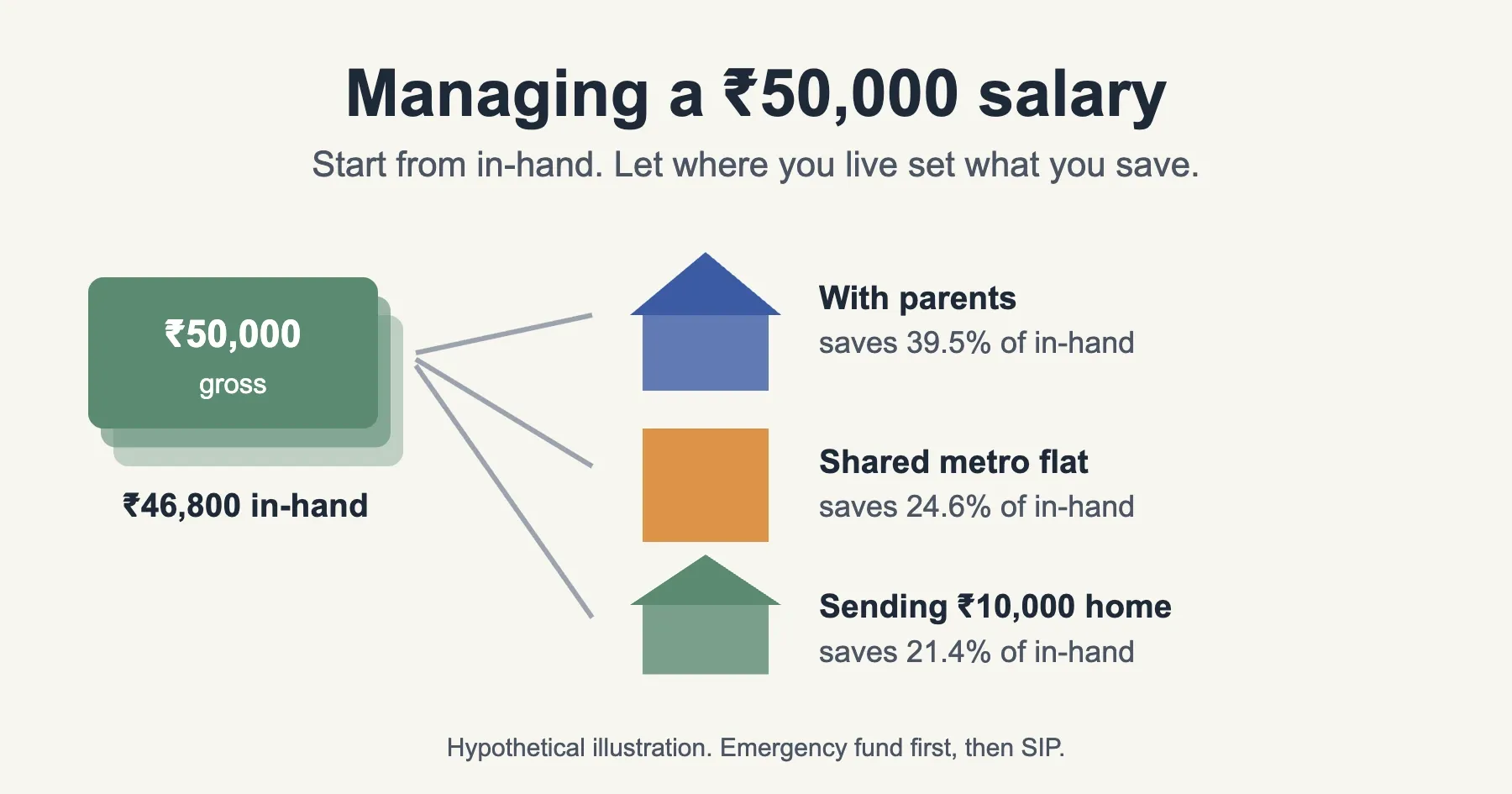
Shreya, 24, is a junior accountant in Kolhapur (she is fictional, and her numbers are hypothetical). She takes home ₹45,000 a month, wants to start her first SIP, and has been told to "keep six months aside first". Six months of salary, or of what she actually spends? And does the SIP wait? Her number turns out to be ₹1,80,000, not ₹2,70,000, and the SIP question has two honest answers. Here is how she got there, so you can do the same with yours.
What an emergency fund is (and isn't)
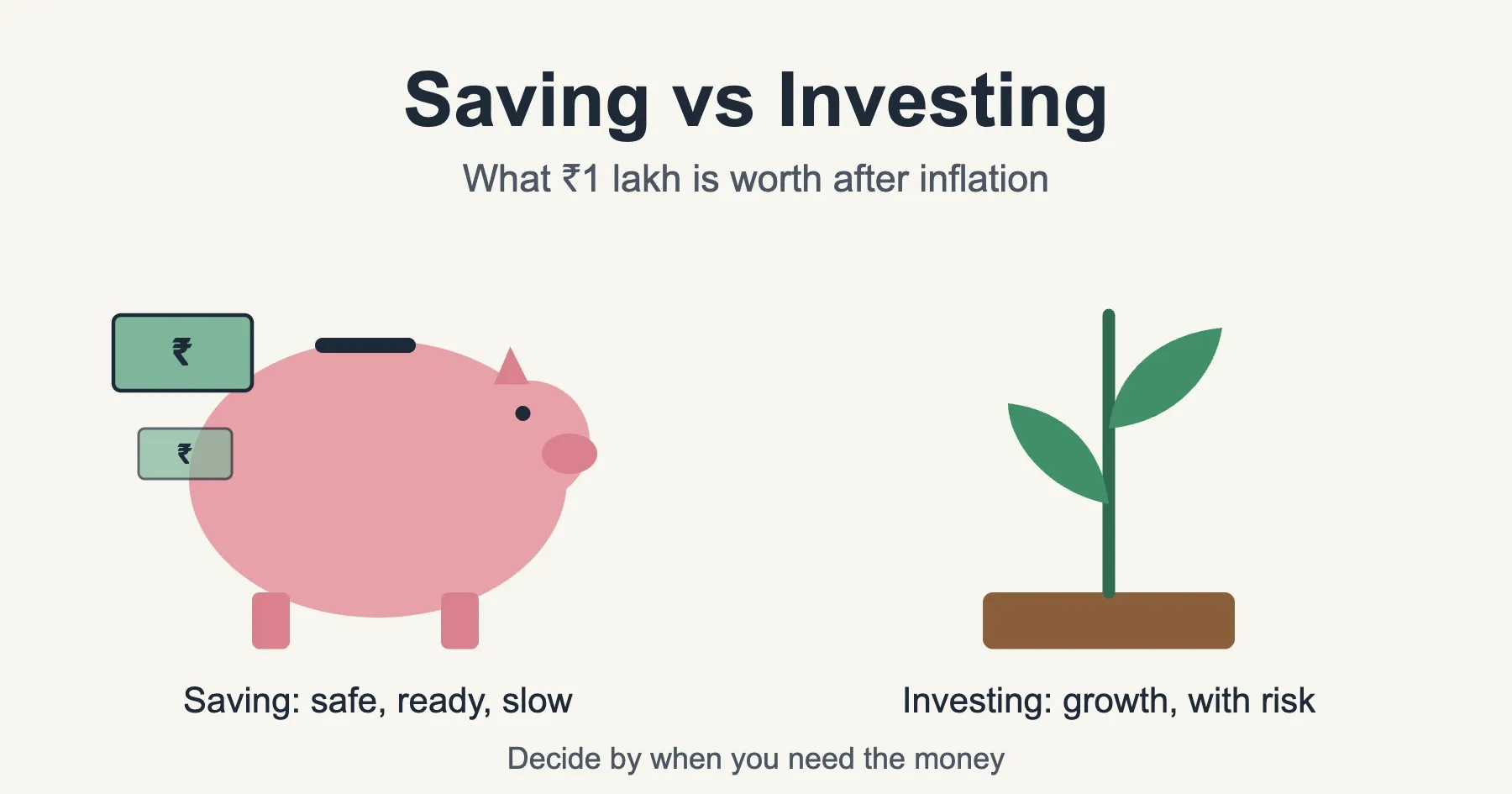
An emergency fund is money set aside, easy to reach and stable in value, to cover essential expenses during an unexpected event such as a job loss or a medical bill. It is not for planned spending, and it is not an investment. What it earns comes second.
It matters before a first SIP because an SIP in an equity fund is usually meant for goals years away. If a surprise bill forces you to redeem in a month when the market is down, you sell at a lower value. A buffer lets the SIP keep its horizon.
What counts as monthly expenses for an emergency fund
Count what you would still have to pay if your income stopped next month.
Count: rent or your share of it, groceries and basic food, electricity, water, gas, phone and internet, commuting, EMIs on any loan, insurance premiums (yearly premiums divided by 12), money you send home regularly, and medicines.
Leave out: eating out, shopping, travel, subscriptions you would cancel, and your SIP. An SIP can be stopped; rent cannot.
Shreya's list (hypothetical):
| Essential expense | ₹ a month |
|---|---|
| Rent (her share of a flat) | 9,000 |
| Groceries and basic food | 7,000 |
| Money sent home to her parents | 6,000 |
| Electricity, water, phone and internet | 2,500 |
| Commute | 2,500 |
| Medicines and personal essentials | 2,000 |
| Insurance premium (yearly amount ÷ 12) | 1,000 |
| Total essentials | 30,000 |
Her essentials come to ₹30,000, not her ₹45,000 salary. Six months of salary would be ₹2,70,000; six months of essentials is ₹1,80,000, a number she can actually reach.
3, 6 or 12 months: why the rules differ
Published guides quote 3 to 6 months, 6 to 8, sometimes 12, because they picture different lives. The months estimate how long a bad patch might last and how many people would feel it. Three questions place you:
- How stable is your income? A regular monthly salary is more predictable than freelance, commission or contract work.
- Does anyone depend on you? If you support parents, a partner or children, a gap hits more people at once.
- What cover do you already have? Health insurance, a partner with a steady income or family support all shorten the gap you fund alone.
| Your situation | Commonly cited range | Why |
|---|---|---|
| Single, stable salaried job, no dependants | 3 to 6 months | Income is predictable and only you are affected |
| Support family, or the only earner at home | About 6 months or more | A gap affects several people |
| Variable income: freelance, commission, contract, own business | 6 to 12 months | Gaps between payments are part of the work |
These ranges are commonly cited in published personal-finance guides. They are rules of thumb, not a regulation.
Shreya's number (hypothetical)
Shreya has a stable salary and no loans, but her parents partly depend on the ₹6,000 she sends home. That puts her between the first two rows:
- 3 months: ₹30,000 × 3 = ₹90,000
- 6 months: ₹30,000 × 6 = ₹1,80,000
She decides to reach 3 months first, then build towards 6, in layers.
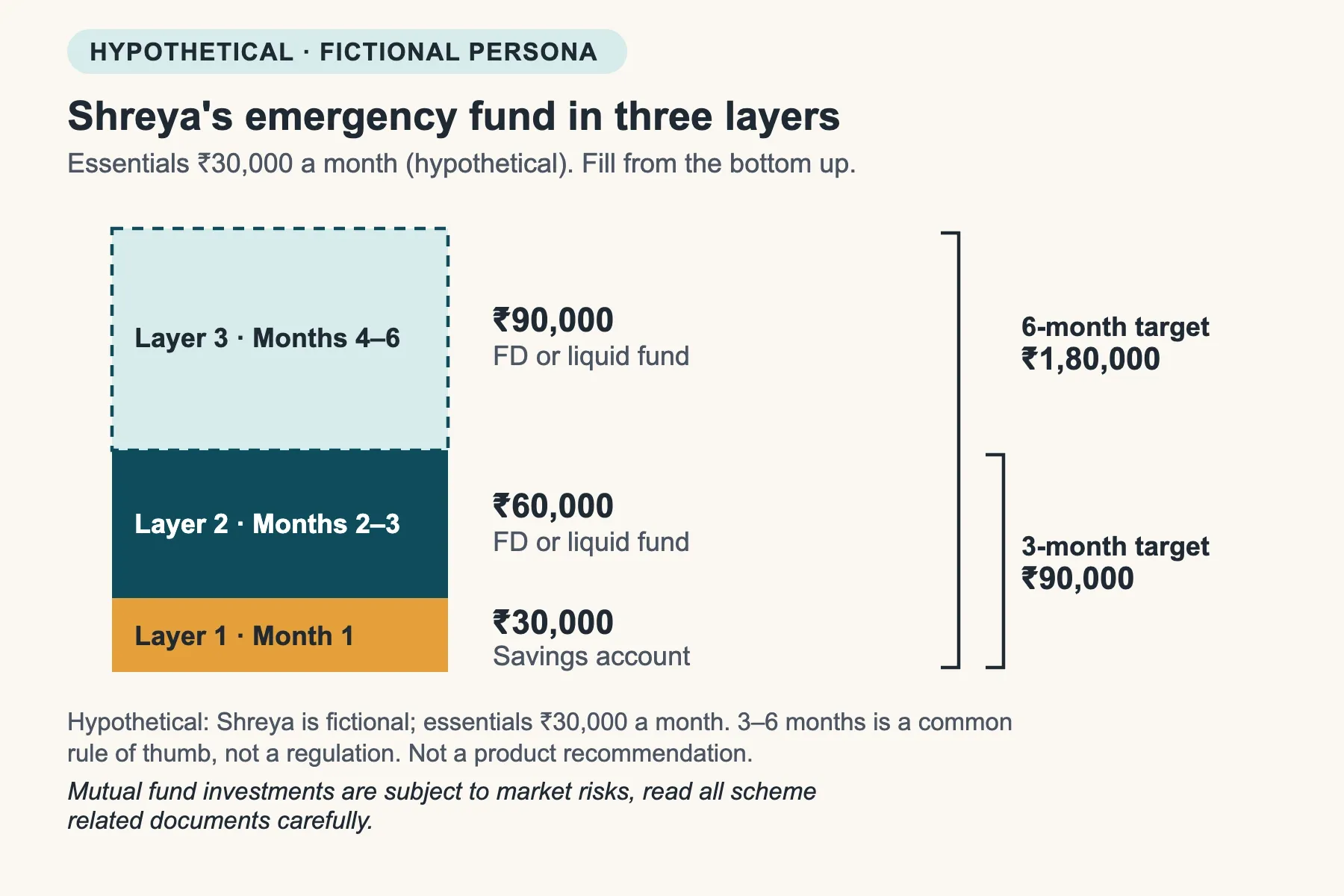
The first month sits where she can reach it the same day. Later layers can take longer to access; she is unlikely to need six months in one week.
Where to keep your emergency fund
Priorities: access first, then stability of value, then earnings.
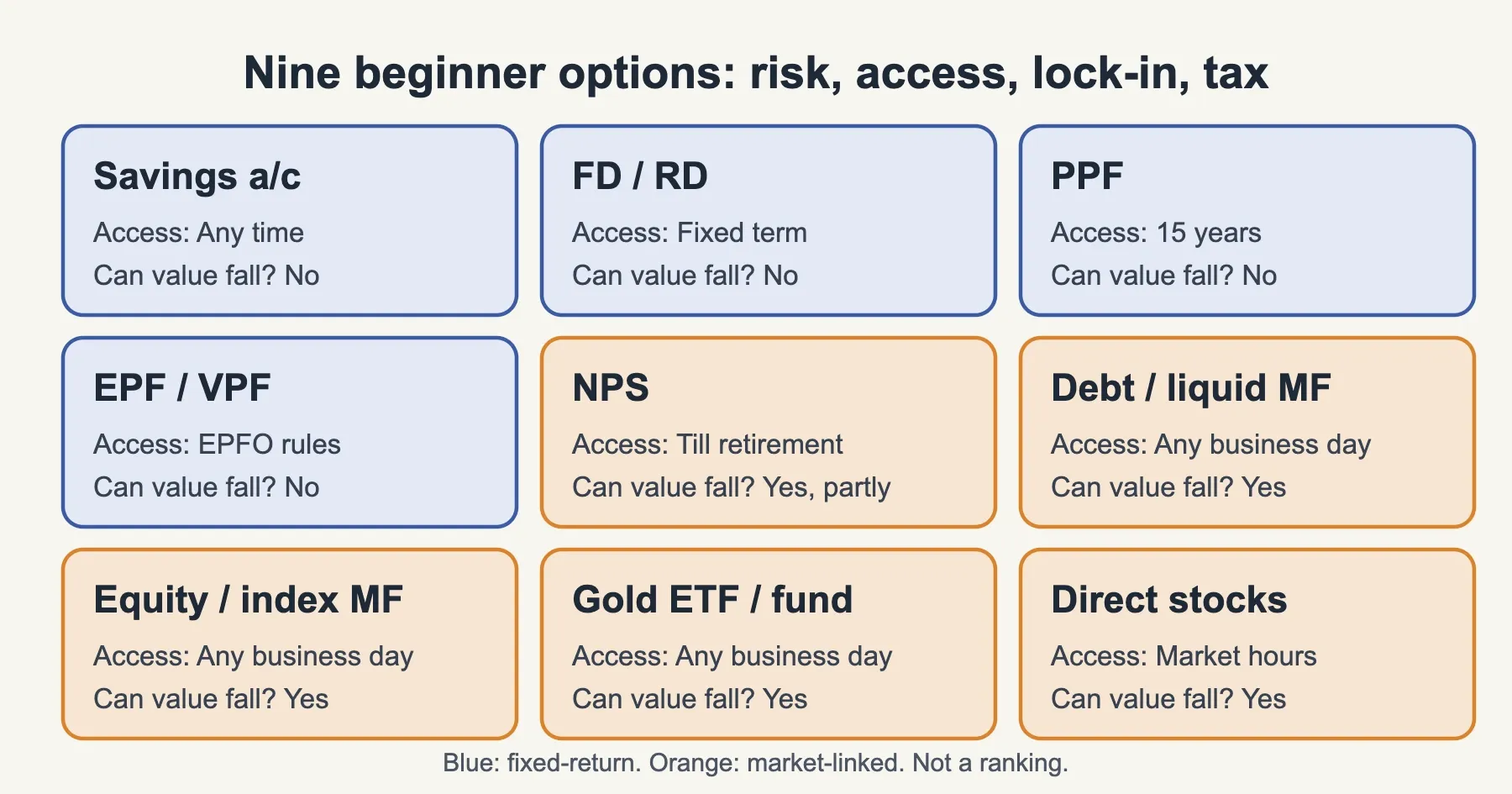
| Where | How you get money out | What can move | What to check |
|---|---|---|---|
| Savings account | Transfer, UPI or ATM, any time | The interest rate can change | Daily transfer and ATM limits on your account |
| Fixed deposit (FD) | Break it early; money goes to your linked account | Breaking early can reduce the interest you receive | The bank's premature withdrawal terms |
| Liquid fund (a debt mutual fund category) | Redeem units; money goes to your registered bank account | The NAV can fall; it is not a deposit | Exit load, redemption timing and any quick-access limits in the scheme information document (SID) |
| Overnight fund (a debt mutual fund category) | Redeem units, as above | The NAV can still move; it is not a deposit | The same SID sections |
- Bank deposits (savings accounts and FDs) are insured by the Deposit Insurance and Credit Guarantee Corporation (DICGC) up to ₹5 lakh per depositor per bank, principal and interest together (RBI's deposit insurance FAQ).
- Liquid funds invest only in debt and money market securities that mature within 91 days, and overnight funds in securities that mature in one day, under SEBI's circular on the categorisation of mutual fund schemes dated 26 February 2026.
- Redemption timing: SEBI's rules require redemption money to be transferred within three working days, with listed exceptions. The rule was set by a circular of 25 November 2022 and is still listed in SEBI's investor charter for mutual funds of 20 March 2026. Each scheme's SID states its own timeline.
The catch with a liquid or overnight fund: it can dip. If a security it holds is downgraded or defaults, the NAV can fall, and deposit insurance does not cover fund units. That is why it suits the later layers, not the first month.
One workable set-up: one month in a savings account, the rest in whichever option you have read and understood. We recommend no bank, scheme or fund house. For how these options compare for longer goals, see SIP vs FD vs RD.
Can you start your first SIP while building your emergency fund?
Yes, if you choose it knowingly. Shreya has ₹15,000 left after essentials and can set aside ₹9,000 a month (hypothetical; no interest or returns counted). Two routes, neither right for everyone:
- Route A: all ₹9,000 to the fund. 3 months (₹90,000) in month 10, 6 months (₹1,80,000) in month 20, then the SIP starts.
- Route B: ₹6,000 to the fund, ₹3,000 into an SIP. 3 months in month 15, 6 months in month 30.
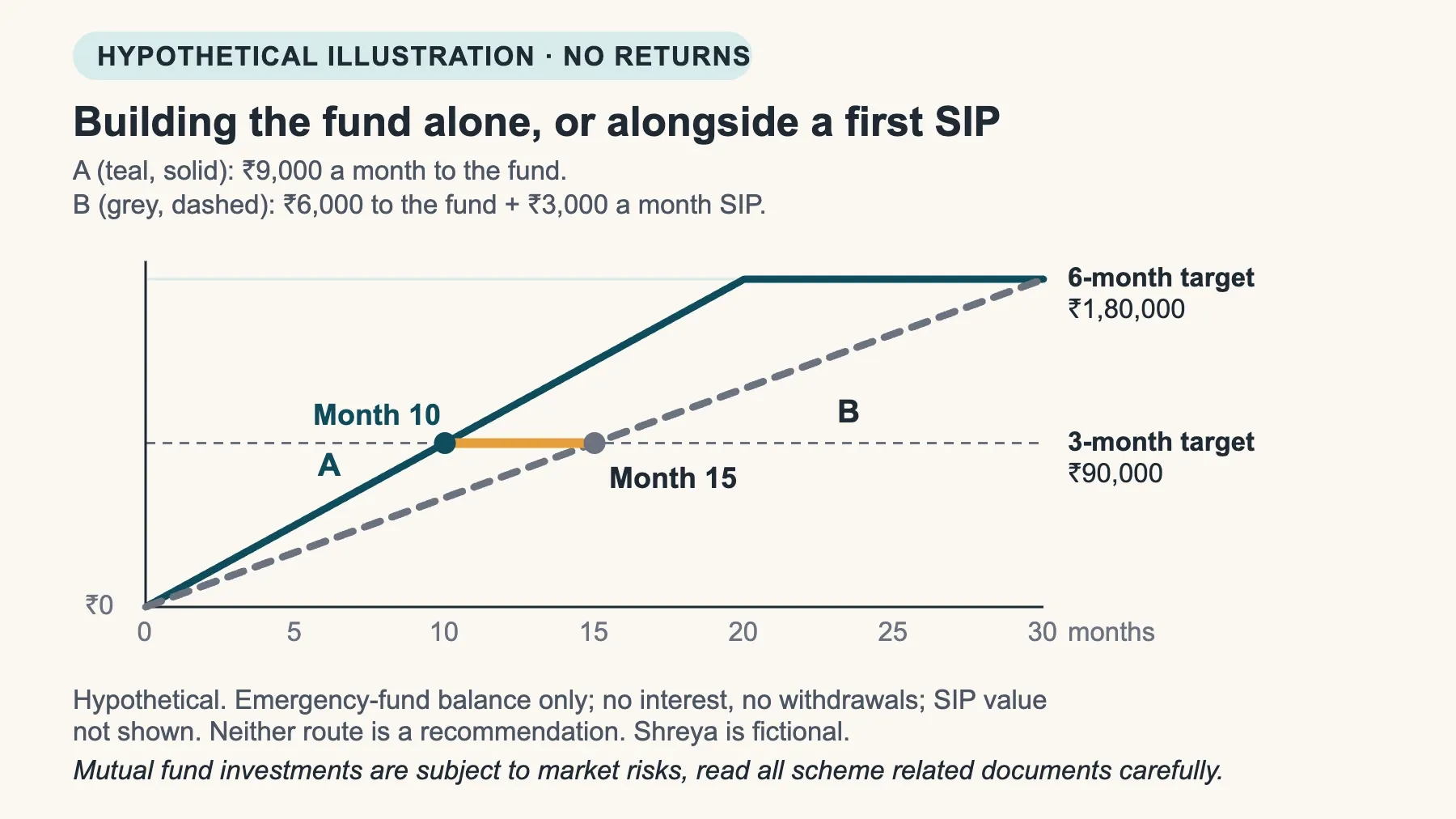
The catch with Route A: her investing habit starts about 10 months later, and those months of SIP instalments don't happen.
The catch with Route B: her safety net takes 5 months longer to reach 3 months. If an emergency arrives in that window, she may have to redeem SIP units at whatever the value is that month, or borrow.
Some switch partway; know which trade-off you accept. To size the SIP itself, see how much SIP to start with your first salary.
What if you also have a credit card balance or a loan?
These factors shape the answer:
- The interest rate on the debt, printed on your statement or loan agreement, compared with what the emergency money would earn.
- Whether any buffer exists. With no buffer at all, a new emergency may go straight back on the card.
- Prepayment terms. Some loans charge a fee for paying early.
- How stable your job is. The less certain your income, the more a buffer is worth.
There is no single right order; it depends on these factors, and splitting money between the two is also an option.
Does health insurance change the amount?
Health insurance covers one large risk: hospital bills, within the policy's terms. It does not replace income or pay rent, and employer cover can end with the job. So insurance may let you stay nearer the lower end of your range; it does not remove the need.
After you use it: rebuilding the fund
Afterwards, refill it like a bill: a fixed amount each month. Decide what happens to your SIP meanwhile: continue, reduce or stop it for a while, on purpose. If markets happen to be falling at the same time, our guide What happens to your SIP when the market falls (and should you stop it?) explains what stopping changes, and can you withdraw your SIP money anytime explains lock-ins and exit loads.
Frequently asked questions
I'm 24 and earn about ₹35,000 a month. How much emergency fund do I need?
Start from your essential expenses, not your salary. If your essentials are ₹22,000 a month (hypothetical), 3 months is ₹66,000 and 6 months is ₹1,32,000. Where you land depends on job stability, dependants and existing cover.
3, 6 or 12 months: which rule fits me?
Commonly cited: 3 to 6 months for a single person with a stable salary, about 6 or more if you support family, 6 to 12 for variable income. Rules of thumb, not a regulation.
Do I count rent, EMIs and SIPs in monthly expenses?
Count anything you would still pay in a month with no income: rent, EMIs, premiums, groceries, utilities, commute, money sent home. Leave out your SIP, eating out and shopping.
Where should I keep my emergency fund, and how fast can I get the money out?
A savings account can be reached the same day; an FD can be broken early, sometimes with less interest. Liquid and overnight funds are debt mutual fund categories whose value can fall; SEBI's rules (set in November 2022, still listed in its March 2026 investor charter) require redemption money within three working days, with listed exceptions, and each SID states its timeline.
Can I start my first SIP while I'm still building my emergency fund?
Yes, if you choose knowingly. Fund-first builds the safety net sooner but starts the SIP later; splitting starts the SIP now but keeps the buffer thinner for longer. In our hypothetical example, splitting moved the 3-month mark from month 10 to month 15.
I have a credit card balance or personal loan. Should I build an emergency fund or repay it first?
It depends on the debt's interest rate (on your statement), whether you have any buffer at all, the loan's prepayment terms and how stable your job is. There is no single right order; it depends on these factors, and splitting money between the two is also an option.
What to do next
- Write your essential expenses on one line and multiply by your months. That is your first goal.
- Considering a liquid or overnight fund? Read the SID sections on exit load and redemption timing first.
- Find out whether your health cover comes through your employer and what happens to it if you leave.
- Recount your essentials once a year, or whenever your rent, family or job changes.
— Laabh