Super top-up health insurance: how the deductible works, shown with two hospital bills
A super top-up pays once your yearly claims cross an aggregate deductible; a top-up checks each claim. See one ₹6.5 lakh year worked through.
Summarize this article with AI





The short version
- A super top-up pays only after your eligible claims in a policy year cross the aggregate deductible.
- A per-claim top-up checks each bill alone; in our hypothetical year it paid ₹0 while a super top-up paid ₹1,50,000.
- The deductible can be met by another policy or your own money, depending on the wording.
- Compare deductible type, waiting periods, sub-limits and co-pay in the CIS, not just the premium.
Short answer: Super top-up health insurance pays only after your total hospital claims in a policy year cross a set amount, called the aggregate deductible. A plain top-up applies its deductible to each claim separately. Depending on the policy wording, another policy, such as your employer's group cover, can meet the deductible, or you pay it yourself.
This is education only, not advice on any policy. Insurance products differ; read the policy wording and the Customer Information Sheet before you decide.
Say you are 27, working in Visakhapatnam, and your employer's group health cover is ₹5 lakh. A colleague mentions a "super top-up" that adds cover above ₹5 lakh. To understand the super top-up health insurance meaning, you need to follow one number: the deductible. Below, one hypothetical year with two hospital bills shows how it works.
What is a super top-up health insurance plan, in simple words?
It is a health policy that sits above a threshold. Below it, the policy pays nothing; above it, the policy pays up to its own sum insured.
That threshold is the deductible: the amount of eligible claims that must be covered by something else (another policy or your own money) before this policy starts paying. A super top-up counts it across all claims in a policy year.
A base policy is the ordinary health policy that pays from the first rupee, up to its sum insured. Your employer's group health insurance is a base policy. A top-up or super top-up does not replace it; it is designed to sit on top of some first layer of cover.
Top-up vs super top-up: what's the difference for multiple hospital bills in a year?
The difference is how the deductible is counted.
- Top-up (per-claim deductible): each claim is checked on its own. The policy pays only if a single claim is bigger than the deductible.
- Super top-up (aggregate deductible): claims in the policy year are added together. The policy pays once the running total crosses the deductible.
With several medium bills in one year, they can pay very different amounts.
One hypothetical year, two hospital bills
Assume employer base cover of ₹5,00,000, and an add-on with a ₹5,00,000 deductible. In one policy year, you have two admissions: ₹2,70,000 and then ₹3,80,000, a total of ₹6,50,000.
| Bill 1 | Bill 2 | Year total | |
|---|---|---|---|
| Hospital bill | ₹2,70,000 | ₹3,80,000 | ₹6,50,000 |
| Employer base cover pays | ₹2,70,000 | ₹2,30,000 (cover used up) | ₹5,00,000 |
| Left after base cover | ₹0 | ₹1,50,000 | ₹1,50,000 |
| Per-claim top-up pays | ₹0 (bill below ₹5,00,000) | ₹0 (bill below ₹5,00,000) | ₹0 |
| You pay with a per-claim top-up | ₹0 | ₹1,50,000 | ₹1,50,000 |
| Super top-up pays | ₹0 | ₹1,50,000 (year total crosses ₹5,00,000) | ₹1,50,000 |
| You pay with a super top-up | ₹0 | ₹0 | ₹0 |
Hypothetical; ignores sub-limits, co-payment, non-payable items and waiting periods. The actual payout depends on the policy wording.
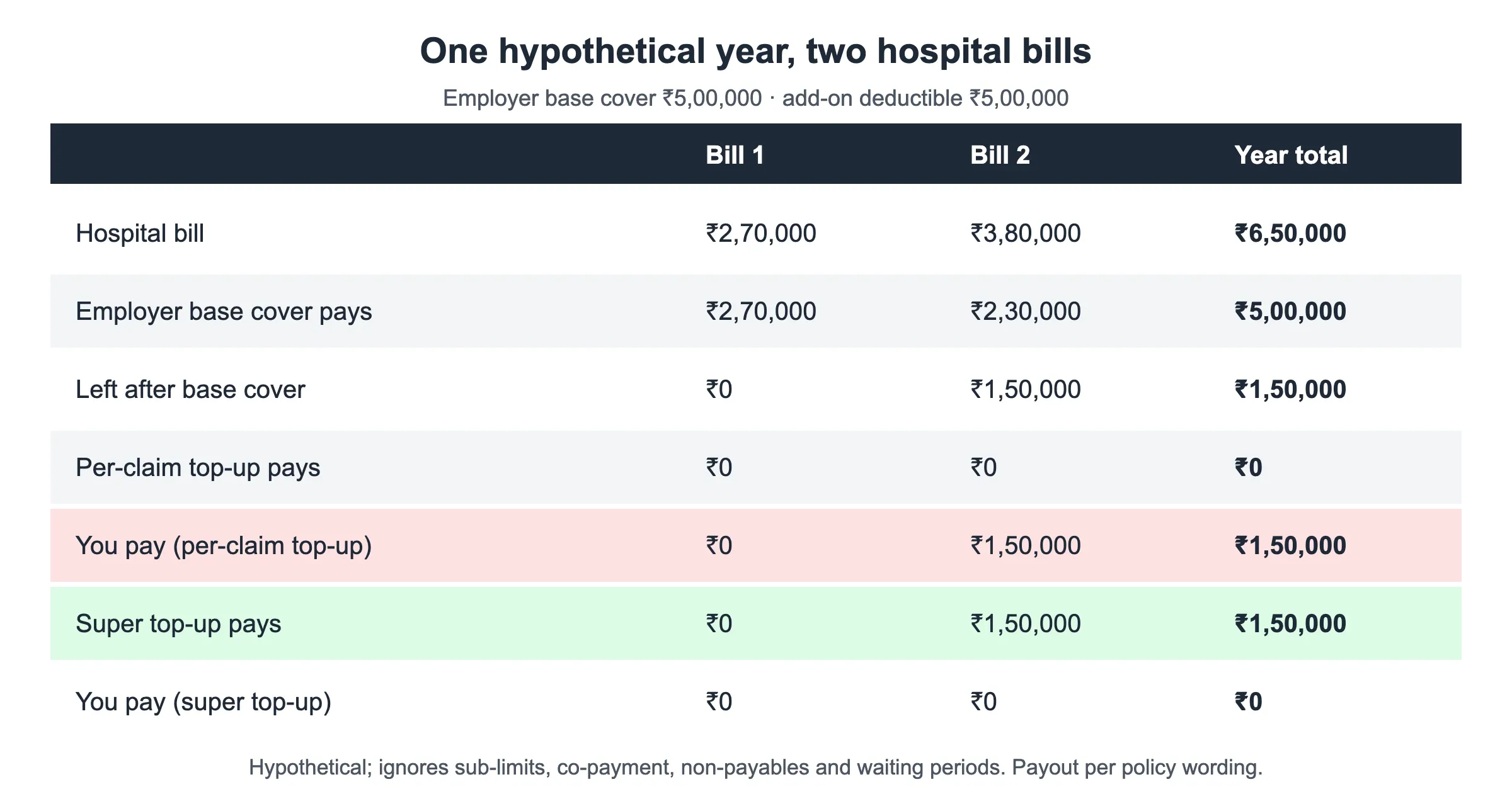
The per-claim top-up pays nothing because neither bill, on its own, is above ₹5,00,000. The super top-up looks at the year: ₹6,50,000 minus the ₹5,00,000 deductible leaves ₹1,50,000, which it pays.
How does the deductible work: do I pay it from my pocket?
Not always. The deductible is a threshold, not a fee paid to the insurer. What matters is who covers the bills below it.
In the example above, the employer policy covered the first ₹5,00,000, so nothing came from your pocket. If there were no base policy, you would pay the first ₹5,00,000 yourself and the super top-up would pay the ₹1,50,000 above it.
Policy wordings differ on the details:
- Some wordings let another health policy meet the deductible; others may say how the deductible is to be borne. Check the definition of "deductible" in the wording.
- Look for sub-limits (caps on room rent or specific treatments) and co-payment (a share of each claim you pay). Both can leave you paying even after the deductible is crossed.
An emergency fund can help cover a deductible gap; see how much emergency fund you should have.
Can my company's group health cover count towards the super top-up deductible?
Often, the employer policy is exactly what is expected to fill the deductible. Whether its payouts count depends on the super top-up's wording, so read the definition rather than assuming.
Three things to keep in mind:
- Job change. Group cover usually ends when you leave the job. If you are between jobs, or the new employer's cover is smaller, the deductible does not shrink. On the same hypothetical ₹6,50,000 year with no base cover, you would pay ₹5,00,000 and the super top-up would pay ₹1,50,000.
- Match the numbers. If the employer cover is ₹3 lakh and the deductible is ₹5 lakh, there is a ₹2 lakh gap you fund yourself in a heavy year.
- Waiting periods. A new super top-up has its own waiting periods, even if your employer's cover had none. IRDAI's rules cap waiting periods, including for pre-existing diseases, at 36 months.
For the other limits of group cover, read is employer health insurance enough.
What should I compare between a base policy plus a super top-up and one larger base policy?
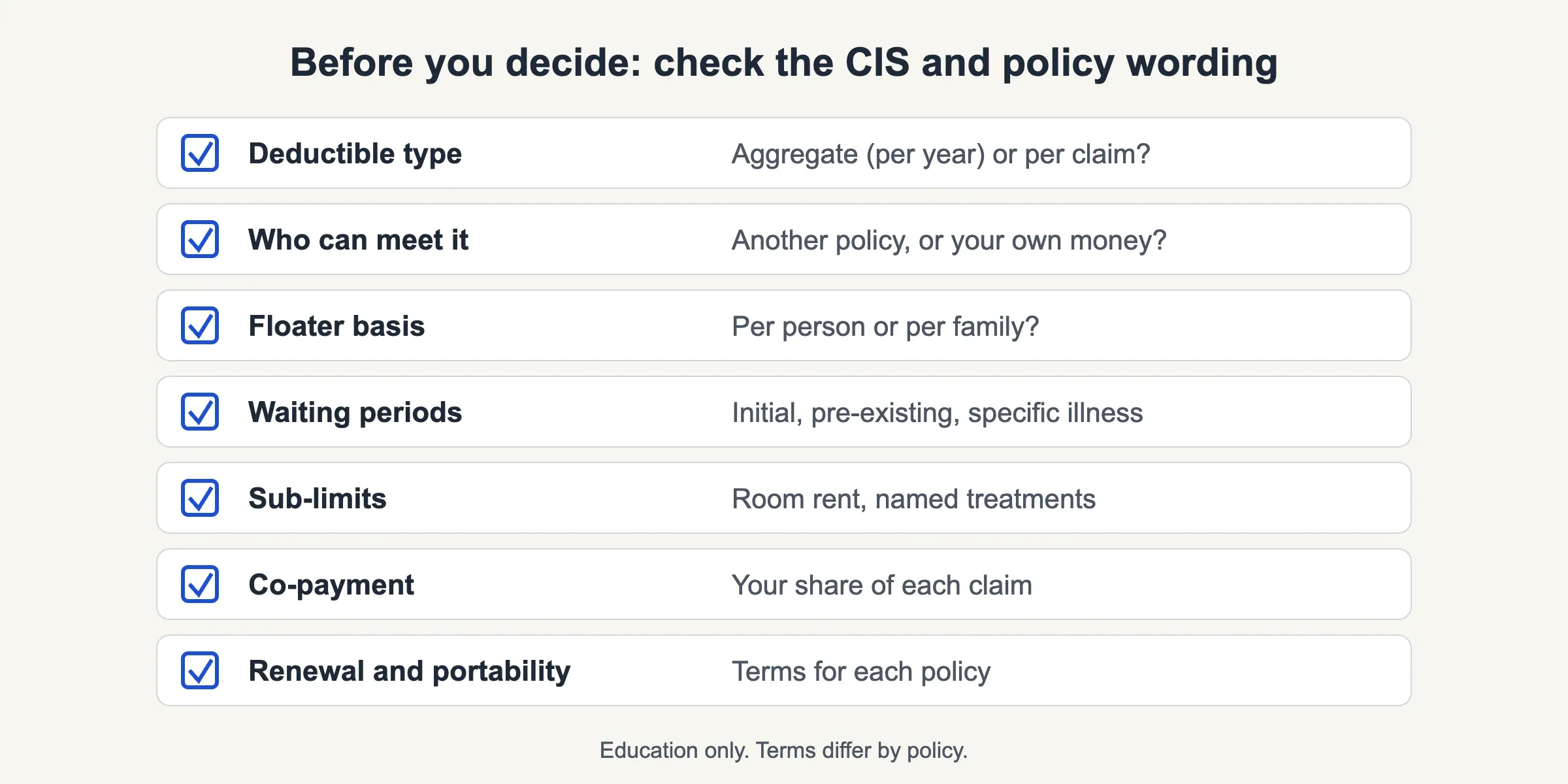
Premiums vary by age, city, insurer and cover, so this page gives no figures. Compare the documents instead. Under IRDAI rules, insurers provide a Customer Information Sheet (CIS), a short summary of the key terms; use it alongside the full policy wording.
| What to check | Base plus super top-up | One larger base policy |
|---|---|---|
| When it pays | Above the aggregate deductible | From the first rupee |
| Deductible type | Aggregate or per-claim? Per person or per family? | Usually none |
| Waiting periods | Separate set for the add-on | One set |
| Sub-limits and co-pay | Check both policies | Check one policy |
| Dependence on employer | High, if group cover fills the deductible | None |
| Renewal and portability | Two renewals to track | One renewal |
The combination adds moving parts; a single base policy has fewer. The CIS shows which terms apply to each.
Frequently asked questions
Does a super top-up have waiting periods?
Yes. It usually has its own initial, pre-existing disease and specific-illness waiting periods, separate from your base or employer policy. IRDAI's rules cap these at 36 months. The policy wording lists them.
What happens to the deductible if I change jobs?
The deductible stays, but the employer cover that filled it may end. Until you have new cover, eligible bills up to the deductible come from your pocket.
In a floater, is the deductible per person or per family?
It depends on the wording. Some floater plans apply one aggregate deductible to the family's combined claims; others may apply it per insured member. Check the deductible clause and the CIS.
Is the premium tax-deductible?
As of 17 November 2026, a health insurance premium deduction (section 80D of the Income-tax Act, 1961; section 126 of the Income-tax Act, 2025) is available only under the old tax regime, for FY 2026-27. Tax rules change; consult a tax professional for your situation.
Where do I complain about a claim?
Start with the insurer's grievance cell. If unresolved, you can approach IRDAI's grievance system (Bima Bharosa) or the Insurance Ombudsman (cioins.co.in). Check the time limits that apply before filing.
Read next
Next: check the five gaps in your employer cover first, in whether employer health insurance is enough. If you are working out the order of your first money decisions, see term insurance before your first investment.
— Laabh