Digital gold vs gold ETF: who regulates it, who holds the gold, and what it costs to get out
SEBI says digital gold operates outside its purview; gold ETFs are SEBI-regulated. Compare custody, costs, tax and exit, as of 19 November 2026.
Summarize this article with AI





The short version
- A gold ETF is a SEBI-regulated mutual fund scheme. Digital gold, per SEBI's 8 November 2025 release, operates "entirely outside the purview of SEBI".
- Digital gold's costs are GST and the spread. A gold ETF's are the expense ratio, brokerage and demat charges.
- Gold ETF units become long-term after 12 months. Digital gold takes more than 24 months (as of 19 November 2026).
- There is no direct transfer from digital gold to an ETF. You sell, then buy.
A gold ETF is a mutual fund scheme regulated by SEBI, traded on a stock exchange and backed by physical gold. Digital gold sold through online platforms is not a SEBI-regulated product: SEBI's press release of 8 November 2025 says such products "operate entirely outside the purview of SEBI". Both give you exposure to gold. The difference is who oversees the product, who holds the metal, and what it costs to get in and out. This page is current as of 19 November 2026.
Mutual fund investments are subject to market risks, read all scheme related documents carefully.
Ishaan, 25, in Patna, wants to put part of a festive bonus into gold. Both options he sees quote the gold price. Neither shows the structure behind it, which is what this page compares.
What SEBI actually said about digital gold
On 8 November 2025, SEBI issued press release No. 70/2025, "Caution to public regarding dealing in 'Digital Gold'". Read on sebi.gov.in, it makes four points:
- Digital gold or e-gold products are "neither notified as securities nor regulated as commodity derivatives".
- They "operate entirely outside the purview of SEBI".
- They "may expose investors to counterparty and operational risks".
- For these products, "none of the investor protection mechanisms under securities market purview shall be available".
The release also lists the gold products SEBI does regulate: gold ETFs offered by mutual funds, Electronic Gold Receipts (EGRs) that trade on stock exchanges, and exchange-traded commodity derivative contracts. These can be accessed through SEBI-registered intermediaries.
The release names no platform and says nothing about the gold price. It is a statement about regulatory status, and this page treats it that way.
Digital gold vs gold ETF: the structure side by side
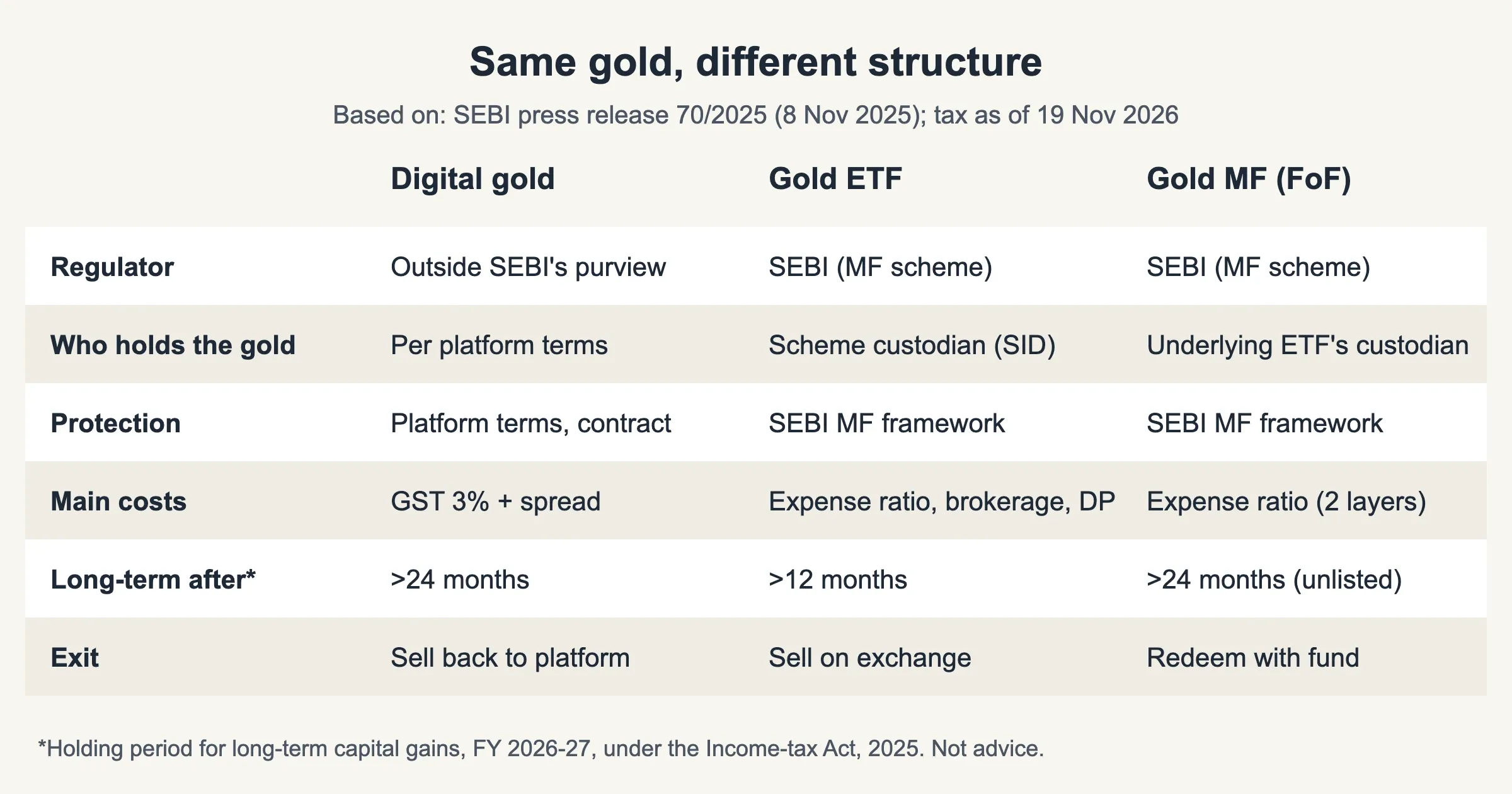
| Digital gold | Gold ETF | Gold mutual fund (fund of fund) | |
|---|---|---|---|
| Regulator | Outside SEBI's purview (SEBI, 8 Nov 2025) | SEBI (mutual fund scheme) | SEBI (mutual fund scheme) |
| What you own | A claim on gold under the platform's terms | Units of a scheme that holds physical gold | Units of a scheme that invests in gold ETF units |
| Who holds the gold | Set by the platform's terms (vault provider, any trustee) | A custodian named in the scheme documents | The underlying ETF's custodian |
| Investor protection | Platform terms and contract law | SEBI's mutual fund framework and SEBI's grievance routes | Same as gold ETF |
| Main costs | GST of 3% on purchase, buy-sell spread | Expense ratio, brokerage, demat charges | Expense ratio of the fund and of the ETF it holds |
| Needs a demat account | No | Yes | No |
| Exit | Sell back to the platform, or delivery where offered | Sell units on the exchange | Redeem units with the fund |
Who holds the gold
With a gold ETF, the scheme buys physical gold and a custodian appointed under the scheme holds it. The scheme information document (SID), filed with SEBI, names the custodian and explains the arrangement.
With digital gold, the arrangement is whatever the platform's terms say. Read who holds the gold, whether a trustee is named, whether it is insured, and what happens if the platform stops operating. SEBI does not review these terms.
Investor protection: framework vs contract
A gold ETF sits inside SEBI's mutual fund rules on disclosure, valuation, trustees and complaints, backed by SEBI's grievance routes.
Digital gold sits outside that framework. In SEBI's words, "none of the investor protection mechanisms under securities market purview shall be available" for these products. Your protection is the platform's terms and general contract law. That is not a judgement on any platform; it means the safeguards are different and you read them yourself.
Costs: GST and spread vs expense ratio and brokerage
Digital gold. Purchases of gold attract GST, commonly 3%. Platforms also quote a buy price and a lower sell price. That gap is the spread, and you pay it when you exit.
Gold ETF. There is no GST on buying units. You pay brokerage and demat or DP charges set by your broker and depository participant, plus an annual expense ratio deducted inside the fund.
A hypothetical ₹8,200 example
Hypothetical, using assumed rates, not actual platform or scheme costs. The gold price is held unchanged; this is not a price view.
Digital gold:
- Purchase: ₹8,200, assuming 3% GST is included in the price.
- Gold value: ₹8,200 ÷ 1.03 ≈ ₹7,961.17. GST ≈ ₹238.83.
- Same-day sale at an assumed illustrative 3% spread: ₹7,961.17 × 0.97 ≈ ₹7,722.33.
- Gap from the amount paid ≈ ₹477.67, about 5.83% of ₹8,200.
Gold ETF:
- No GST on units. Brokerage and DP charges depend on your broker (not modelled here).
- At an assumed illustrative expense ratio of 0.5% a year, the annual cost on ₹8,200 ≈ ₹41.
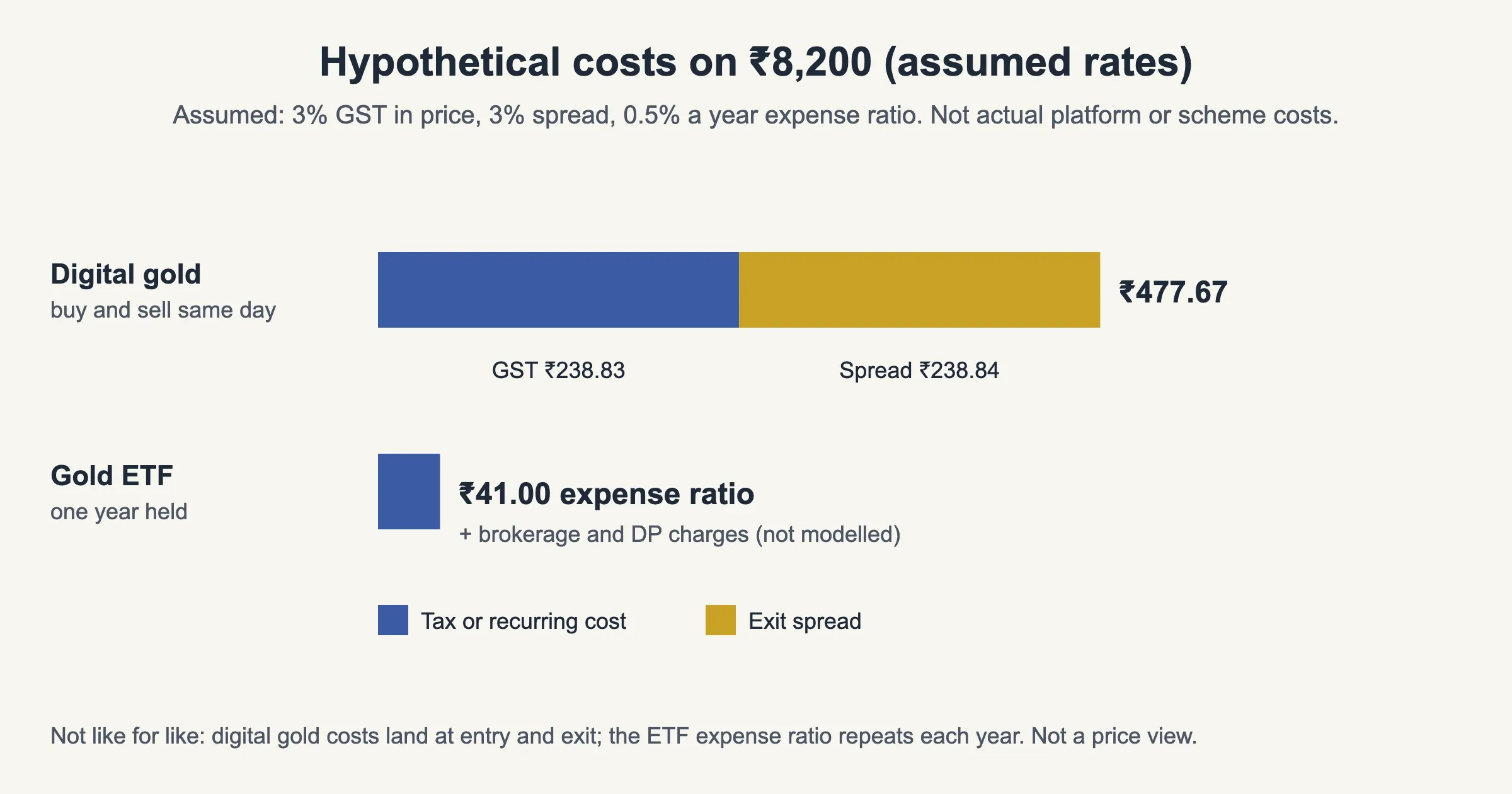
These are not like for like. Digital gold's costs land at entry and exit; a gold ETF's expense ratio repeats every year, and brokerage applies to each trade. Check actual figures on the price screen, the scheme factsheet and your broker's charges page.
Tax: how digital gold and gold ETFs are taxed
As of 19 November 2026, FY 2026-27, under the Income-tax Act, 2025:
- Gold ETF (listed units). Held for more than 12 months, gains are long-term and generally taxed at 12.5% without indexation, plus surcharge and cess. Held for 12 months or less, gains are short-term and taxed at your slab rate.
- Digital gold. Treated as a capital asset like physical gold. Held for more than 24 months, gains are generally long-term at 12.5% without indexation. Shorter holdings are taxed at your slab rate.
- Gold mutual fund (unlisted units). The long-term threshold is generally more than 24 months.
Confirm sections, rates and holding periods on incometax.gov.in. For mutual fund taxation more broadly, see our tax guide.
Tax rules change; consult a tax professional for your situation.
Exit and conversion: no direct transfer
You cannot transfer digital gold into a gold ETF or a gold mutual fund as it is. Digital gold is not a security, so it cannot move into a demat account. The usual route is two steps: sell the digital gold back to the platform, then buy ETF or fund units with the proceeds.
You pay the spread on the sale, and any gain is taxed by how long you held the digital gold.
Other SEBI-regulated gold routes
SEBI's release names three regulated routes. Two are covered here:
- Gold mutual fund (fund of fund). Invests in gold ETF units. You need no demat account, and many such funds accept SIPs. The trade-off is two layers of expense ratio. Our hub page compares this with a gold ETF in detail.
- Electronic Gold Receipt (EGR). A receipt for physical gold in a vault, traded on a stock exchange under SEBI's framework. Check whether your broker offers EGR trading.
The third, exchange-traded commodity derivatives, involves leverage and is a separate topic. For Sovereign Gold Bonds, check rbi.org.in for whether any new tranche is open.
Frequently asked questions
Is digital gold on payment apps regulated by SEBI?
No. SEBI's press release of 8 November 2025 says digital gold products are "neither notified as securities nor regulated as commodity derivatives" and "operate entirely outside the purview of SEBI". SEBI-regulated gold products include gold ETFs and EGRs.
How does oversight differ between digital gold and a gold ETF?
A gold ETF follows SEBI's mutual fund rules on disclosure, custody and grievances. Digital gold runs on the platform's terms, without securities market protections. Neither guards against a fall in the gold price.
How is digital gold taxed compared to a gold ETF?
As of 19 November 2026, FY 2026-27, listed gold ETF units become long-term after 12 months and digital gold after 24 months. Long-term gains on both are generally taxed at 12.5% without indexation. Shorter holdings are taxed at your slab rate.
Can I move my digital gold into a gold ETF or a gold mutual fund?
Not directly. You sell the digital gold and use the money to buy units, paying the spread; the sale may create a taxable gain.
What happens to my digital gold if the platform shuts down?
It depends on the platform's terms: the vault provider, whether a trustee holds the gold for customers, and how claims are settled. SEBI's framework does not apply.
Learn more
Learn more in gold ETF vs gold mutual fund, or see how silver and gold ETFs differ.
— Laabh



