Silver ETF vs gold ETF: why two precious metals behave so differently in a portfolio
Gold and silver ETFs share a wrapper but not a metal. See why silver swings more, how each is bought and taxed, and what to check before you invest.
Summarize this article with AI





The short version
- Gold and silver ETFs share the same exchange-listed wrapper; the metal is the difference.
- SEBI's November 2021 circular requires silver ETFs to hold at least 95% in silver and silver-related instruments, with 30 kg, 99.9% LBMA Good Delivery bars.
- Silver's industrial demand is one reason its price has tended to swing more than gold's.
- In our hypothetical ₹24,000 example, an 8% fall needs about 8.7% to recover; a 20% fall needs 25%.
- Tax depends on the route, ETF or fund of funds, not on the metal.
Gold and silver ETFs both hold physical metal, track its domestic price and trade on the exchange through a demat account. The difference is the metal: silver is partly an industrial commodity, which is one reason its price has tended to swing more than gold's. Fund of funds routes allow SIPs without demat; tax depends on the route.
Mutual fund investments are subject to market risks, read all scheme related documents carefully.
Lakshmi, 26, a design engineer in Vijayawada, has a monthly SIP running and wants some precious metal alongside it. Her app lists gold ETFs and silver ETFs side by side, with similar names. This guide explains what actually differs in silver ETF vs gold ETF, from the metal to the tax, without telling you which one to own.
What is the difference between a gold ETF and a silver ETF in India?
The wrapper is the same: a mutual fund scheme whose units are listed on a stock exchange and which holds the physical metal. The metal, and the rules written for it, are what change.
SEBI set the norms for silver ETFs in a circular dated 24 November 2021 (SEBI/HO/IMD/DF2/CIR/P/2021/668). It says:
- A silver ETF "shall invest at least 95% of the net assets of the scheme" in silver and silver-related instruments.
- The silver "shall be of standard 30 kg bars with fineness of 999 parts per thousand (or 99.9% purity)" and must meet London Bullion Market Association (LBMA) Good Delivery Standards.
- The benchmark is "the price of silver (based on LBMA Silver daily spot fixing price)"; the objective refers to physical silver in domestic prices, and NAV is calculated in rupees.
The same circular applies its NAV, tracking error and disclosure norms to gold ETFs too. Same template, different metal inside.
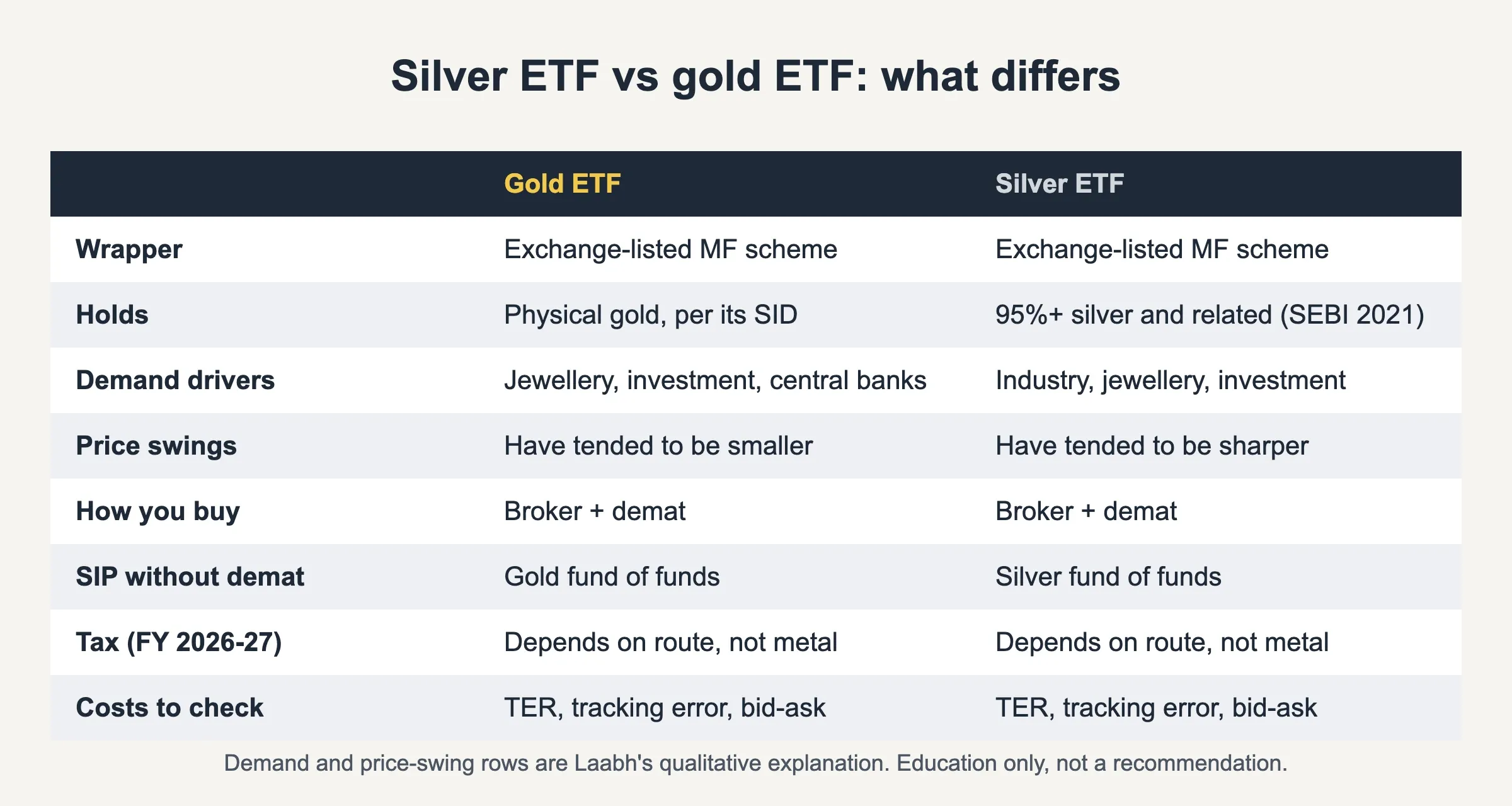
| Gold ETF | Silver ETF | |
|---|---|---|
| What it holds | Physical gold, per its SID | At least 95% in silver and silver-related instruments (SEBI, 2021) |
| Main demand drivers | Jewellery, investment, central bank buying | Industry as well as jewellery and investment |
| Price swings (qualitative) | Have tended to be smaller than silver's | Have tended to be sharper than gold's |
| How you buy | On the exchange, through a broker and demat | Same |
| SIP without demat | Through a gold fund of funds | Through a silver fund of funds |
| Costs to check | Expense ratio, tracking error, bid-ask spread, brokerage | Same |
Rows on demand drivers and price swings are our explanation, not a regulator's statement.
Why do silver prices move more sharply than gold?
Gold is held mostly as jewellery, as an investment and in central bank reserves. Silver has those uses too, but a large part of its demand is commonly described as industrial: electronics, solar panels and other manufacturing. When the industrial cycle speeds up or slows down, silver demand moves with it. Gold has less of that link.
Silver is also generally described as a smaller market than gold, so the same flow of buying or selling can move its price further. These are among the reasons silver's price has tended to rise and fall more steeply. That describes past behaviour, not a forecast.
A hypothetical example: same amount, different fall
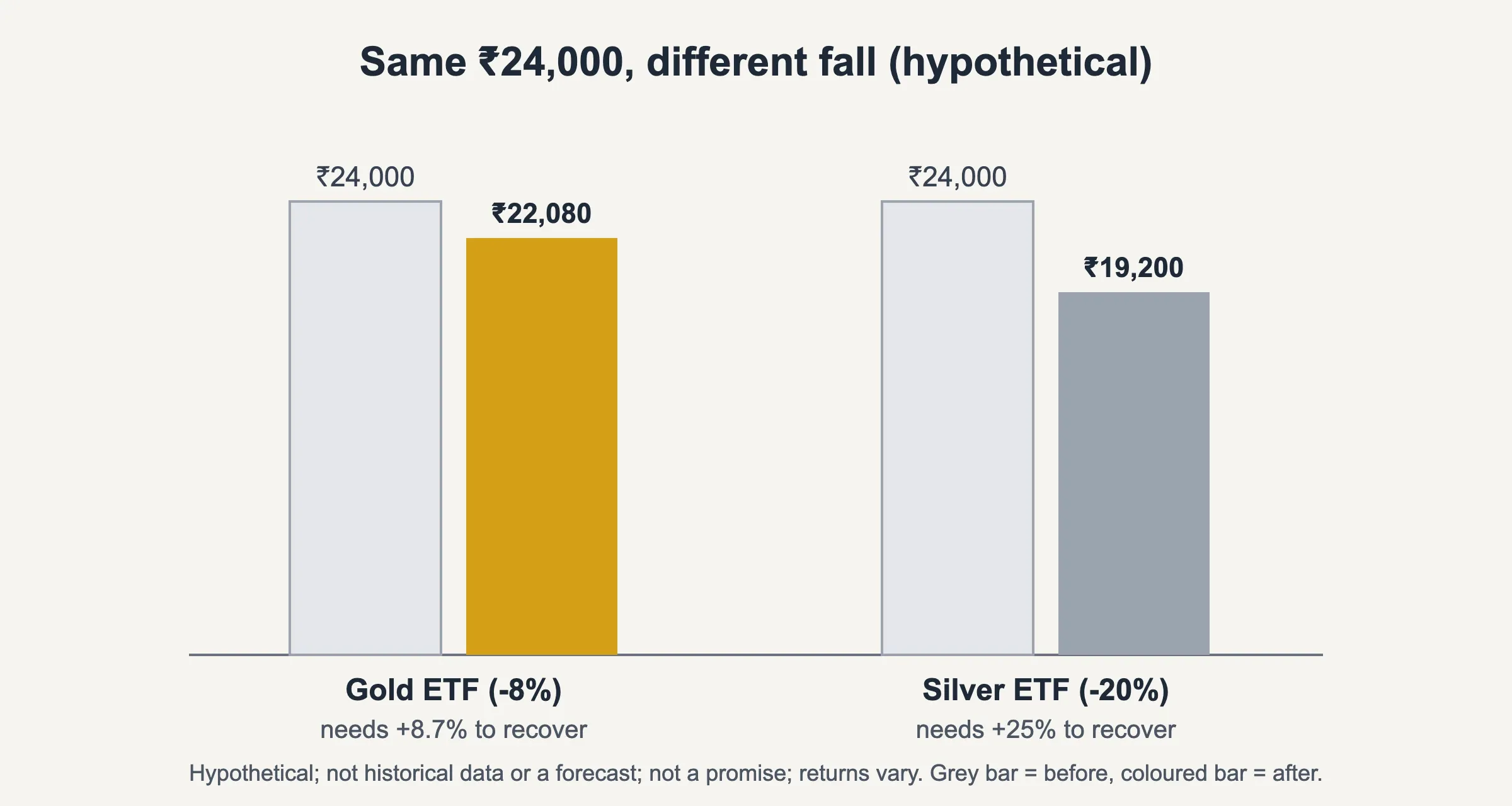
Say Lakshmi puts ₹24,000 into a gold ETF and ₹24,000 into a silver ETF. Then comes a rough stretch for precious metals (hypothetical; not historical data or a forecast; shows the volatility difference only):
- Gold falls 8%: ₹24,000 becomes ₹22,080, a fall of ₹1,920.
- Silver falls 20%: ₹24,000 becomes ₹19,200, a fall of ₹4,800.
Together, ₹48,000 becomes ₹41,280.
The recovery maths is less obvious. To get back to ₹24,000, the gold holding needs to rise about 8.7%; the silver holding needs 25%. A bigger fall needs a proportionally bigger rise to undo it, which is why larger swings are harder to sit through. In a rising market, silver can also move further.
How are gold ETFs and silver ETFs taxed after Budget 2024?
Rules as of 16 November 2026, as of FY 2026-27, under the Income-tax Act, 2025.
- The metal does not change the tax. The route does: ETF or fund of funds.
- Listed ETF units: held more than 12 months, gains are long-term. The Income Tax Department states long-term capital gains are taxed at 12.5% without indexation. Shorter-held gains are taxed at your slab rate.
- Fund of funds units: not listed, so a 24-month holding period applies for long-term treatment, at 12.5%. A metal FoF invests in ETFs, not debt, so the "specified mutual fund" rule in section 76 does not apply.
Tax rules change; consult a tax professional for your situation.
Can I do an SIP in a silver ETF, or do I need a silver fund of funds?
An ETF trades like a share, so there is no fund-house SIP on the ETF itself. Some brokers offer a recurring buy; that is a broker feature with its own terms.
A silver fund of funds is a scheme that puts nearly all its money into a silver ETF. You invest at its NAV, including by SIP, through a mutual fund folio, and pay a second layer of expenses on top of the ETF's own. Our guide to gold ETF vs gold mutual fund explains that structure; it works the same way for silver. For the wider ETF-or-fund question, see how an index fund or ETF buys units for your SIP.
Do I need a demat account to buy a gold or silver ETF?
To buy the ETF directly, yes in practice: units are listed, so you trade through a broker and hold them in demat. Through a fund of funds, no; units sit in a mutual fund folio. More in investing in mutual funds without a demat account.
What to check: expense ratio, tracking error, iNAV, bid-ask
The same four checks apply to either metal.
- Expense ratio. The annual running cost, taken from the scheme's assets; a fund of funds adds its own. See what an expense ratio is.
- Tracking error. How closely the ETF follows the metal's price. SEBI's 2021 circular sets tracking error norms for both; the scheme discloses it.
- iNAV. The indicative NAV, an estimate of each unit's value during trading hours. Compare it with the market price before you order; the scheme's SID or KIM says where it is published.
- Bid-ask spread and volume. A thinly traded ETF can have a wider gap between buying and selling prices, a cost you pay on each trade.
Also read the scheme's riskometer in its SID, and ask whether a metal ETF fills a gap or overlaps what you hold; how many funds a beginner needs covers that thinking.
Frequently asked questions
What is iNAV?
iNAV, or indicative NAV, estimates an ETF unit's value during trading hours from the current price of what it holds. Comparing it with the market price shows whether you are paying more or less than that value.
What is tracking error?
Tracking error measures how far an ETF's returns drift from its benchmark, here the metal's price, because of expenses, cash and timing. SEBI's 2021 circular sets tracking error norms for silver and gold ETFs.
Is a silver ETF riskier than a gold ETF?
Silver's price has historically moved more sharply than gold's, partly because of industrial demand. Check each scheme's riskometer in its SID. Larger swings are not a reason to own or avoid either; they show how much movement you need to be comfortable with.
Where is the metal stored?
The ETF holds physical metal for unitholders, with storage arrangements described in its SID. SEBI's 2021 circular requires the SID to disclose the risks of storing physical silver, and the statutory auditor must physically verify the silver and report to trustees every half year.
Can I hold both a gold ETF and a silver ETF?
Yes. How much metal, if any, belongs in your portfolio depends on your goals, time frame and comfort with price swings. This guide does not suggest an allocation.
Next step
See how an ETF differs from a fund of funds, including the extra cost layer and the demat question, in gold ETF vs gold mutual fund.
— Laabh



