Gold ETF vs gold mutual fund: the real difference is structure, not gold
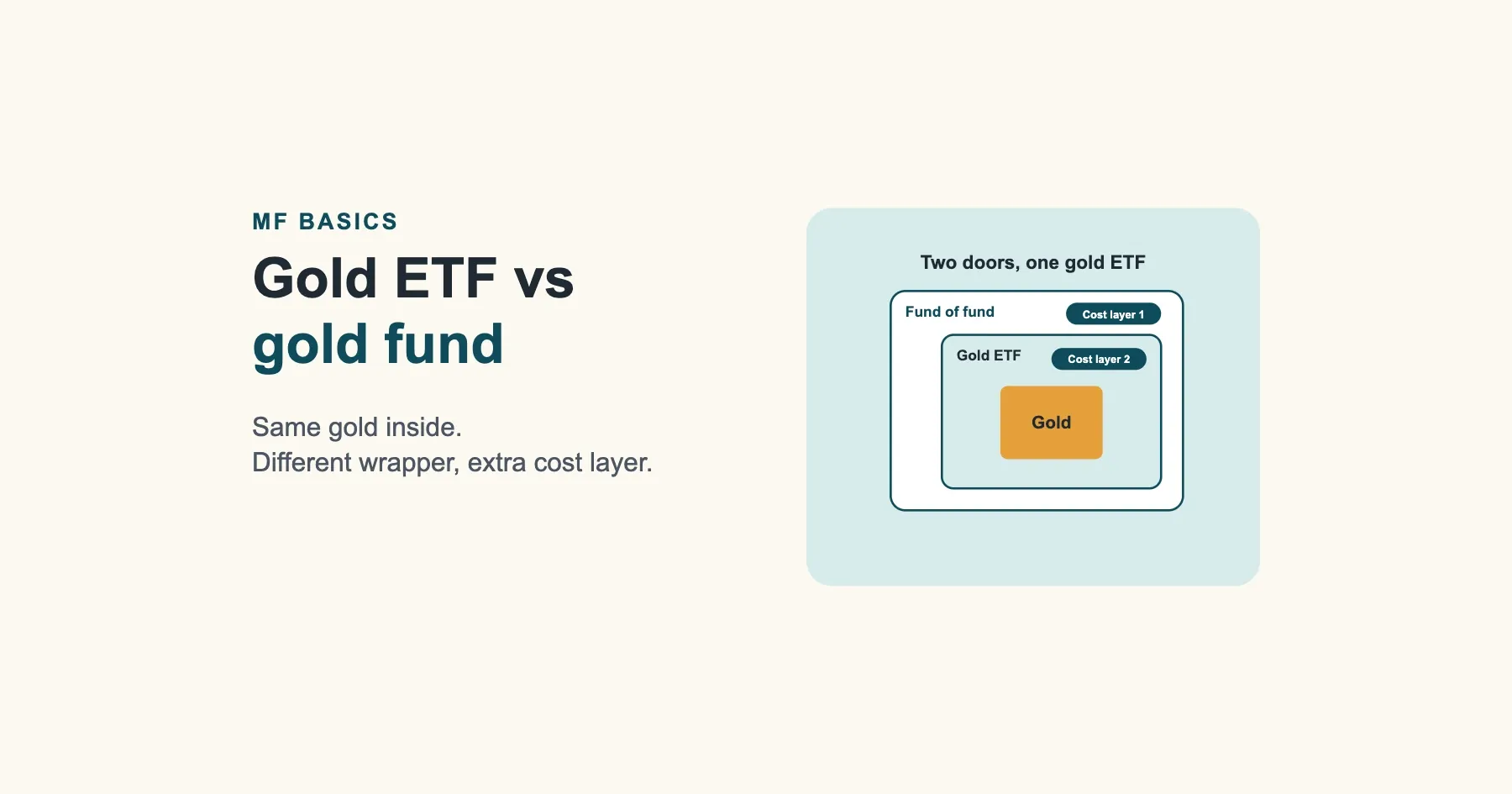
A gold ETF trades on an exchange and needs demat; a gold fund of fund doesn't, but adds a second expense layer. See both, quoted from the KIM.
Summarize this article with AI





The short version
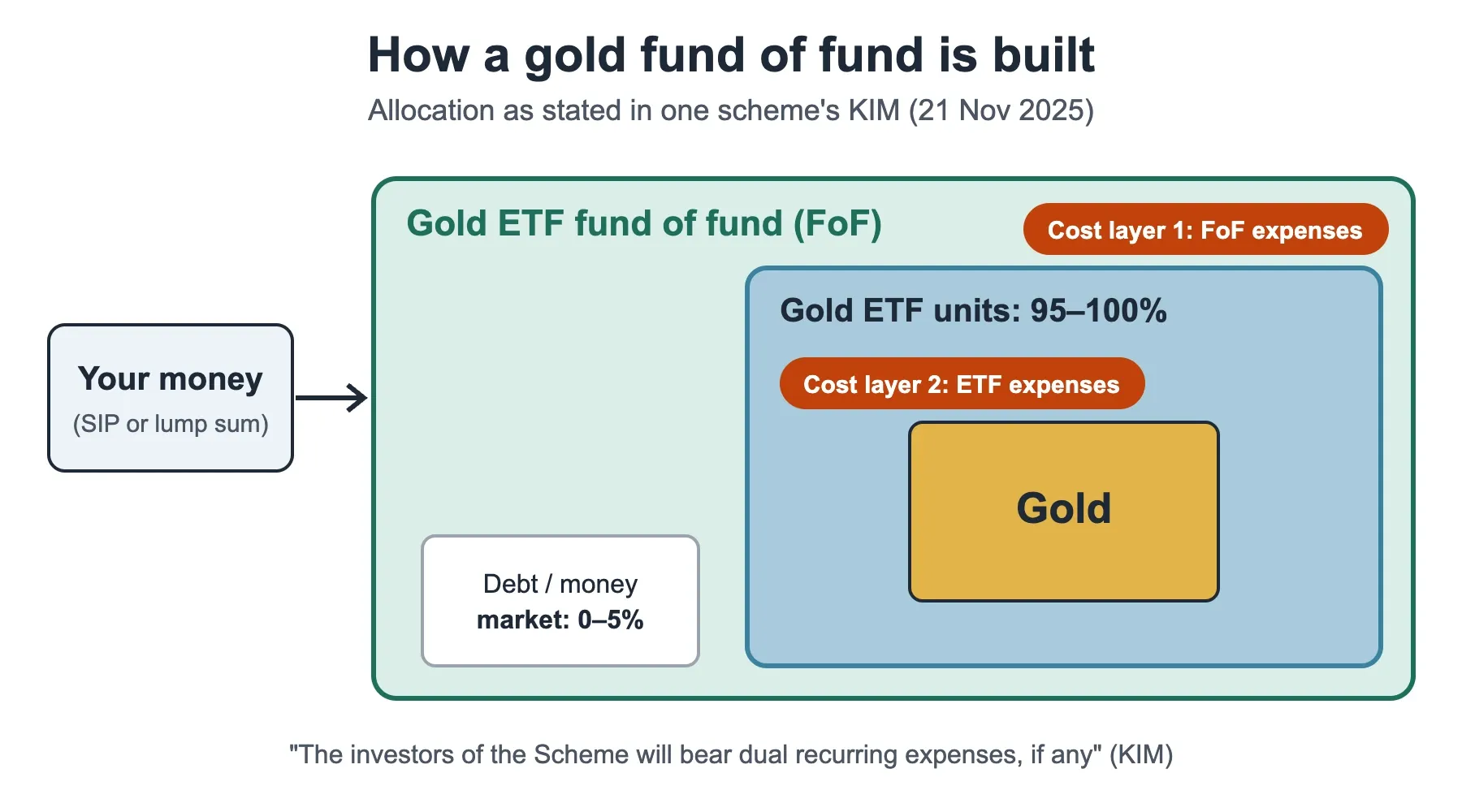
- A gold ETF trades on a stock exchange; a "gold mutual fund" is usually a gold ETF fund of fund that puts 95–100% of its money into a gold ETF.
- The FoF does not need a demat account (its KIM says so); the ETF does in practice.
- FoF investors "bear dual recurring expenses": the FoF's and the ETF's.
- The ETF route has its own costs: brokerage, demat and transaction charges.
- Neither route tracks gold exactly.
Door 1, gold ETF: units listed and traded on a stock exchange, which you buy through a broker and, in practice, hold in a demat account. Door 2, gold mutual fund (a gold ETF fund of fund): a scheme that puts almost all its money into a gold ETF, which you can buy from the fund house like any other mutual fund scheme, including by SIP, without a demat account.
That is the core of gold ETF vs gold mutual fund. Both routes lead to the same gold ETF units. The fund of fund (FoF) saves you the demat account, but its offer document says plainly that "The investors of the Scheme will bear dual recurring expenses, if any": its own expenses on top of the ETF's.
This guide sets the two side by side on structure, access, cost and price. We don't say whether to own gold, or which route is better.
Offer-document wording as quoted from the scheme KIM dated 21 November 2025 (read 12 November 2026).
What is the difference between a gold ETF and a gold mutual fund?
A gold ETF (exchange traded fund) is a mutual fund scheme whose units trade on a stock exchange. SEBI's Mutual Funds Regulations define an exchange traded fund as a scheme that "invests in securities in the same proportion of an index of securities" and "whose units are mandatorily listed and traded on a stock exchange platform". That definition is written for index-tracking ETFs; a gold ETF tracks gold, not a securities index, so we borrow only the exchange-listing feature, which gold ETF units share.
What is usually called a "gold mutual fund" is a fund of fund. One fund house's KIM (key information memorandum) for such a scheme describes it as an open-ended fund of fund investing in the same fund house's gold ETF, with the objective of capital appreciation through units of that ETF. Its asset allocation puts 95% to 100% in units of that gold ETF and 0% to 5% in debt securities and money market instruments.
The structure is common: another fund house's gold ETF fund of fund SID describes the same design, also with 95% to 100% in its gold ETF's units.
| Gold ETF | Gold ETF fund of fund (FoF) | |
|---|---|---|
| What it holds | Gold, as set out in its own SID | Units of a gold ETF (95–100%), plus 0–5% debt/money market |
| Where you buy | On a stock exchange, through a broker | From the fund house or an MF platform |
| Demat account | Needed (units trade on an exchange) | "not mandatory" (KIM) |
| SIP | Depends on your broker; not covered here | Yes, like any MF scheme |
| Cost layers | ETF expense ratio + broker/demat costs | FoF expenses + the ETF's ("dual recurring expenses") |
| Price you get | Market price during trading hours | The scheme's NAV |
Do you need a demat account for either?
For the fund of fund, no. The first KIM says a demat account is not mandatory, unlike for its gold ETF, and that investors can invest through physical (non-demat) mode. The second SID gives unitholders the option to hold units in demat or account statement form.
For the gold ETF itself, you need a demat account, because ETF units are listed and traded on an exchange. See also investing without a demat account.
Can you start a gold SIP without a demat account?
Through the fund of fund route, yes: a fixed amount at regular intervals buys units at the scheme's NAV, as with any mutual fund SIP. New to SIPs? Start with what an SIP is.
Minimums are set by each scheme. The first KIM lists a minimum purchase of ₹100; other schemes set their own figures, so check the KIM of the scheme you are looking at.
Through the ETF route, you buy units on the exchange through a broker, like a share. Any regular-purchase option there is a broker feature with its own terms, so we don't describe it here.
Why a gold fund of fund can cost more: the two cost layers
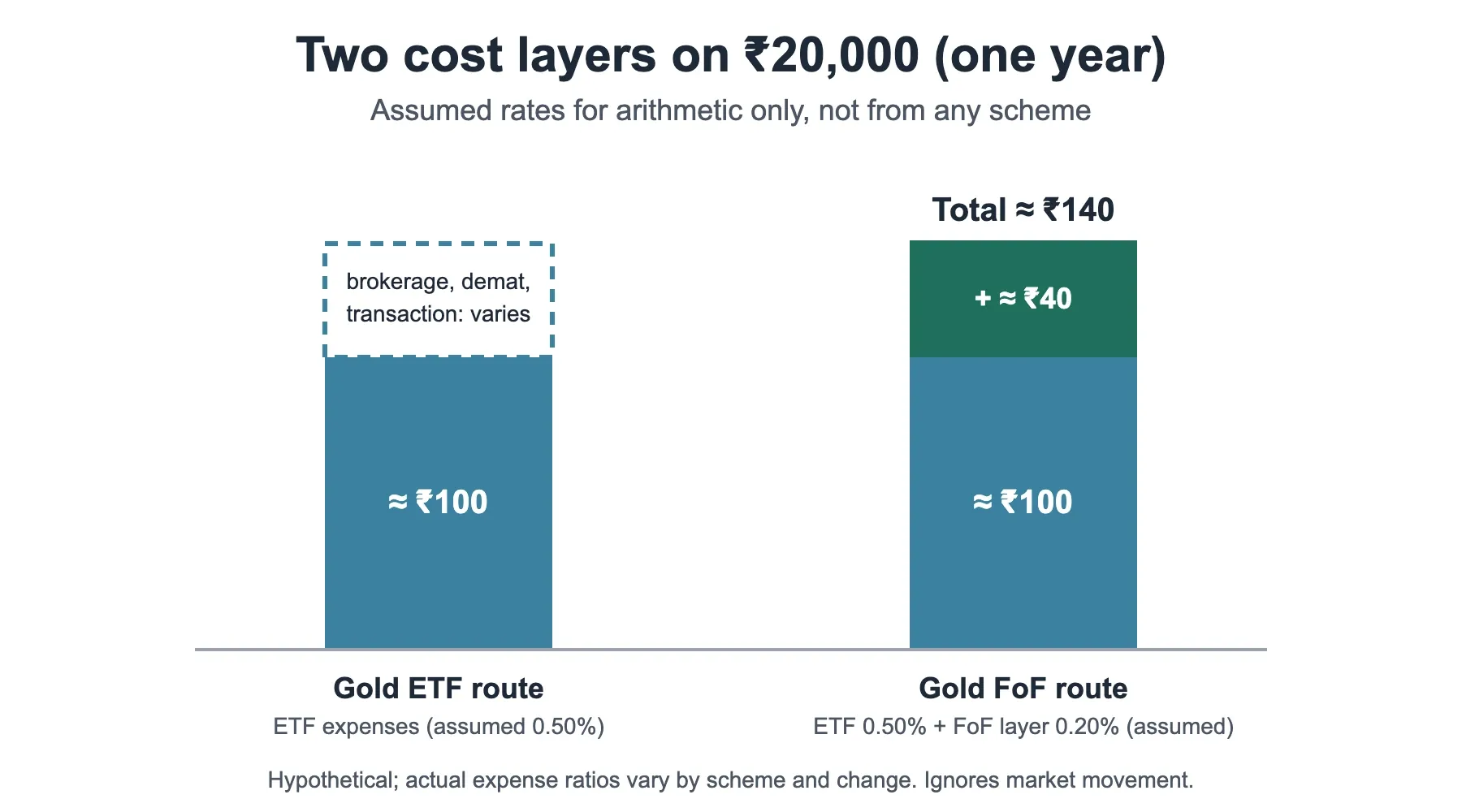
An expense ratio (TER) is a scheme's annual running cost, taken from its assets. In a fund of fund you bear two: the FoF's own, and the ETF's, already reflected in the ETF's NAV. That is "dual recurring expenses".
A worked example, with assumed rates. These figures are not taken from any scheme:
| ₹20,000 held for one year | Gold ETF route | Gold FoF route |
|---|---|---|
| ETF expense ratio (assumed 0.50% a year) | about ₹100 | about ₹100 |
| Extra FoF layer (assumed 0.20% a year) | none | about ₹40 |
| Total yearly expenses | about ₹100 | about ₹140 |
| Brokerage, demat and transaction charges | Can apply; vary by broker | No broker needed; check any platform charges |
Illustrative rates assumed for arithmetic only, not taken from any scheme. Actual expense ratios vary by scheme and change; check the scheme's latest TER disclosure. Ignores market movement.
On these assumed numbers the FoF costs about ₹40 more a year. But the ETF route has brokerage on each trade, demat account charges and transaction charges, which can narrow or reverse the gap depending on how often you buy. That is why we don't name a cheaper route. What a fund charges explains TER in detail.
Check exit loads too. The first KIM sets a 1% exit load on units redeemed or switched out within 15 days of allotment. Other schemes set their own terms.
Tracking difference: why returns may not match gold exactly
Neither route mirrors the gold price exactly. The first KIM notes that, because of its own expenses, the fund of fund's performance will differ from that of the underlying ETF.
The gaps come from expenses at each layer, the small portion kept in debt or cash, and timing of money flowing in and out. The ETF itself can also differ from the gold price because of its own costs.
Buying and selling: exchange price vs NAV
In short:
- Gold ETF: you buy and sell units on the exchange during market hours, at the market price at that moment. That price can differ from the ETF's NAV.
- Gold FoF: you buy and redeem with the fund house at the scheme's applicable NAV, declared once a day. For how that NAV works, see what NAV is.
Which route fits which situation
These are situations, not recommendations:
- If you already have a demat account and are comfortable placing exchange orders, the ETF route avoids the second expense layer, with brokerage and demat costs instead.
- If you want a monthly SIP without a demat account, the fund of fund route works like any MF SIP, with dual recurring expenses as the price of that convenience.
Either way, compare expense ratio, exit load and riskometer in the KIM, not the word "gold" in the name. Index funds apply a similar passive idea to shares.
Not in scope: physical gold, sovereign gold bonds and other gold products are different products with different rules. Tax is also left out here; tax treatment differs by product, so check the scheme documents or ask a tax professional.
Frequently asked questions
What is the difference between a gold ETF and a gold mutual fund?
A gold ETF's units trade on a stock exchange through a broker. A gold mutual fund is usually a fund of fund that invests 95–100% in a gold ETF, bought from the fund house at NAV, with its own expenses on top of the ETF's.
Do I need a demat account for gold ETFs or gold mutual funds?
For a gold ETF fund of fund, no: one scheme's KIM says "Demat account is not mandatory". For a gold ETF, in practice yes, because its units are listed and traded on an exchange.
Can I do an SIP in gold without a demat account?
Yes, through a gold ETF fund of fund, which works like any mutual fund SIP. The minimum amount is set by each scheme, so check its KIM.
Why does a gold fund of fund cost more than a gold ETF?
FoF investors pay two layers of expenses, the FoF's and the ETF's. The ETF route avoids the second layer but adds brokerage, demat and transaction charges.
What is tracking difference in a gold fund?
It is the gap between a fund's returns and what it tracks. Because of expenses, cash and timing, in one KIM's words, "the performance of Scheme shall be at variance with that of the underlying scheme".
Is a gold fund of fund the same as physical gold or SGBs?
No. Physical gold and sovereign gold bonds are different products with different rules, so we don't compare them here.
Try this with one KIM
Pick any gold fund of fund you've heard of, open its KIM and find the line on expenses. It takes two minutes and tells you what you'll actually pay.
— Laabh



