Expense ratio in mutual funds: what you pay, where it goes, and what SEBI's 2026 rules say
The expense ratio is a yearly % of a fund's assets, reflected in NAV, never billed. Base vs total expense ratio under SEBI's 2026 rules, with a ₹ example.
Summarize this article with AI





The short version
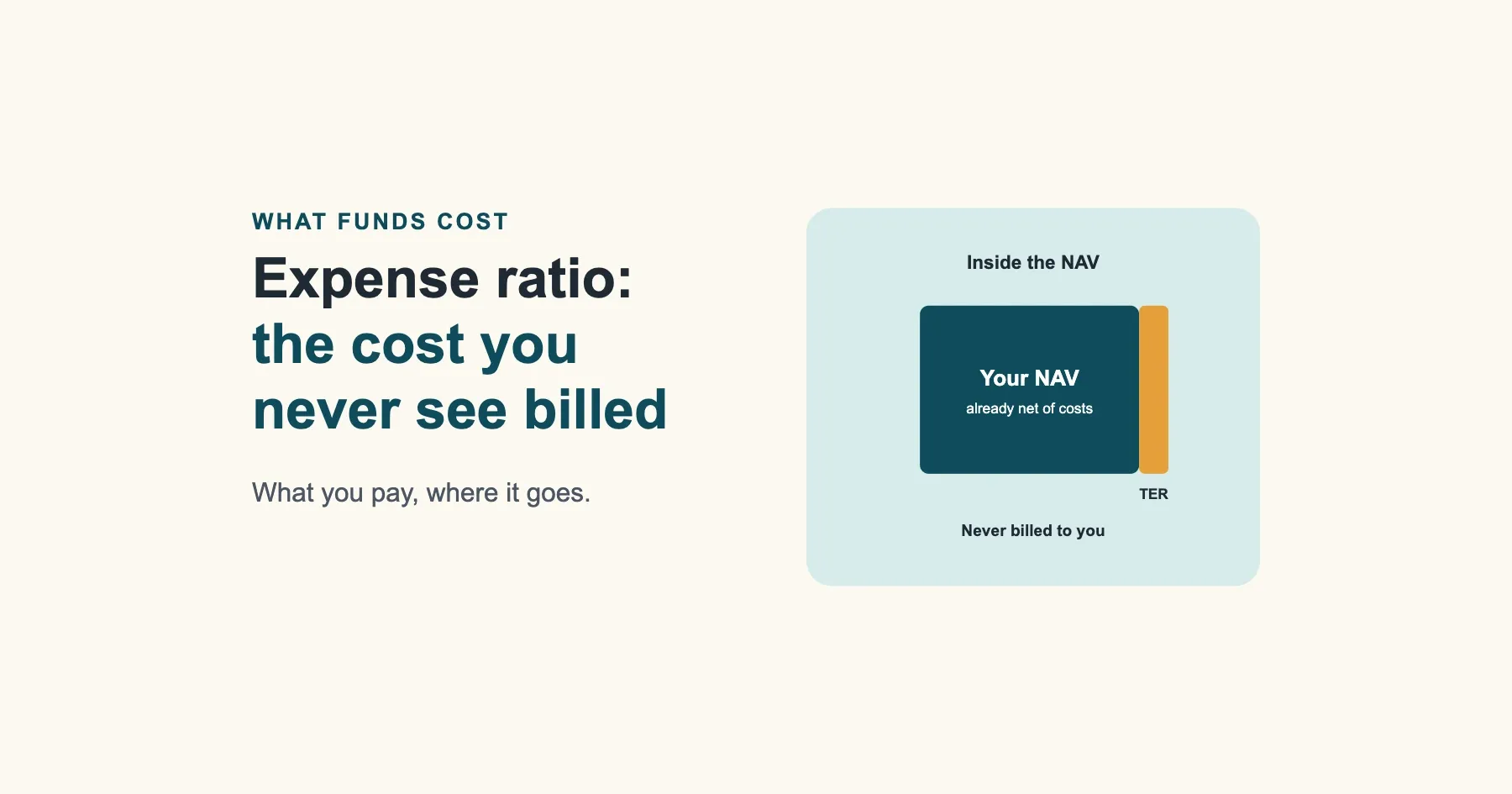
- The expense ratio is a yearly percentage of the scheme's assets, reflected in the NAV. It is never billed to you or cut from your SIP instalment.
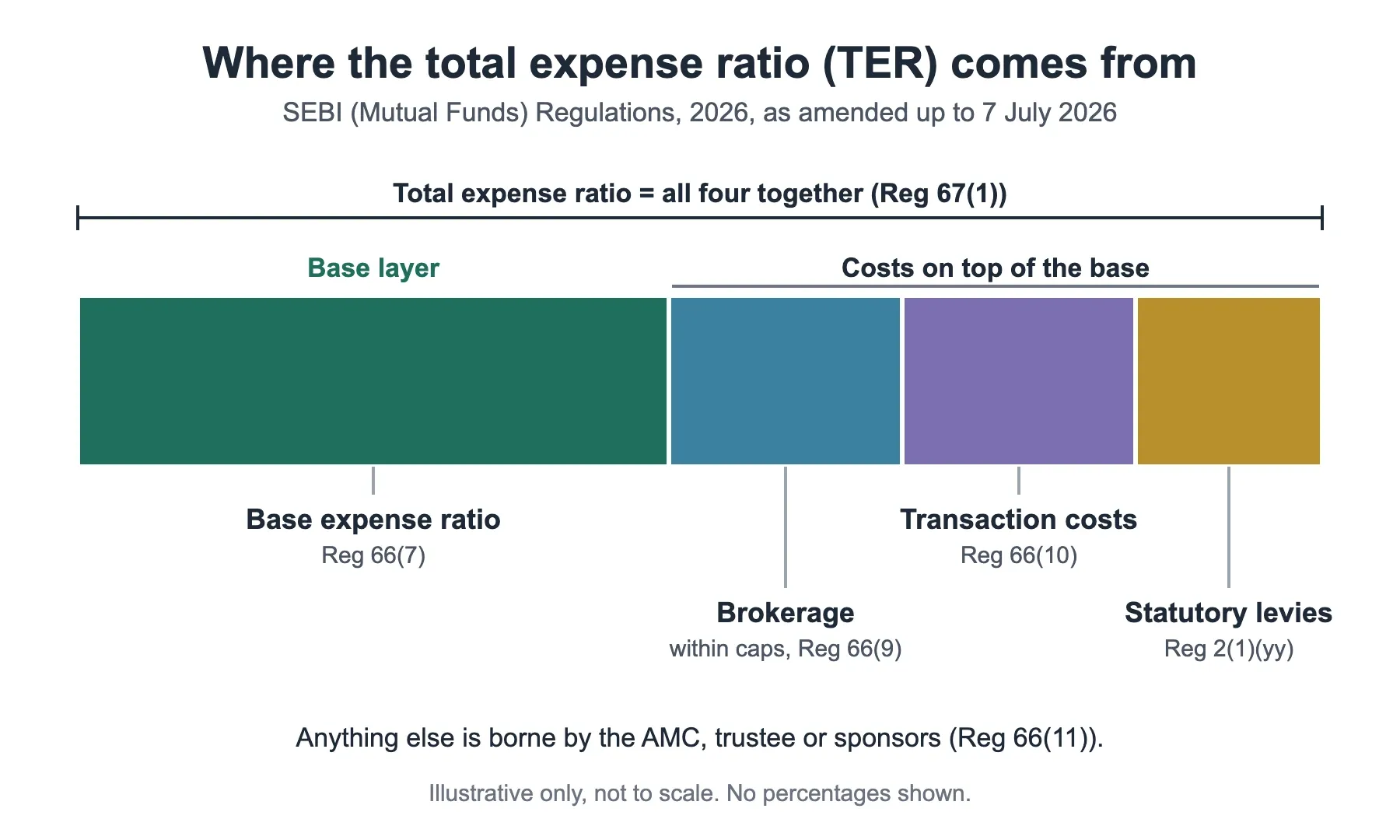
- Under the SEBI (Mutual Funds) Regulations, 2026, TER = base expense ratio + permitted brokerage + transaction costs + statutory levies.
- Exit load is separate: it applies only if you exit within the stated period, and it is credited to the scheme.
- Find the TER on the scheme's latest factsheet and compare it only between similar schemes.
The expense ratio in a mutual fund is the yearly cost of running a scheme, expressed as a percentage of the scheme's assets. You never receive a bill for it, and it is not cut from your SIP instalment: it is reflected in the scheme's NAV (net asset value). Under the SEBI (Mutual Funds) Regulations, 2026, in force from 1 April 2026, the total expense ratio (TER) is the base expense ratio plus permitted brokerage, transaction costs and statutory levies.
That two-layer structure is why some headlines spoke of "lower" expense limits while others said funds are "not cheaper". Below: where the cost goes, what it looks like on ₹50,000, and what the regulation says.
Last checked 11 November 2026, against the Regulations as amended up to 7 July 2026.
What is the expense ratio (TER)?
Every scheme is run by an asset management company (AMC), or fund house. SEBI's regulations decide which running costs may be charged to investors, and up to what limit.
SEBI defines the total expense ratio as "the ratio of total of all expenses charged to the investors of the scheme to the total asset under management of the scheme."
In plain words: expenses charged to the scheme's investors, divided by the scheme's size. Every investor bears it in proportion to what they hold, and it is a yearly rate, not a one-time fee.
Is the expense ratio deducted from my SIP every month?
No. The expense ratio is not taken out of your SIP instalment and is not a line in your statement. It is charged to the scheme, so it shows up as a slightly lower NAV. The cost is already inside the price you see.
SEBI writes its expense limits as a percentage of "daily net assets". Our reading (an interpretation, not a quoted rule) is that the cost is worked out on the scheme's assets day by day, so the example below shows a daily figure. The fund house can confirm how it is applied.
Worked example: ₹50,000 at an assumed 1.5% expense ratio
Hypothetical illustration. Assumed TER and return rates; not a forecast or a recommendation.
Say you invest ₹50,000 once at an assumed TER of 1.5%, and the value stays constant.
| Item | Calculation | Amount |
|---|---|---|
| Cost per year at 1.5% | ₹50,000 × 1.5% | ₹750 |
| Cost per day at 1.5% | ₹750 ÷ 365 | about ₹2.05 |
| Cost per year at 0.5% (for comparison) | ₹50,000 × 0.5% | ₹250 |
You never pay that ₹750 by UPI or cheque; the NAV simply grows a little less, or falls a little more. In reality your holding's value changes daily, so the rupee cost moves with it.
Base expense ratio vs total expense ratio: what the 2026 Regulations say
The 2026 Regulations split the cost into two layers:
- Base expense ratio: the scheme's running expenses, with a ceiling set by the type of scheme and, for many schemes, by its size.
- Costs on top of the base: brokerage on the scheme's trades (within caps), transaction costs and statutory levies.
The total expense ratio is both layers added together.
The base expense ratio and its limits
The ceilings depend on the kind of scheme. All are a percentage of daily net assets, and they are maximums; the TER a scheme actually charges is in its factsheet.
| Scheme type | Base expense ratio limit |
|---|---|
| Open-ended index fund or ETF | 0.90% |
| Close-ended: equity-oriented / other | 1.00% / 0.80% |
| Fund of funds in liquid, index or ETF schemes | 0.90% (incl. underlying schemes) |
| Fund of funds with at least 65% in equity-oriented schemes | 2.10% (incl. underlying schemes) |
| Other fund of funds | 1.85% (incl. underlying schemes) |
For other open-ended schemes, the limit steps down as daily net assets grow:
| Daily net assets | Equity-oriented | Other than equity-oriented |
|---|---|---|
| First ₹500 crore | 2.10% | 1.85% |
| Next ₹250 crore | 1.90% | 1.65% |
| Next ₹1,250 crore | 1.60% | 1.40% |
| Next ₹3,000 crore | 1.50% | 1.25% |
| Next ₹5,000 crore | 1.40% | 1.15% |
| Next ₹40,000 crore | lower by 0.05% per ₹5,000 crore or part | same |
| Balance | 0.95% | 0.70% |
Summarised from Reg 66(7) of the SEBI PDF, checked twice on 11 November 2026; labels shortened and the "next ₹40,000 crore" row paraphrased. The PDF is the authority.
A performance-based base expense ratio is also allowed, under "the expense ratio structure and disclosures thereto as specified by the Board". We have not read that structure.
What sits on top of the base
- Brokerage on the scheme's trades, up to the caps; anything beyond counts within the base limit.
- Transaction costs: regulatory levies and stock exchange and clearing corporation charges.
- Statutory levies: levies imposed by the state and central governments. The text we read does not list which, so we don't name them.
In our reading, this means a scheme's TER can sit above the base ceilings in the tables.
What can't be charged to you
Nothing beyond the base expense ratio, the three items above and exit load. Any other expense is borne by the AMC, trustee or sponsors.
Why the headlines disagree
Our interpretation: a headline about the base expense ratio and one about the total expense ratio measure different things. Both can be partly right. We have not compared the 2026 limits with the earlier rules, so we make no claim that funds became cheaper or costlier. Your cost is the TER your scheme actually charges.
Expense ratio vs exit load
| Expense ratio (TER) | Exit load | |
|---|---|---|
| What it is | Yearly cost of running the scheme, % of its assets | A charge on redeeming within a stated period |
| When it applies | All the time you stay invested | Only if you exit within the period in the scheme's documents |
| Who bears it | Every investor, through the NAV | Only the investor who exits early |
| Where the money goes | Pays the scheme's permitted expenses | "credited to the respective scheme" |
| Regulatory limit | Base ceilings by type and size, plus costs on top | Open-ended schemes: "shall not exceed three per cent of the Net Asset Value of the scheme" |
Whether a scheme has an exit load, and for how long, is in its Scheme Information Document (SID).
Where to check a fund's TER, and how you'll know if it changes
The Regulations say "The total expense ratio of mutual fund schemes shall be disclosed to the investors", in a manner and format SEBI specifies. The text we read does not say how often or where; SEBI's circulars may, and we did not read them. So check the scheme's factsheet and the fund house's or AMFI's website, and confirm with the fund house.
On changes, the Regulations allow "no change in the fundamental attributes of any scheme, fees and expenses payable" unless conditions are met, one being that "unit holders are given an option to exit at the prevailing Net Asset Value without any exit load." Our reading, not a quoted rule: the text names "fees and expenses payable" but does not say whether every change in the TER a scheme charges within the ceilings counts. How such changes are notified may sit in SEBI circulars we did not read, so ask the fund house.
SEBI's Second Amendment Regulations of 8 October 2026 do not mention the expense ratio. Later SEBI documents may change these limits; check sebi.gov.in.
Does a lower expense ratio mean a better fund?
Not on its own. Cost matters because it compounds.
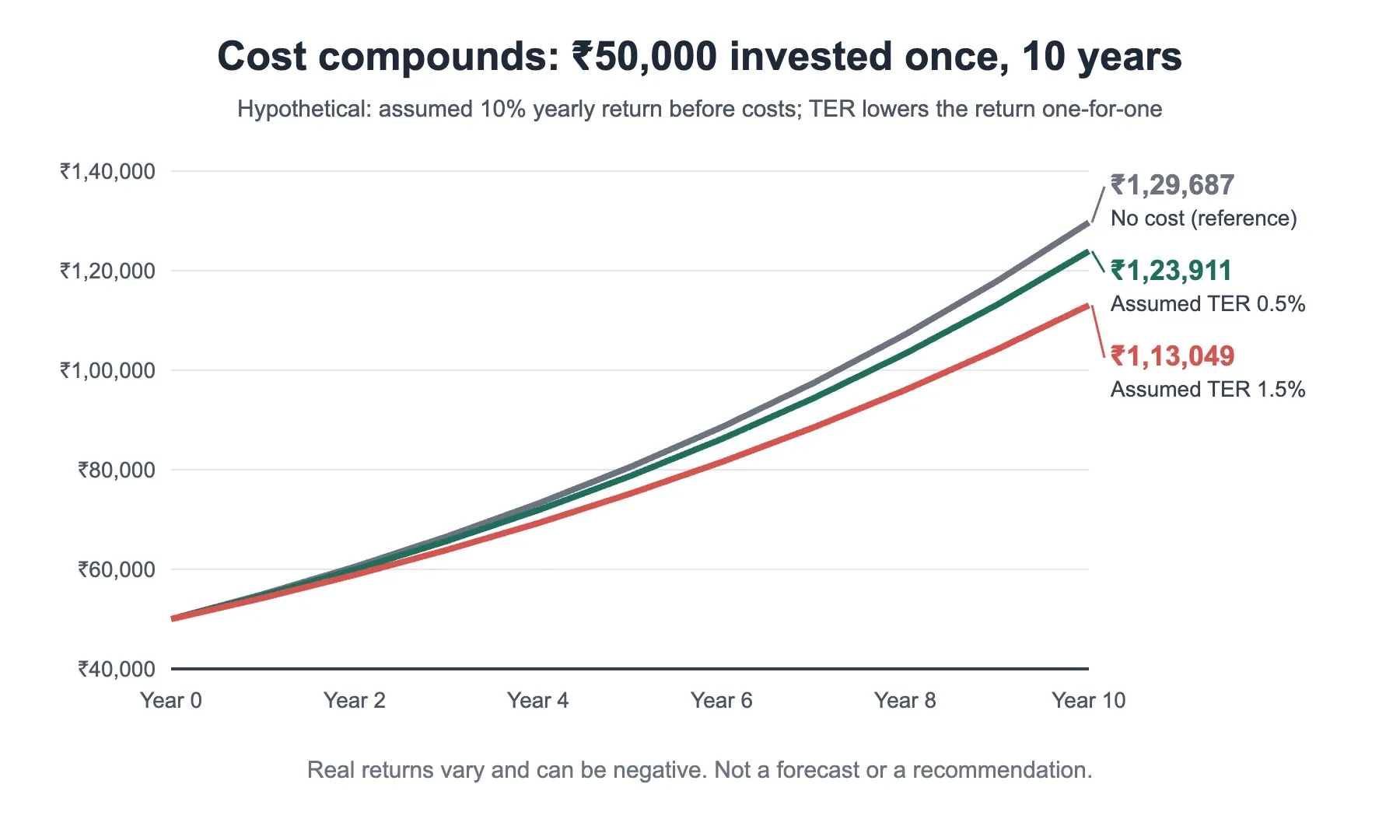
Hypothetical illustration: assumes a constant 10% yearly return before costs and that the expense ratio lowers the yearly return one-for-one. Real returns vary and can be negative. Not a forecast.
| ₹50,000 invested once, 10 years | Value after 10 years |
|---|---|
| No cost (reference only) | about ₹1,29,687 |
| Assumed TER 0.5% | about ₹1,23,911 |
| Assumed TER 1.5% | about ₹1,13,049 |
Here a 0.5% vs 1.5% TER gap grows to about ₹10,862.
Still, a lower TER is one factor, not a verdict. As a general principle:
- Compare like with like. Ceilings differ by scheme type, so an index fund and an active equity scheme sit at different cost levels.
- Fit comes first. Category, riskometer level, goal and time horizon matter before cost.
- Then weigh cost between schemes doing the same job.
Frequently asked questions
Is the expense ratio deducted from my SIP amount every month?
No. It is charged to the scheme, not your instalment, so it is reflected in the NAV rather than shown as a deduction.
What is the difference between base expense ratio and total expense ratio?
The base expense ratio covers the scheme's running expenses, with ceilings by scheme type and size. The total expense ratio adds permitted brokerage, transaction costs and statutory levies on top.
Expense ratio vs exit load: what's the difference?
The expense ratio is a continuing yearly cost every investor bears through the NAV. Exit load applies only if you redeem within the stated period; it goes to the scheme and, for open-ended schemes, cannot exceed 3% of NAV.
If a fund's expense ratio is 1.5%, how much do I pay on ₹50,000 in a year?
About ₹750 a year, roughly ₹2.05 a day, if the value stayed constant. This is a hypothetical, simplified figure; the real rupee cost moves with your holding's value.
What changed under SEBI's Mutual Fund Regulations, 2026?
In force from 1 April 2026, they define the TER as a base expense ratio plus brokerage, transaction costs and statutory levies, with base ceilings by scheme type and size. We don't compare them with earlier rules here.
Where can I check a fund's current expense ratio?
On the scheme's latest factsheet and the fund house's or AMFI's website. Confirm with the fund house if unsure.
Your next step
Open the latest factsheet of a fund you're considering and find its TER line. Now you know what it includes.
Related reading: What is NAV in a mutual fund? · Which type of mutual fund should a beginner start with?
— Laabh



