What is NAV in a mutual fund? Why a ₹15 NAV isn't cheaper than ₹450
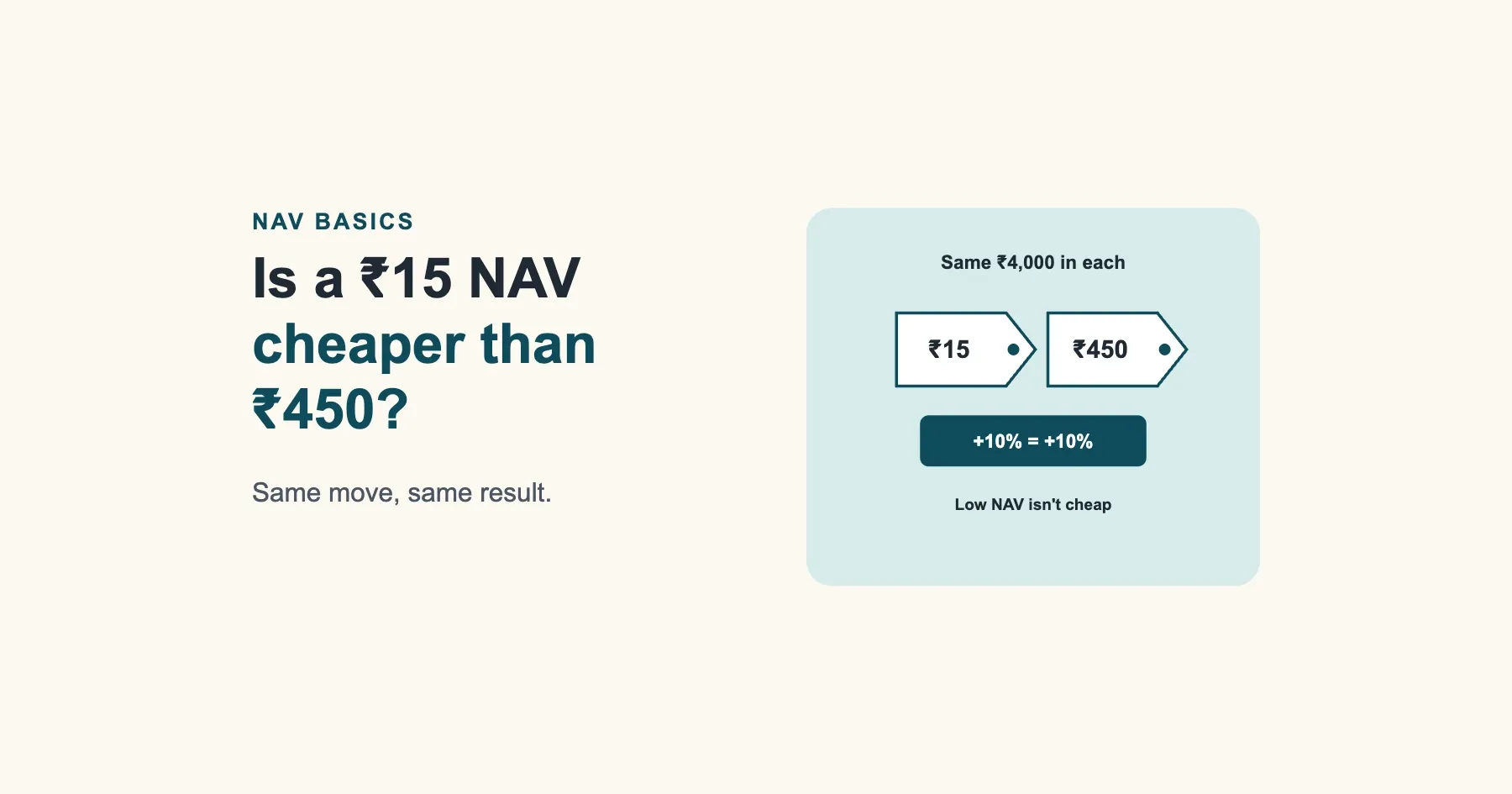
NAV is the value of one mutual fund unit: net assets ÷ units. A ₹15 NAV isn't cheaper than ₹450. See why with ₹4,000, plus what a NAV fall means.
Summarize this article with AI





The short version
- NAV is the value of one unit of a scheme: net assets ÷ units outstanding, computed daily under SEBI's Regulation 43.
- Your units = amount ÷ NAV. ₹4,000 at a NAV of ₹25 buys 160 units, before any applicable charges.
- A low NAV is not cheap. The same percentage move gives the same result on the same money.
- Your value = units × NAV. A NAV fall leaves your units unchanged but is a real fall in value.
- Check the official NAV on the fund house's or AMFI's website, and the cut-off time in the scheme's SID.
NAV (net asset value) is the value of one unit of a mutual fund scheme: the scheme's net assets divided by the number of units outstanding. When you invest, you get units equal to your amount divided by the NAV. A lower NAV gives you more units, not a better deal, because your gain or loss depends on the percentage change in NAV, not on its level.
It's a natural assumption that a fund at ₹15 is "cheaper" than one at ₹450, the way a ₹15 pen is cheaper than a ₹450 pen. With mutual funds, that comparison points you at the wrong number. Below: why, using ₹4,000 and two funds, and what a NAV fall after you invest really means.
Last checked 11 November 2026 against SEBI's Mutual Funds Regulations, 2026 (as amended up to 7 July 2026) and AMFI's investor pages.
What is NAV, in simple words?
A scheme pools investors' money and buys securities such as shares or bonds. Each investor owns units of the scheme, and NAV is what one unit is worth on a given day.
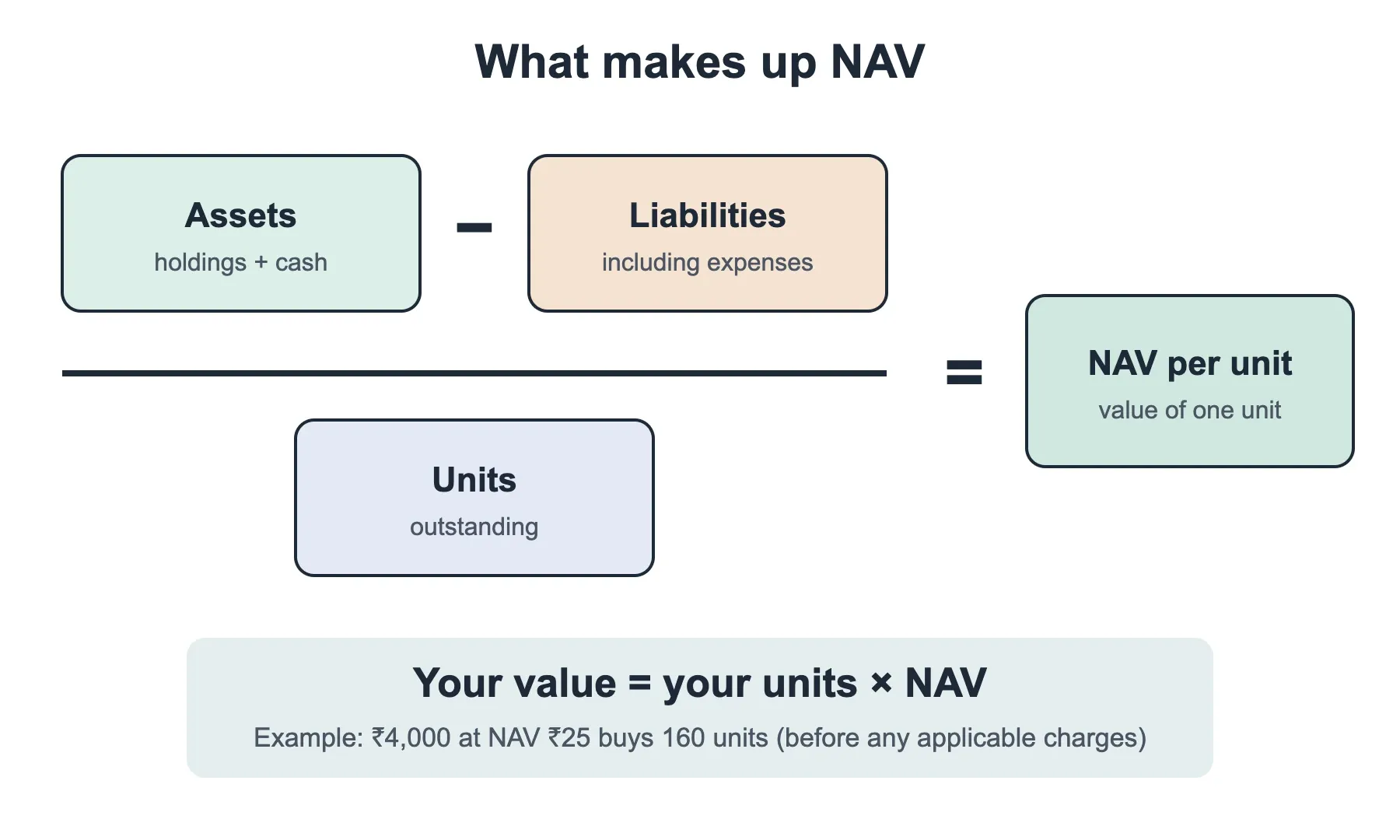
SEBI's Regulation 43 says every asset management company "shall compute the Net Asset Value of each scheme, on a daily basis," and sets the method: the scheme's net assets, valued under SEBI's valuation norms, divided by the number of units outstanding on the date of valuation.
In plain words (our explanation), net assets are what the scheme owns, such as holdings at market value and cash, minus what it owes, including accrued expenses.
NAV per unit = (assets − liabilities) ÷ units outstanding
A tiny worked line, with made-up scheme figures: assets of ₹102 crore, liabilities of ₹2 crore and 4 crore units outstanding give net assets of ₹100 crore, so the NAV is ₹100 crore ÷ 4 crore = ₹25 per unit.
Because the scheme's running costs are among its liabilities, the expense ratio is reflected in the NAV rather than billed to you separately. Our guide to the expense ratio in mutual funds explains that cost in detail.
How many units does your money buy?
The arithmetic is one division:
Units = amount invested ÷ NAV
If you invest ₹4,000 when the NAV is ₹25, you get ₹4,000 ÷ ₹25 = 160 units. That is before stamp duty or any other applicable charges, so the units credited to your folio may be slightly fewer. Your account statement shows the exact units allotted.
From then on, the value of your holding is:
Your value = your units × the current NAV
Your units stay the same unless you buy more or redeem some; the NAV is the part that moves.
Is a ₹15 NAV fund cheaper than a ₹450 NAV fund?
No. A lower NAV gets you more units, but each unit is worth less. What you own in rupees is the same on day one, and what happens next depends on how much each NAV moves in percentage terms.
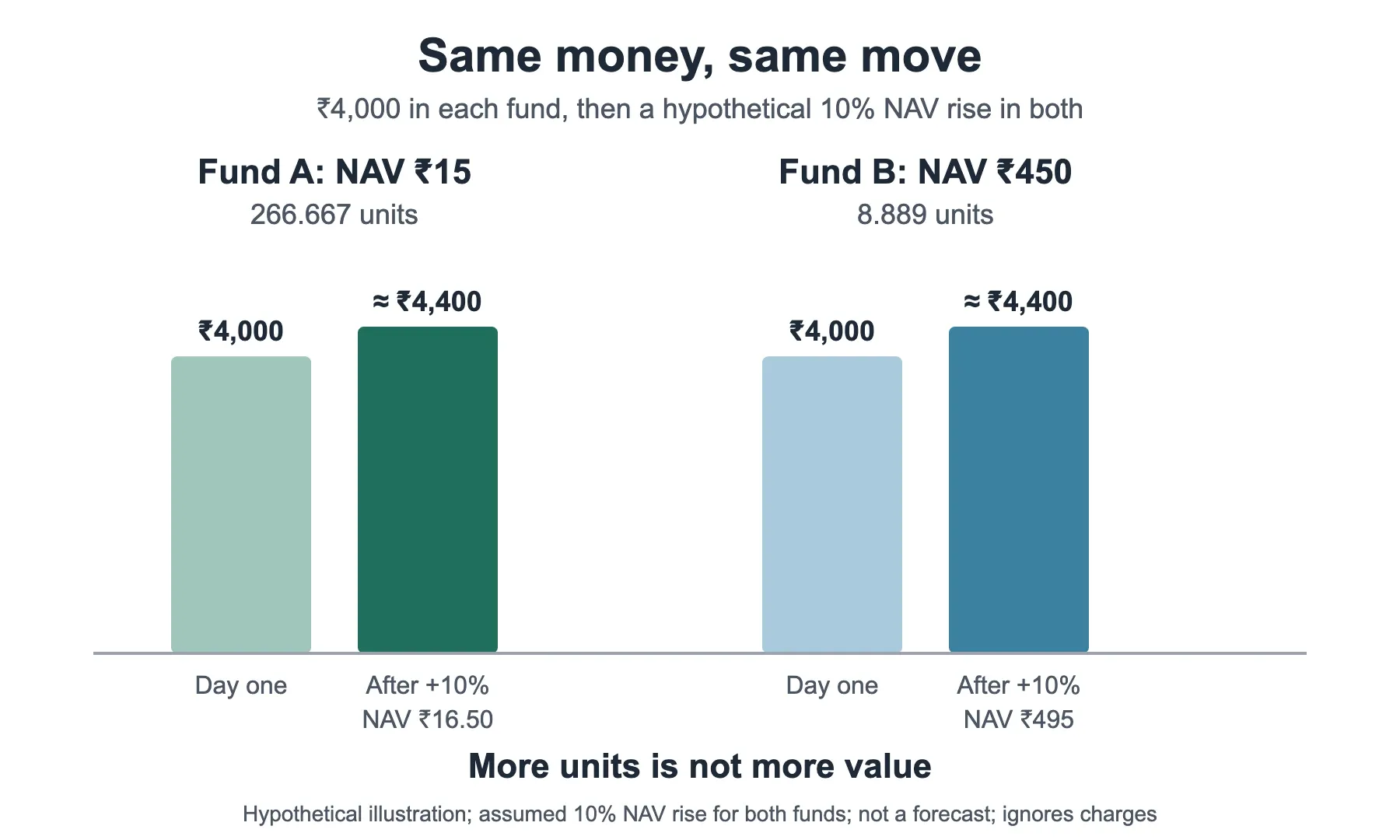
Here is ₹4,000 invested in two funds on the same day, followed by the same hypothetical 10% rise in both NAVs.
| Fund A | Fund B | |
|---|---|---|
| NAV on purchase | ₹15 | ₹450 |
| Units for ₹4,000 (before charges) | 266.667 | 8.889 |
| Value on day one | ₹4,000 | ₹4,000 |
| NAV after a hypothetical 10% rise | ₹16.50 | ₹495 |
| Value after the rise | ≈ ₹4,400 | ≈ ₹4,400 |
Hypothetical illustration; assumed 10% NAV rise for both funds; not a forecast; ignores charges. Units shown to three decimals for illustration only.
Fund A gave you 30 times as many units. It made no difference to the result: 266.667 × ₹16.50 and 8.889 × ₹495 both come to about ₹4,400. If Fund B's NAV had risen 12% and Fund A's only 8%, the "expensive" fund would have done better. The NAV level told you nothing.
Why do NAVs differ so much in the first place? Mostly history. AMFI's page notes that a fund with a high NAV today "may have had a much lower NAV when it was launched." A high NAV can reflect years of past growth; it says nothing certain about future growth.
How often does NAV change, and where is the official figure?
SEBI's Regulation 43 requires the fund house to compute NAV "on a daily basis". AMFI's investor page adds that "NAVs of mutual fund schemes are declared at the end of each trading day after markets are closed" and that they "are published on respective mutual funds' websites as well as AMFI's website daily."
So NAV is not a live price during the day; it is one end-of-day figure. For the official number, check the fund house's website or AMFI's website, and confirm there if a figure elsewhere looks odd. Neither page we read gives a fixed publication hour, so we don't state one.
Which day's NAV do you get?
AMFI's page explains that units are allotted "only at prospective NAV, i.e., the NAV that would be declared at the end of the day", and that "A mutual fund may accept applications even after the cut-off time, but you will get the NAV of the next business day."
In our understanding, the NAV you get depends on when your application and your money reach the fund house, compared with the cut-off time. AMFI's page refers to a rule on applicable NAV effective from 1 February 2021 (liquid and overnight funds excluded) but gives no cut-off times on the page we read, so we don't state any here. Check the cut-off time in the scheme's SID (scheme information document) or with the fund house.
NAV vs share price
A share price and a fund's NAV look similar on a screen but are set very differently.
| Share price | NAV of an open-ended fund | |
|---|---|---|
| How it is set | Buyers and sellers trading on the exchange | Computed from the scheme's holdings: net assets ÷ units |
| When it changes | Through the trading day | Once a day, declared after markets close |
| Where you transact | On the exchange, with another investor | With the fund house, at the applicable NAV |
AMFI's page puts the contrast this way: "Unlike stocks, where the price is driven by the stock market and changes from minute-to-minute, NAVs of mutual fund schemes are declared at the end of each trading day".
One exception worth knowing: exchange traded funds (ETFs). SEBI's regulations describe ETFs as schemes "whose units are mandatorily listed and traded on a stock exchange platform". On the exchange, ETF units trade at a market price, which, in our understanding, can differ from the ETF's NAV.
NAV fell after I invested. Have I lost money?
Say you invested ₹4,000 at a NAV of ₹25 and got 160 units. A week later the NAV is ₹22.50, a hypothetical 10% fall.
- Your units have not changed. You still hold 160 units.
- Your value has. 160 × ₹22.50 = ₹3,600, which is ₹400 less than you put in.
That ₹400 is unrealised: you lose it in rupees only if you redeem at that NAV. But don't dismiss it as "only on paper". It is a real fall in what your holding is worth today, and nothing guarantees the NAV will return to ₹25 by any particular date. AMFI's own page reminds investors that "Since market value of securities changes every day, NAV of a scheme also varies on day-to-day basis."
Whether to stay invested is a separate question about your goal, time horizon and the reason you chose the fund. Our guide on whether to stop your SIP when the market falls works through that decision.
Three NAV mistakes to skip
- Comparing funds by NAV level. A ₹15 NAV and a ₹450 NAV say nothing about which fund is better or cheaper. Compare similar funds on category, risk level, cost and how consistently they have followed their stated objective.
- Waiting for the NAV to "come down" before investing. A lower NAV next week only means you get more units for the same money. Your result still depends on the percentage change from your purchase NAV, which no one can know in advance.
- Reading one day's NAV move as a verdict on the fund. A 1% fall in a day usually reflects the market the fund invests in. Judging a fund needs longer periods and a comparison with its benchmark and category. For returns across many SIP instalments, see what is XIRR in a mutual fund SIP?.
Frequently asked questions
What is NAV in a mutual fund, in simple words?
NAV is the value of one unit of a mutual fund scheme on a given day. It is the scheme's net assets (what it owns minus what it owes) divided by the number of units outstanding.
Is a fund with a NAV of ₹15 cheaper than one with a NAV of ₹450?
No. The lower NAV gives you more units, but each is worth less. If both NAVs rise by the same percentage, the same amount invested grows by the same amount, as the hypothetical ₹4,000 example shows.
How many units will I get for ₹4,000 at a NAV of ₹25?
₹4,000 ÷ ₹25 = 160 units, before stamp duty or any other applicable charges. Your account statement shows the exact units allotted.
How is a mutual fund NAV different from a share price?
A share price is set by trading and changes through the day. An open-ended fund's NAV is computed from its holdings and declared once a day after markets close, and you buy or redeem with the fund house at the applicable NAV.
Does NAV going down after I invest mean I've lost money?
Your units stay the same, but your holding is worth less while the NAV is lower. The loss is unrealised until you redeem, yet it is a real fall in value, and a recovery is not guaranteed.
Where can I check a fund's official NAV?
On the fund house's website or AMFI's website, where NAVs are published daily. If a figure elsewhere looks different, confirm it with the fund house.
Your next step
Next time you compare two funds, cover up the NAV and compare category, risk level and cost instead. Our guides to the expense ratio and the mutual fund riskometer cover the last two.
— Laabh



