What is a demat account? What it holds, and how it differs from a trading account
A demat account holds your shares, ETFs and bonds electronically. See what it holds, how it differs from a trading account, and BSDA charges.
Summarize this article with AI





The short version
- Three accounts, three jobs: the bank account holds money, the trading account places orders, and the demat account holds securities.
- A demat account holds units of securities (shares, ETFs, bonds, mutual fund units if you choose), not cash, FDs or insurance.
- Equity trades on Indian exchanges settle on T+1; the demat account then shows units, not rupees.
- Charges depend on your DP. A BSDA has nil maintenance charge up to ₹4 lakh of holdings and ₹100 a year up to ₹10 lakh (CDSL investor FAQ, January 2025; charges can change).
- Mutual funds do not need a demat account; statement-of-account holding works too.
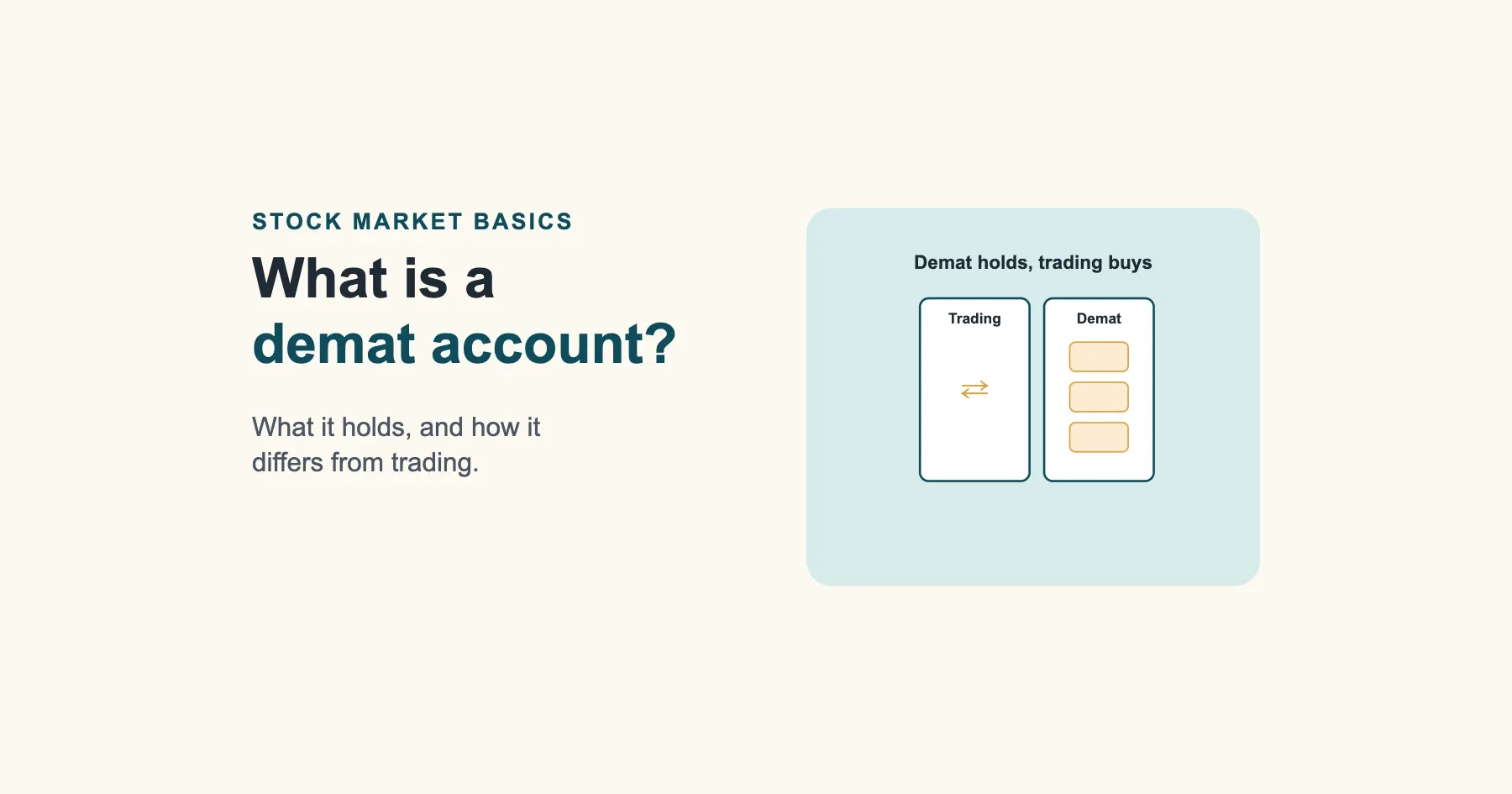
A demat account holds your shares, ETFs, bonds and other securities in electronic form with a depository (NSDL or CDSL), through a depository participant. It does not place orders. A trading account does that, and money moves through your bank account. Mutual fund units can be held in demat or in statement-of-account form.
Think of it as a locker, not a shop. If you invest through mutual funds and are curious about a first share or ETF, this is the account that would hold it.
What is a demat account, in simple words?
"Demat" is short for dematerialised. Shares used to be paper certificates. Today they are entries in an electronic register, and your demat account is your page in that register.
Three parties are involved:
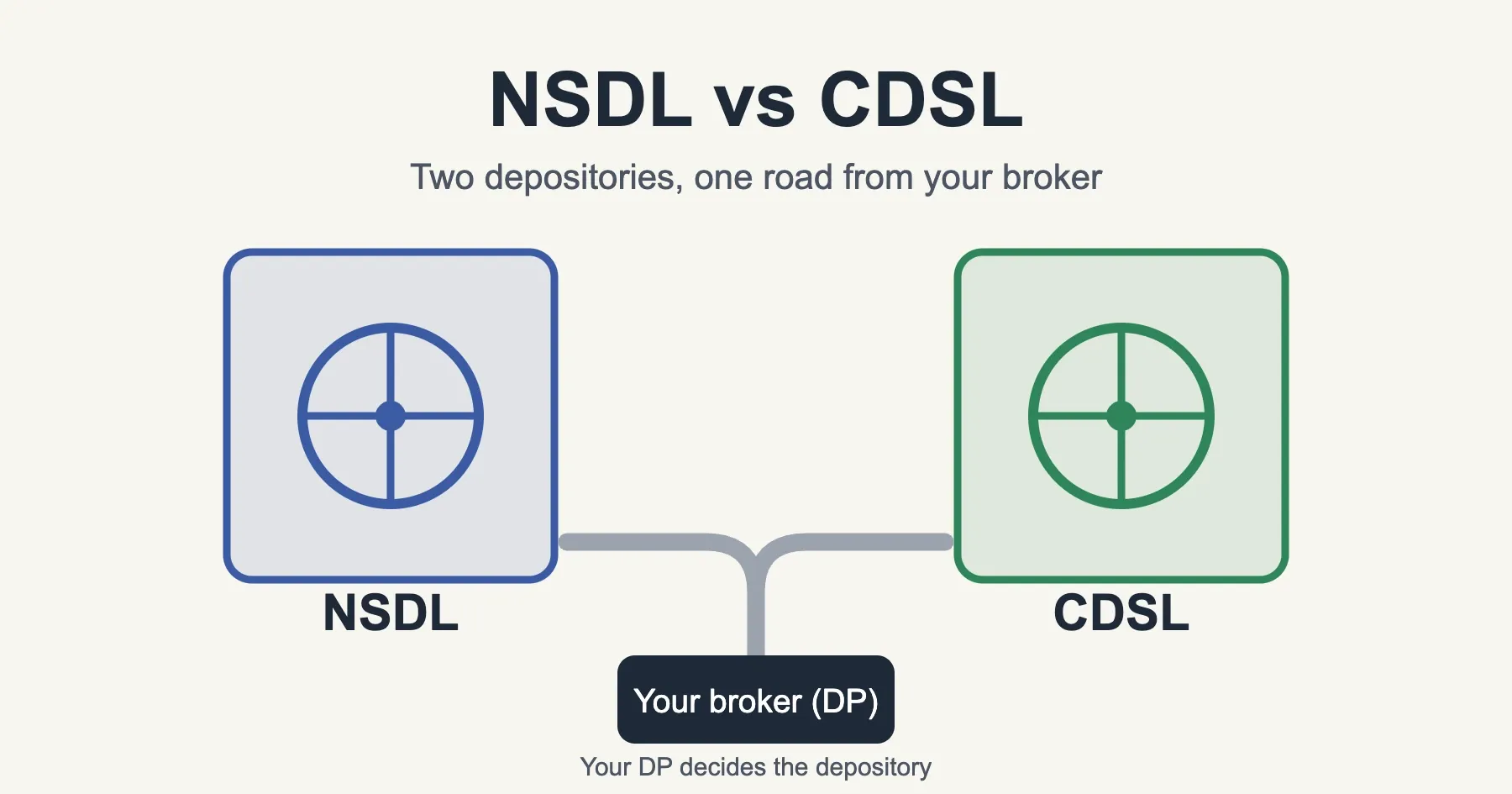
- Depository. India has two: NSDL and CDSL. The depository keeps the electronic record of who owns which securities.
- Depository participant (DP). You cannot open an account with a depository directly. You open it through a DP, an intermediary registered with SEBI, which maintains your account, sends you statements and acts on your instructions. Many DPs are also brokers or banks.
- You, the beneficial owner. The securities are held in your name. Your account is identified by a DP ID and a client ID.
Every security in the account is identified by its ISIN, a 12-character code unique to that security. Your demat statement lists ISINs and quantities, not rupees.
Is a demat account the same as a trading account?
No. They are opened together so often that people treat them as one, but they do different jobs:
| Account | What it does | What it holds |
|---|---|---|
| Bank account | Sends and receives money | Rupees |
| Trading account | Places buy and sell orders on the exchange | Nothing permanent; it is your order window |
| Demat account | Records the securities you own | Units of securities, by ISIN |
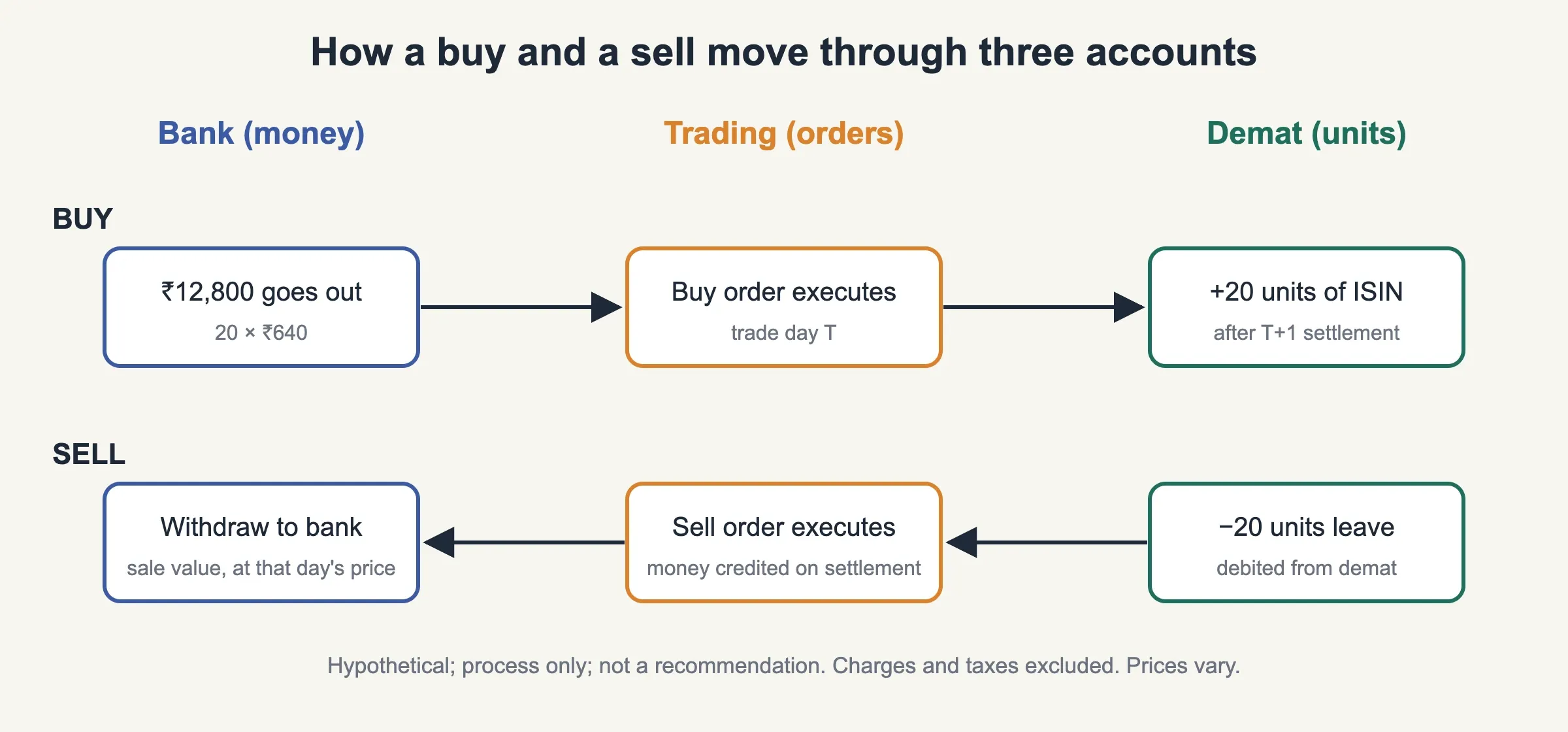
How a buy and a sell move through the three
Buying. You place an order in your trading account. The broker sends it to the exchange. When it executes, money goes from your bank account (through the broker) to the clearing system. On settlement, the shares come to your demat account.
Selling. You place a sell order. The shares are debited from your demat account and delivered through the clearing system. On settlement, the money is credited to your trading account balance, and you can withdraw it to your bank.
Equity trades on Indian stock exchanges settle on T+1, the next working day after the trade day. BSE's settlement page records T+1 for all equity groups with effect from 27 January 2023. The broker then passes the shares on to your demat account; check the contract note and your DP's statement to see the exact credit date.
A worked example: 20 shares at ₹640
Hypothetical; process only; not a recommendation. Charges and taxes excluded.
Riya, 24, in Pune, buys 20 shares of a listed company at ₹640 each.
- Order value: 20 × ₹640 = ₹12,800. This money leaves her bank account through the trading account.
- The order executes on trade day (T).
- After settlement on T+1, her demat account shows 20 units of that company's ISIN. It does not show ₹12,800.
- The value of those 20 units moves with the market price. If the price later read ₹600, the holding would be worth ₹12,000; at ₹680, ₹13,600. These prices are hypothetical, not a forecast; prices vary and the value can fall below what you paid.
What exactly sits in my demat account: shares, mutual funds, bonds, ETFs?
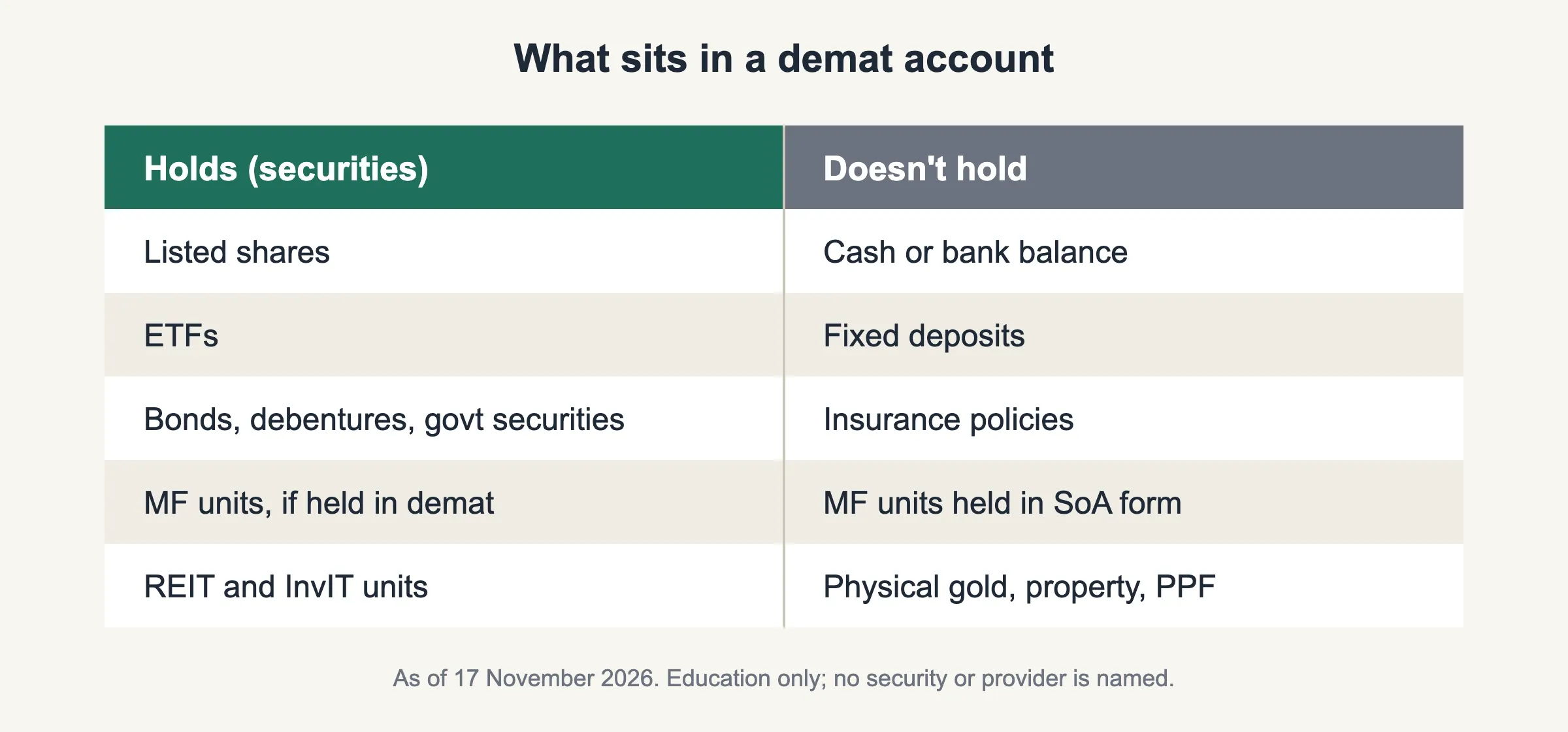
| Holds (securities in electronic form) | Doesn't hold |
|---|---|
| Listed shares | Cash or your bank balance |
| ETFs | Fixed deposits |
| Bonds, debentures and government securities | Insurance policies |
| Mutual fund units, if you choose to hold them in demat | Mutual fund units held in statement-of-account form |
| REIT and InvIT units | Physical gold, property, PPF |
If it is not a security admitted by the depositories, it does not sit in your demat account.
Are there yearly charges to keep a demat account open even if I don't use it?
Often, yes. A DP can levy an annual maintenance charge (AMC) whether or not you trade. There may also be a charge each time securities are debited, for example when you sell. These amounts are set by each DP, so read your DP's tariff sheet before you open the account and check it again if it is revised.
For small holdings there is a separate category, the Basic Services Demat Account (BSDA). CDSL's investor FAQ (dated January 2025), based on SEBI's circular of 28 June 2024, sets out these points:
- Only individuals can hold a BSDA, and only one, where they are first or sole holder.
- You cannot have any other demat account as first or sole holder across depositories.
- The holdings limit is ₹10 lakh at any point in time, counting debt and other securities together.
- Annual maintenance charge: nil for holdings up to ₹4 lakh; ₹100 for holdings above ₹4 lakh and up to ₹10 lakh. Above ₹10 lakh, the account is no longer a BSDA and the regular AMC may apply.
- New individual accounts are opened with the BSDA flag where eligible; you can opt out with consent through your registered email.
In Riya's example, holdings of ₹12,800 are well below ₹4 lakh. If her account qualified as a BSDA, the annual maintenance charge would be nil under these rules. Rules as of 17 November 2026; check the current position with your DP.
Do I need a demat account to invest in mutual funds?
No. Mutual fund units can be held directly with the fund house, recorded in a folio and shown in a statement of account (SoA). That works without any demat account. If you already have one, you can choose to hold units in demat, and they then appear alongside your shares.
The difference is where the record sits and which statement shows it, not what you own. Our guide on investing in mutual funds without a demat account explains what changes if you go either way.
Nomination and your consolidated statement
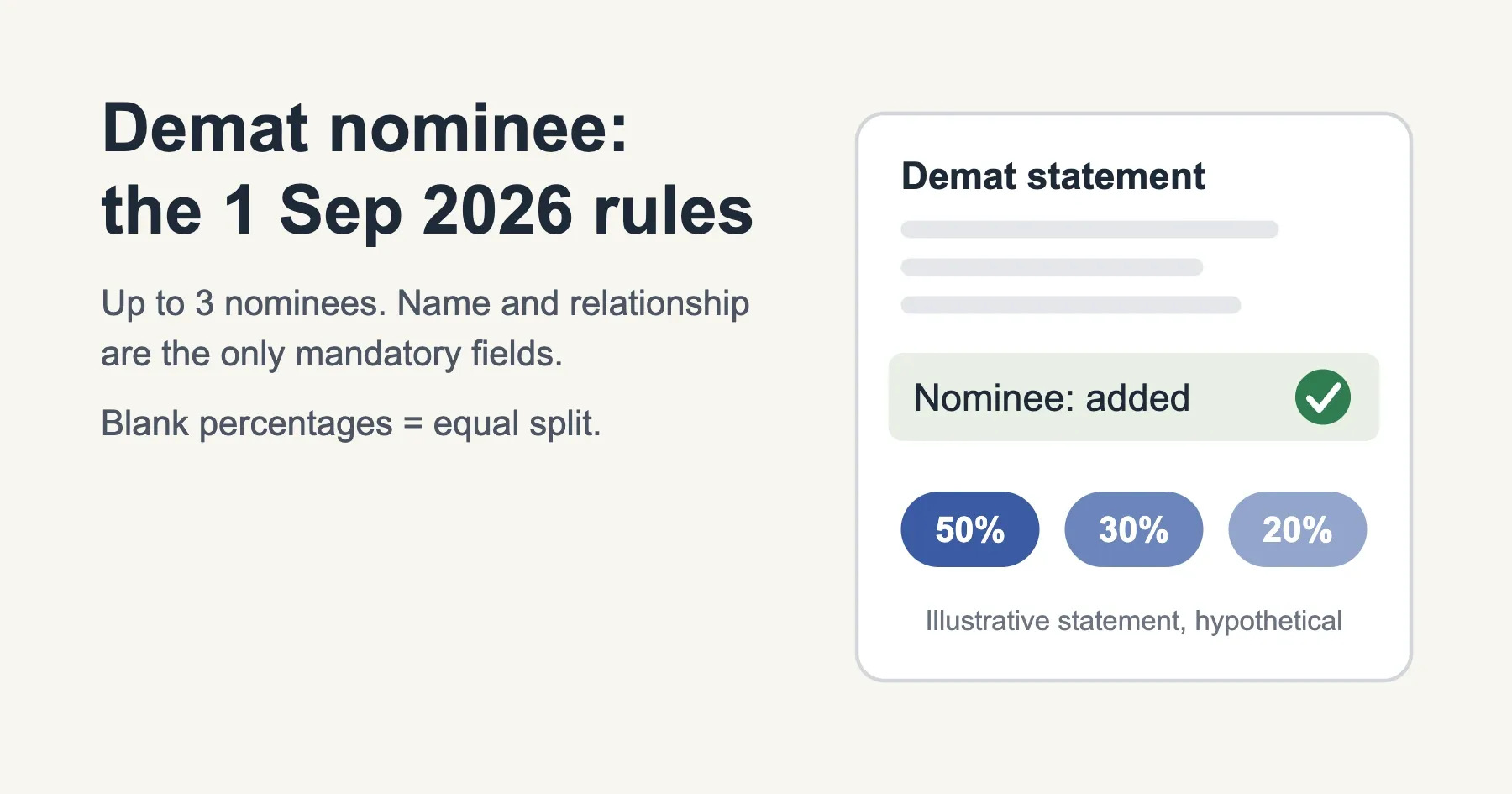
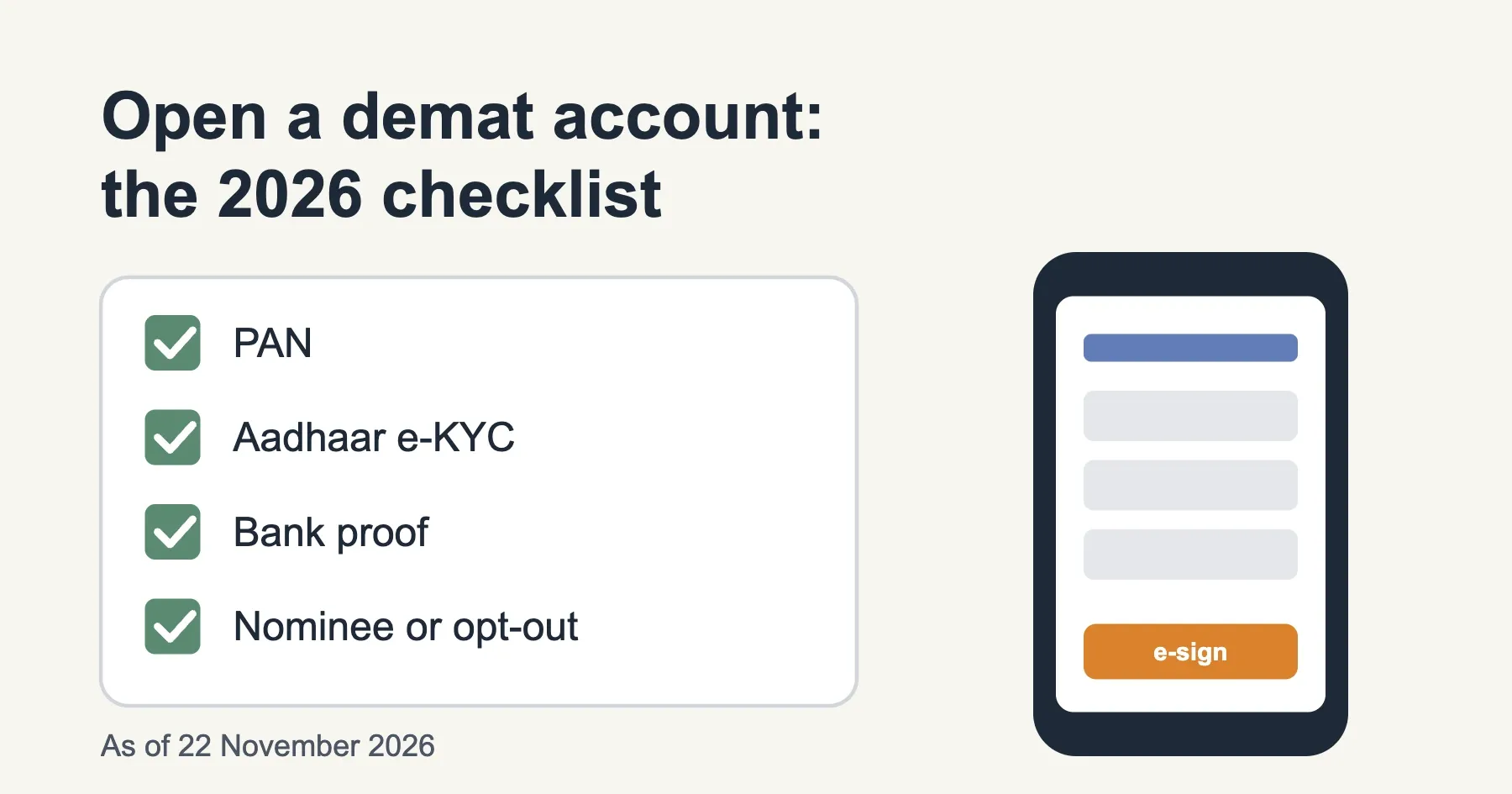
Nomination. SEBI's nomination framework for securities accounts was revised by a circular of 10 January 2025, amended on 28 February 2025. Under it, a single holder must either add a nominee or explicitly opt out, and the nomination form provides slots for up to ten nominees. The changes were phased in through 2025; check the current details with your DP.
Consolidated account statement (CAS). The depositories send a statement that brings together your demat holdings and, where linked by PAN, your mutual fund folios. It is a useful single view of what you own. See how to read your CAS for a walkthrough.
Common mix-ups to avoid
- "My money is in my demat account." Money sits in your bank or as a balance with your broker. The demat account holds units.
- "No trades means no charges." An annual maintenance charge can apply anyway, unless the account is a BSDA within the nil slab.
Frequently asked questions
Can I have more than one demat account?
Yes. You can hold demat accounts with more than one depository participant. The catch is the Basic Services Demat Account (BSDA): you can hold it only if you have no other demat account as first or sole holder across depositories, so a second account means losing BSDA status.
What is a BSDA?
A Basic Services Demat Account is a demat account category for individuals with small holdings. Per CDSL's investor FAQ (January 2025), based on SEBI's circular of 28 June 2024, the holdings limit is ₹10 lakh, with nil annual maintenance charge up to ₹4 lakh and ₹100 a year from ₹4 lakh to ₹10 lakh. Rules as of 17 November 2026; check with your DP.
Who holds my shares, the broker or the depository?
Your shares are recorded electronically at a depository (NSDL or CDSL), in a demat account in your name. The depository participant maintains that account and passes your instructions on. The broker places your orders on the exchange; after settlement, the shares are credited to your demat account.
What are DP ID and client ID?
The DP ID identifies your depository participant, and the client ID identifies your account with that DP. Together they make up your demat account number, which you will see on your account opening letter and statements. You need it to receive shares, for example in an IPO application or an off-market transfer.
Read next
Already in mutual funds without demat? See what changes if you invest in mutual funds without a demat account. Next, compare stock SIP vs mutual fund SIP or read how IPO allotment works.
— Laabh