Section 80C Deduction List in 2026: Every Option, Its Lock-In, and Why It's Now Section 123
Up to ₹1.5 lakh, old regime only, now section 123 with Schedule XV. Every option compared by lock-in, with a worked example.
Summarize this article with AI





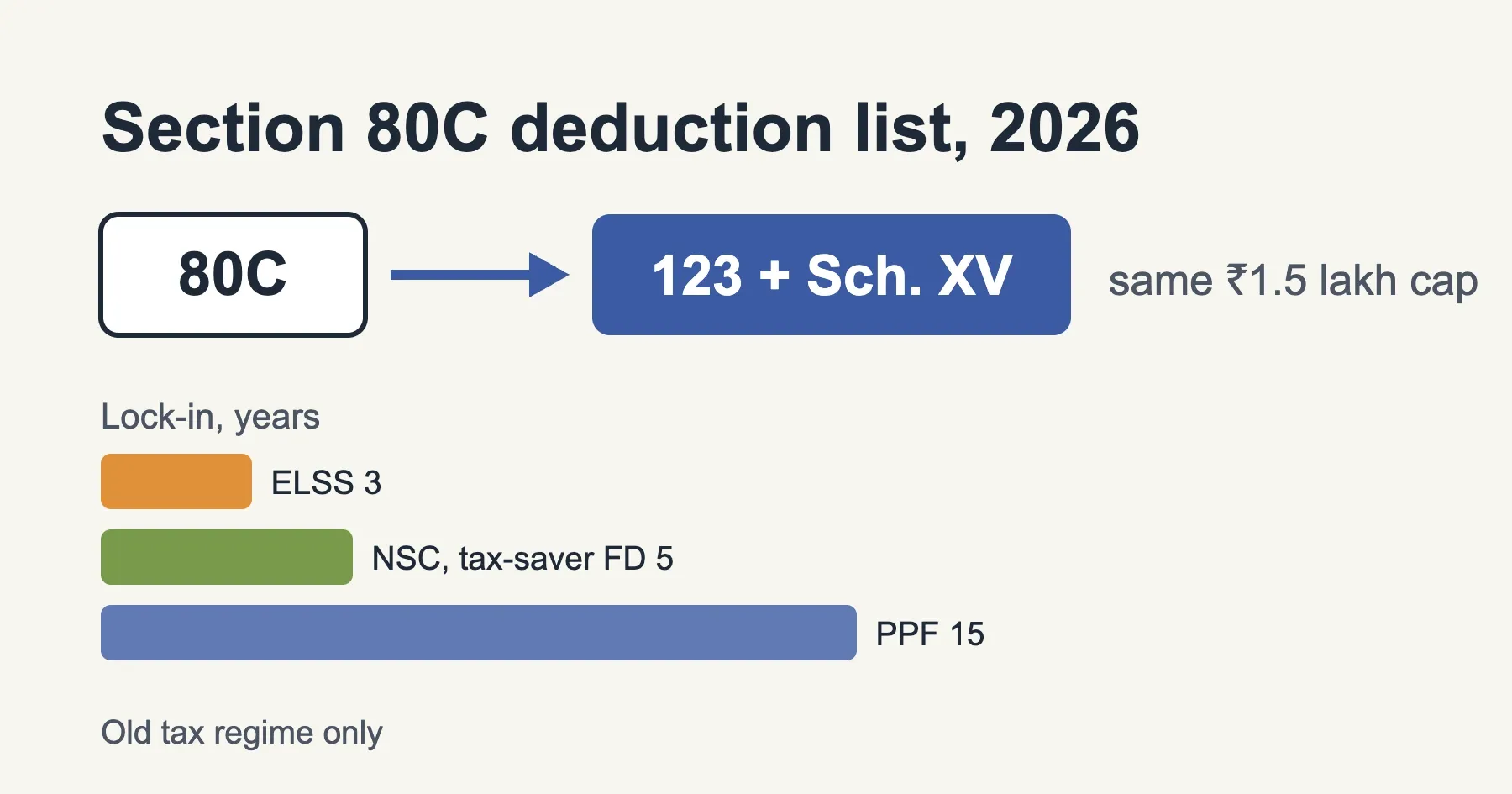
The short version
- Section 80C (now section 123, with the list in Schedule XV of the Income-tax Act, 2025) allows up to ₹1,50,000 a year, in the old regime only.
- FY 2025-26 returns use section 80C of the 1961 Act; section 123 applies from tax year 2026-27.
- Check your regime first: in a hypothetical ₹12 lakh example, new-regime tax is ₹0 while the old regime is ₹1,17,000 even after the full deduction.
- Count EPF (your share), premiums, tuition fees and home-loan principal before buying anything new.
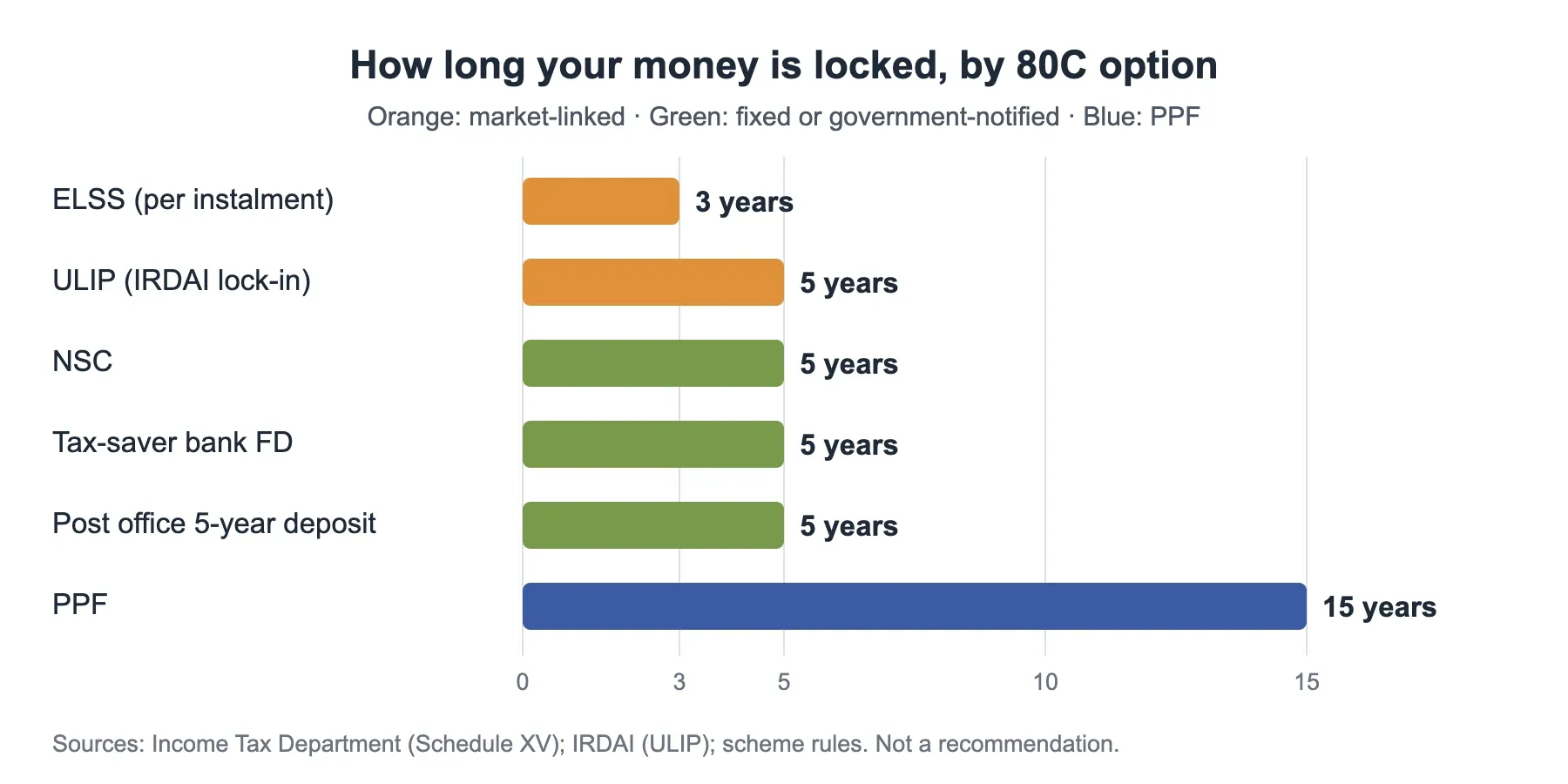
- Compare the remaining options by lock-in, access and risk: ELSS 3 years per instalment, NSC and tax-saver deposits 5 years, PPF 15 years.
You can deduct up to ₹1,50,000 a year for a set list of investments and payments, from EPF and PPF to ELSS, life insurance premiums, tuition fees and home-loan principal, but only if you are in the old tax regime. From 1 April 2026 this deduction sits in section 123 of the Income-tax Act, 2025, with the list moved to Schedule XV; the ₹1,50,000 cap is the same. Income for FY 2025-26 is still governed by section 80C of the 1961 Act.
Meghna, 29, a salaried analyst in Pune, has HR's yearly email asking for investment proofs. Before buying anything, she needs two answers: does this deduction help her at all, and how much of the ₹1,50,000 has she already used? This page answers both, then compares every option by how long your money stays locked.
What changed in 2026, and what didn't
| Income-tax Act, 1961 | Income-tax Act, 2025 | |
|---|---|---|
| Applies to | FY 2025-26 and earlier | Tax year 2026-27 onwards (from 1 April 2026) |
| Section | 80C (with 80CCC and 80CCD(1) inside one combined cap) | Section 123, items listed in Schedule XV |
| Cap | ₹1,50,000 | ₹1,50,000 |
| New regime | Section 115BAC | Section 202, still the default |
Section 123 allows a deduction for "the aggregate of the sums enumerated in Schedule XV, as does not exceed Rs. 150000." Schedule XV covers the familiar items, from insurance premiums and provident fund to NSC, ELSS-type units and tuition fees. The department says the new Act "does not impose any new tax"; the numbering and vocabulary changed. More in our new Income Tax Act explainer.
Step 1: Does section 80C even matter for you?
Section 80C (now section 123) is an old-regime deduction: section 202, the new regime, disallows it along with most other deductions. The new regime is the default, so you get this deduction only if you opt out.
A hypothetical test, using the slabs Budget 2026 kept unchanged for tax year 2026-27 and 4% cess:
- At ₹12 lakh gross: new regime tax is ₹0 (the ₹75,000 standard deduction leaves ₹11.25 lakh, inside the ₹12 lakh rebate limit). The old regime, even with the full ₹1,50,000 deduction, is ₹1,17,000. At this salary, 80C cannot help.
- At ₹18 lakh gross (Meghna's salary): the new regime comes to ₹1,50,800. The old regime with ₹1,50,000 under 80C, a ₹25,000 health insurance premium and a ₹3.6 lakh HRA exemption comes to ₹1,84,080. At this salary, the old regime wins only when deductions beyond the standard deduction exceed about ₹6.42 lakh.
Unsure which side you are on? Use our old vs new tax regime guide first. The rest of this page assumes the old regime.
Step 2: Count what you already have
Most salaried people have used part of the ₹1,50,000 before buying any tax-saving product. Check four lines:
- EPF, your own share. Recognised provident fund contributions qualify; the employer's share does not.
- Life insurance premiums for yourself, your spouse or children. For policies issued from 1 April 2012, the premium counts only up to 10% of the sum assured.
- Tuition fees for up to two children's full-time education in India; development fees and donations excluded.
- Home-loan principal, plus stamp duty and registration on the purchase.
The gap left after these is the only part you choose.
Step 3: The full section 80C deduction list, compared
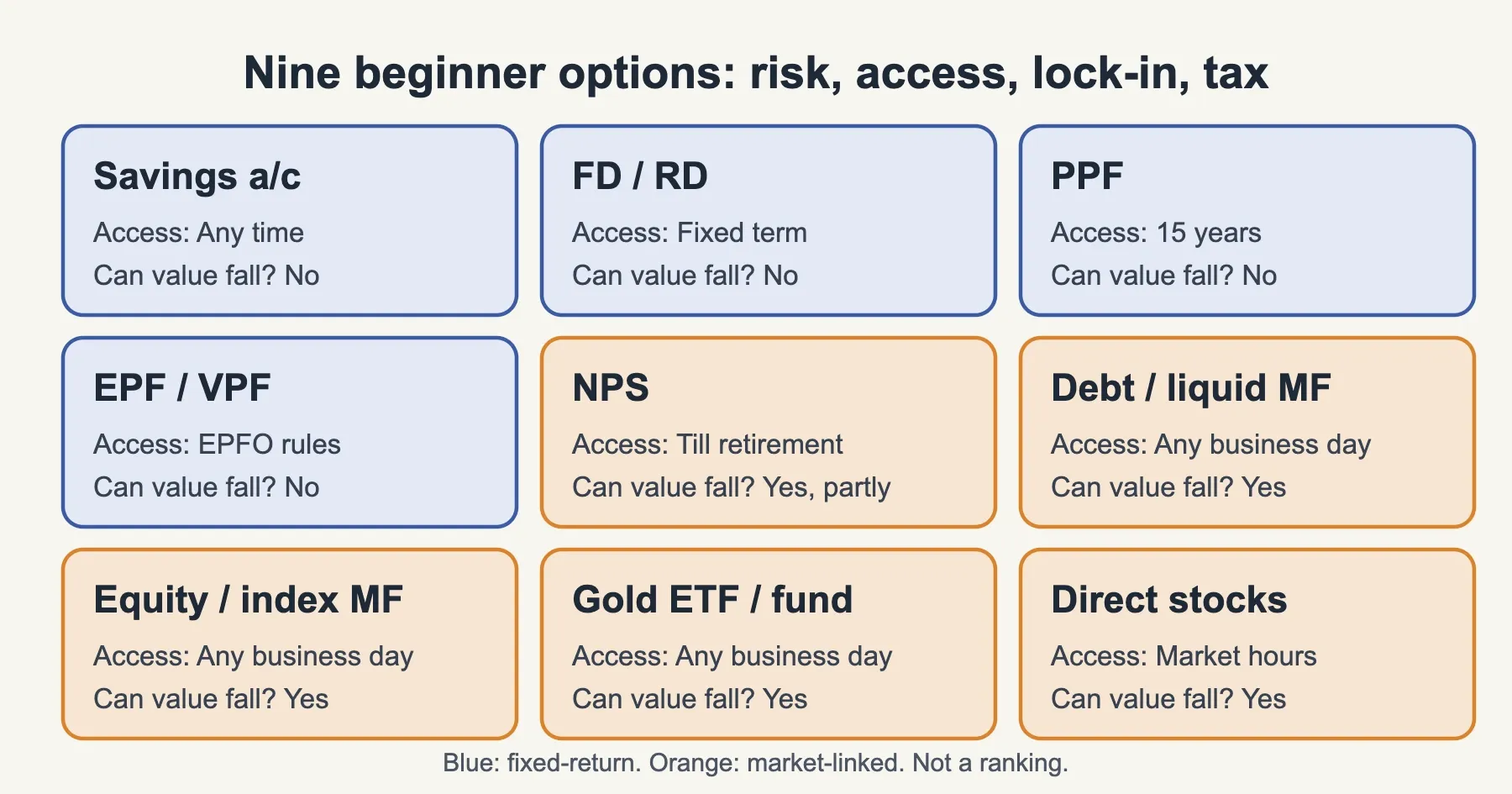
| Option | Minimum holding or lock-in | Partial access before then | Return type | Watch out for | Risk |
|---|---|---|---|---|---|
| ELSS (tax-saving mutual fund) | 3 years, per instalment | No | Market-linked | Gains taxed as capital gains | Market risk |
| ULIP | 5 years (IRDAI lock-in) | Policy terms | Market-linked | Charges and reversal rule | Market risk |
| NPS Tier I (own contribution) | Until retirement, under PFRDA exit rules | Limited, by rules | Market-linked | Annuity rules at exit | Market risk |
| PPF | 15 years | Limited withdrawals in later years | Government-notified rate | Annual deposit rules | Low |
| Sukanya Samriddhi Yojana | Long-term, for a girl child | Scheme rules | Government-notified rate | Only for a daughter or ward | Low |
| NSC | 5 years | No | Government-notified rate, set at purchase | Interest is taxable | Low |
| Senior Citizens' Savings Scheme | 5 years | Allowed, but early withdrawals are taxed as income | Government-notified rate | Age eligibility | Low |
| Tax-saver bank FD / post office 5-year deposit | 5 years | Bank FD: no. Post office deposit: early withdrawal taxed as income | Fixed rate | Interest is taxable | Low |
| Payments: premium, tuition, home-loan principal | Not an investment | Not applicable | None | Premium cap; reversal rules | Not applicable |
Market-linked: ELSS, ULIP and NPS
ELSS units are locked for three years, and with an SIP each instalment gets its own three years; our ELSS lock-in guide maps the dates. Insurance-company ULIPs have a five-year lock-in under IRDAI rules; their premiums count under the life insurance item, so the two-year policy reversal rule applies. Your own NPS contribution is also in Schedule XV, so it shares the ₹1,50,000 cap (up to 10% of salary for employees). Under the 1961 Act, section 80CCD(1B) allowed a further ₹50,000 for NPS outside the cap; under the 2025 Act this is section 124(3), again up to ₹50,000, and the same amount cannot be claimed under both section 123 and section 124(3). None of these has a fixed return.
Government-notified rates: PPF, SSY, NSC and SCSS
These pay a government-notified rate, reset each quarter. PPF runs for 15 years, so it fits long-horizon money; see what a PPF account is and our PPF vs SIP comparison. For SCSS and the post office five-year deposit, Schedule XV taxes amounts withdrawn before five years as income that year.
Fixed: the five-year tax-saver deposit
Schedule XV accepts a bank term deposit of not less than five years under a notified scheme. The interest is taxable.
Payments, not investments
These count because you already pay them. Two reversal rules apply: if a policy is surrendered or lapses within two years, earlier deductions are added back to income; and if you transfer the house within five years from the end of the tax year of possession, those deductions are reversed.
Worked example: filling Meghna's gap
Hypothetical: assume Meghna is in the old regime.
| Already counted | Amount |
|---|---|
| EPF employee share (12% of ₹25,000 basic × 12) | ₹36,000 |
| Term insurance premium | ₹14,000 |
| ELSS SIP (₹2,500 × 12) | ₹30,000 |
| PPF | ₹45,000 |
| Total | ₹1,25,000 |
| Room left | ₹25,000 |
The full ₹1,50,000 is worth ₹46,800 in the 30% slab (31.2% with cess) and ₹31,200 in the 20% slab. Her missing ₹25,000 is worth ₹7,800 at 31.2%. PPF, a five-year deposit or ELSS changes the lock-in, not the ₹7,800. Yet at ₹18 lakh with these deductions, the new regime still costs her ₹33,280 less. The regime choice outweighs the last ₹25,000.
Common mistakes
- Buying insurance just for the deduction. A policy should fit a protection need.
- Last-minute lump sums in March, chosen without checking the lock-in.
- Counting EPF twice, or counting the employer's share.
- Forgetting the separate NPS amount that sits outside the cap (section 80CCD(1B) under the 1961 Act, now section 124(3)).
- Ignoring reversal rules on policies and a house sold early.
Before you submit proofs
Save this checklist: confirm your regime, total what you already pay, then compare only the gap by lock-in.
Frequently asked questions
What is the section 80C deduction list for 2026?
Up to ₹1,50,000 a year across market-linked options (ELSS, ULIP, own NPS contribution), government schemes (PPF, Sukanya Samriddhi, NSC, SCSS), five-year deposits, and payments such as premiums, tuition fees and home-loan principal. From tax year 2026-27 the list is in Schedule XV of the Income-tax Act, 2025.
Is section 80C replaced by section 123?
Yes, from 1 April 2026, with the same ₹1,50,000 cap. FY 2025-26 income is still governed by the 1961 Act, so returns for that year use section 80C.
Can I claim 80C in the new tax regime?
No. Section 202, the new regime, disallows it. In our hypothetical example, a ₹12 lakh earner pays ₹0 in the new regime and ₹1,17,000 in the old one even after the full deduction.
Which 80C option has the shortest lock-in?
ELSS, at three years per instalment, against five years for NSC and tax-saver deposits and 15 years for PPF. The shorter lock-in comes with market risk; this is a fact, not a recommendation.
Does EPF count towards 80C?
Your own contribution does, within the cap; the employer's share does not. At 12% of a ₹25,000 basic, that is ₹36,000 a year already used.