Mutual fund KYC on hold: what it means and how to fix it
What "KYC on hold" means for a mutual fund investor, how to check your status with your PAN, and how to fix it by reason.
Summarize this article with AI





The short version
- "On hold" means a KRA could not verify a detail in your KYC record; SEBI's FAQ says such clients cannot transact further until it is verified.
- Read the exact status and remark on a KRA website using your PAN. The reason decides the fix.
- Fixes, as KRAs and registrars describe them: validate mobile and email, re-KYC with Aadhaar as the OVD, or link PAN with Aadhaar.
- Aim for KYC Validated: it is portable across intermediaries.
Mutual fund KYC "on hold" means the KYC Registration Agency (KRA) holding your record has found a detail it could not verify. NDML KRA's status page puts it as "KYC kept on hold due to discrepancy in KYC documents". Until that detail is corrected, new transactions such as a first SIP may be restricted, so read the reason on a KRA website using your PAN and update your record through a KYC intermediary, such as a fund house or its registrar.
Nasreen, 27, is a quality inspector in Jamshedpur. She completed KYC some years ago through an intermediary she no longer uses. This month she sat down to start her first SIP and was told her KYC is "on hold". She wants to know what went wrong, whether her existing money is affected, and what to do next. We'll follow her path; her actual reason is on her KYC record.
What "on hold" means
When you complete KYC for mutual funds, the record is stored with a KRA, an agency that keeps KYC records for the securities market so you don't repeat KYC with every fund house. The KRAs investors commonly meet are CVL KRA, NDML KRA, CAMS KRA, KFintech KRA and DotEx (NSE's KRA).
SEBI's KYC FAQ (published 2024) says KRAs are required to verify your PAN, name, address, mobile number and email against official databases, such as the Income Tax Department's PAN database and Aadhaar. Records verified this way, where PAN–Aadhaar linking has also been verified, are "Validated Records" (FAQ 40). The registrar KFintech's FAQ dates this process change to 1 April 2024.
SEBI's FAQ does not use the words "on hold". It says clients whose KYC attributes cannot be verified by KRAs "will not be allowed to transact further in the securities market until the attributes are verified" (FAQ 42), and sends investors to KRA websites for the statuses and their implications (FAQ 43). "On hold" is the label KRAs use for a record with an unresolved problem.
It is not the same as a debit freeze on a folio.
The KYC statuses at a glance
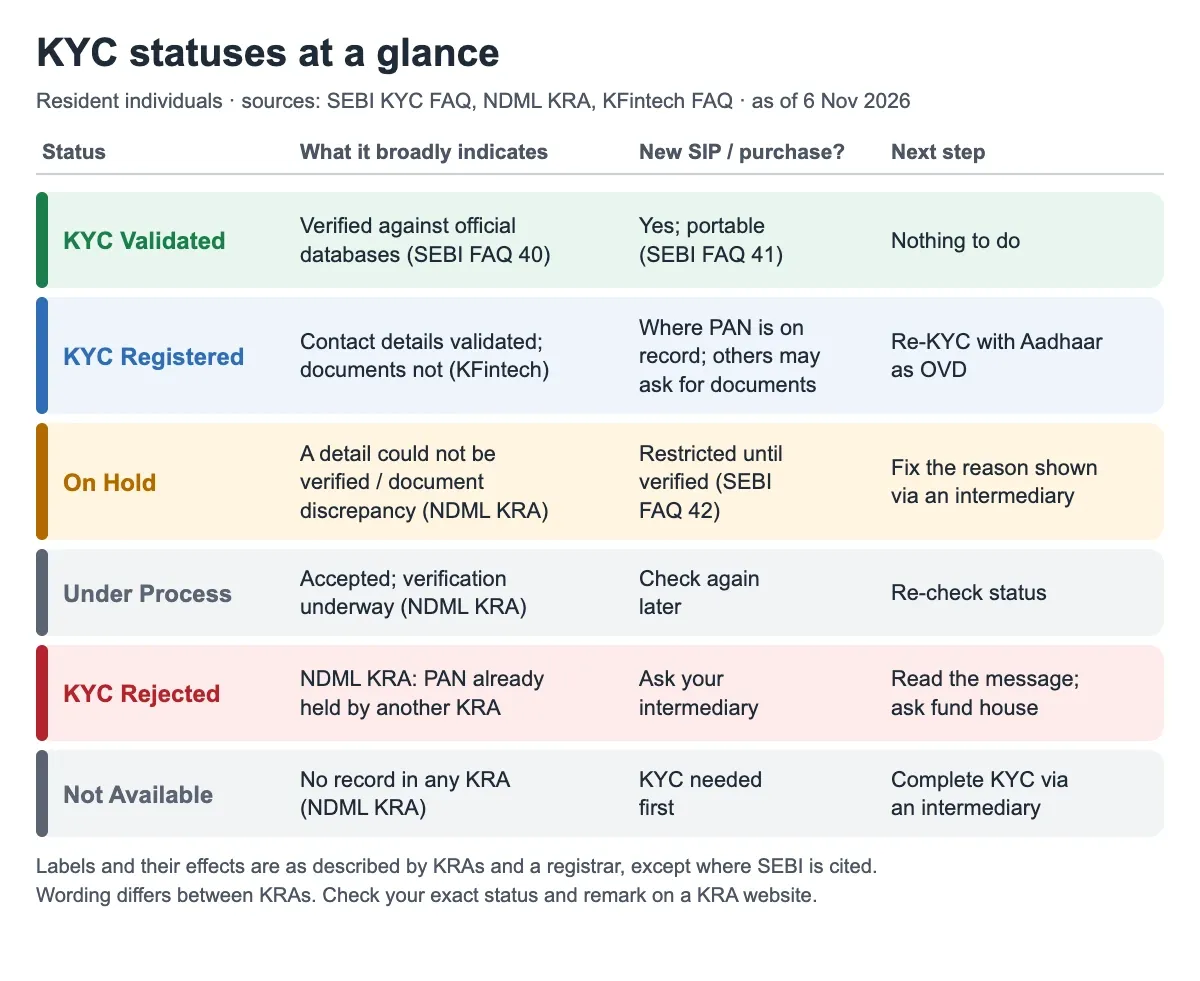
The table separates what SEBI says from how KRAs and a registrar describe each label. Wording differs between KRAs, so the status message on your own KRA record is the final word.
| Status | What the source says | New SIP or purchase? | What to do |
|---|---|---|---|
| KYC Validated | Verified against official databases, including PAN–Aadhaar linking (SEBI FAQ 40) | Yes. Portable: another intermediary can fetch it (SEBI FAQ 41) | Nothing |
| KYC Registered | KFintech: mobile and email validated; documents not independently validated | KFintech: continues where your PAN is on record; a new intermediary may ask for documents | Re-KYC with Aadhaar as the officially valid document (OVD), as KFintech describes |
| On Hold | NDML KRA: "discrepancy in KYC documents". KFintech: failed validation, non-OVD documents or invalid contact details | Restricted. SEBI: no further transactions until attributes are verified (FAQ 42) | Fix the reason shown, through an intermediary |
| Under Process | NDML KRA: accepted, verification underway | Check again later | Re-check the status |
| KYC Rejected | NDML KRA: PAN already held by another KRA; other KRAs may differ | Ask your intermediary | Read the message, then ask the fund house or registrar |
| Not Available | NDML KRA: no record in any KRA | KYC needed first | Complete KYC through an intermediary |
KYC Validated vs KYC Registered: can I start an SIP?
With KYC Validated, yes: SEBI's FAQ says a validated record is portable, so a new fund house can fetch it from the KRA (FAQ 41 and 44).
With KYC Registered, it depends on where you invest. KFintech's FAQ says transactions continue where your PAN is already on record, but a new intermediary may ask for KYC documents. One fund house's 2024 statutory note says a Registered investor submits a fresh set of KYC documents when investing with a new fund house, and suggests re-KYC with Aadhaar as the OVD. Before a first SIP with a new fund house, ask what it needs.
Why KYC goes on hold
The documents we read point to a few common reasons. This list is not complete; your KRA record shows your actual reason.
- Mobile number or email not validated. KFintech's FAQ lists invalid contact details as an on-hold case "irrespective of OVDs submitted".
- Documents that could not be validated, including KYC done with documents that are not OVDs (KFintech).
- A discrepancy in documents, in NDML KRA's words. In our reading this can include a name or address that differs across records; the KRA message tells you.
- PAN–Aadhaar not linked. Verified linking is part of a Validated record (SEBI FAQ 40), and a fund-house note lists linking as a fix.
Why now, if KYC was done years ago? KFintech's FAQ says status was assessed "as on 31st March'24" under the new checks. A record created earlier, with older documents or unvalidated contact details, may not have passed.
How to check your KYC status
- Open a KRA's KYC enquiry page (for example CVL KRA, KFintech KRA or NDML KRA) and search with your PAN. SEBI's FAQ says KRAs let you check your status on their websites (FAQ 43).
- Note the exact status and any remark shown. A remark about contact details needs a different fix from one about documents.
- Note which KRA holds your record. SEBI's FAQ says each KYC record is unique and tagged to a single PAN (FAQ 44).
How to fix mutual fund KYC on hold, by reason
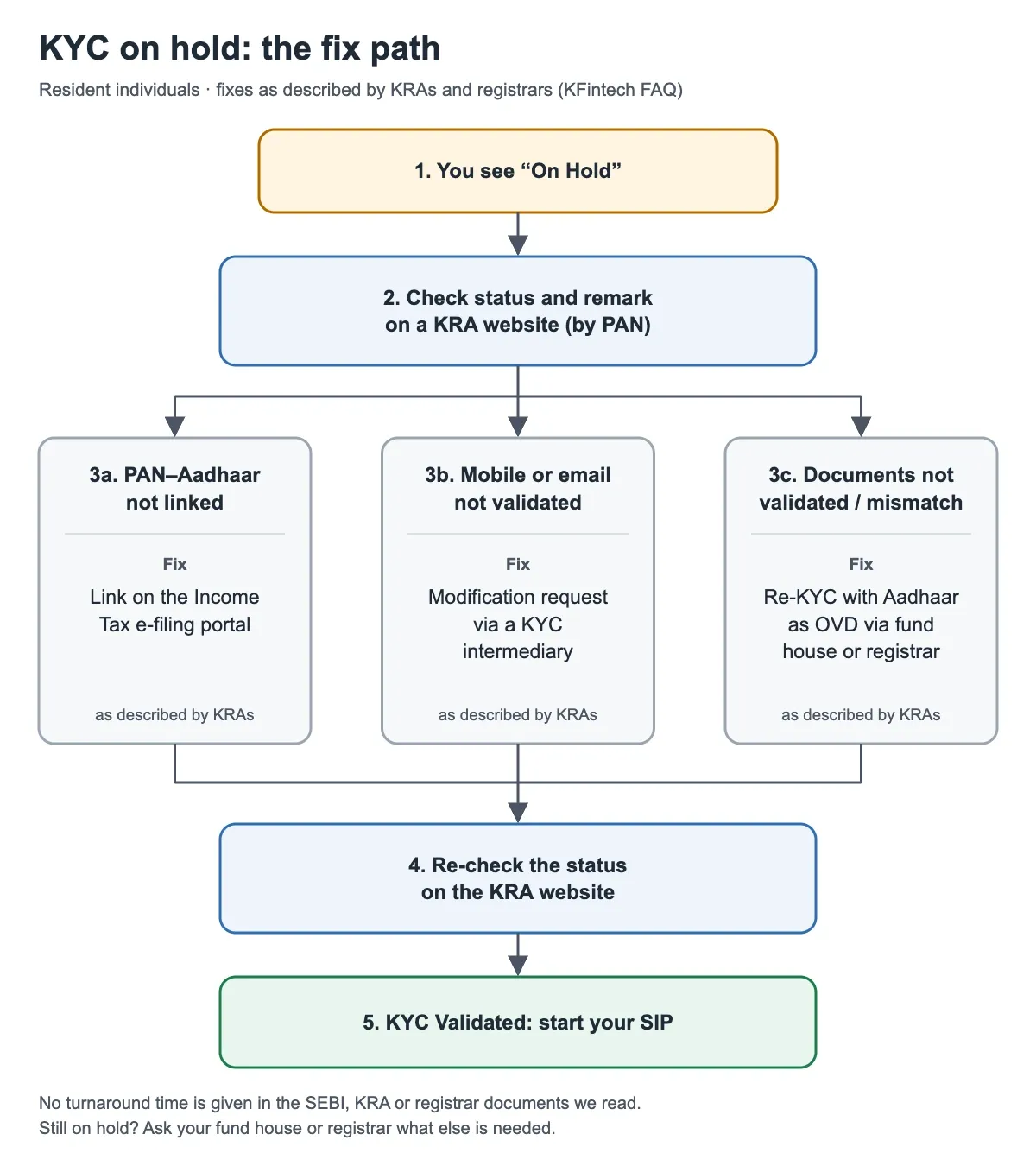
KFintech's FAQ describes the general route: a modification request "with the valid email and/or mobile number or fresh set of KYC documents", sent to your KRA through any intermediary (A14). Once the KRA validates the record, it updates your status and informs the registrar, and you can transact once the registrar's records are updated.
PAN–Aadhaar not linked
Linking is done with the Income Tax Department, through its e-filing portal. SEBI's FAQ notes the government has made it mandatory for everyone to link PAN to Aadhaar, with certain exceptions. The same FAQ says seeding is not mandatory to transact: with a valid PAN you can continue with your existing intermediary, but your KYC isn't portable (FAQ 12). After linking, re-check your KRA status; if it still shows on hold, ask your fund house or registrar whether a modification request is also needed.
Mobile number or email not validated
Submit a modification request with your own working mobile number and email through an intermediary: the fund house you want to invest with, or a registrar such as CAMS or KFintech.
Documents not validated, or details that don't match
KFintech's FAQ and a fund-house note both describe online re-KYC using Aadhaar as the OVD as the route to a validated record. If a detail differs between documents, correct it at the source first, then submit the KYC change.
How long does it take?
None of the SEBI, KRA or registrar documents we read gives a turnaround time. Re-check the KRA website after you submit, and ask the intermediary if nothing changes.
Worked example: Nasreen's five steps
- She sees "on hold" on her SIP form and holds off on starting it.
- She checks a KRA website with her PAN, and writes down the status, the remark and the KRA's name.
- She matches the remark to a fix: a modification with her mobile and email if it points to contact details; re-KYC with Aadhaar as the OVD if it points to documents; linking on the e-filing portal if PAN–Aadhaar is the issue.
- She re-checks the KRA website after the intermediary confirms her request.
- Once it shows KYC Validated, she returns to the fund house and starts her SIP.
Your existing investments meanwhile
- Investors existing on 31 March 2024: SEBI's FAQ says existing clients as on that date whose KYC attributes cannot be verified "shall be allowed to exit (sale / redemption, etc.)" from existing investments, "subject to adequate due diligence by intermediaries" (FAQ 45).
- Running SIPs: KFintech's FAQ says further SIP triggers will be restricted for on-hold folios (A12), so upcoming instalments may not be processed until the KYC is fixed.
- Other transactions: one fund house's 2024 note says transactions will not be allowed for on-hold investors, without addressing exits separately. Before you redeem or switch, ask your fund house or registrar what it needs.
If you live outside India, KYC rules differ; check with your fund house.
Before your first SIP: a 3-step KYC check
- Look up your status by PAN on a KRA website before you start.
- Aim for KYC Validated. If it says Registered, ask the fund house whether it needs documents. If it says On Hold, fix the reason first.
- Keep your mobile, email and PAN–Aadhaar link current, since these are what KRAs verify.
Once you're set up, read our Chhoti SIP guide and what happens to your SIP when the market falls.
Frequently asked questions
My mutual fund KYC shows "on hold". What does that mean?
The KRA holding your record could not verify part of it; NDML KRA describes it as a "discrepancy in KYC documents". SEBI's FAQ says clients whose KYC attributes cannot be verified cannot transact further until they are. The remark on a KRA website shows what to fix.
KYC registered vs KYC validated: can I still start an SIP?
KYC Validated is portable, so a new fund house can fetch your record (SEBI FAQ 41). With KYC Registered, KFintech's FAQ says transactions continue where your PAN is already on record, but a new intermediary may ask for documents. Ask the fund house before you start.
Why is my KYC on hold when I completed KYC years ago?
KRAs began verifying records against official databases in 2024, and KFintech's FAQ says status was assessed as on 31 March 2024. An older record with unvalidated contact details or documents may have been put on hold.
Can I redeem my mutual funds while my KYC is on hold?
SEBI's FAQ says existing clients as on 31 March 2024 whose KYC cannot be verified are allowed to exit existing investments, subject to due diligence by intermediaries (FAQ 45). Ask your fund house or registrar what it needs to process a redemption.
Will linking my PAN with Aadhaar fix the on-hold status?
It can, if missing PAN–Aadhaar linking is the reason, since verified linking is part of a Validated record (SEBI FAQ 40). SEBI's FAQ 12 says a valid unlinked PAN can still transact with your existing intermediary. If the remark points to contact details or documents, that needs fixing too. Re-check your KRA status after linking.
— Laabh



