Chhoti SIP of ₹250: who can start one and how it works
A ₹250 SIP for a first-time mutual fund investor: eligibility, payment by UPI AutoPay or NACH, and the 60-instalment design.
Summarize this article with AI





The short version
- A Chhoti SIP is a ₹250 monthly SIP that fund houses offer to first-time mutual fund investors, following a SEBI letter dated 20 February 2025. It is a facility inside schemes, not a fund type.
- As fund houses describe it: new to mutual funds, UPI AutoPay or NACH, up to three (one per fund house), and a 60-instalment design you can stop early.
- ₹250 a month builds the habit and the groundwork more than a large corpus. The value can fall below what you put in, so read the scheme documents before you start.
A Chhoti SIP (small-ticket SIP) is a ₹250-a-month SIP that fund houses offer to people investing in mutual funds for the first time, following a SEBI letter dated 20 February 2025. As fund houses describe it, you need to be new to mutual funds, pay through UPI AutoPay or NACH, and sign up for a 60-instalment design that you can stop early. It is a fund-house facility, not a separate type of fund, so the exact terms sit in each scheme's documents.
Sandeep, 32, is an electrician in Rohtak. His site-work income varies month to month, he has not invested in a mutual fund before, and ₹250 is an amount he can set aside even in a lean month. He wants to know: does he qualify, what is he signing up for, and is ₹250 worth it?
What a Chhoti SIP is (and isn't)
A Chhoti SIP is an option inside existing mutual fund schemes, not a new fund, a fund category or a government savings scheme. Each fund house (AMC) decides whether to offer it and in which schemes.
The two fund-house documents we read for this guide cite the same SEBI letter: SEBI/HO/IMD/POD-1/OW/P/2025/5586/1, dated 20 February 2025. The letter is also listed in SEBI's index of policy letters. We could not read the letter itself, so the conditions below are given as fund houses describe them, not as SEBI's own words. You may also see the facility spelt "Choti SIP".
As of 6 November 2026, fund-house pages and notices describe the facility as available. Start dates differ by fund house: one addendum we read took effect on 21 July 2025, and another fund house's notice on 1 August 2025.
Who can start one: the eligibility checklist
"New to mutual funds"
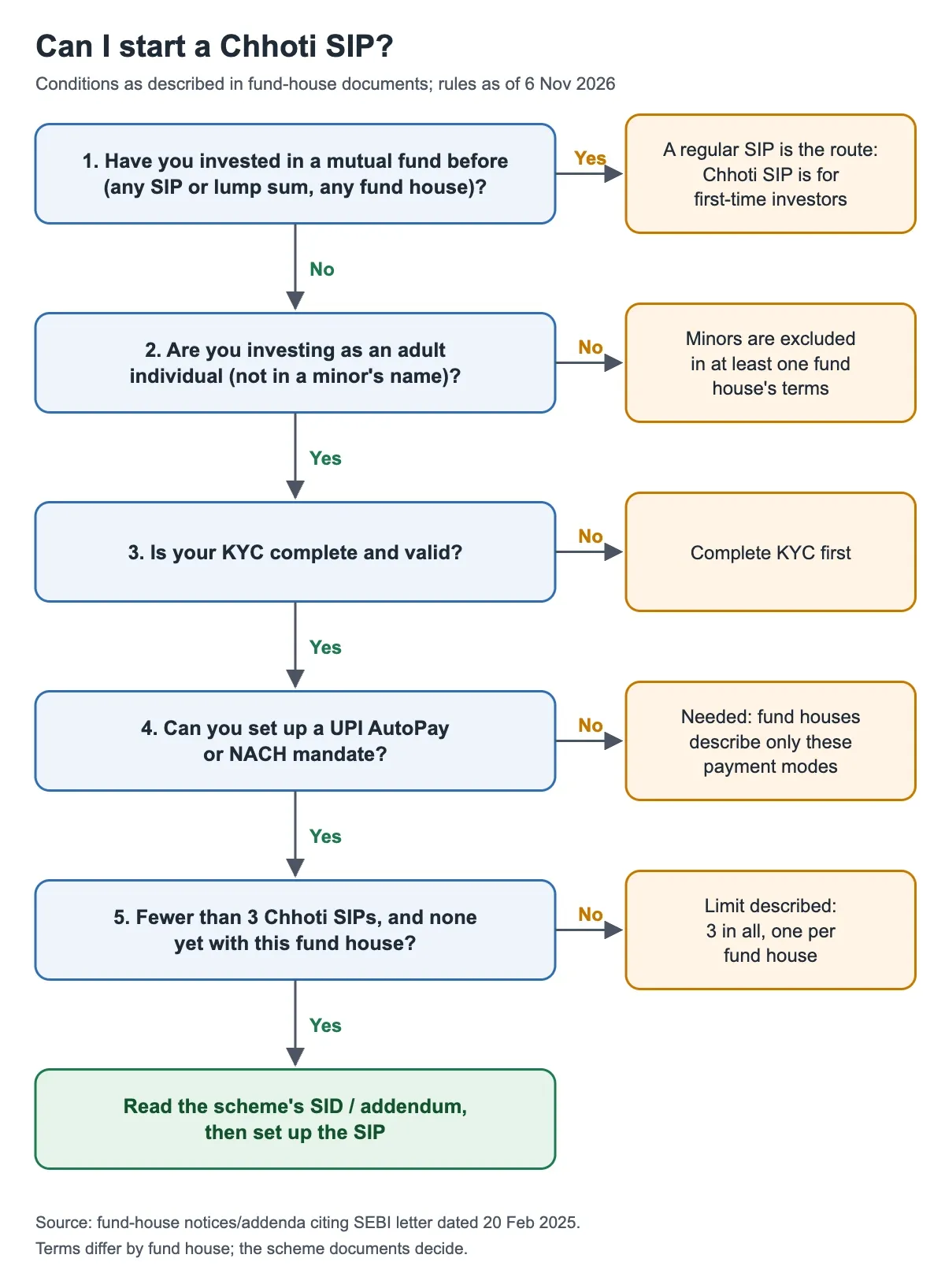
One fund house's addendum says the facility is "available exclusively to first-time individual investors in the mutual fund industry". Another fund house's notice describes eligible investors as those new to the mutual fund industry.
The word "industry" matters. Our reading is that an earlier SIP or lump-sum investment with any fund house, not only the one you are approaching now, means you are not a first-time investor. That is an interpretation: neither document explains how eligibility is checked, so confirm with the fund house before you apply.
Both documents also describe what happens later. If a Chhoti SIP investor starts any other kind of SIP or makes a lump-sum investment, they can no longer start new Chhoti SIPs. Chhoti SIPs already running continue as they are.
Who's excluded
One addendum explicitly excludes minors. The other notice we read does not mention minors either way. If you were hoping to start a ₹250 SIP for a child, check the scheme's documents first (see how to start an SIP in your child's name).
How many you can have
Both documents describe a maximum of three Chhoti SIPs, one per fund house. Three Chhoti SIPs with three different fund houses fits that description; two with the same fund house does not.
How it works, step by step
- Complete your KYC. Mutual fund investing needs valid KYC. If your status shows a problem, sort that out before anything else (see mutual fund KYC on hold).
- Find a scheme that offers it. Each fund house picks its eligible schemes and says it can change the list. One notice we read lists eleven schemes and limits the facility to their growth option; one addendum names a single index fund. The scheme's notice, addendum or Scheme Information Document (SID) is where this is written down.
- Set up a UPI AutoPay or NACH mandate. Both documents say Chhoti SIP instalments can be paid only through these routes.
- Let the monthly debit run. Both documents describe a monthly frequency and exactly ₹250 per instalment.
- Keep your mobile number registered. One addendum says statutory disclosures for Chhoti SIPs are sent by SMS or WhatsApp to the registered mobile number, and by email only if you provide an email ID.
The 60-instalment design
Both fund-house documents describe a "minimum commitment" of 60 instalments. At ₹250 a month, that is five years and ₹15,000 in total.
"Commitment" sounds binding, but the same documents say you can stop early. One says "premature withdrawal of SIP by the investor shall be allowed". The other says investors can stop before 60 instalments, with exit load applying as per the scheme's SID. Neither document describes a separate penalty for stopping the SIP itself.
Here is what we infer, as opposed to what the documents state: if you stop, the units you have already bought stay in your folio, and you can redeem them under the scheme's normal rules, including any exit load. The documents we read do not describe what happens after the 60th instalment. Check the SID or ask the fund house.
So treat 60 as a design target rather than a lock-in: five years gives you time to build the habit and to see how a market-linked investment moves through ups and downs, though its value can still end up below what you put in.
Chhoti SIP vs a regular SIP
| Chhoti SIP (as described by fund houses) | Regular SIP | |
|---|---|---|
| Amount per instalment | Exactly ₹250 | Scheme's minimum or more, as set in its SID |
| Frequency | Monthly only | Options set by each scheme |
| Who can use it | First-time mutual fund investors; minors excluded in at least one fund house's terms | Any investor eligible under the SID |
| Payment mode | UPI AutoPay or NACH only | Modes offered by the fund house |
| How many | Up to 3 in all, one per fund house | No Chhoti-style cap described |
| Instalments | 60 described as the minimum commitment; can stop early | Chosen by you, within SID rules |
| Raising the amount | One fund house's notice says top-up isn't available; check with the fund house | Check the scheme's step-up or top-up options |
Note the first row: ₹250 is a fixed amount, not a minimum.
Is ₹250 a month worth it? A hypothetical illustration
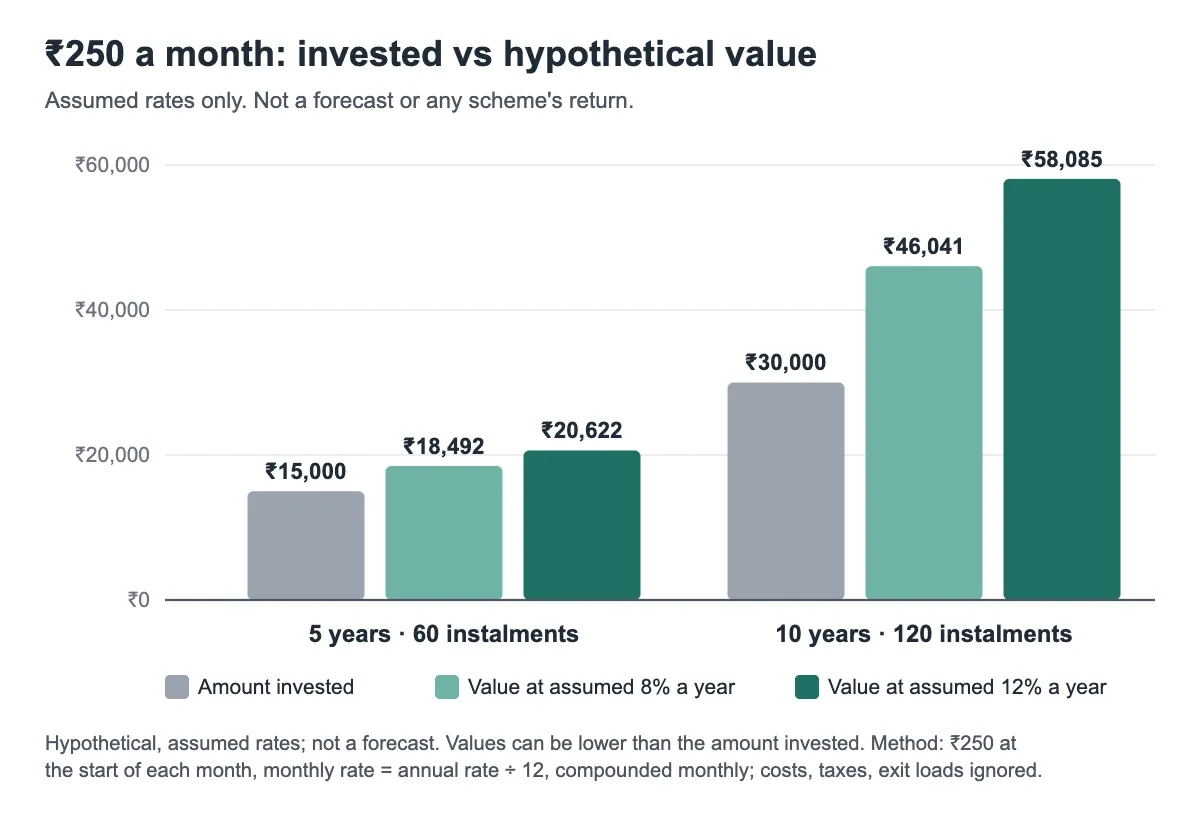
Sandeep's ₹250 a month for 60 instalments adds up to ₹15,000 invested. Below is what that could look like at two assumed annual rates: hypothetical, not a forecast, and not the return of any scheme.
| Period | Instalments | Amount invested | Value at assumed 8% a year | Value at assumed 12% a year |
|---|---|---|---|---|
| 5 years | 60 | ₹15,000 | ₹18,492 | ₹20,622 |
| 10 years | 120 | ₹30,000 | ₹46,041 | ₹58,085 |
Method: ₹250 invested at the start of each month; monthly rate = annual rate ÷ 12, compounded monthly; costs, taxes and exit loads are left out. If returns are 0%, the value equals the amount invested. If markets fall, it can be lower than that, sometimes for long stretches (see what happens to your SIP when the market falls).
An honest reading: ₹250 a month will not, on its own, build a large corpus. For comparison, ₹500 × 60 is ₹30,000 invested and ₹1,000 × 60 is ₹60,000 invested, before any returns.
What ₹250 does give Sandeep is the groundwork: KYC done, a folio opened, a mandate that runs, and five years of watching NAVs move. When his income allows, he can invest more. Per the fund-house documents, starting a regular SIP or a lump sum ends eligibility for new Chhoti SIPs (existing ones continue), so ask the fund house how a larger amount would work (see step-up SIP: how much to raise).
Before you start: 4 checks
- KYC status. Complete and valid.
- The scheme's riskometer and category. The schemes offering Chhoti SIP can range from equity to hybrid to gold funds, with different levels of risk. Read the riskometer and understand the category first (see which type of mutual fund a beginner can start with).
- The SID or addendum terms. Check that the scheme lists Chhoti SIP, which plan and option it applies to, the exit load, and anything said about stopping or completing 60 instalments.
- A mandate you can keep funded. With irregular income, choose a debit date when ₹250 is reliably in the account, such as a few days after you are usually paid. Ask the fund house how a failed debit is treated.
Frequently asked questions
What is a Chhoti SIP and who can start one?
A ₹250-a-month SIP that some fund houses offer in selected schemes, following a SEBI letter dated 20 February 2025. Fund houses describe it as only for first-time mutual fund investors, and at least one excludes minors. The scheme's SID or addendum has the exact conditions.
I haven't invested in mutual funds before. Can I start an SIP with just ₹250 a month?
Yes, if the scheme offers Chhoti SIP and you meet the fund house's conditions: valid KYC, a UPI AutoPay or NACH mandate, and exactly ₹250 a month. An earlier SIP or lump sum in any mutual fund may mean you are not treated as a first-time investor.
Can I stop a Chhoti SIP before 60 instalments, and what happens if I do?
Fund-house documents describe 60 instalments as the minimum commitment but allow stopping early, with any exit load as per the scheme's SID. Our reading is that units already bought stay invested until you redeem them; confirm in the scheme documents.
How many Chhoti SIPs can I have, and with how many fund houses?
Fund houses describe a limit of three Chhoti SIPs in all, with one per fund house. So you could have one each with three different fund houses, but not two with the same one.
Can I pay a Chhoti SIP through UPI AutoPay or NACH?
Yes. Fund-house documents say Chhoti SIP instalments can be paid only through UPI AutoPay or NACH, so you need to set up one of these mandates on your bank account.
— Laabh



