Can you invest in mutual funds without a demat account? Yes. Here's what changes
Yes, you can invest in mutual funds without a demat account. How a folio (statement of account) and demat differ on CAS, nomination and switching.
Summarize this article with AI





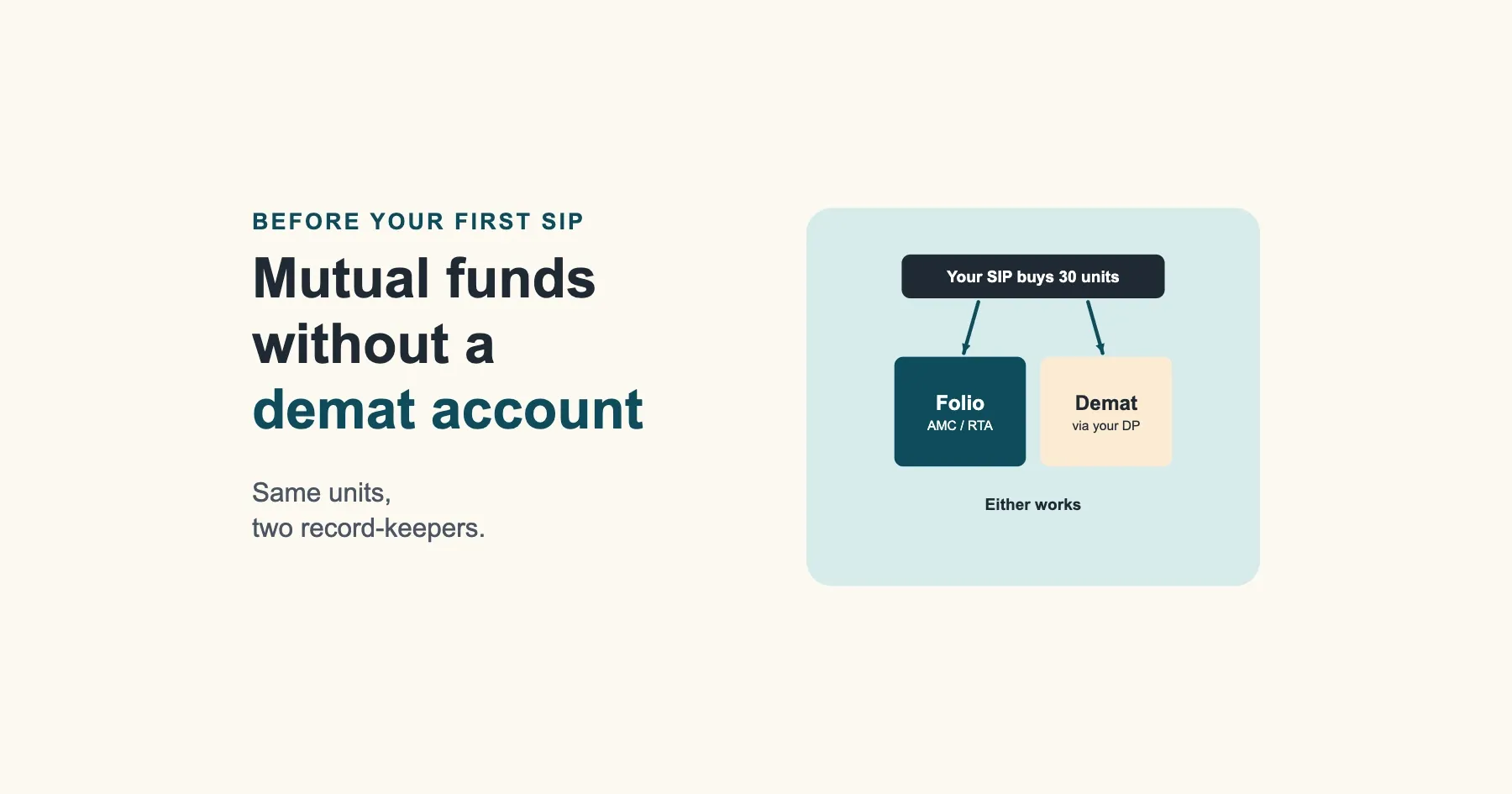
The short version
- A demat account is optional for mutual funds and SIPs; SEBI's 2011 circular made it "an option" in all schemes.
- Folio: the AMC and its RTA keep the record. Demat: the depository does, through your DP, and the demat account's nomination applies.
- Your CAS comes from a depository if your PAN has a demat account, otherwise from the AMC/RTA.
- You can convert later (CRF) or go back (RRF), both through a DP.
Yes. You can invest in mutual funds, including through an SIP, without a demat account: holding units in demat is an option, not a requirement. Without demat, your units are recorded in a folio with the fund house (AMC) and its registrar (RTA), and you get a statement of account. With demat, the same units sit in your demat account, held through a depository participant (DP).
Ankit, 27, is a telecom field technician in Shimla (a fictional example). He is about to start his first SIP and has never opened a demat account. Does he need one, and will the choice matter later? The units he buys are the same either way. Only the record-keeper changes, so the useful question is which record he will actually check.
Can I invest in mutual funds without a demat account?
Yes. In its circular of 19 May 2011 (CIR/IMD/DF/9/2011), SEBI said mutual funds "should provide an option to the investors to receive allotment of Mutual Fund units in their demat account", in all schemes from 1 October 2011. The word that matters is option. Demat is one way to hold units, not the only one. One AMC's investor page cites the same option as clause 14.4.2 of SEBI's Master Circular for Mutual Funds of 19 May 2023; SEBI has since issued a Master Circular for Mutual Funds dated 20 March 2026, and we could not read which paragraph now carries this option, so ask your fund house if you need the current clause.
KYC applies on either route. AMFI's KYC page calls it "a mandatory process to invest in mutual funds". The route only decides where your units are recorded.
What a folio and a statement of account are
A folio is an account number with an AMC. Its registrar (RTA) records every unit you buy or sell there, and you receive a statement of account (SoA) listing them. The units are electronic records. Some forms call this "physical" or non-demat mode; that only means "not in demat", not paper certificates.
What demat means for mutual fund units
A demat account is held with a depository (NSDL or CDSL) through a depository participant, usually a broker or a bank. NSDL's investor FAQ puts it plainly: "You can hold securities such as equity, debt instruments, Government securities and Mutual Fund Units in a single demat account." Your fund units then appear in your demat holding statement, next to any shares.
Demat vs statement of account: the same units, two record-keepers
| Statement of account (folio) | Demat account | |
|---|---|---|
| Who keeps the record | The AMC and its registrar (RTA) | The depository, through your DP |
| Statement you get | SoA from the AMC/RTA | Demat holding statement from your DP |
| Who sends your CAS | The AMC/RTA, if your PAN has no demat account | The depository, if your PAN has a demat account |
| Nomination | Recorded for the folio | The demat account's nomination applies to the units |
| How you redeem | A request to the AMC/RTA (or through the platform you used) | Through your DP or your stock broker |
| Extra party and charges | No DP in the chain | A DP, which may charge under its own tariff |
| Scheme costs (expense ratio, exit load) | As in the scheme documents | The same scheme documents apply |
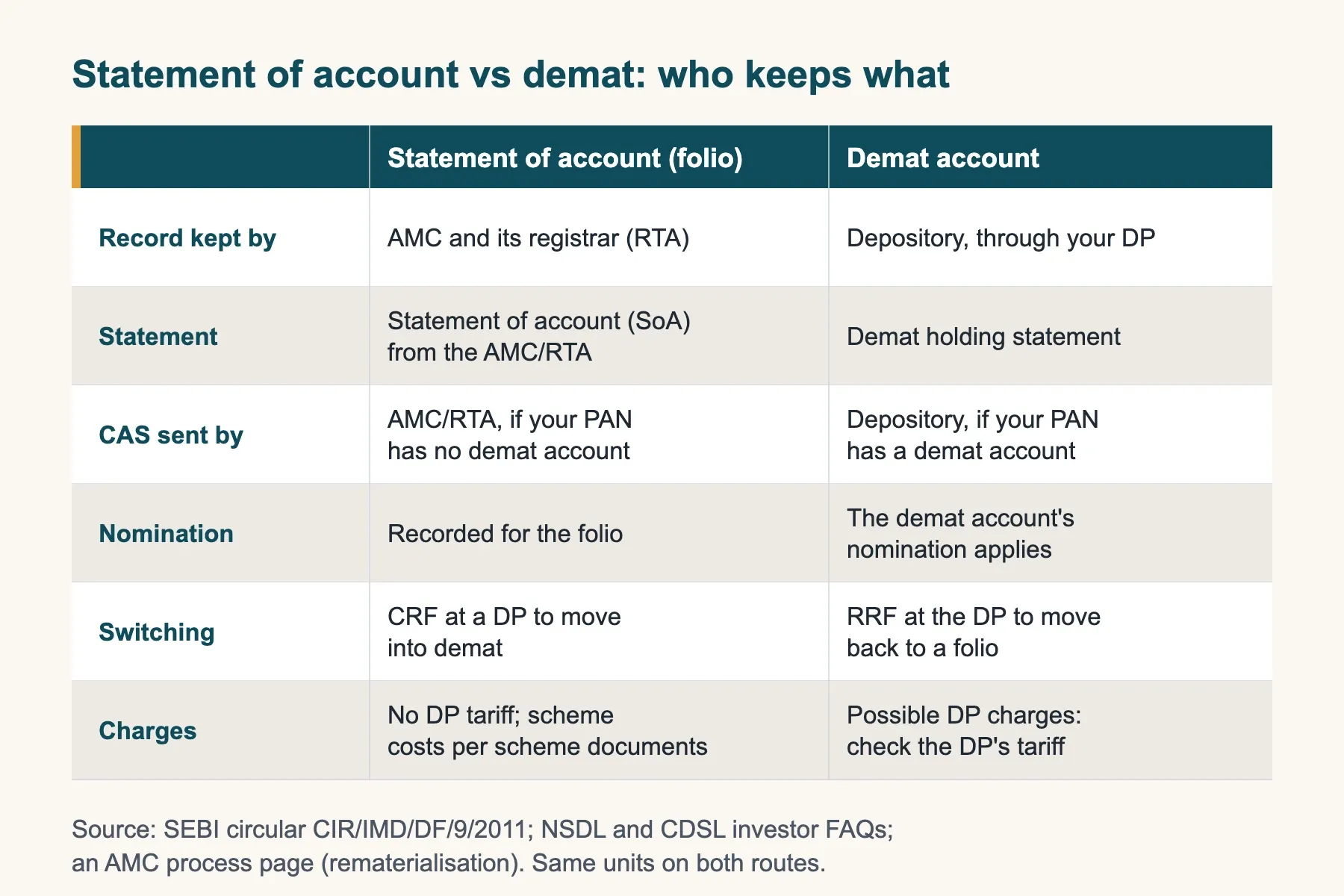
Each route wins one path. A folio wins on fewer parties: no DP, no DP tariff. Demat wins if you already have a demat account: your funds sit next to your shares, and one depository statement shows both.
The catch with demat: it adds a DP and that DP's tariff, and redemption runs through the DP or broker rather than straight to the AMC.
The catch with folios: each AMC gives you a separate folio, so funds from three fund houses mean three folio numbers. The CAS (next section) pulls them together.
Where do I see all my mutual funds in one place?
In your Consolidated Account Statement (CAS). It is consolidated by PAN, and who sends it depends on one question: does your PAN have a demat account?
- Yes: the depository sends it. CDSL's FAQ says: "For PANs which are common between Depositories and AMCs, the Depositories send the CAS." That statement also covers any units you hold in folios.
- No: the fund side sends it. In CDSL's words, for "PANs with no demat account and only MF units holding", the "AMCs/MF-RTAs shall continue to send the CAS."
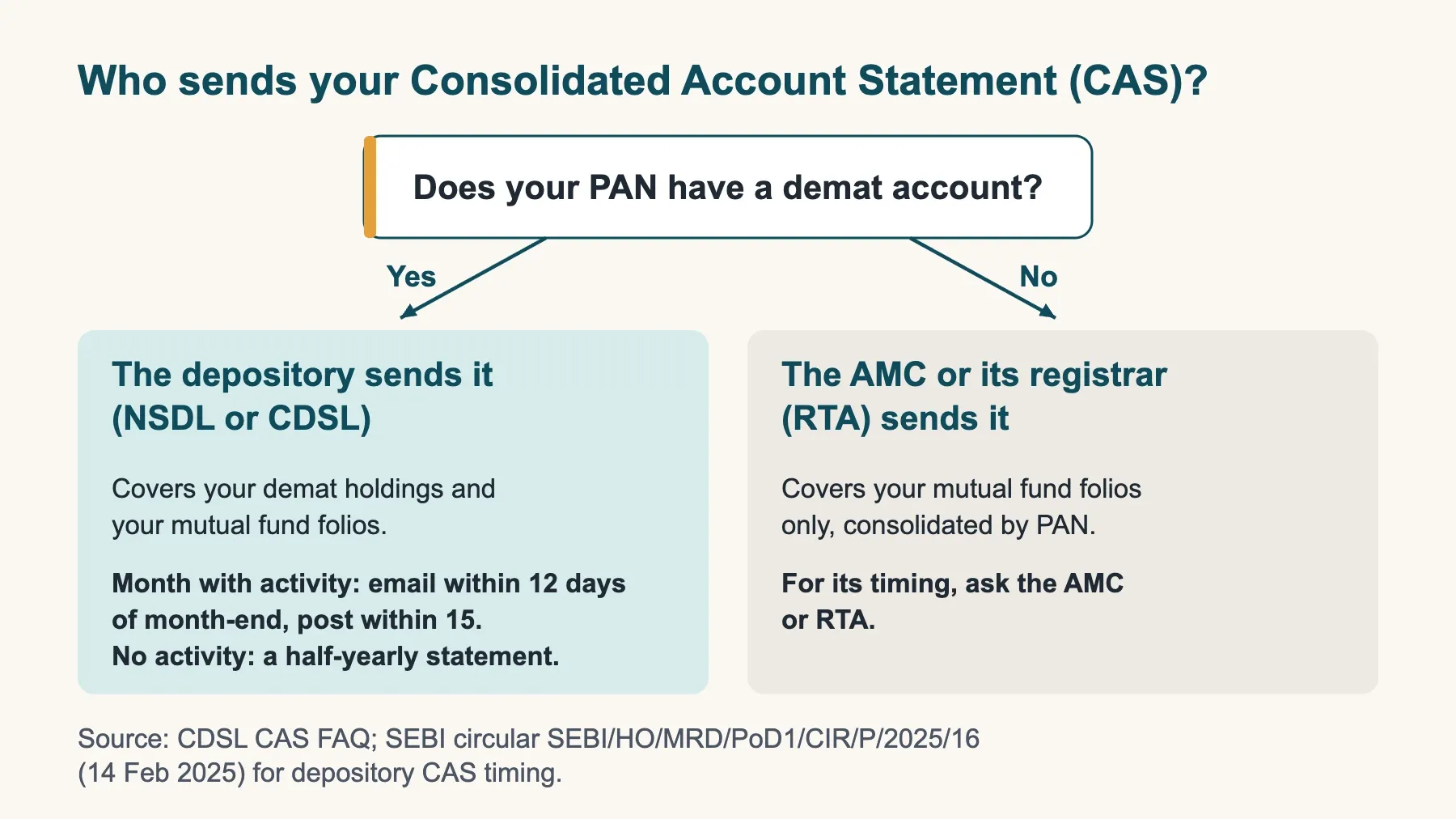
For a CAS sent by a depository, SEBI's circular of 14 February 2025 (SEBI/HO/MRD/PoD1/CIR/P/2025/16, effective 14 May 2025) sets the timing. If anything moved in your accounts that month, the CAS goes out "within twelve (12) days from the month end" by email, or "within fifteen (15) days from the month end" by post. If nothing moved, you get a CAS with holding details every half year: by email on or before 18 April and 18 October, by post on or before 21 April and 21 October.
That circular covers depository CAS. If yours comes from an AMC or RTA, ask them for its timing; we did not find a current SEBI document stating it, and some older pages still quote "the 10th".
Switching later: from a folio into demat, and back
Your first choice is not permanent; both directions go through a DP.
Folio to demat (conversion). From NSDL's investor FAQ:
- Get a Conversion Request Form (CRF) from your DP.
- Submit it with your statement of account. You need one CRF per folio, and separate CRFs for locked-in and free units of the same scheme.
- "The name and pattern of the holding must be same in demat account and Statement of Account." A folio in your name alone cannot go into a joint demat account.
- The DP sends the request on; once the AMC/RTA confirms it, the units are credited to your demat account.
Demat to folio (rematerialisation). Per one AMC's process page, you submit a Remat Request Form (RRF) to your DP for each ISIN, fund or folio, with a self-attested PAN copy and address proof. The DP forwards it to the AMC/RTA, and the units return to statement-of-account mode.
One detail to check: NSDL says "The nomination present in a demat account will also be applicable for Mutual Fund Units held in that demat account." When units move into demat, check the demat account's nomination; the folio's nomination no longer governs those units. For folio units, the nomination stays with the AMC/RTA, so check it with your fund house.
Worked example: one SIP instalment, two records
Illustrative NAV, not a real fund. No return is assumed or projected.
Ankit's first SIP instalment is ₹1,500. Suppose the scheme's NAV that day is ₹50.
Units bought = ₹1,500 ÷ ₹50 = 30 units
This ignores stamp duty and any other deduction, which reduce the units slightly. NAV changes every business day, so each instalment buys a different number of units. Now follow those 30 units down each route:
- Folio route. His SoA shows the folio number, scheme, date, amount, NAV and 30 units. With no demat account on his PAN, his CAS comes from the AMC/RTA.
- Demat route. His demat holding statement shows the scheme's ISIN and 30 units. Because his PAN now has a demat account, his CAS comes from the depository.
Same money, same NAV, same 30 units. Only the statement and its sender differ.
Who each route may suit
This is our reading of the trade-offs above, not a recommendation.
- A folio may suit someone like Ankit: no demat account, only mutual funds for now, and a preference for fewer parties.
- Demat may suit someone who already holds shares in demat and wants one statement for both, or who buys units through a stock broker.
Neither route changes the scheme, its NAV, its risk or its scheme costs.
Common mistakes to avoid
- Opening a demat account only because you think an SIP needs one.
- Moving units into demat and assuming the folio's nominee still applies.
- Trying to convert a single-name folio into a joint demat account, or the reverse.
Frequently asked questions
Is a demat account required for SIP?
No. SEBI's 2011 circular describes demat as an option in all schemes, and an SIP is a way of investing in a scheme, so a folio with the AMC works. Some platforms, such as a stock broker on the exchange platform, may record units in demat, so ask how yours does it.
Can I move my units into demat later, or back out of it?
Yes. To move folio units into demat, submit a Conversion Request Form with your statement of account to your DP, one per folio, with the same name and holding pattern. To move back, submit a Remat Request Form to your DP.
Does nomination work differently for demat and non-demat units?
Yes. For a folio, the nomination is recorded with the AMC/RTA for that folio. For units in demat, NSDL says the demat account's nomination applies, so check it before you convert.
Are there extra charges for holding mutual funds in demat?
There can be. Demat brings in a DP, which may charge under its own tariff, so check that tariff before you decide. Scheme costs such as the expense ratio and exit load apply on either route.
If I invest through an app, who keeps the record of my units?
The record sits with the fund house or a depository, whichever app you use: in a folio kept by the AMC and its registrar, or in demat with a depository through a DP. Ask the app which route it uses; your CAS sender is also a clue.
What to do next
- Check whether any demat account exists in your PAN, including an old one opened for an IPO.
- Before your first SIP, decide which statement you would actually read.
- Ask any platform how it records your units: folio with the AMC/RTA, or demat with a DP.
- Write down each folio number as your first statements arrive.
- Check that a nomination exists where your units sit.
- If you choose demat, read the DP's tariff before you invest.
If you are still getting ready, our pieces on how much emergency fund to keep and how much SIP to start with your first salary belong to the same "Before your first SIP" reading list.
— Laabh



