NAV cut-off time for an SIP: which day's NAV you get, and why it can be the next day
Your SIP gets the NAV of the day the fund house has your money before cut-off (3 pm for most funds), not the debit day. See one ₹4,000 instalment traced.
Summarize this article with AI





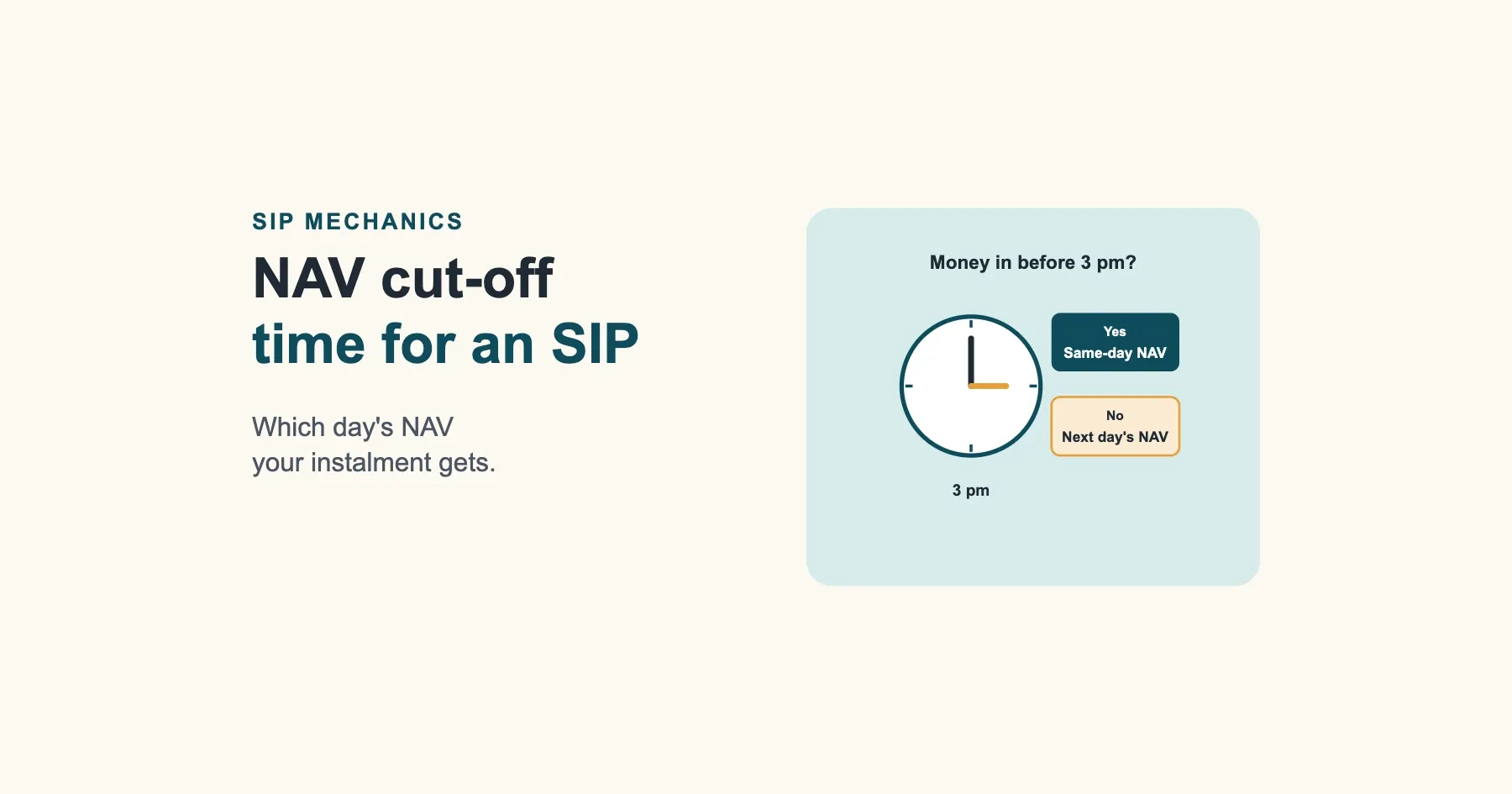
The short version
- Your SIP gets the NAV of the business day on which the fund house has your money available before the cut-off, not the day it leaves your bank.
- The cut-off is 3 pm for most equity and debt funds; liquid and overnight funds use 1:30 pm and the previous day's NAV (as of 17 November 2026).
- Weekends and holidays move the NAV to the next business day the money is available.
- A different NAV day can mean slightly more or fewer units; it isn't something to time.
For mutual fund purchases, including every SIP instalment, you get the NAV of the business day on which the fund house has your money available before the cut-off time. That is 3 pm for most equity and debt funds. If the money arrives after the cut-off, or on a non-business day, the next business day's NAV applies.
Rules as of 17 November 2026, from SEBI's investor FAQs and AMFI's applicable-NAV note.
Say Pooja, 25, in Bengaluru, has an SIP on the 5th. Her bank shows the debit on Tuesday morning, but her statement shows Wednesday's NAV. Nothing went wrong. The NAV cut-off time for an SIP works on when the money reaches the fund, not when it leaves your bank. Below, we follow one instalment from debit to units.
What is the cut-off time for an SIP, and which day's NAV will I get?
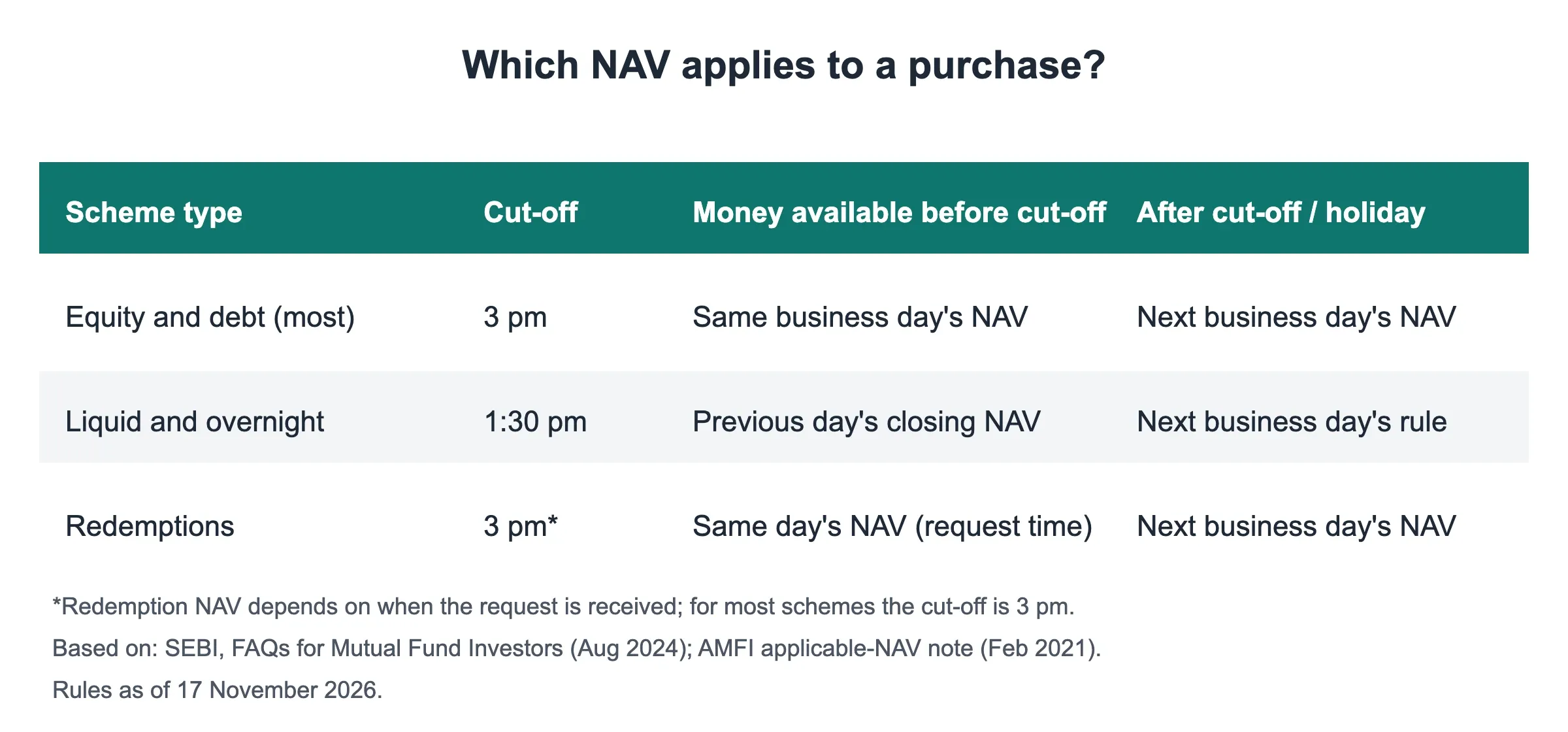
The cut-off time is the point in a business day that decides which day's closing NAV your purchase gets. SEBI sets these timings uniformly for all mutual funds. For equity and debt schemes other than liquid and overnight funds, the purchase cut-off is 3 pm.
AMFI's note on the SEBI rule says that, since 1 February 2021, units are allotted at the NAV of the business day on which the funds are realised, meaning available for the fund to use, up to 3 pm. This applies irrespective of the amount, in all schemes, and to lump sums, SIP instalments and switch-ins alike.
Why did my SIP get the next day's NAV though money left my account in the morning?
Because a debit and a realisation are two different events. An SIP instalment usually travels like this:
- Mandate debit. Your bank debits the amount under your auto-pay mandate (for example, a NACH or e-mandate) on or around the SIP date.
- Clearing and settlement. The money moves through the payment system towards the mutual fund's collection account.
- Realisation. The fund house's account receives the money and it becomes available for use.
- NAV day. If realisation happens before the cut-off on a business day, that day's NAV applies. If not, the next business day's NAV applies.
- Units in your statement. The units are allotted at that NAV and later show up in your account statement and your CAS.
A morning debit can still mean the money is realised after 3 pm, or on the next business day, depending on how the payment route settles. AMFI's note makes the point directly for SIPs: units are allotted at the SIP date's NAV only if the money is credited to the fund's account before 3 pm that day.
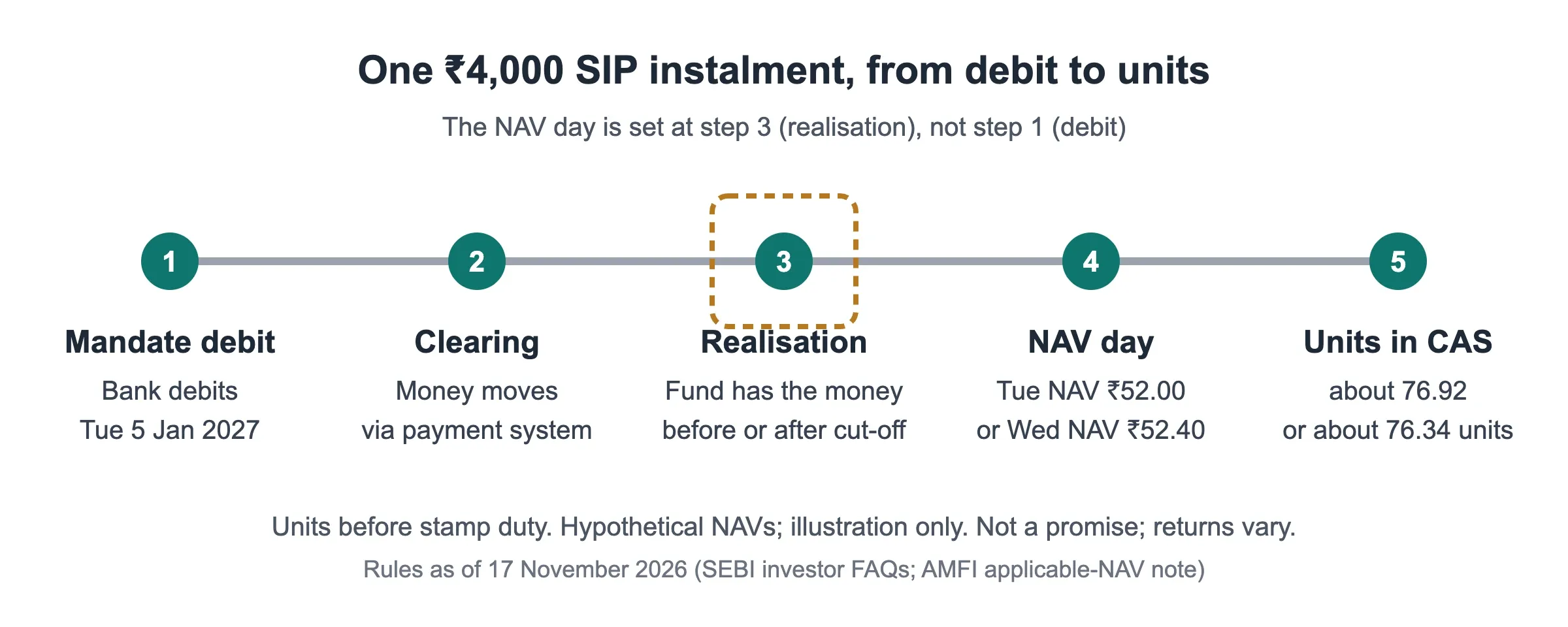
A worked example in ₹: same instalment, two NAV days
Hypothetical NAVs; illustration only. Not a promise; returns vary.
Take a ₹4,000 SIP instalment debited on Tuesday, 5 January 2027.
| Realised before cut-off Tuesday | Realised Wednesday | |
|---|---|---|
| NAV applied (hypothetical) | ₹52.00 | ₹52.40 |
| Units for ₹4,000 (before stamp duty) | about 76.92 | about 76.34 |
| Difference | about 0.59 fewer units |
Same rupees, different NAV day. Here Wednesday's hypothetical NAV is higher, so fewer units; on another day it could be lower. You can't know in advance, so this is a rule to understand, not something to time.
Stamp duty is also deducted from the purchase amount before units are allotted. At 0.005% (rate as of 17 November 2026), that is about ₹0.20 on ₹4,000, leaving ₹3,999.80 to buy about 76.92 units at ₹52.00 or about 76.33 units at ₹52.40.
My SIP date fell on a holiday or weekend: which NAV applies?
NAVs are declared only for business days. If your SIP date falls on a weekend or a market holiday, the money can't be realised against that day's NAV, so the next business day on which the fund has your money before the cut-off applies. AMFI's example uses a Friday-afternoon receipt after cut-off, with Saturday and Sunday as non-business days, getting Monday's NAV.
A bank holiday can also shift the debit itself, so your bank and fund statements may show different dates for one instalment.
Is the cut-off different for liquid and overnight funds?
Yes. SEBI's investor FAQs set a 1:30 pm cut-off for purchases in liquid and overnight funds. If the application is received and the funds are available by 1:30 pm, you get the closing NAV of the day immediately before the day of receipt. If either comes after 1:30 pm, the next business day's rule applies.
The realisation rule applied to these funds even before 2021.
Does NAV depend on when I place the order or when money reaches the fund house?
For purchases, on when the money reaches the fund house, as long as the application is also in. If you place an order at 11 am but the funds are available only the next day, you get the next business day's NAV. If the money is already available and the application is time-stamped before the cut-off, the time stamp decides.
The same rule covers a lump sum, an SIP instalment and a switch-in; an SIP just repeats it monthly. Redemptions are different: they depend on when your redemption request is received, against the redemption cut-off.
What to check, and common mistakes
- Mistaking the debit date for the NAV date. Check the NAV date against each instalment in your statement, not your bank SMS.
- Assuming a missed NAV day means a failed SIP. A later NAV date is usually just realisation timing. A failed debit is different; see what happens when you miss an SIP instalment.
- Treating the cut-off as a timing trick. The next day's NAV can be higher or lower. The cut-off decides which NAV applies, not whether it is good.
Frequently asked questions
Where can I see which NAV my SIP got?
Your account statement and your Consolidated Account Statement (CAS) list each transaction with its date, NAV and units. Use the transaction date there, not your bank's debit date.
Does the payment route change the timing?
It can. The NAV depends on when the money is available to the fund, and different routes, such as a bank mandate or an exchange platform, settle on their own timelines. The scheme's SID sets out applicable NAV for each route.
Is stamp duty deducted from my SIP instalment?
Yes. Stamp duty applies to mutual fund purchases, including SIP instalments, and is deducted before units are allotted. As of 17 November 2026 the rate is 0.005%, about ₹0.20 on ₹4,000.
Does the cut-off apply to redemptions too?
Yes, but differently. For redemptions, the NAV depends on when your request is received against the cut-off, since there is no money to realise. Requests after the cut-off get the next business day's NAV.
Read next
Check the NAV date against each instalment in your CAS. Our walkthrough on how to read your mutual fund CAS shows where to find it, and the guide to XIRR in an SIP explains how those dates feed into your return.
— Laabh



