Missed an SIP instalment? What your bank and your fund house each do next
One missed SIP debit doesn't cancel your SIP or bring a fund-house penalty (AMFI). Your bank may charge. See when an SIP is cancelled and your options.
Summarize this article with AI





The short version
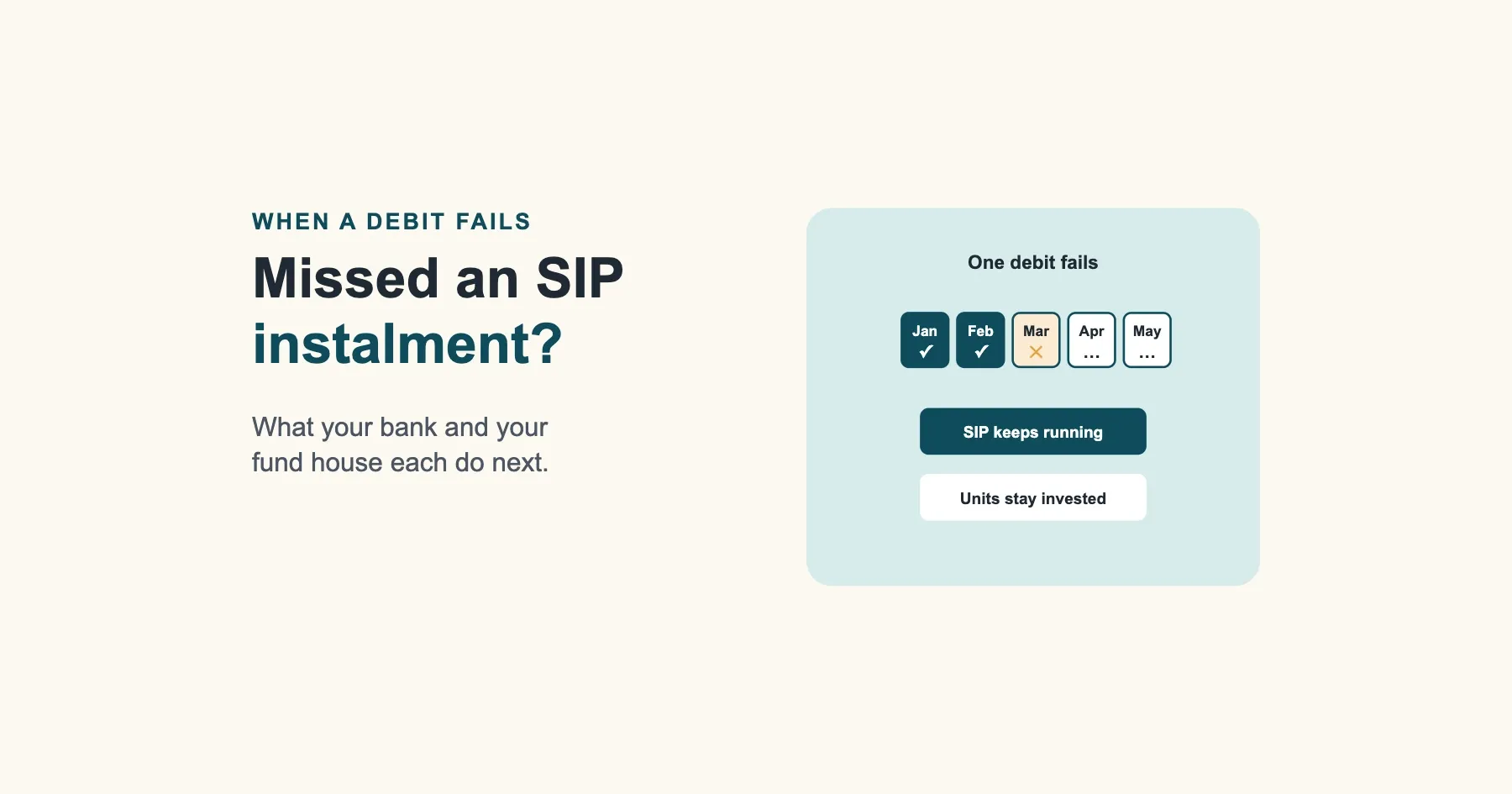
- One failed debit means one instalment not invested; your SIP registration stays in place.
- Fund houses don't charge a penalty (AMFI). Your bank may, as per its own schedule of charges.
- Cancellation comes only after repeated failures: three for monthly SIPs in the documents we checked. Your scheme's SID is the rule that applies.
- Units already bought stay invested and remain subject to market risk.
One missed SIP instalment does not cancel your SIP, and according to AMFI (the Association of Mutual Funds in India), fund houses don't charge a penalty for it; that month's units are simply not bought. Your bank may charge you for the failed debit, as per its own schedule of charges. The SIP registration is cancelled only after repeated failed attempts (three for monthly SIPs in the documents we checked), and the units you already hold stay invested.
Rules as read on 10 November 2026. Rules vary by scheme and fund house, so check your scheme's Scheme Information Document (SID).
A message arrives on the morning of your SIP date: the debit has failed, because this month's salary hasn't come in yet. Two different parties act on a failed debit, the bank and the fund house, and they follow different rules. This guide separates them.
What happens on the day the debit fails
On your SIP date, the instalment is collected from your bank account under the mandate you signed: an e-mandate, NACH or UPI AutoPay. If the debit cannot go through, for example because the balance is short that day:
- No money leaves your account for that instalment, so no units are bought for that month.
- Your bank may apply a charge for the failed debit. The amount, and whether one applies, depends on your bank's schedule of charges.
- You are told about it. One fund house's SID addendum dated 1 April 2024 says: "The AMC/RTA shall send a communication to the investor after 1st failed debit attempt, mentioning that the SIP will cease in case of aforesaid." An AMC-hosted FAQ on the same rule says investors "will be informed through Email / SMS immediately after the first failed installment."
Your SIP registration stays in place after one failure.
Bank side vs fund-house side
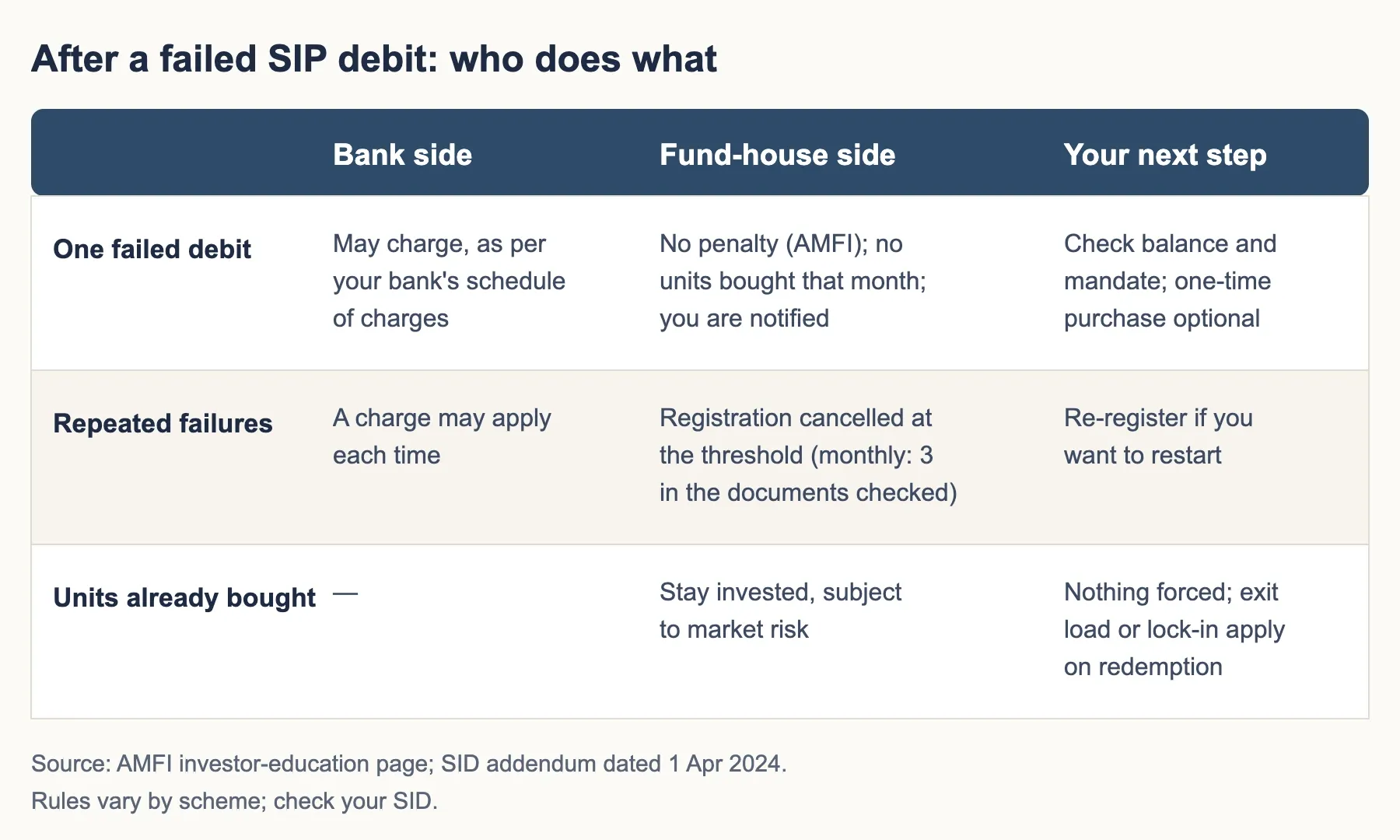
| Bank side | Fund-house side | Your next step | |
|---|---|---|---|
| One failed debit | May charge, as per your bank's schedule of charges | No penalty (AMFI); no units bought that month; you are notified | Check your balance and mandate; a one-time purchase is optional |
| Repeated failures | A charge may apply each time | Registration cancelled at the threshold (3 for monthly SIPs in the documents checked) | Re-register if you want to restart |
| Units already bought | — | Stay invested, subject to market risk | Nothing is forced; exit load or lock-in apply on redemption |
How many missed instalments cancel an SIP?
For a monthly SIP, the documents we read point to three, described in slightly different words.
What AMFI's investor-education page says
AMFI's investor-education page (undated; accessed 10 November 2026) says "your SIP will automatically be cancelled if you fail to make the payments for three consecutive months."
What a fund house's SID addendum says
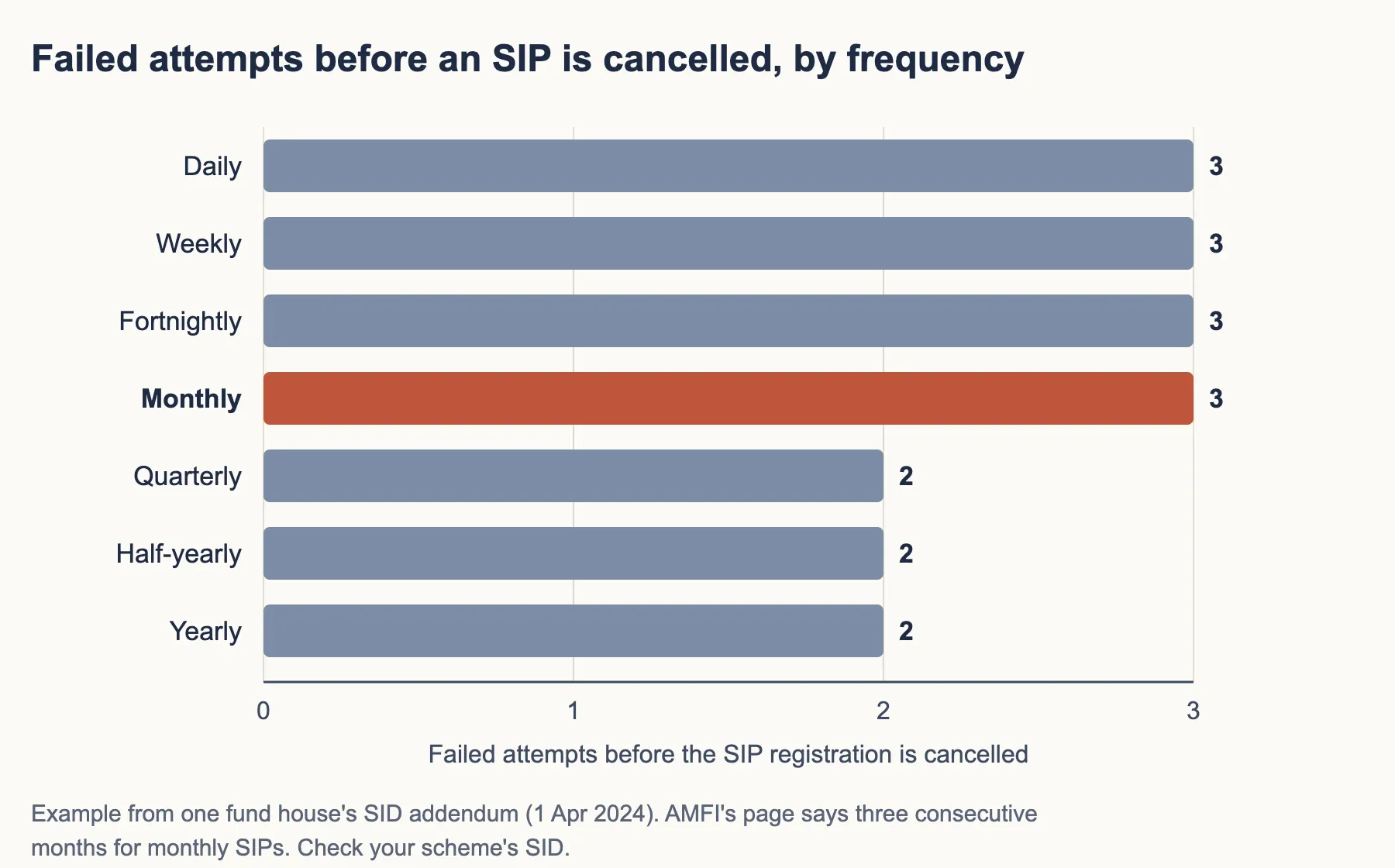
One fund house's notice-cum-addendum to its SID (Addendum No. 1/2024-25, dated and effective 1 April 2024) has a table headed "No. of failed attempts prior to cancellations of SIPs". It lists 3 for daily, weekly, fortnightly and monthly SIPs, and 2 for quarterly, half-yearly and yearly SIPs. Once the threshold is reached, "The SIP registration will be discontinued or considered as closed/ cancelled by the AMC."
Why the wording difference matters
AMFI's page says "consecutive". The addendum's table says "failed attempts" and does not use the word "consecutive". An AMC-hosted FAQ on the same 1 April 2024 change says "AMFI has advised the AMCs that the SIPs shall be auto-cancelled on consecutive failed transactions", and attributes the standard approach to SEBI guidance. We could not locate and read the underlying SEBI or AMFI circular, so treat that attribution as the FAQ's, not ours.
None of these documents says how a successful debit between two failures is counted. Your scheme's SID or Statement of Additional Information (SAI) is what applies to you; if unclear, ask the fund house.
Other cases to know about
- Quarterly and longer SIPs: the addendum lists 2 failed attempts, not 3.
- SIPs placed through channels, MFU or an exchange (non-demat): the AMC-hosted FAQ says "if the SIP transaction feed is not received for 3 consecutive installments, SIPs will be auto-cancelled."
- A pause is not a failure: the same FAQ says "PAUSE option will not be considered as failure transactions for the above auto-cancellation purpose."
- Older articles: some still say two missed debits cancel an SIP; the 1 April 2024 addendum lists three failed attempts for monthly SIPs, and AMFI's undated page says three consecutive months.
Does the fund house charge a penalty for a missed SIP?
According to AMFI's page, no: "While Mutual Fund companies don't penalize for non-payment of SIP instalments". The same page says "your bank will penalize you for dishonoring the auto debit payments."
The bank charge is set by each bank and may apply every time a debit fails, so there is no single figure to quote. Look up "failed mandate" or "ECS/NACH return" in your bank's schedule of charges, or ask your branch.
Worked example: a ₹3,000 monthly SIP that misses a month
Hypothetical illustration only. No returns, NAV or unit figures are assumed.
Suppose a salaried investor has a ₹3,000 monthly SIP on the 5th, and one month the salary arrives on the 7th.
| Month | Debit | What happens |
|---|---|---|
| 1–10 | ₹3,000 each | ₹30,000 invested in total |
| 11 | Fails | No units bought; the ₹3,000 stays in the account; bank charge as per the bank |
| 12 | Succeeds | SIP continues; check how your fund house counts failed attempts |
| If instead 11, 12 and 13 all failed | — | Registration may be cancelled; the units bought with the ₹30,000 stay invested |
10 instalments × ₹3,000 = ₹30,000 invested before the miss. Why it matters: one failed month means one instalment not invested; what turns a miss into a cancelled SIP is the same timing problem repeating unnoticed. AMFI's page also notes the cost of skipped payments: "you would accumulate lower wealth than what you had initially expected".
What you can do next
None of these is required; which suits you depends on your own cash flow.
Keep the balance ready before the next SIP date
Check your balance a day or two before the SIP date, and check that the mandate is still active with your bank. If short months are common, a small buffer helps (see how much emergency fund to keep).
Make a one-time additional purchase, if you choose
If you want the missed month's money invested, you can make a one-time additional purchase, provided your scheme accepts additional purchases (its SID says so). Two points to keep in mind:
- The price is today's, not the missed date's. Our reading of how mutual fund purchases work: the units are allotted at the NAV applicable on the day your purchase is processed under the scheme's cut-off rules, not the NAV of the SIP date you missed.
- Minimum amounts apply. The minimum additional purchase amount is stated in the scheme's SID or KIM.
It is a separate purchase; the documents we read don't say it affects how failed SIP attempts are counted.
Move the SIP date closer to your salary credit
If the salary arrives after the SIP date, moving the SIP date a few days after your usual credit date removes the clash. How you change the date depends on your fund house or the platform you used; in some cases it may mean cancelling and re-registering the SIP, so ask first (see best date for an SIP).
Miss, pause or stop: how they differ
A missed debit happens to you; a pause or a stop is something you choose.
| Missed debit | Pause (where offered) | Stop (cancel) | |
|---|---|---|---|
| Instalment | Not collected that month | Not collected for the pause period you choose | No further instalments |
| Registration | Continues, until the failed-attempt threshold | Continues; per the AMC-hosted FAQ, a pause is not counted as a failure | Ends |
| Units held | Stay invested | Stay invested | Stay invested |
Pause options and terms vary by fund house and platform. Stopping because markets have fallen is a different question, covered in Should you stop your SIP when the market falls?.
The units you already hold
A failed debit, or even a cancelled registration, does not sell anything. AMFI's page contrasts an SIP with an insurance policy, where non-payment of a premium can lead to the policy being inactivated; with an SIP, the investments made so far remain.
The units you have bought stay in your folio and remain subject to market movements, up or down. You can redeem them when you need to, subject to any exit load in the scheme and, for ELSS, the lock-in period (see can you withdraw your SIP money anytime?).
Frequently asked questions
How many SIP instalments can I miss before my SIP is cancelled?
For monthly SIPs, AMFI's investor-education page says three consecutive months, and one fund house's SID addendum dated 1 April 2024 lists 3 failed attempts. Quarterly and longer SIPs are listed at 2. Rules vary by scheme, so check your SID or ask the fund house.
Does the mutual fund charge a penalty for a missed SIP, or only my bank?
According to AMFI, fund houses don't penalise for a missed SIP instalment. Your bank may charge for the failed debit, as per its schedule of charges.
Can I pay a missed SIP instalment later or top it up with a lump sum?
You can't re-run the missed debit, but if your scheme accepts additional purchases you can invest the amount as a one-time purchase. In our reading, units are allotted at the NAV applicable when that purchase is processed, not the missed date's NAV, and the scheme's minimum additional amount applies.
My SIP debit failed because my salary came late. What happens now?
No units are bought for that month, and your bank may apply a charge. Your SIP continues, and you should be notified after the first failed attempt. Keep the balance ready for the next date, or consider moving the SIP date after your salary credit.
How much does a bank charge when an SIP mandate bounces?
There is no single figure: each bank sets its own charge in its schedule of charges. Check it or ask your branch.
What happens to the units I already hold if my SIP is cancelled?
They stay invested and remain subject to market movements. You can redeem them, subject to any exit load or ELSS lock-in, and you can register a new SIP if you want to restart.
If a debit has just failed
If a debit has just failed, check your balance and mandate before the next SIP date, and read your scheme's SID or ask the fund house how it counts failed attempts.
Related read: how long to keep an SIP going, and what to weigh before stopping.
— Laabh



