Record Date vs Ex-Date: The Last Day You Can Buy a Share and Still Get the Dividend Under T+1
Record date vs ex-date under T+1: buy one trading day before the record date to get the dividend. Calendar example, price drop and tax.
Summarize this article with AI





The short version
- The record date decides who gets the dividend, bonus or split; the ex-date is the first day a purchase no longer qualifies.
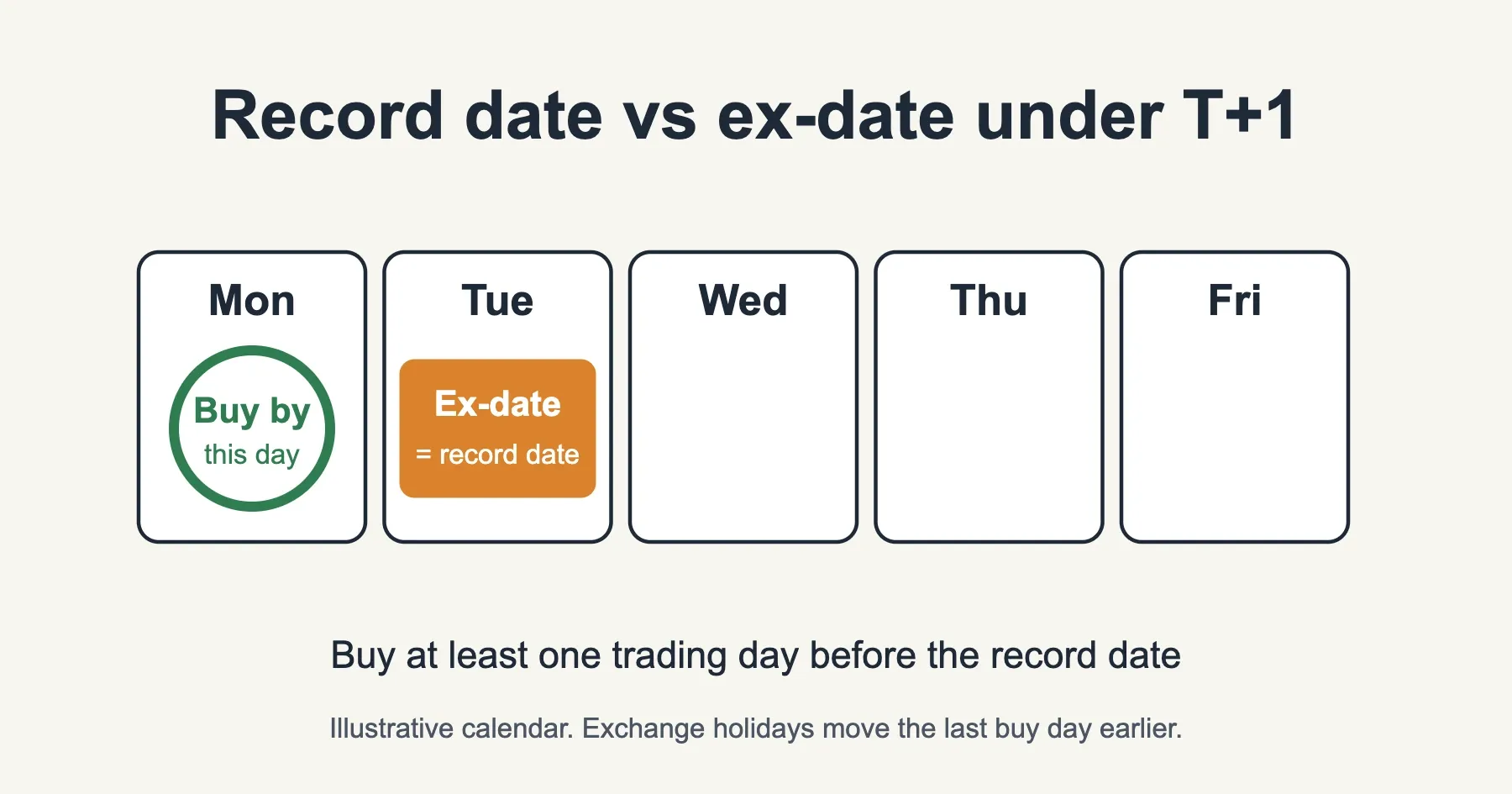
- Under T+1, a buy settles the next trading day, so the ex-date generally falls on the record date.
- Last day to buy and still be entitled: one trading day before the record date.
- Selling on the ex-date does not take away your entitlement; selling the day before does.
As of 22 November 2026: under India's T+1 settlement, a share you buy reaches your demat account one trading day later, so you must buy it at least one trading day before the record date to get the dividend. That is why the ex-date now generally falls on the record date itself. Buy on the ex-date and the dividend goes to the seller, not to you.
Pooja, 27, in Hyderabad, sees "Ex-date: Tuesday" next to a dividend in her app. Which is her last day to buy, and can she sell on Tuesday and keep it? One week's calendar answers both.
Record date vs ex-date: the four dates in a corporate action
Four dates matter in a dividend, bonus or split:
| Date | What it means | What it means for you |
|---|---|---|
| Announcement date | The company announces the action to the exchanges | Your cue to look up the record date |
| Ex-date | The first trading day on which a buyer of the share no longer gets the benefit | Buying on or after this day means no dividend for that buy |
| Record date | The day the company checks who holds its shares, from depository records | You must be on that list |
| Payment date | The day the company pays the dividend | Money reaches your linked bank account |
The record date decides who is entitled; the ex-date, from when a purchase misses out. Companies fix the record date and file it with the exchanges under Regulation 42 of SEBI's listing rules (SEBI LODR Regulations, 2015). NSE's FAQs on corporate action filing state that "Any Cut-off date or Book Closure date specified by the Company will not be recognised", so the record date filed with the exchange is the one that counts.
Why ex-date and record date line up under T+1
Settlement is when shares reach the buyer's demat account and money reaches the seller. SEBI introduced the T+1 settlement option through Circular No. SEBI/HO/MRD2/DCAP/P/CIR/2021/628 dated 7 September 2021. SEBI's master circular sets the T+1 schedule: securities pay-in by 11:00 AM and pay-out by 3:30 PM on the day after the trade.
Applied to one corporate action:
- A Monday buy settles on Tuesday, so the shares are in the buyer's demat on Tuesday.
- If Tuesday is the record date, Monday's buyer is on the list.
- A Tuesday buy settles on Wednesday, after the record date, so that buyer is not on the list.
So Tuesday, the record date, is also the first day a purchase no longer qualifies: the ex-date. Under the older T+2 cycle the ex-date fell one trading day before the record date. The rule of thumb: last day to buy = one trading day before the record date. Exchange holidays push this earlier, because "one trading day" skips them.
Calendar: three scenarios and who gets the dividend
Hypothetical example. A company declares a dividend of ₹7.50 per share. The record date (and ex-date) is Tuesday, 8 December 2026. Assume 7 to 9 December are all trading days. For 160 shares, the gross dividend is 160 × ₹7.50 = ₹1,200.
| Scenario | What you did | Shares in your demat on Tue 8 Dec (record date)? | Dividend of ₹1,200? |
|---|---|---|---|
| A | Bought 160 shares on Mon 7 Dec, the day before the ex-date | Yes: Monday's buy settles on Tuesday | Yes, you get it |
| B | Bought 160 shares on Tue 8 Dec, the ex-date | No: Tuesday's buy settles on Wednesday | No, the seller gets it |
| C | Already held 160 shares; sold all of them on Tue 8 Dec | Yes: your sale settles on Wednesday, so on Tuesday you still hold them | Yes, you get it |
Scenario C surprises many: selling on the ex-date does not take away the dividend, because the shares are still yours on the record date. Had you sold on Monday 7 December, that sale would settle on Tuesday and the buyer would get the dividend.
If tax is deducted at source at 10% (see the tax section below), ₹120 of the ₹1,200 would be withheld and ₹1,080 credited.
Why the share price drops on the ex-date
From the ex-date, the share trades without the right to the upcoming dividend, and the company is about to pay out ₹7.50 of cash per share. In theory, the price adjusts down by roughly the dividend amount.
Hypothetical illustration. Suppose the share closed at ₹250 on Monday 7 December. In theory, it would open near ₹250 − ₹7.50 = ₹242.50 on Tuesday, all else being equal.
| Before ex-date | After ex-date (theoretical) | |
|---|---|---|
| Value of 160 shares | 160 × ₹250 = ₹40,000 | 160 × ₹242.50 = ₹38,800 |
| Dividend due to you | Nil yet | ₹1,200 (paid later, before any TDS) |
| Total | ₹40,000 | ₹40,000 |
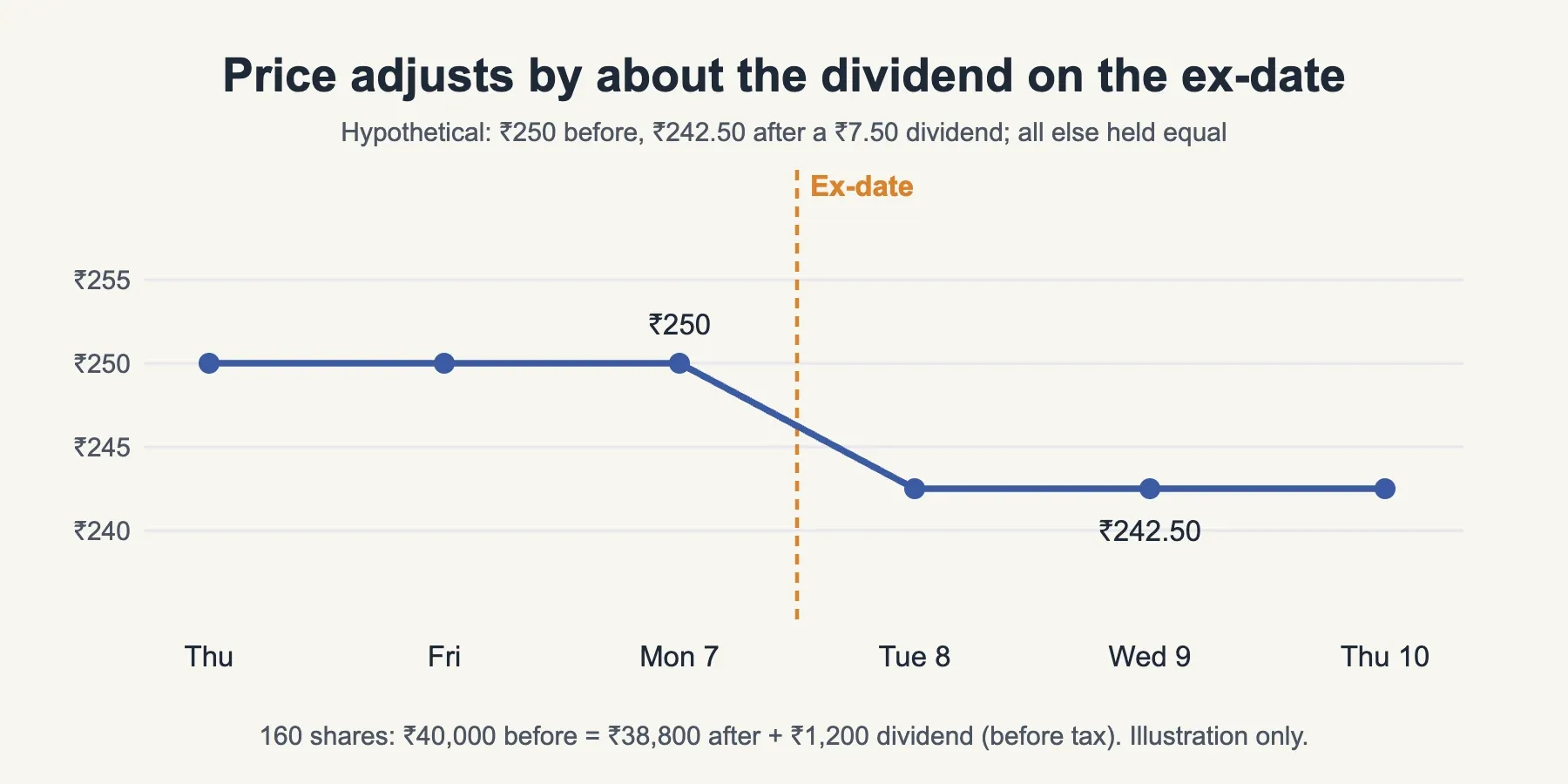
The dividend does not make you richer on the day: value moves from the share price into your bank account, and tax may apply. Real prices also move with news and market mood, so the actual drop can be larger or smaller. Buying a share just to "capture" a dividend is not free money.
Same logic for bonus issues and stock splits
The record date and T+1 rule work the same way for a bonus issue or a stock split; only the benefit changes.
- Bonus issue (hypothetical 1:1): one extra share for each held on the record date. 160 shares at ₹250 become 320, with the price adjusting in theory to about ₹125.
- Stock split (hypothetical, face value ₹10 split to ₹5): each share becomes two, so 160 becomes 320 at about half the price.
In both cases the bonus or split record date decides who is entitled, and the last day to buy is one trading day before it. The new shares reach your demat account after the record date.
Where to check record dates and ex-dates
- Exchange corporate-action pages. NSE and BSE list corporate actions with purpose, ex-date and record date; BSE also issues record date bulletins.
- The company's filing with the exchange states the record date, dividend per share and, where known, the payment date.
- Your broker app. A useful reminder, but the exchange filing is the primary source.
Watch for exchange holidays before the record date. To see how a buy order travels to your demat account, read how the stock market works in India; for what your demat account holds, see what is a demat account.
How dividends are taxed (as of 22 November 2026)
Dividends are taxable in the shareholder's hands as part of total income. Under Section 393 of the Income-tax Act, 2025, a domestic company deducts tax at source (TDS) at 10% on dividends to resident shareholders before paying them. The section also sets exemptions, and certain resident individuals with nil estimated tax can file a declaration to avoid deduction. TDS is not the final tax: it is credited against what you owe when you file your return.
Frequently asked questions
What is the difference between record date and ex-date?
The record date is when the company checks who holds its shares; the ex-date is the first trading day a buyer no longer gets the benefit. Under T+1 settlement, the two generally fall on the same day.
What is the last date to buy shares to get a dividend?
One trading day before the record date. With a Tuesday record date, a Monday buy settles on Tuesday and qualifies; a Tuesday buy does not. Exchange holidays move this earlier.
If I sell on the ex-date, do I still get the dividend?
Yes. A sale on the ex-date settles the next trading day, so the shares are still yours on the record date. A sale one day earlier settles on the record date, and the buyer gets the dividend.
Why does share price fall on the ex-dividend date?
A buyer from the ex-date no longer gets the dividend, which the company is about to pay out. In theory the price adjusts by roughly the dividend; market moves can make the change larger or smaller.
Is the dividend I receive taxable?
Yes. As of 22 November 2026, dividends are taxable as part of your income, and a domestic company deducts TDS at 10% for residents, subject to exemptions in Section 393 of the Income-tax Act, 2025. Tax rules change; consult a tax professional.
Save this rule
Save this rule for your next corporate action: check the record date on the exchange, then buy at least one trading day before it. For regular investing in shares, see stock SIP vs mutual fund SIP.