Stock SIP vs mutual fund SIP: who picks, who pays, and what you own
A stock SIP buys one company's shares; a mutual fund SIP buys a diversified fund. Compare who picks, charges, demat needs and concentration risk.
Summarize this article with AI






The short version
- "SIP" is the rhythm; the product behind it decides your risk.
- A stock SIP concentrates on one company you pick; a fund SIP spreads money across many holdings.
- Stock SIPs need demat and carry per-trade charges; fund SIPs carry an expense ratio inside the NAV.
- In the hypothetical example (not a promise; returns vary), a 30% fall in one company cut a ₹54,000 stock SIP to ₹37,800; at a 5% fund weight it cost about ₹810.
A stock SIP buys shares of one company at regular intervals into your demat account. A mutual fund SIP buys units of a fund whose manager holds many securities. Both invest a fixed amount regularly; they differ in diversification, who selects, costs and account needs.
Shreya, 24, runs a ₹4,500 monthly SIP in an equity fund. A colleague does a "SIP in shares" of one company and asks why she pays someone to pick for her. The stock SIP vs mutual fund SIP question is about what sits behind that word: the rhythm is shared; what you buy, who chooses and what you pay are not.
What is the difference between a stock SIP and a mutual fund SIP?
An SIP describes how you invest (a set amount on a set date), not what you invest in. In a mutual fund SIP, each instalment buys units of a scheme. In a stock SIP, each instalment places a buy order, through your stockbroker, for shares of a company you named.
| Stock SIP | Mutual fund SIP | |
|---|---|---|
| What you buy | Shares of one company you choose | Units of a scheme that holds many securities |
| Who selects | You | The fund manager, within the scheme's stated objective (an index fund follows its index) |
| Diversification | None within one stock SIP | Built in, within SEBI's investment restrictions |
| Costs | Brokerage per your broker's tariff sheet, plus STT, stamp duty and other levies as applicable, on each purchase | Expense ratio, charged within the NAV; exit load may apply on early redemption |
| Account needed | Trading account, demat account and bank account | No demat needed; units can come in a statement of account |
| Rules that apply | SEBI rules for stockbrokers and depositories; it is a broker facility, not a fund | SEBI (Mutual Funds) Regulations, 2026 |
| Main risk | One company's fortunes drive the whole holding | Market and category risk across the portfolio |
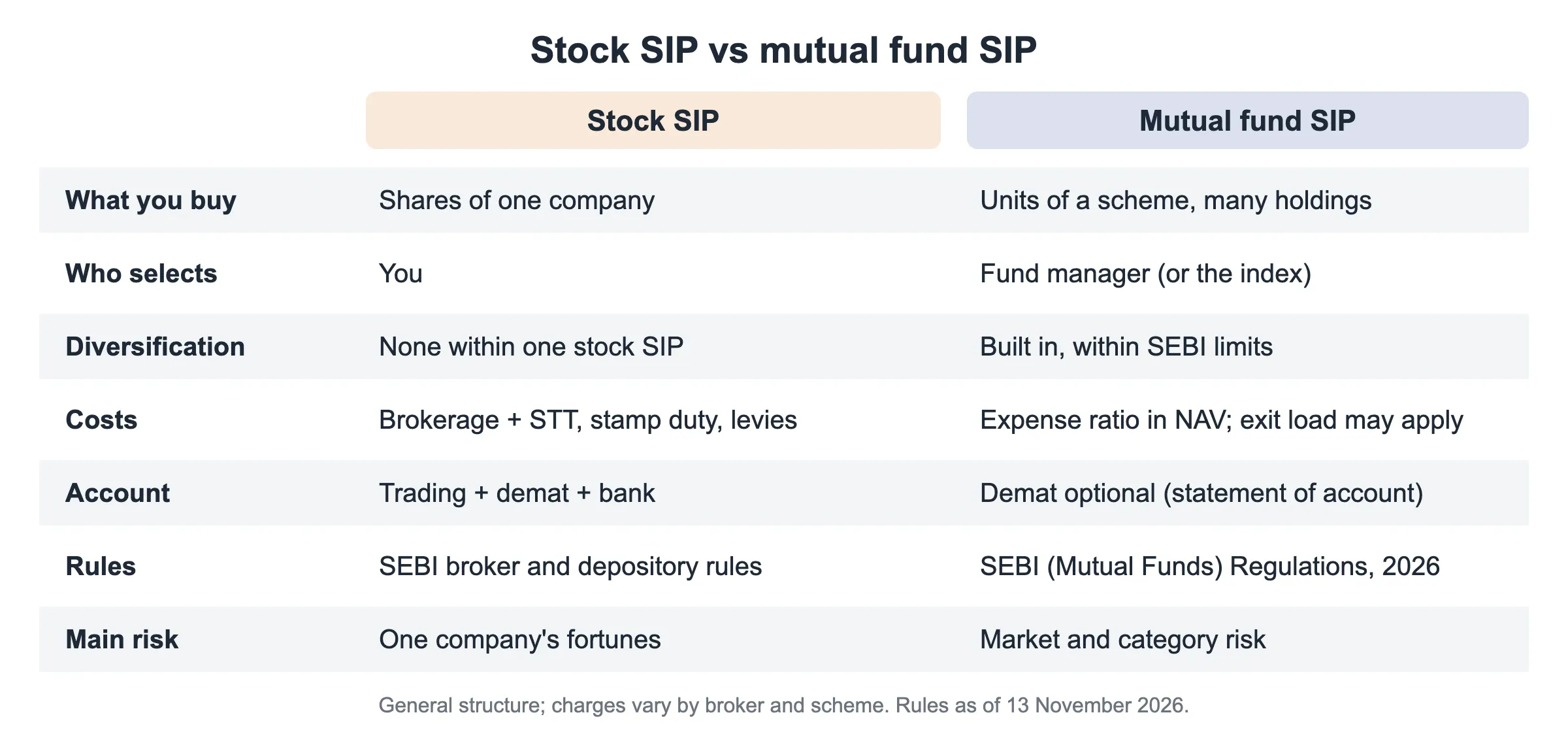
Who chooses the stocks in a mutual fund SIP versus a stock SIP?
In a mutual fund SIP, you choose the scheme and the fund manager chooses the holdings, within the objective and asset allocation set out in the scheme information document (SID). An index fund simply holds what its index holds.
In a stock SIP, you pick the company and the broker buys it on schedule. Nobody reviews whether it still fits your plan unless you do. A fund SIP hands research and rebalancing to a manager for a fee; a stock SIP keeps both jobs, and the time they take, with you.
One company vs many: what concentration does
Here is a worked example. It is hypothetical; not a promise; returns vary. Both routes can lose money.
Take ₹4,500 a month for 12 months, a total of ₹54,000.
- Route A, stock SIP: every instalment buys shares of one company.
- Route B, mutual fund SIP: every instalment buys units of an equity fund that holds the same company at an assumed 5% of its portfolio.
Suppose that company ends the year 30% below your average buy price.
- Route A: ₹54,000 × (1 − 0.30) = ₹37,800, a fall of ₹16,200.
- Route B: the company is about ₹2,700 of your ₹54,000 (5%). A 30% fall on that slice costs about ₹810, or 1.5% of what you put in.
That ₹810 is only that one company's effect. The other ₹51,300 (95%) in Route B moves with the fund's other holdings and can fall too. Diversification spreads company risk; it does not remove market risk.
Concentration works both ways. If the company instead ends 30% higher, Route A is worth ₹70,200 (a gain of ₹16,200), while in Route B it adds about ₹810. One stock magnifies one company's outcome, either way.
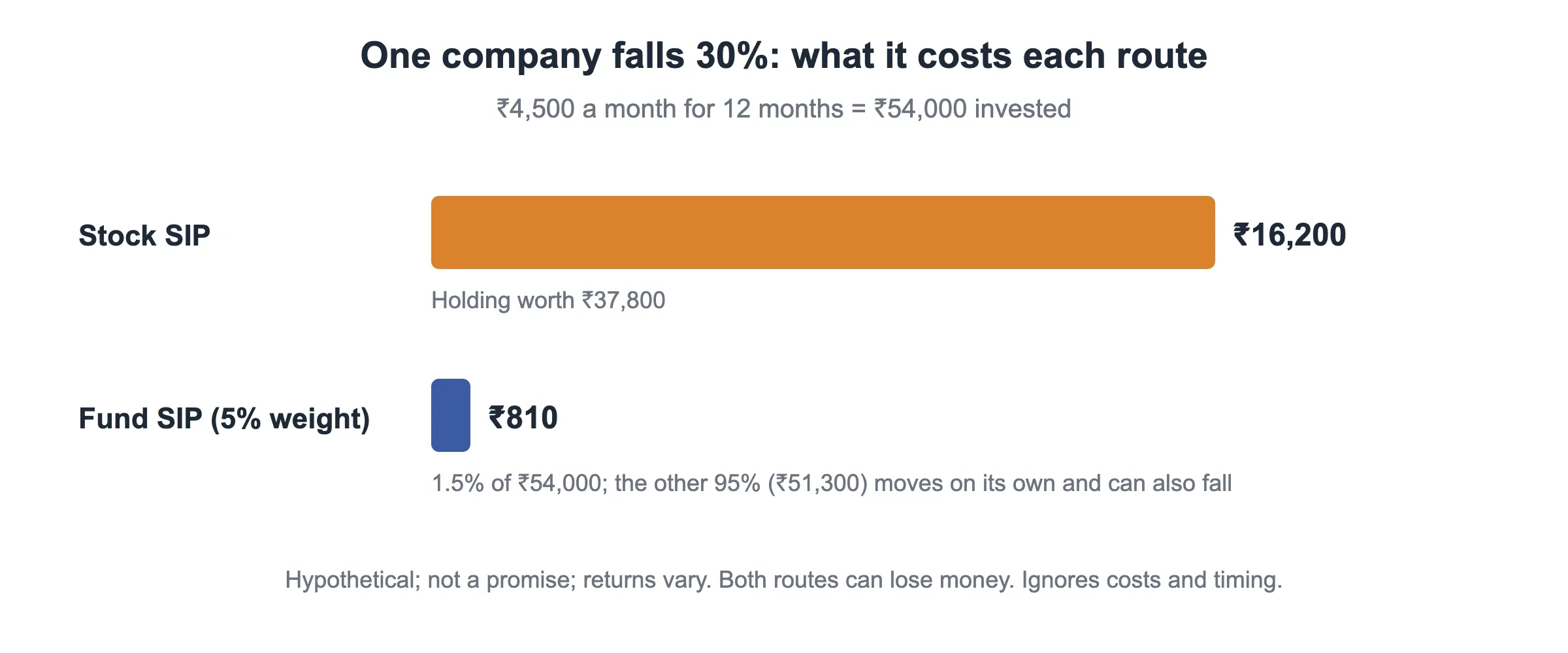
The example assumes a steady 5% weight and ignores costs and timing; real fund weights change.
Do I need a demat account for a stock SIP?
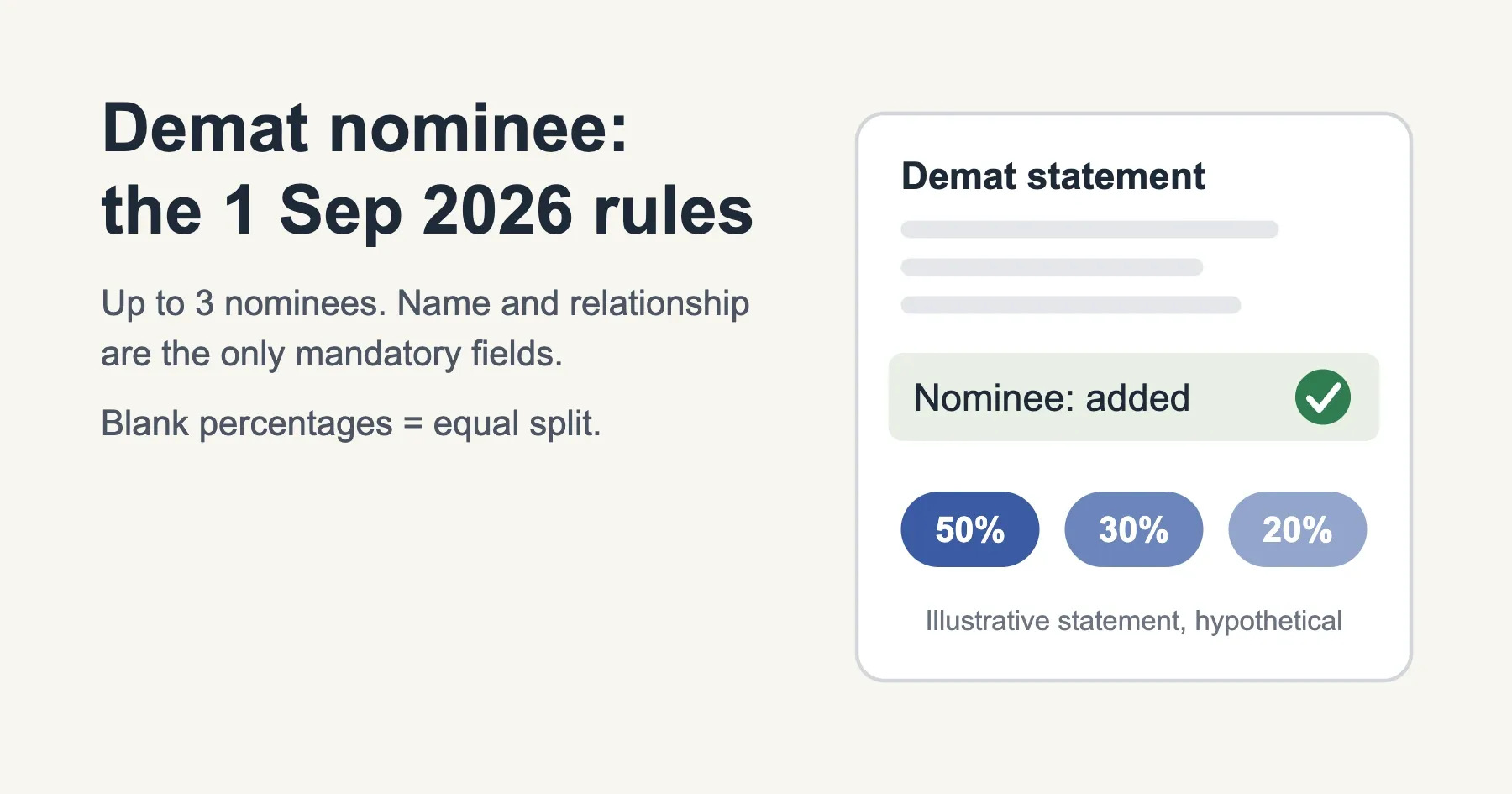
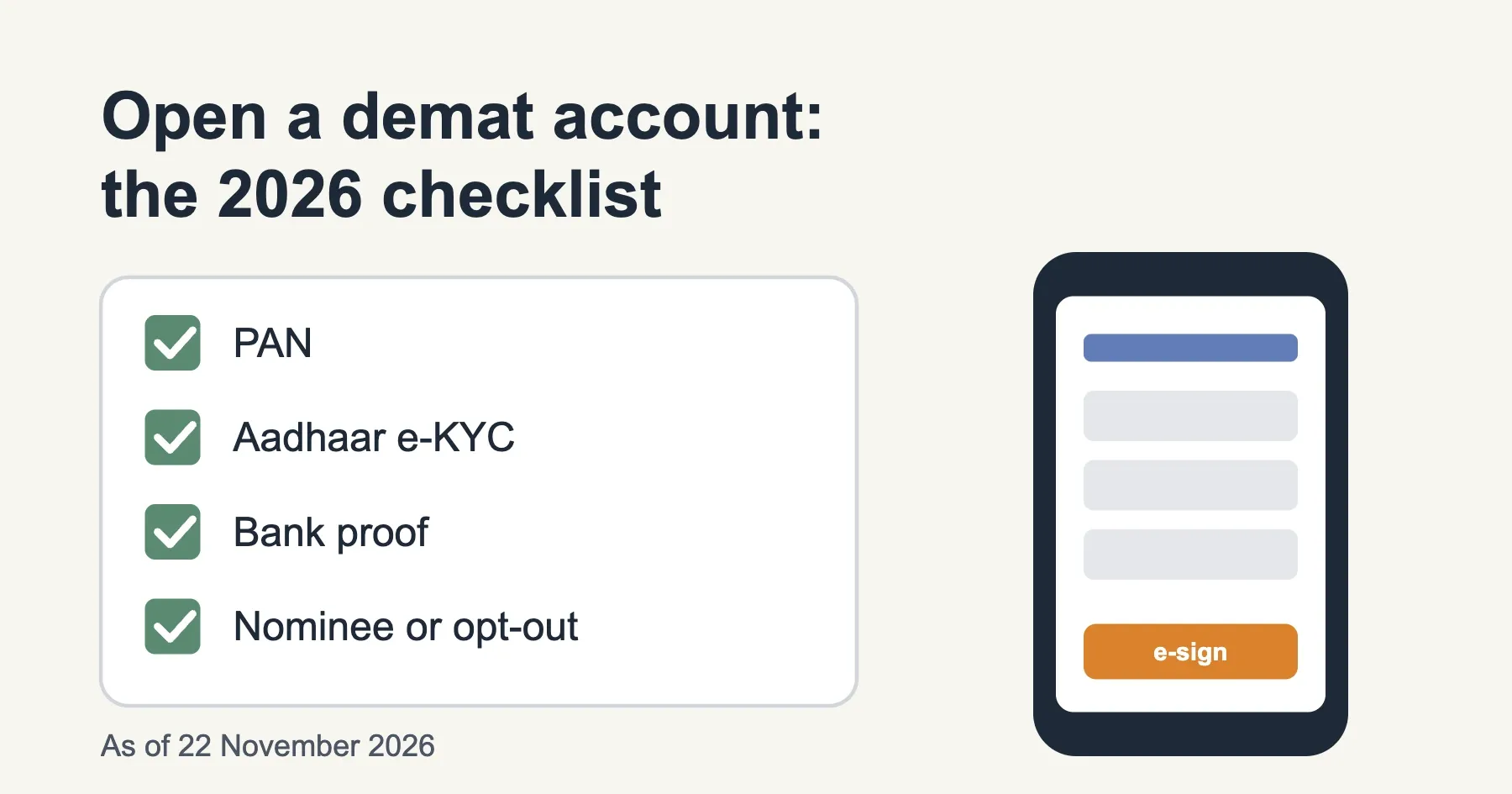
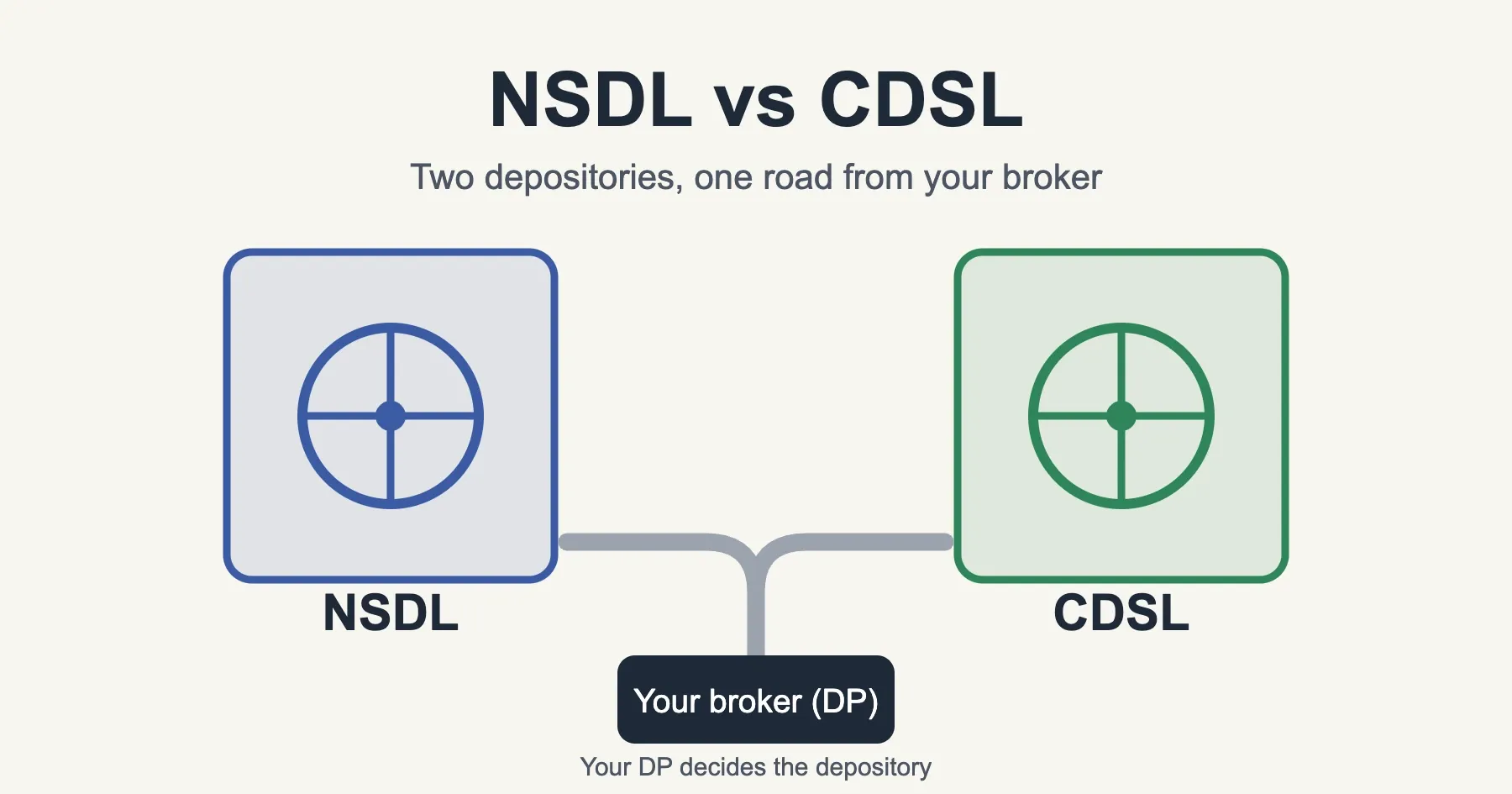
Yes. SEBI's investor-education material says to link your trading, demat and bank accounts before buying shares online. The shares sit in your demat account with a depository participant, under NSDL or CDSL.
A mutual fund SIP is different. Under SEBI's Mutual Funds Regulations, 2026, an investor can receive units in either statement of account mode or demat mode. So demat is optional for a fund SIP, though units traded on an exchange, such as ETF units, need it. Our guide on investing in mutual funds without a demat account has the details.
How a stock SIP executes (a fixed number of shares or a fixed amount, order timing) varies by broker, so read its terms first.
What are the charges in a stock SIP compared with a mutual fund SIP?
Stock SIP. Each instalment is a separate trade. SEBI's FAQ for stock-broker clients lists what a broker can charge: brokerage, Securities Transaction Tax (STT) as applicable, stamp duty as applicable and taxes on the broker's service. You get a tariff sheet at account opening and a contract note within 24 hours of each trade. On a small monthly amount, a fixed per-order charge takes a bigger share of each instalment, so check the tariff sheet against your SIP size.
Mutual fund SIP. The main running cost is the total expense ratio, which SEBI defines as the ratio of all expenses charged to the scheme's investors to its assets under management. It is deducted daily within the NAV, with no separate bill. An exit load may apply if you redeem early. Our explainer on the expense ratio shows how it works.
Is a stock SIP better than a mutual fund SIP for beginners?
It depends on what you are ready to do. Use this rule.
A mutual fund SIP fits if you want diversification from your first instalment, do not yet have the time or the method to study companies, or do not have a demat account and would rather not open one yet.
A stock SIP fits if you have studied the business, can accept a sharp fall in one company, already hold diversified investments, and will review the holding yourself.
Check these before choosing:
- Can I explain, in two lines, why I own this company?
- What would I do if it fell 30%, as in the example above?
- What does each instalment cost me, after brokerage and levies, as a share of ₹4,500?
- Who reviews this holding next year?
Some investors hold both, with a fund SIP as the core. Our piece on how many mutual funds a beginner needs helps you size that core first.
Frequently asked questions
Is a stock SIP regulated like a mutual fund?
Not in the same way. A mutual fund scheme is governed by SEBI's Mutual Funds Regulations, 2026. A stock SIP is a broker facility for regular buy orders; the broker and depository are SEBI-regulated, but no scheme, fund manager or SID sits behind your purchases.
Can I hold both a stock SIP and a mutual fund SIP?
Yes. They run independently. Decide how much of your money each one should carry before you start.
Does a stock SIP average my cost like a fund SIP?
Regular buying averages your purchase price in both. Averaging does not help if the company itself declines for good.
What protection is there if my broker defaults?
Every stock exchange is required to maintain an Investor Protection Fund to compensate investors, within its rules, when a defaulting broker's assets fall short. It does not cover a fall in share prices.
Read next
Wondering if a fund SIP needs a demat account at all? That one has a short answer: mutual funds without a demat account. For the basics, go back to our guide to what an SIP is, or check whether an SIP is risk free.
— Laabh