How to start an SIP in your child's name: who pays, who gets paid, and what changes at 18
How to start an SIP in a minor's name: who can pay, where redemption money goes, documents, and what changes at 18. Dated to SEBI rules.
Summarize this article with AI





The short version
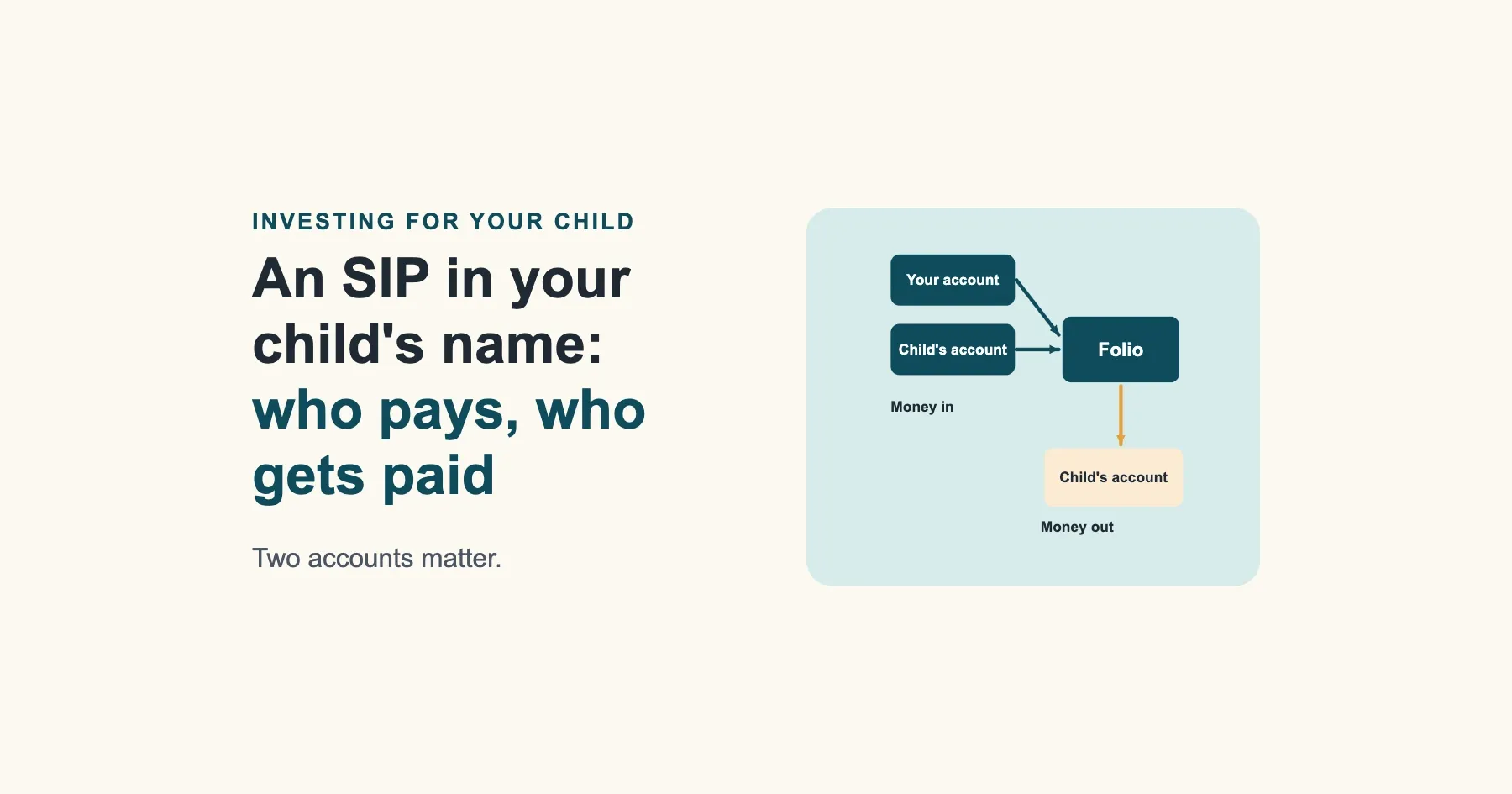
- Money in can come from the child's, a parent's or a legal guardian's account, or the child's joint account with them. Money out goes only to the child's verified account.
- The SIP runs only up to the 18th birthday. At 18 the folio is frozen for the guardian and paused until the status change.
- Your own name keeps flexibility; your child's name keeps the money clearly theirs. As of 4 November 2026, a minor's income is generally added to a parent's income either way.
To start an SIP for your child in the minor's own name, you open a minor folio: your child is the only holder, and you act as guardian (a parent or a court-appointed guardian). The instalments can come from the child's bank account, a parent's or legal guardian's account, or the child's joint account with a parent or guardian, but redemption money goes only to the child's own verified bank account. The SIP runs only up to the 18th birthday; after that the folio pauses until your child, now an adult, completes the minor-to-major status change.
Revathi, 30, a college librarian in Tiruchirappalli (fictional), wants to put ₹2,000 a month aside for her four-year-old daughter. Her first real question is not which fund but which bank accounts: two accounts matter, the one that pays and the one that gets paid. The rulebook here is SEBI's circulars of 24 December 2019 and 12 May 2023 and AMFI's guidelines on minors' accounts.
How do I start an SIP in my child's name?
An SIP (Systematic Investment Plan) in a minor folio needs a few extra papers. In order:
- Do your own KYC as guardian. Fund-house forms ask for the guardian's KYC status (check the form you use).
- Gather the child's date-of-birth proof. AMFI's guidelines list a birth certificate, school leaving certificate or mark sheet, passport, or any other suitable proof of the date of birth.
- Add proof of relationship. A parent gives a document showing the relationship with the child. A court-appointed guardian gives a copy of the court order.
- Choose the paying account. It must be one of the accounts SEBI allows (next section).
- Give the child's bank account for payouts. This is where any redemption money will land.
- Set the SIP end date before the 18th birthday. AMFI's guidelines say standing instructions in a minor's folio are registered or executed "only till prior to the date of the minor attaining majority".
Whether the child needs a PAN at this stage differs between fund houses and platforms, so ask the fund house before you apply.
Money in, money out: the two bank accounts
SEBI's 12 May 2023 circular (effective 15 June 2023) treats the two directions differently.
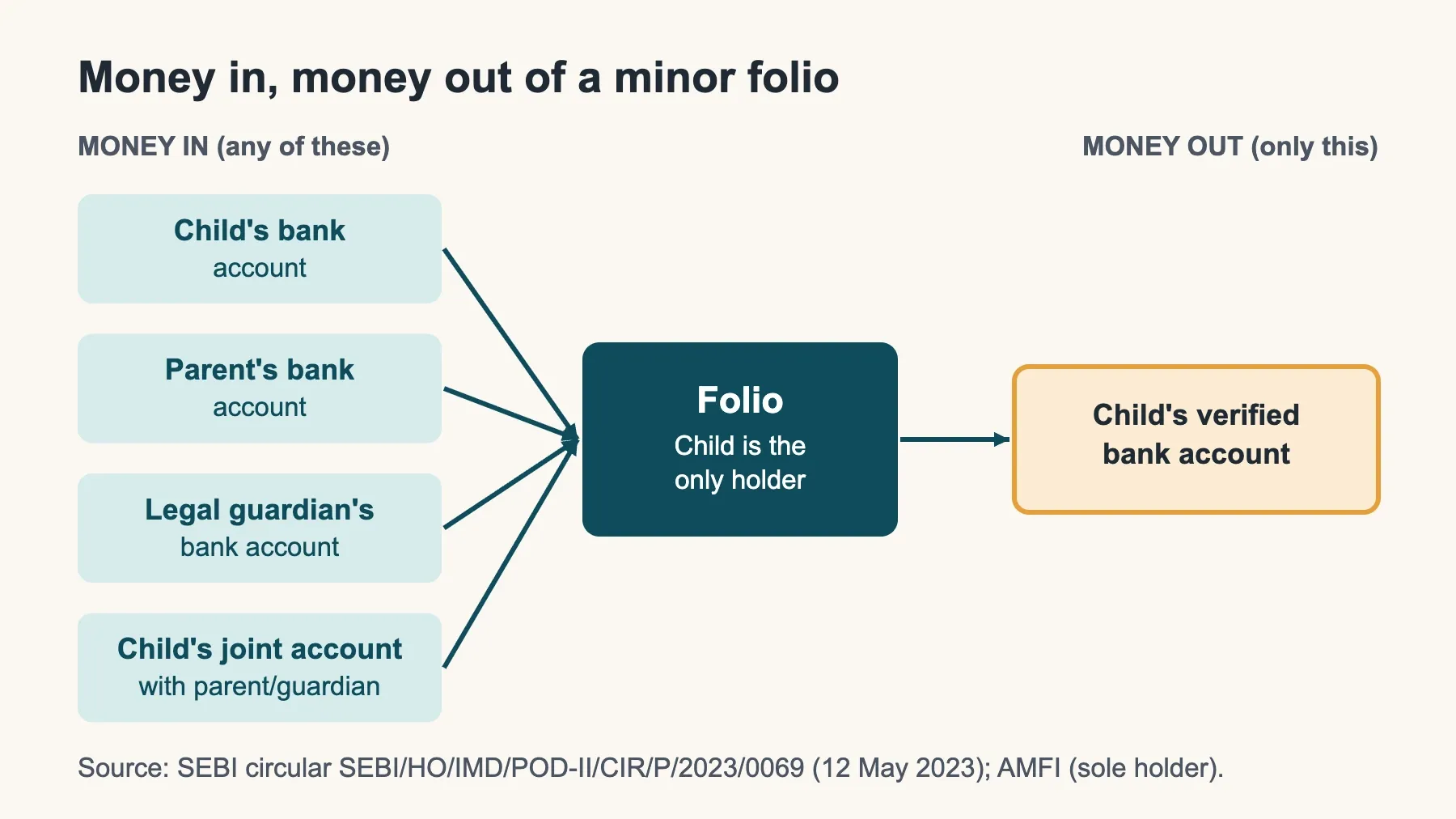
Money in. Payment by any mode is accepted from:
- the minor's bank account,
- a parent's or legal guardian's bank account, or
- a joint account of the minor with a parent or legal guardian.
Money out. "Irrespective of the source of payment for subscription", the circular says, "all redemption proceeds shall be credited only in the verified bank account of the minor". That is the account the minor holds with the parent or legal guardian, after KYC.
The catch: Revathi can pay from her salary account, but money withdrawn lands in her daughter's account, not hers. If your child has no bank account yet, open one well before you might need to redeem.
For existing folios, the circular has fund houses insist on a Change of Pay-out Bank mandate before processing a redemption, so check which account is registered for payouts.
A hypothetical example: Revathi's ₹2,000 a month
Revathi's daughter is four, so an SIP that has to stop before her 18th birthday has 14 years to run: 168 monthly instalments of ₹2,000.
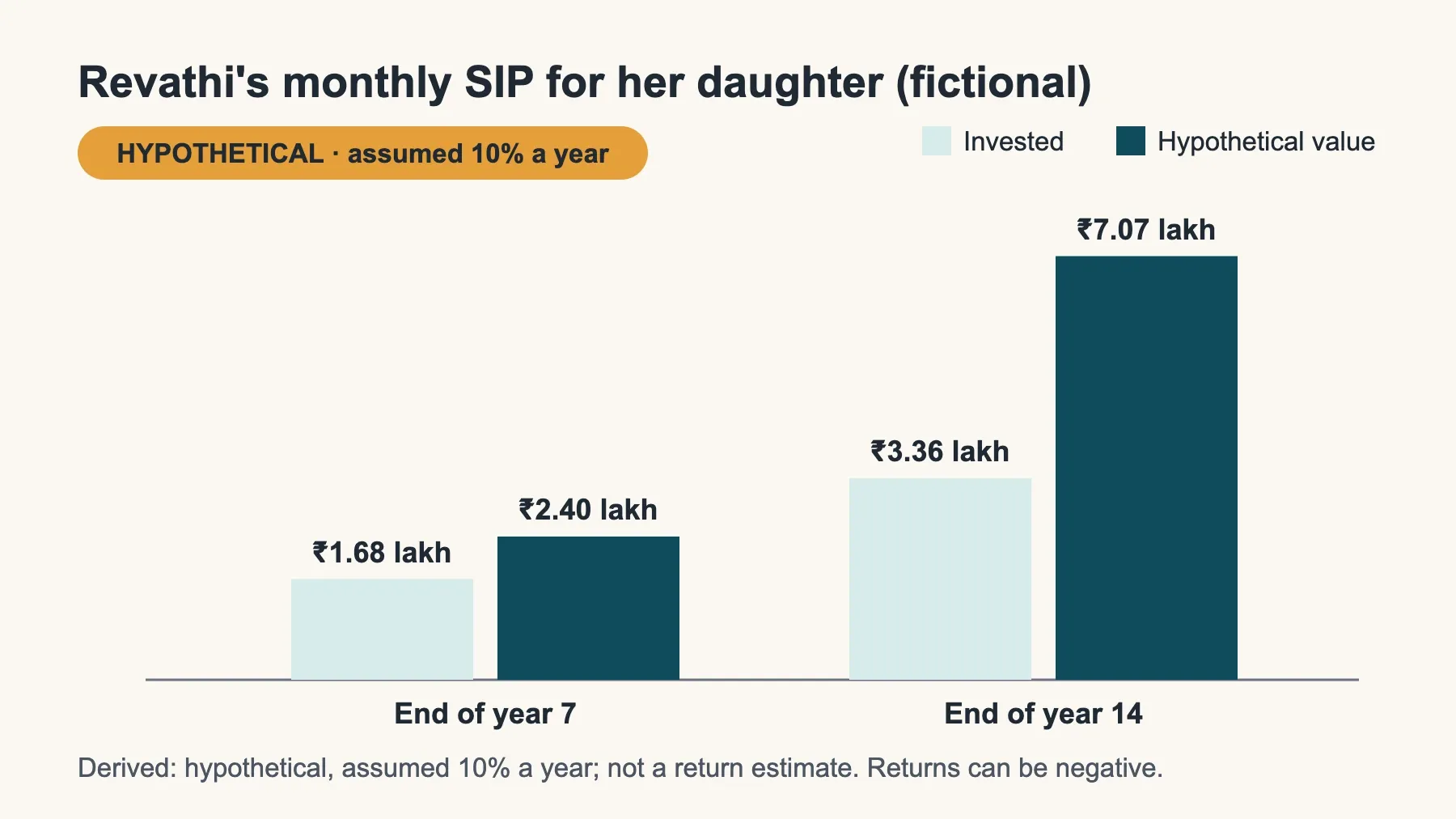
| Point in time | Instalments | Amount invested | Hypothetical value at an assumed 10% a year |
|---|---|---|---|
| End of year 7 | 84 | ₹1,68,000 | about ₹2.40 lakh (₹2,39,846) |
| End of year 14 | 168 | ₹3,36,000 | about ₹7.07 lakh (₹7,07,238) |
How we worked it out: an assumed 10% a year, converted to a monthly rate of (1.10)^(1/12) − 1, about 0.797%, with each ₹2,000 paid at the start of the month. Value = 2,000 × [((1 + r)^n − 1) ÷ r] × (1 + r), with n = 84 or 168.
Hypothetical, assumed rate, not a return estimate; returns can be negative. The value in any year could be below the amount invested. See also what happens to your SIP when the market falls and how long should you continue your SIP.
What happens when your child turns 18?
- Notice. AMFI's guidelines of 16 July 2020 ask fund houses to send an advance intimation to the minor's registered address at least 30 days before majority, with the status-change form. We found no later AMFI text changing this; if no notice arrives, ask the fund house, and note the date yourself too.
- Freeze. AMFI's guidelines say the folio is frozen for operation by the guardian on the day the minor attains majority.
- No transactions. SEBI's 2019 circular says "No further transactions shall be allowed till the status of the minor is changed to major."
- Standing instructions stop. The same circular has fund houses build a system control so that SIP, STP and SWP instructions are suspended at majority until the status changes.
The catch: the units belonged to your child from day one, but at 18 nothing moves until the young adult acts.
The age-18 checklist (from AMFI's guidelines):
- Get a PAN and complete KYC in the young adult's own name.
- Update the bank account to their own name, or open a new one.
- Submit the minor-to-major form with a PAN copy, KYC acknowledgement, a cancelled cheque with their name printed (or a recent bank statement or passbook) and a nomination form.
- Sign a fresh SIP, STP or SWP mandate if they want to continue.
We have not found a fixed deadline for this in a SEBI or AMFI document; if a fund house gives one, it is its own process.
My name or my child's name?
You can also invest in your own name for your child's goal. Each route wins on one path.
| In your child's name (minor folio) | In your own name | |
|---|---|---|
| Who owns the units | The child, from day one | You |
| Who transacts until 18 | You, as guardian | You |
| Where redemption money goes | Only the child's verified bank account | Your registered bank account |
| After 18 | Frozen until the young adult completes the status change; then they control it | Unchanged; you decide how to use or give the money |
| SIP end date | Before the 18th birthday | Any date you choose |
| Tax, as of 4 November 2026 | Income from the child's units is added to the income of the parent with the higher income, with exceptions (section 99, Income-tax Act, 2025) | Taxed as your income |
| The catch | You give up control at 18 | Nothing in the folio marks it as the child's money |
On tax. As of 4 November 2026, section 99 of the Income-tax Act, 2025, as published on the Income Tax Department's website, includes a minor child's income in the income of the parent whose total income is greater (or, if the parents' marriage does not subsist, the parent who maintains the child). It excludes income from the child's own work or skill, and a child with a specified disability. So the child's name alone does not move the tax away from you. Tax rules change; consult a tax professional for your situation.
Frequently asked questions
Can I pay my child's SIP from my own bank account?
Yes, if you are the child's parent or legal guardian. SEBI's 12 May 2023 circular accepts payment from a parent's or legal guardian's account, as well as the minor's own or joint account. Redemption money still goes only to the child's verified bank account.
Does my child need a separate bank account to invest in mutual funds?
Yes, for payouts. You can pay from your own account, but redemption proceeds go only to the minor's verified bank account, held with a parent or legal guardian. Open it before you need to withdraw.
What documents do I need to invest in a minor's name?
The child's date-of-birth proof (birth certificate, school leaving certificate or mark sheet, or passport), plus relationship proof from a parent or the court order for a court-appointed guardian. Expect a guardian KYC check, and ask whether the child's PAN is needed.
Will my child's SIP stop automatically at 18?
Yes. AMFI's guidelines register standing instructions only until just before majority, and SEBI's 2019 circular suspends SIP, STP and SWP instructions at majority until the status changes. To continue, the young adult completes KYC, updates the bank account and signs a fresh mandate.
Can grandparents start an SIP for a grandchild?
Our reading of the 2023 circular: a grandparent can pay from their own account only if they are the child's legal guardian, because the circular's list names only the minor's, a parent's or a legal guardian's account. If grandparents want to help another way, ask the fund house first.
What to do next
Children's Day falls on Saturday, 14 November. Before it, a few checks you can do on your own:
- Write down which bank account would receive the money if you redeemed.
- If your child has no bank account, open one first.
- Decide which account you will pay from: yours, your child's, or your joint account with your child.
- Find your child's date-of-birth proof and your relationship proof.
- Note the day before your child's 18th birthday as the latest SIP end date, and read the scheme's SID and KIM.
- Revisit each year: the bank details on the folio and the SIP end date.
— Laabh



