SIP returns after inflation: how to work out your real return, and why you can't just subtract
Real return = (1 + nominal) ÷ (1 + inflation) − 1. See a hypothetical SIP in nominal and today's rupees, and how to inflate your goal. Assumed rates only.
Summarize this article with AI





The short version
- Real return = (1 + nominal) ÷ (1 + inflation) − 1; subtraction slightly overstates it.
- At an assumed 12% return and 6% inflation, the real rate is about 5.66%, not 6%.
- Hypothetical ₹5,900/month for 20 years: ≈₹58.95 lakh on paper at an assumed 12% is ≈₹18.38 lakh in today's rupees.
- Inflate the goal or deflate the SIP value, but use the same inflation assumption on both sides.
- You control the amount, the years and step-ups; returns and inflation you can only assume.
Short answer (as of 19 November 2026): Your real return is what your money earns after inflation: real return = (1 + nominal return) ÷ (1 + inflation) − 1. With an assumed 12% return and assumed 6% inflation, that is about 5.66%, not 6%. SIP returns are not guaranteed, so any rate you plug in is an assumption, not a forecast.
An SIP calculator can tell you that a few thousand rupees a month becomes "₹58 lakh". What it rarely tells you is what that ₹58 lakh will buy when you finally hold it. This guide shows the maths behind that gap, step by step, so you can convert both your SIP value and your goal into today's money before judging either one.
Nominal return vs real return
The nominal return is the growth you see on your statement. It is the rate a calculator asks for, and the rate behind measures like CAGR and XIRR (see our guide to XIRR in an SIP).
The real return is that growth after adjusting for inflation, which is the rise in prices over time. It tells you how much your purchasing power has grown, which is what actually matters when you spend the money on a goal.
The formula, and why subtraction is only a shortcut
The exact formula is:
Real return = (1 + nominal return) ÷ (1 + inflation) − 1
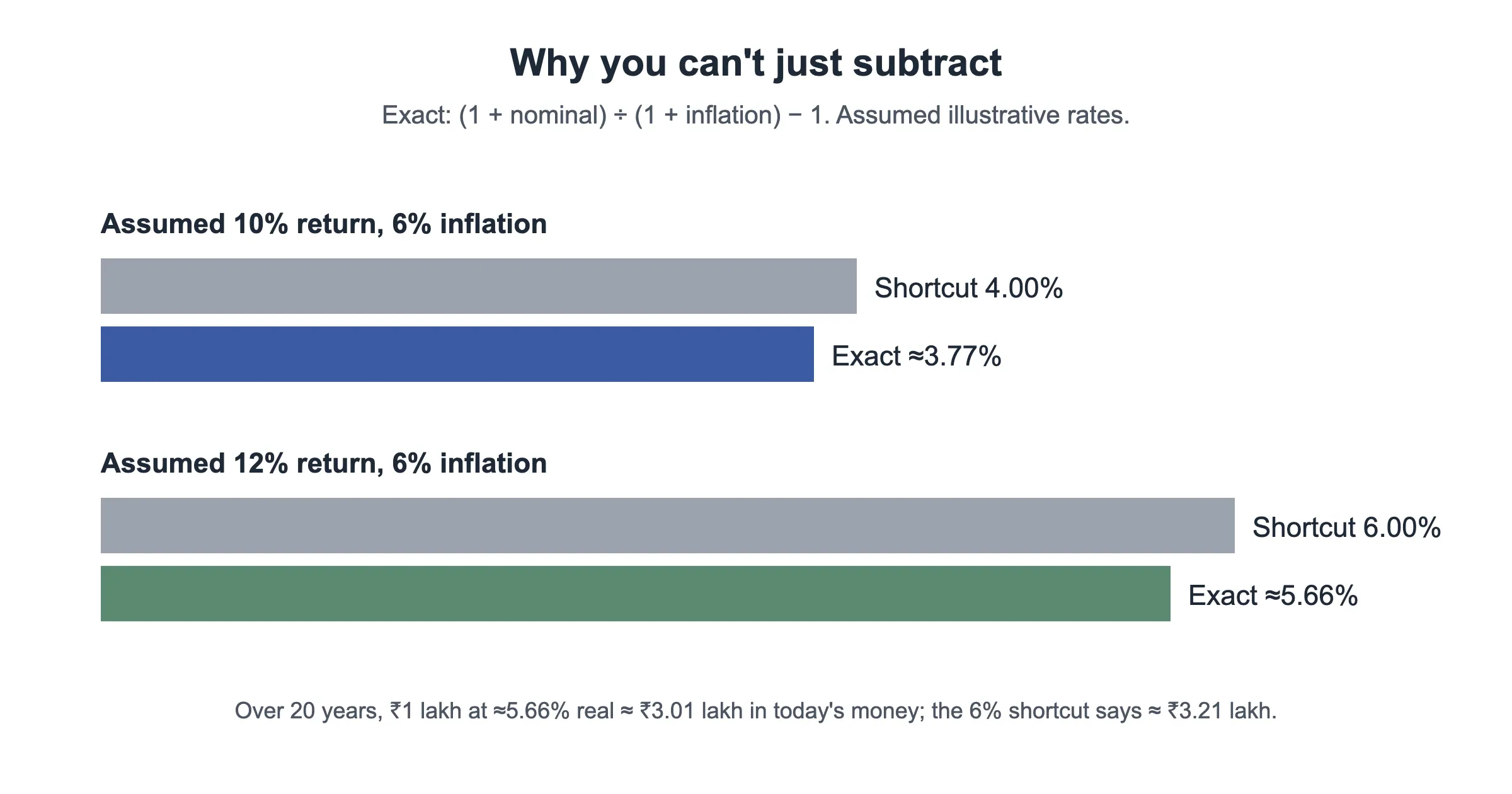
The common shortcut is "nominal minus inflation". It is close when both rates are small, but it overstates the real return whenever inflation is positive and the return is above inflation, because it ignores the fact that inflation also eats into this year's gains.
| Assumed nominal return | Assumed inflation | Subtraction shortcut | Exact real return |
|---|---|---|---|
| 10% | 6% | 4.00% | ≈3.77% |
| 12% | 6% | 6.00% | ≈5.66% |
A third of a percentage point sounds trivial. Compound it and it is not. At an assumed real 5.66% a year, ₹1 lakh grows to about ₹3.01 lakh in today's money over 20 years. Using the 6% shortcut gives about ₹3.21 lakh. The shortcut overstates the result by roughly ₹20,000 on every lakh, which is the kind of gap that quietly widens a shortfall on a long goal.
Worked example: one SIP in nominal and today's rupees
Here is a hypothetical SIP of ₹5,900 a month. The rates are assumed illustrative rates, not forecasts:
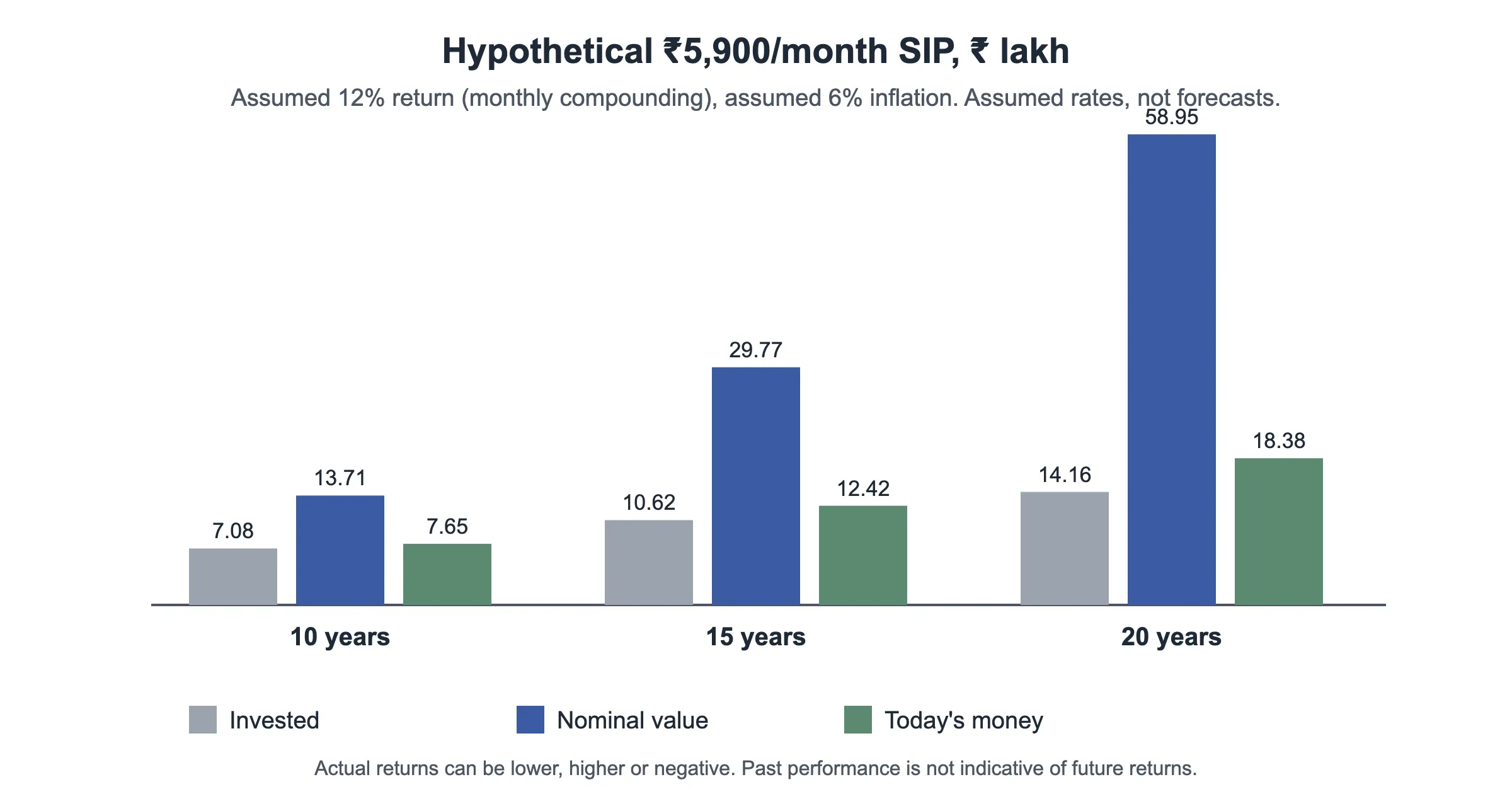
- Nominal return: an assumed 10% or 12% a year, compounded monthly (10% ÷ 12 or 12% ÷ 12 each month), with each instalment invested at the start of the month.
- Inflation: an assumed 6% a year.
- Today's-money value = nominal value ÷ 1.06^years.
| Years | Total invested | At assumed 10%: nominal / today's money | At assumed 12%: nominal / today's money |
|---|---|---|---|
| 10 | ₹7,08,000 | ≈₹12.19 lakh / ≈₹6.80 lakh | ≈₹13.71 lakh / ≈₹7.65 lakh |
| 15 | ₹10,62,000 | ≈₹24.66 lakh / ≈₹10.29 lakh | ≈₹29.77 lakh / ≈₹12.42 lakh |
| 20 | ₹14,16,000 | ≈₹45.18 lakh / ≈₹14.09 lakh | ≈₹58.95 lakh / ≈₹18.38 lakh |
Hypothetical illustration using assumed rates; actual returns can be lower, higher or negative. Past performance is not indicative of future returns.
What the table shows: at an assumed 10% return and 6% inflation, ≈₹45.18 lakh on paper is ≈₹14.09 lakh in today's rupees. At an assumed 12%, ≈₹58.95 lakh on paper is ≈₹18.38 lakh in today's rupees. The bigger number is not wrong. It is simply measured in rupees that will buy less than today's rupees do.
Two notes on reading the table:
- The "total invested" column is in rupees paid at different times, so it is not in today's money either. Each ₹5,900 paid in year 20 is worth less, in today's terms, than the ₹5,900 paid in month one.
- Changing the compounding convention (for example, using an effective annual rate instead of dividing by 12) changes these figures slightly. What matters is that you know which convention a calculator uses.
Inflating the goal: what a future cost looks like
The second half of the maths is the goal itself. A goal priced in today's rupees will cost more later. The step is:
Future cost = today's cost × (1 + inflation)^years
Taking a hypothetical goal that costs ₹20 lakh today and an assumed 6% inflation:
- In 10 years, it would cost about ₹35.82 lakh.
- In 20 years, it would cost about ₹64.14 lakh.
Run it backwards and you get the question many first-time investors ask: what is ₹1 crore in 20 years worth today? At an assumed 6% inflation, ₹1 crore received 20 years from now has the buying power of about ₹31.2 lakh today. Over 10 years, it would be about ₹55.84 lakh.
So there are two honest ways to compare an SIP with a goal:
- Inflate the goal into future rupees, and compare it with the SIP's nominal value, or
- Deflate the SIP's value into today's rupees, and compare it with the goal's price today.
Both give the same answer, provided you use the same inflation assumption on both sides. The mistake is mixing them: comparing a nominal SIP value with a goal priced in today's money.
Which inflation number should you use?
For India, the headline measure is the Consumer Price Index (CPI), published monthly by the National Statistics Office under the Ministry of Statistics and Programme Implementation (MoSPI). The RBI's Monetary Policy Committee sets policy with reference to a CPI-based inflation target, and its policy statements discuss how headline inflation compares with that target's tolerance band.
As of 19 November 2026, MoSPI's latest release (dated 12 November 2026, on base 2024=100) puts all-India CPI inflation at 6.09% for October 2026 (provisional), up from 5.54% for September 2026 (final).
Three points to keep in mind:
- CPI is past data. It tells you what prices did over the last year. It does not tell you what inflation will be over your 10 or 20 years.
- Your own inflation may differ. CPI is an all-India basket. If your goal is a specific cost, such as education fees or a home, its price may rise faster or slower than CPI.
- Pick an assumption and label it. The 6% used in this guide is an assumption chosen for illustration. It is not derived from, or a forecast based on, any single month's print. Testing a higher and a lower figure shows how sensitive your plan is.
Is "12%" a realistic SIP return?
Every return figure in this article is an assumed illustrative rate. Equity mutual fund returns are market-linked: they vary year to year, can be negative over some periods, and are not guaranteed. Past performance is not indicative of future returns, and no single long-run average tells you what your SIP will earn.
What you can do is stop treating 12% as a promise and treat it as one scenario among several:
- Run the maths at more than one assumed return, as the table above does with 10% and 12%. A lower-return scenario is a useful stress test.
- Convert every scenario into today's money with the real-return formula. At an assumed 12% and 6%, the real rate is ≈5.66%. At an assumed 10% and 6%, it is ≈3.77%.
- Remember that costs, taxes on redemption and your actual timing of instalments will also affect what you end up with.
The point is not to decide whether 12% will happen. It is to see what your plan looks like if it doesn't.
What you control: amount, years and step-ups
You can't set the market's return or the inflation rate. You can set three inputs:
- The monthly amount. The value of an SIP scales with the instalment. Under the same assumptions, an SIP twice the size ends up with twice the value.
- The number of years. In the hypothetical table, at an assumed 12% and 6%, going from 15 to 20 years lifts the today's-money value from ≈₹12.42 lakh to ≈₹18.38 lakh. Time does a lot of the work, as our guide to how SIP compounding works explains.
- Step-ups. Raising the SIP as your income rises helps your contributions keep pace with prices. Our guide to how much to step up an SIP walks through how to size an increase.
A simple routine: once a year, re-price your goal in today's rupees, check your SIP's value in today's rupees, and adjust the amount or the timeline if the gap has widened.
Frequently asked questions
What is the real return of my SIP after inflation?
It is the growth in your purchasing power: real return = (1 + nominal return) ÷ (1 + inflation) − 1. With an assumed 12% nominal return and assumed 6% inflation, it is about 5.66% a year. These are illustrative assumptions; SIP returns are market-linked and not guaranteed.
If my SIP gives 12% and inflation is 6%, is my real return 6%?
Not exactly. Subtracting gives 6%, but the exact formula gives (1.12 ÷ 1.06) − 1 ≈ 5.66%. Over 20 years, ₹1 lakh grows to about ₹3.01 lakh in today's money at 5.66%, versus about ₹3.21 lakh if you use the 6% shortcut. Both rates here are assumptions, not forecasts.
How do I increase my SIP goal amount for inflation?
Multiply today's cost by (1 + inflation) raised to the number of years. A hypothetical goal costing ₹20 lakh today would cost about ₹35.82 lakh in 10 years and about ₹64.14 lakh in 20 years at an assumed 6% inflation. Then compare it with the SIP's nominal value, not its today's-money value.
Is assuming 12% SIP returns realistic once inflation is counted?
No single rate can be called realistic for the future, because equity mutual fund returns vary and can be negative over some periods. Past performance is not indicative of future returns. Treat 12% as one assumed scenario, test a lower one such as 10%, and convert each into today's money: at an assumed 6% inflation, those give real rates of about 5.66% and 3.77%.
How much will ₹1 crore be worth in 20 years?
At an assumed 6% inflation, ₹1 crore received 20 years from now would buy about what ₹31.2 lakh buys today. Over 10 years, it would be about ₹55.84 lakh. A different inflation rate gives a different answer, so state your assumption.
A quick checklist before you trust an SIP projection
- Is the return labelled as an assumption, with the rate shown?
- Is the result shown in nominal rupees, today's rupees, or both?
- Is the goal inflated to the same future date, at a stated inflation rate?
- Did you use (1 + nominal) ÷ (1 + inflation) − 1 rather than subtraction?
- Have you tried at least one lower-return scenario?
If a projection fails any of these, it may still be useful, but it is incomplete.
— Laabh



