SIP compounding is mostly about the years you give it
In an SIP, early instalments compound longest, so starting earlier often beats investing more later. A hypothetical ₹10,000 example plus the rule of 72.
Summarize this article with AI





The short version
- Compounding means returns earn returns, and in an SIP the earliest instalments compound the longest.
- In our hypothetical example, starting five years earlier at ₹10,000 a month beat starting later at ₹16,000 a month at 8%, 10% and 12% (not a promise; returns vary).
- Growth looks slow at first because most of the early balance is your own money.
- The rule of 72 (72 ÷ rate) roughly estimates doubling time for a lump sum; it predicts no return.
- Unlike an FD, a mutual fund's return is not fixed or guaranteed.
The power of compounding in an SIP means your returns start earning returns of their own. Each instalment stays invested for a different length of time, and the earliest ones stay longest. So starting earlier can matter more than investing a little more later. Market-linked returns are not guaranteed and vary from year to year.
Kavya, 23, is two months into her first job in Hyderabad. She can start a ₹10,000-a-month SIP now, or wait five years and put in ₹16,000. Waiting sounds sensible. In the hypothetical numbers below, it trails at every rate we tested.
What is the power of compounding in SIP?
SEBI's investor education page describes compounding as earning interest "not only on the initial amount of money (the principal) but also on the accumulated interest". A lump sum compounds as one amount. An SIP is a series of small lump sums, one each month.
So in a 25-year SIP, the first instalment gets about 25 years to grow and the last one gets a month. The early instalments do most of the compounding work.
A worked split, at a hypothetical 10% a year (not a promise; returns vary): in a ₹10,000-a-month SIP for 25 years, the first five years' instalments (₹6 lakh) grow to about ₹57.2 lakh (hypothetical) by year 25. The last five years' instalments (also ₹6 lakh) reach about ₹7.8 lakh (hypothetical). Same money in, very different time invested.
How much difference does starting an SIP 5 or 10 years earlier make?
Assumptions: the instalment is invested at the start of each month, returns compound monthly at the annual rate divided by 12, and no costs or taxes are deducted. The rates of 8%, 10% and 12% a year are hypothetical, not a promise; returns vary, can be negative in some years and do not arrive evenly. They are not an expected return for any fund.
| Plan (hypothetical) | Total invested | At 8% | At 10% | At 12% |
|---|---|---|---|---|
| ₹10,000/month for 25 years (start now) | ₹30 lakh | ₹95.7 lakh | ₹1.34 crore | ₹1.90 crore |
| ₹10,000/month for 20 years (start 5 years later) | ₹24 lakh | ₹59.3 lakh | ₹76.6 lakh | ₹99.9 lakh |
| ₹16,000/month for 20 years (start 5 years later, invest more) | ₹38.4 lakh | ₹94.9 lakh | ₹1.23 crore | ₹1.60 crore |
| ₹10,000/month for 15 years (start 10 years later) | ₹18 lakh | ₹34.8 lakh | ₹41.8 lakh | ₹50.5 lakh |
All values are hypothetical and rounded.
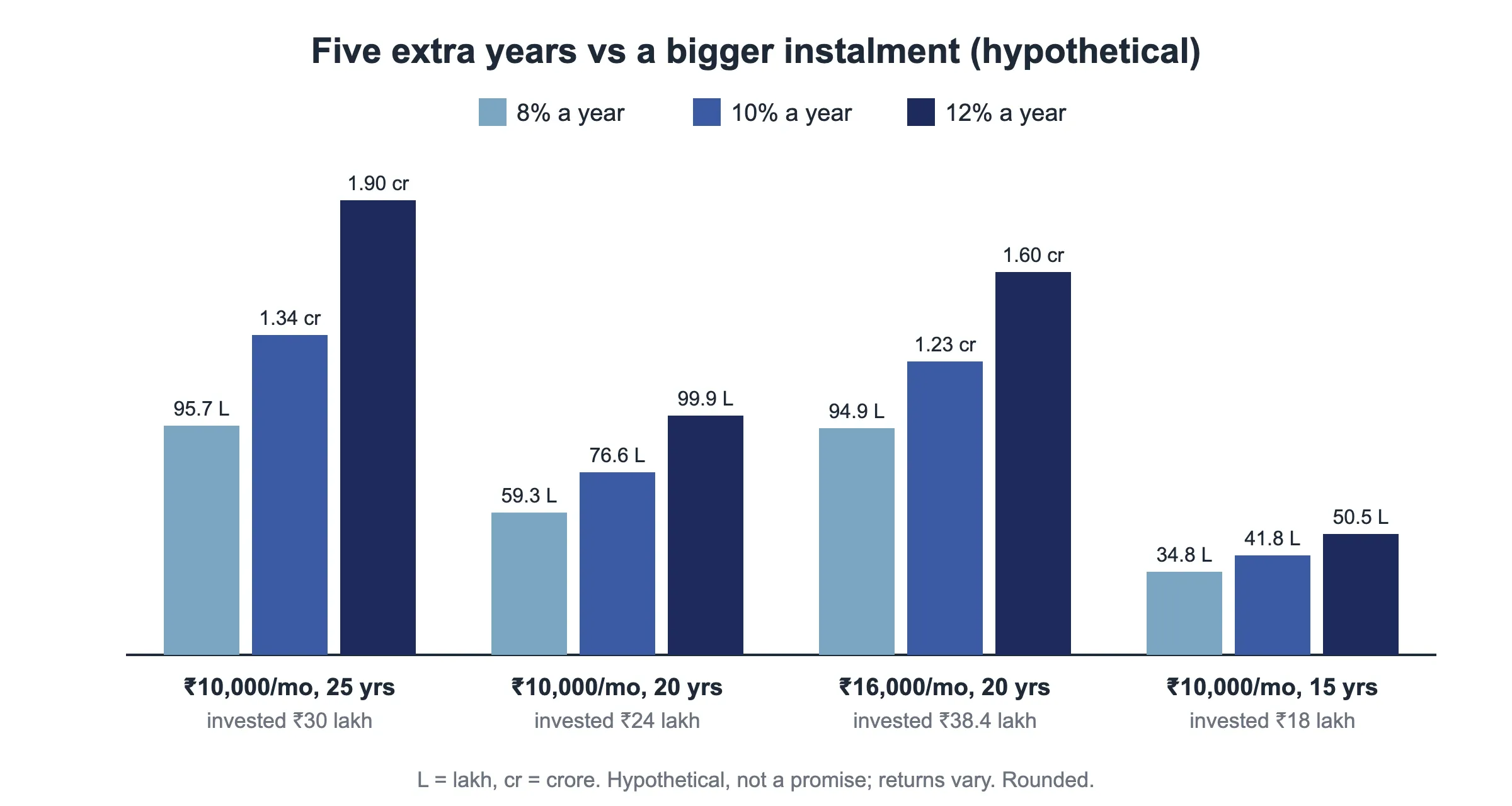
Three things stand out:
- Five years late at the same amount ends at about 53% to 62% of the early-start value (hypothetical).
- Five years late at ₹16,000 means investing ₹8.4 lakh more than the early starter, and still ending a little lower at 8% and clearly lower at 10% and 12% (hypothetical). The higher the assumed rate, the more the extra years matter.
- Ten years late at ₹10,000 ends at about 27% to 36% of the early-start value (hypothetical).
In these examples, time did more than the size of the instalment. A bigger instalment still helps a late starter; it just has to work harder to make up for missing years.
Why does SIP growth look slow in the first few years?
Because at first, most of your balance is your own money, and compounding works on what has already grown. Here is the same ₹10,000-a-month SIP at a hypothetical 10% a year, checked every five years.
| Year | Invested so far | Value (hypothetical) | Growth as a share of value |
|---|---|---|---|
| 5 | ₹6 lakh | ₹7.8 lakh | 23% |
| 10 | ₹12 lakh | ₹20.7 lakh | 42% |
| 15 | ₹18 lakh | ₹41.8 lakh | 57% |
| 20 | ₹24 lakh | ₹76.6 lakh | 69% |
| 25 | ₹30 lakh | ₹1.34 crore | 78% |
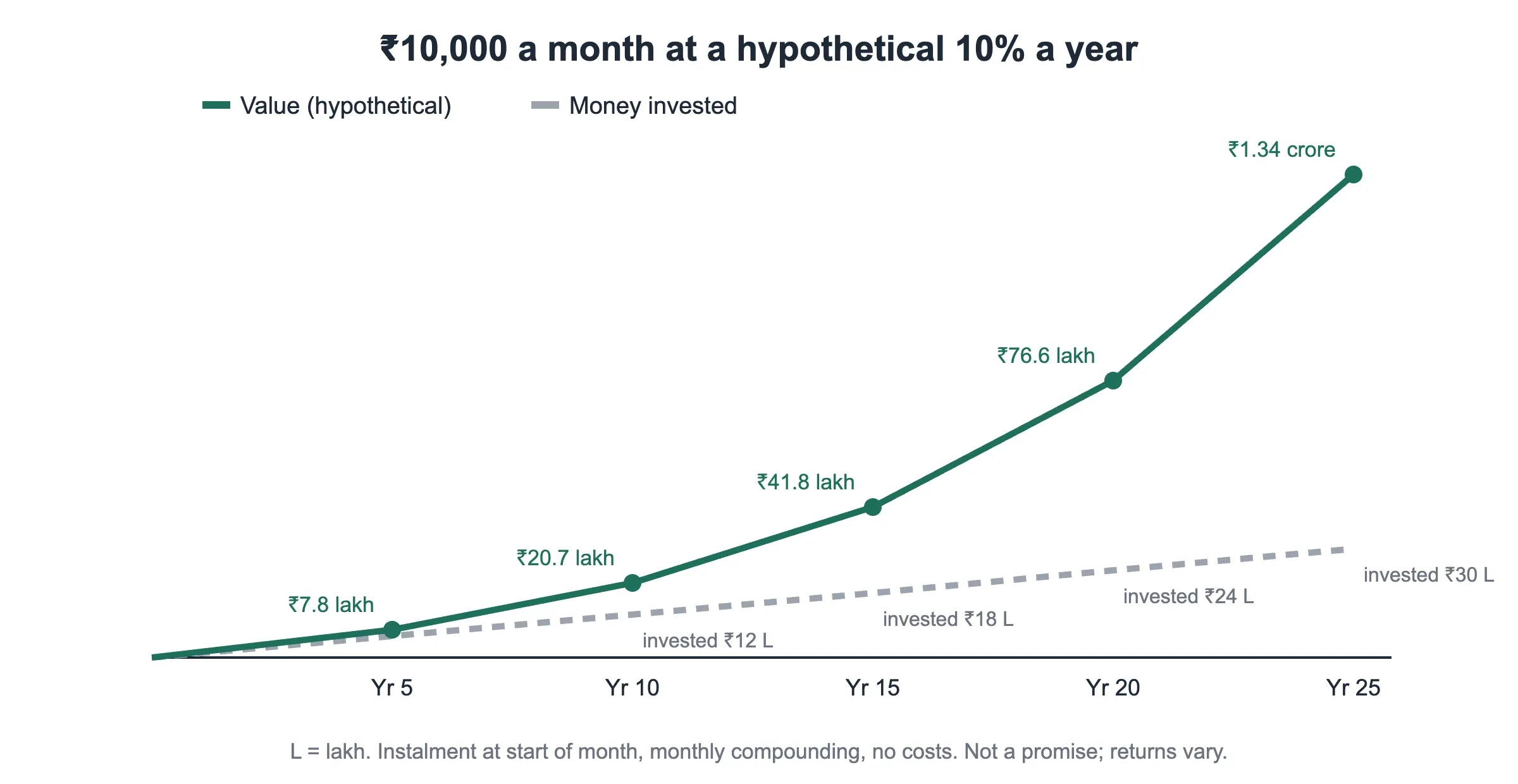
In year five, growth is under a quarter of the balance; by year 25 it is more than three-quarters. Real markets will not draw a smooth curve, and some years will be flat or negative. But the shape explains why early years can feel like nothing is happening.
What is the rule of 72 and how is it used?
The rule of 72 is a quick way to estimate how long money takes to double: divide 72 by the yearly rate of return. SEBI's investor education page uses it with a 9% example (72 ÷ 9 = 8 years).
| Hypothetical rate | Rule of 72 estimate | Exact doubling time |
|---|---|---|
| 8% a year | 9 years | 9.0 years |
| 10% a year | 7.2 years | 7.3 years |
| 12% a year | 6 years | 6.1 years |
It is an approximation for a single lump sum at a steady rate, so it does not tell you when an SIP's value doubles, and it says nothing about whether a rate will happen. Use it to feel how time and rate interact: at a hypothetical 8%, one rupee doubles roughly every nine years.
Does compounding work in an SIP the same way as in an FD?
The idea is the same; the certainty is not. A fixed deposit's interest rate is set when you book it and stays fixed for that term, under the bank's terms. A mutual fund has no fixed rate. Its value moves with the market, and AMFI's investor education material states that the returns or potential returns of a mutual fund product cannot be guaranteed.
So an FD compounds at a known rate, while an SIP compounds at whatever the market delivers, unevenly. If you are weighing the two by goal, our comparison of SIP, FD and RD starts with when you need the money.
What can interrupt compounding?
Compounding only works on money that stays invested.
- Stopping the SIP early. Pausing in the slow-looking years cuts off instalments that would have compounded longest. Our guide on how long to continue an SIP links the end date to a goal.
- Withdrawing for non-goal spending. Every rupee taken out stops compounding from that day.
- Costs. A scheme's expense ratio is charged within the NAV, so small yearly costs compound against you. Our tables deduct no costs or taxes.
Frequently asked questions
Does a step-up SIP compound faster?
Not faster; it puts more money in over time, so there is more to compound. Its early instalments still compound longest. Our step-up SIP guide explains how to size the increase.
Is the return in these examples my return?
No. The 8%, 10% and 12% rates are hypothetical and chosen only to show the shape of compounding. Your actual return depends on the scheme and the market, and is usually measured as XIRR, which accounts for each instalment's date.
Is it too late to benefit from compounding if I start at 30 or 35?
No. Compounding works on every rupee you invest; there is simply less time. A later starter can partly make up with a larger instalment or by staying invested longer.
How many years does compounding need to show?
There is no fixed number. In our hypothetical 10% example, growth was 42% of the balance at year 10 and 69% at year 20. Real returns are bumpier.
Read next
New to SIPs? Start with our plain-English guide to SIPs.
Laabh



