Old vs new tax regime for salaried employees in FY 2026-27: count your deductions, then compare
Old vs new tax regime for salaried, FY 2026-27: slabs, standard deduction, rebate, a break-even method and a worked ₹14.5 lakh example.
Summarize this article with AI





The short version
- The new regime is the default for FY 2026-27; you may opt for the old regime.
- New regime: ₹75,000 standard deduction and a rebate that can make salary up to about ₹12.75 lakh nil-tax.
- The old regime costs less only when your real deductions cross a break-even point. At a hypothetical ₹14,50,000 salary, that is about ₹5,81,250.
- HRA, 80C-type, 80D-type and self-occupied home-loan interest benefits are not available in the new regime; employer NPS is.
- Salaried people can choose each year in their return, filed by the due date.
Short answer: For FY 2026-27, the new tax regime is the default and, can make salary up to about ₹12.75 lakh nil-tax after the ₹75,000 standard deduction and the rebate. The old regime can still cost less if your deductions, like 80C, HRA and health insurance, are large. Compute both with your own numbers each year.
Tax lines in this article are as of 17 November 2026, for FY 2026-27 (tax year 2026-27), under the Income-tax Act, 2025. This is general education, not tax advice. Tax rules change; consult a tax professional for your situation. Mutual fund investments are subject to market risks, read all scheme related documents carefully.
Choosing between the old vs new tax regime for salaried employees in FY 2026-27 is not about which regime has the better headline. It is arithmetic. List the deductions you can actually claim, work out the tax both ways, and compare. Below, a hypothetical ₹14,50,000 salary shows the method and a break-even number.
Old or new tax regime: which is better for a salaried person in FY 2026-27?
It depends on how much you can deduct, not on the regime's name. Here is what each regime looks like for a resident individual under 60, as of FY 2026-27, under the Income-tax Act, 2025.
New regime (the default, Section 202 of the 2025 Act):
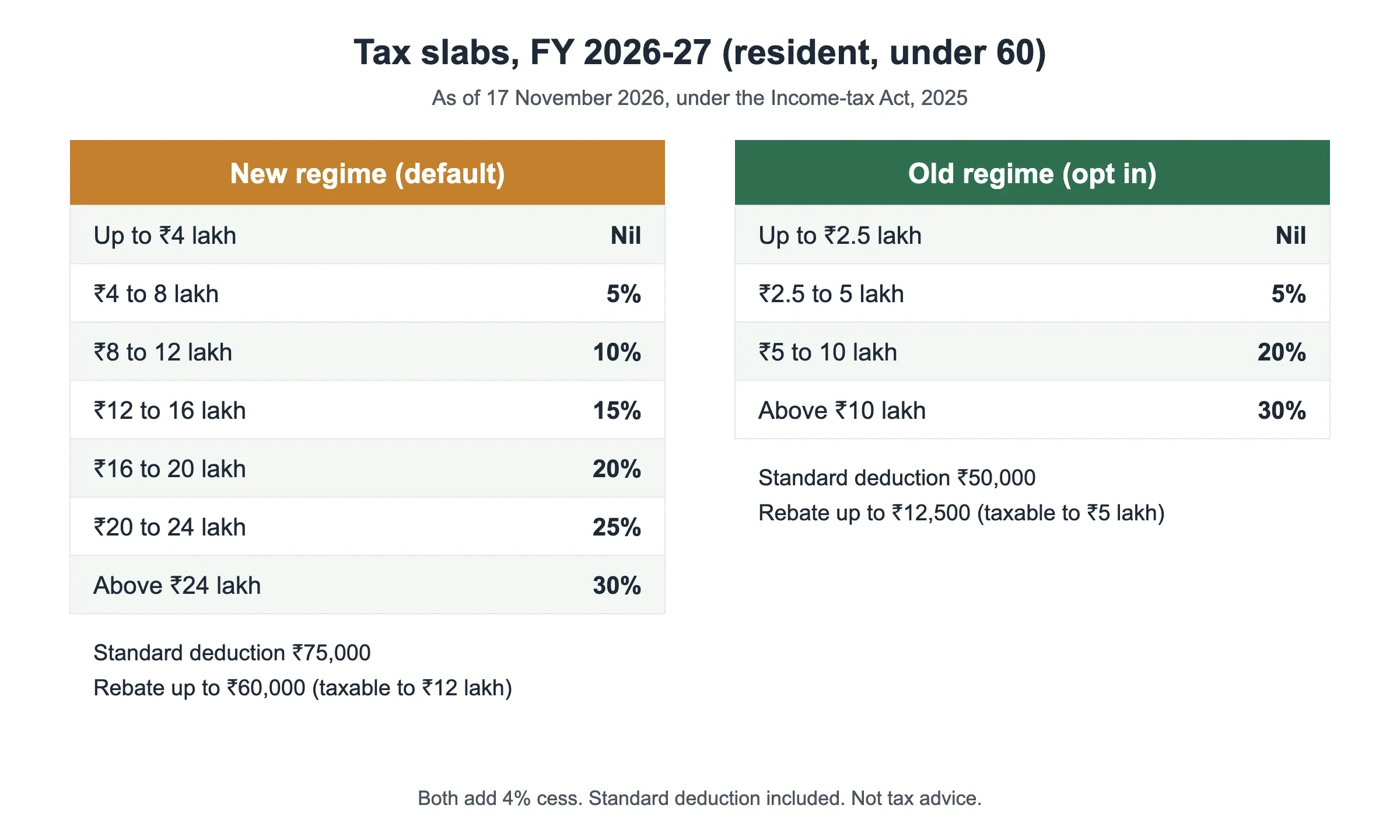
- Slabs: nil up to ₹4 lakh, 5% from ₹4 to 8 lakh, 10% from ₹8 to 12 lakh, 15% from ₹12 to 16 lakh, 20% from ₹16 to 20 lakh, 25% from ₹20 to 24 lakh, 30% above ₹24 lakh.
- Standard deduction for salary: ₹75,000.
- Rebate: up to ₹60,000, so taxable income up to ₹12 lakh pays no tax. Add the ₹75,000 standard deduction and a salary of about ₹12.75 lakh can be nil-tax. Just above ₹12 lakh of taxable income, marginal relief caps the tax at the amount by which income exceeds ₹12 lakh.
- Very few deductions: employer contribution to NPS (up to 14% of salary) and interest on a let-out property are among those the Income Tax Department lists.
Old regime (you opt for it):
- Slabs: nil up to ₹2.5 lakh, 5% from ₹2.5 to 5 lakh, 20% from ₹5 to 10 lakh, 30% above ₹10 lakh.
- Standard deduction: ₹50,000.
- Rebate: up to ₹12,500, so taxable income up to ₹5 lakh pays no tax.
- Many deductions and exemptions: 80C-type investments, health insurance, HRA, home-loan interest on a self-occupied house, and more.
Both regimes add 4% health and education cess on the tax. Budget 2026-27 left these slabs unchanged; the Key Features of Budget 2026-27 list no change to personal slabs.
At what salary and deductions does the old regime still save more tax?
The old regime saves tax only when your deductions are large enough to pull your old-regime tax below your new-regime tax. That point is the break-even.
The method in four steps:
- Take your gross salary.
- New regime: subtract ₹75,000 and apply the new slabs, rebate and cess.
- Old regime: list every deduction you can actually claim this year (standard deduction, 80C-type investments, health insurance, HRA exemption, home-loan interest). Subtract the total and apply the old slabs and cess.
- Compare. If the old figure is lower, the old regime costs less for that year.
Worked example: ₹14,50,000 salary (hypothetical)
This is a hypothetical example, not tax advice. No investment return is assumed, so it is not a promise; returns vary. Figures are as of FY 2026-27, under the Income-tax Act, 2025.
New regime: taxable income is ₹14,50,000 minus ₹75,000, which is ₹13,75,000. Tax is ₹20,000 (5% on ₹4 to 8 lakh) plus ₹40,000 (10% on ₹8 to 12 lakh) plus ₹26,250 (15% on ₹1,75,000), so ₹86,250. With 4% cess, that is ₹89,700.
Old regime: say your deductions add up to ₹3,45,000: standard deduction ₹50,000, 80C-type investments ₹1,50,000, health insurance ₹25,000 and HRA exemption ₹1,20,000. Taxable income is ₹11,05,000. Tax is ₹1,44,000. With cess, that is ₹1,49,760.
Here the new regime is lower by ₹60,060.
Break-even: to bring the old-regime tax down to the new regime's ₹86,250 (before cess), old-regime taxable income would need to fall to ₹8,68,750. That means total deductions of about ₹5,81,250, including the standard deduction. With ₹3,45,000, this hypothetical person is ₹2,36,250 short.
The same method gives different break-even points at other salaries (hypothetical, computed with the slabs above):
| Gross salary | New regime tax (incl. cess) | Old-regime deductions needed to match |
|---|---|---|
| ₹10,00,000 | ₹0 | ₹5,00,000 |
| ₹14,50,000 | ₹89,700 | ₹5,81,250 |
| ₹18,00,000 | ₹1,50,800 | about ₹6,91,667 |
| ₹24,00,000 | ₹2,92,500 | ₹8,37,500 |
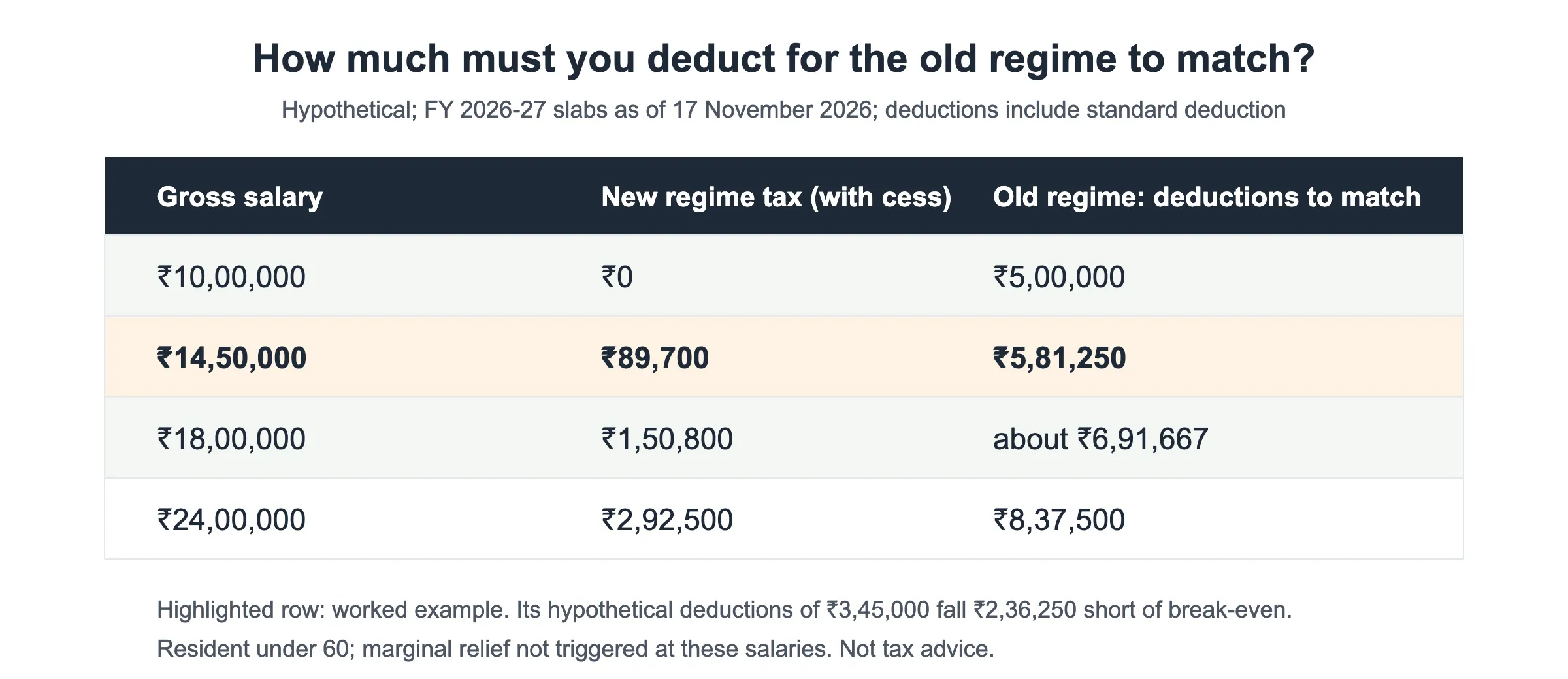
Read the first row closely. At ₹10 lakh, the new regime is nil-tax, so the old regime only matches it if deductions bring taxable income down to ₹5 lakh. The bar rises with salary, but so can your deductions, for example with city rent or a home loan.
Do I lose HRA, 80C and home-loan interest benefits in the new regime?
Yes, broadly. The Income Tax Department's help page for salaried individuals lists 80C, 80D and self-occupied home-loan interest only among old-regime deductions. A CA Journal article published by ICAI (October 2026) lists these as not allowed under Section 202 of the 2025 Act:
- 80C-type investments (now Section 123): PF, life insurance premium, ELSS, PPF
- House rent allowance (HRA) exemption
- Health insurance premium (80D-type)
- Interest on a home loan for a self-occupied house
- Education loan interest, donations, leave travel allowance and your own NPS contribution
What stays: the standard deduction and the employer's NPS contribution (Section 124(1) of the 2025 Act, up to 14% of salary).
Old Act to new Act, section by section:
| What it is | Income-tax Act, 1961 | Income-tax Act, 2025 |
|---|---|---|
| New (default) regime | 115BAC | 202 |
| PF, PPF, ELSS, life insurance | 80C | 123 |
| Standard deduction (salary) | 16(ia) | 19 |
| Rebate | 87A | 156 |
| Employer NPS contribution | 80CCD(2) | 124(1) |
| Return of income | 139(1) | 263(1) |
If you are weighing ELSS or PPF mainly for the deduction, decide your regime first. Our guide on whether ELSS is worth it in the new tax regime walks through that order, and PPF or SIP? compares what each rupee is for.
Can I switch between the old and new regime every year as a salaried employee?
Yes. If you have no business or professional income, you can choose the regime each year when you file your return. Section 202(4)(b) of the 2025 Act ties the option to the return furnished under Section 263(1) for that tax year. The Income Tax Department's salaried help page says the same for non-business cases under the old Act, and says Form 10-IEA is for business and professional income only.
The condition to remember: file your return by the due date. If you file late, you may lose the option to choose the old regime for that year and stay in the default new regime.
What do I tell my employer, and can I change it while filing?
There are two separate choices, and they do different jobs.
1. Your declaration to your employer. At the start of the year (or when you join), payroll asks which regime to use for TDS on your salary. If you say nothing, employers generally deduct TDS under the default new regime. If you choose the old regime, you will usually need to submit investment proofs, rent receipts and loan certificates between December and February.
2. Your choice in the income tax return. This is the one that counts. You can pick a different regime in your return than the one you declared to your employer, provided you file on time. If more tax is due, you pay it before filing; if too much was deducted, you claim a refund.
So the employer declaration decides how much is taken from each payslip. The return decides your final tax. Your Form 16 shows which regime payroll used. Our guide to CTC vs in-hand salary traces where TDS sits in your monthly credit.
A checklist before proof season
- List deductions you will actually claim: rent paid, insurance premium, EPF already deducted, any home loan.
- Run both calculations, or use the Income Tax Department's tax calculator.
- Compare your deduction total with the break-even for your salary.
- Tell payroll your choice, and keep proofs ready if you choose the old regime.
- Redo it next year. A raise, a new rent agreement or a home loan can flip the answer.