Health insurance waiting periods explained: the four clocks that start with your policy
A health policy runs up to four waiting periods: initial, pre-existing disease, specific illness and maternity. See how each works, with IRDAI rules.
Summarize this article with AI





The short version
- A health policy can run four waiting periods at once: initial, PED, specific illness and maternity.
- Accidents are usually covered from day one; check your wording.
- The moratorium is 60 months of continuous cover and is about contesting claims, not about when claims start.
- Portability and migration carry over waiting-period credits; any increase in sum insured may start fresh.
- Your CIS is the one page that lists your exact clocks.
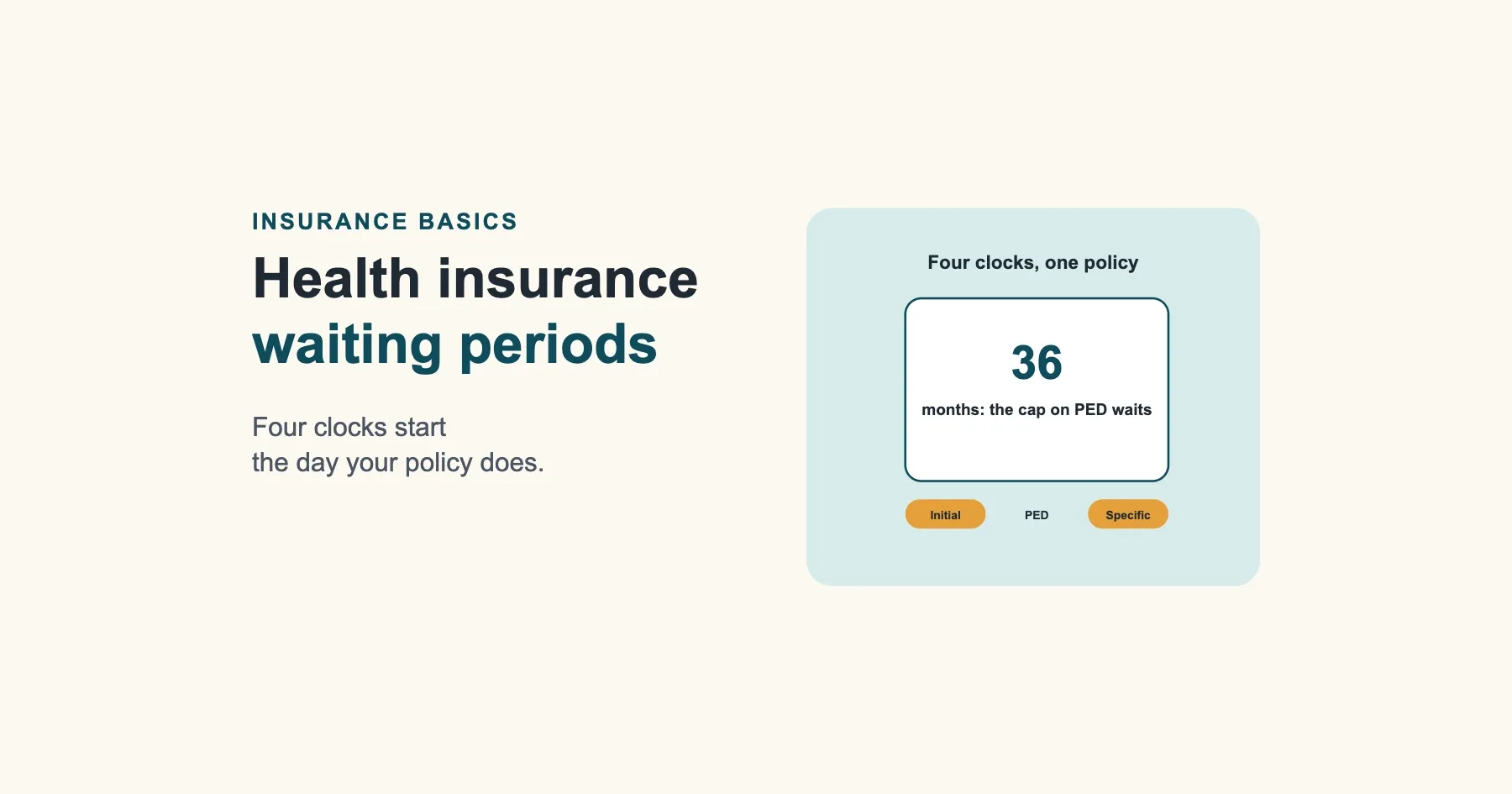
A health insurance waiting period is a stretch of time after your policy starts during which certain claims are not paid. Most individual policies run up to four of them at once: an initial wait for illness, a pre-existing disease (PED) wait, a specific-illness wait and, where covered, a maternity wait. Your policy's Customer Information Sheet (CIS) lists each one. This guide reflects IRDAI rules as of 19 November 2026.
Pallavi, 27, has just bought her first personal health policy in Udaipur. She compared premiums for a week but never checked when each part of the cover starts. Picture four clocks that start on day one and run out on different dates. Knowing which clock applies to your claim is as important as the premium you pay.
The four waiting periods in a health policy
1. Initial waiting period
For the first few weeks, illness-related hospitalisation is not covered. In many policy wordings this is 30 days (check your CIS).
2. Pre-existing disease (PED) waiting period
A pre-existing disease is a condition you had, or were treated or advised for, before the policy began. Think thyroid disorders, diabetes or high blood pressure. Claims linked to a declared PED are paid only after this wait ends. IRDAI's older rules, in its 22 July 2020 master circular, allowed a maximum of 48 months. From 1 April 2024, IRDAI's rules cap it at 36 months of continuous coverage. Your policy can set a shorter wait, never a longer one than the cap allows.
3. Specific-illness or specific-procedure waiting period
Some listed conditions and procedures, such as certain surgeries, have their own wait even if you never had them before. The policy wording lists them.
4. Maternity waiting period
If maternity is covered at all, it carries its own wait, often the longest. Many policies do not cover it.
Accidents: usually no wait
Hospitalisation caused by an accident is typically covered from day one, because the initial wait applies to illness (check your policy wording).
What IRDAI's 2024 Master Circular says
IRDAI issued its Master Circular on Health Insurance Business on 29 May 2024 (reference IRDAI/HLT/CIR/PRO/84/5/2024). As of 19 November 2026, four parts of it matter for waiting periods:
- The CIS. Every policy must come with a Customer Information Sheet in a set format, listing items such as sum insured, exclusions, sub-limits, deductibles and waiting periods.
- Moratorium. After 60 months of continuous coverage, a policy or claim cannot be contested for non-disclosure or misrepresentation, except where fraud is established.
- Portability and migration. When you move to another insurer (portability) or to another policy with the same insurer (migration), you can carry over credits, including sum insured, no claim bonus, specific waiting periods and PED waiting periods.
- Grace period. If you renew within the grace period, accrued credits, including PED waiting periods already served, are protected.
Moratorium period: not the same as a waiting period
The difference in one line each:
- A waiting period decides when a type of claim becomes payable.
- The moratorium decides when the insurer can no longer question your policy or a claim for non-disclosure or misrepresentation.
The moratorium is 60 months (five years) of continuous coverage. It does not remove permanent exclusions or policy limits, and ported or migrated policies count earlier continuous cover towards it.
Worked example: a hypothetical ₹7 lakh policy
This example is hypothetical. The periods are assumed for illustration, not typical or expected values; your CIS sets the real ones.
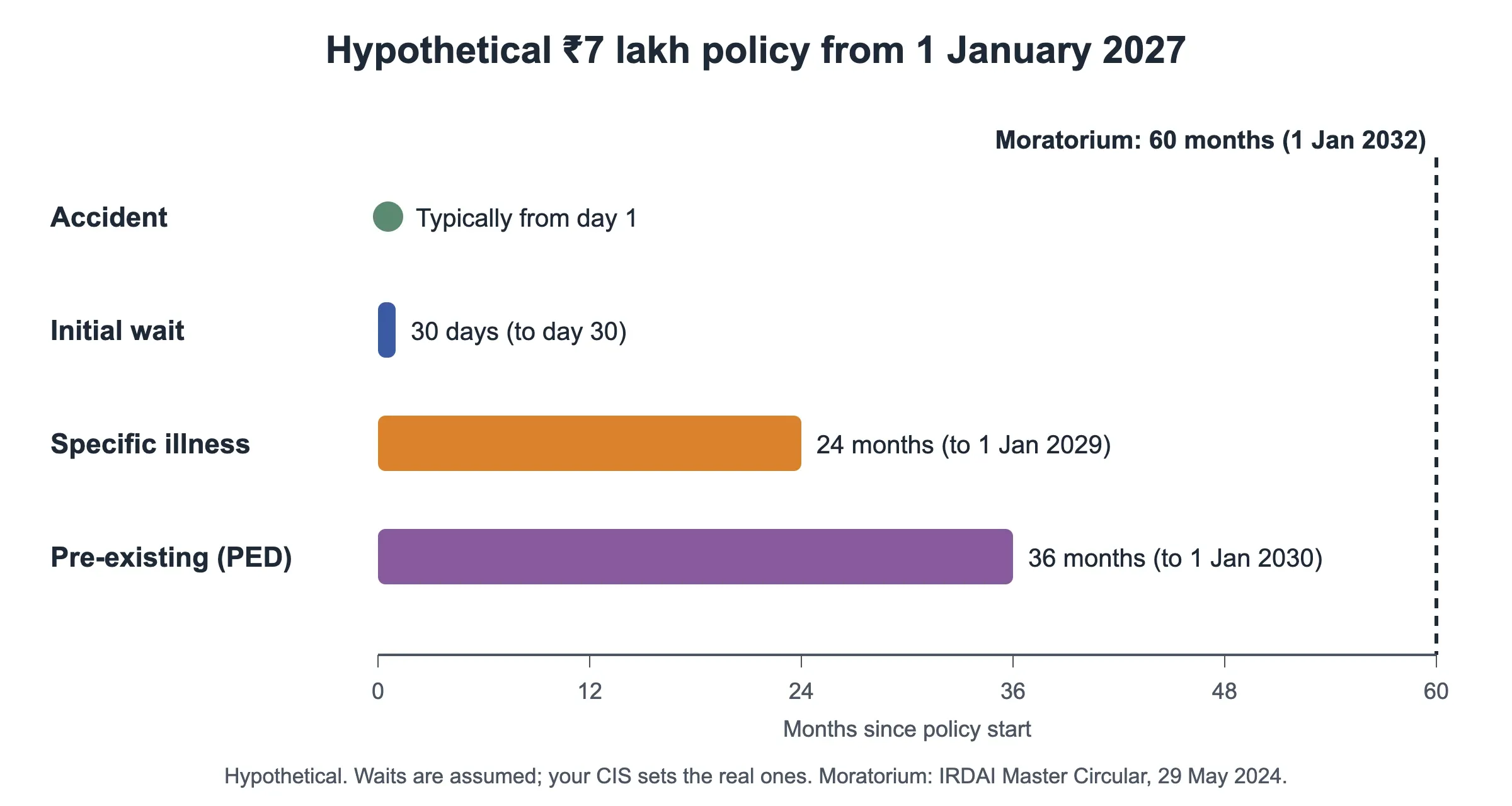
Assume Pallavi's individual policy has a ₹7 lakh sum insured and starts on 1 January 2027. She declared hypothyroidism. Assume the CIS lists: initial wait 30 days, specific-illness wait 24 months, PED wait 36 months.
| Event (hypothetical) | Date | Which clock applies | Outcome under these assumptions |
|---|---|---|---|
| Road accident, hospitalised | Day 5 (5 January 2027) | None for accidents | Typically claimable |
| Fever, hospitalised | Day 20 (20 January 2027) | Initial wait (1 to 30 January) | Not payable |
| Listed procedure | Before 1 January 2029 | Specific-illness wait, 24 months | Not payable until then |
| Hypothyroidism-related claim | Before 1 January 2030 | PED wait, 36 months | Not payable until then |
| Moratorium reached | 1 January 2032 | 60 months continuous cover | Non-disclosure can no longer be contested, except fraud |
If she had ported instead
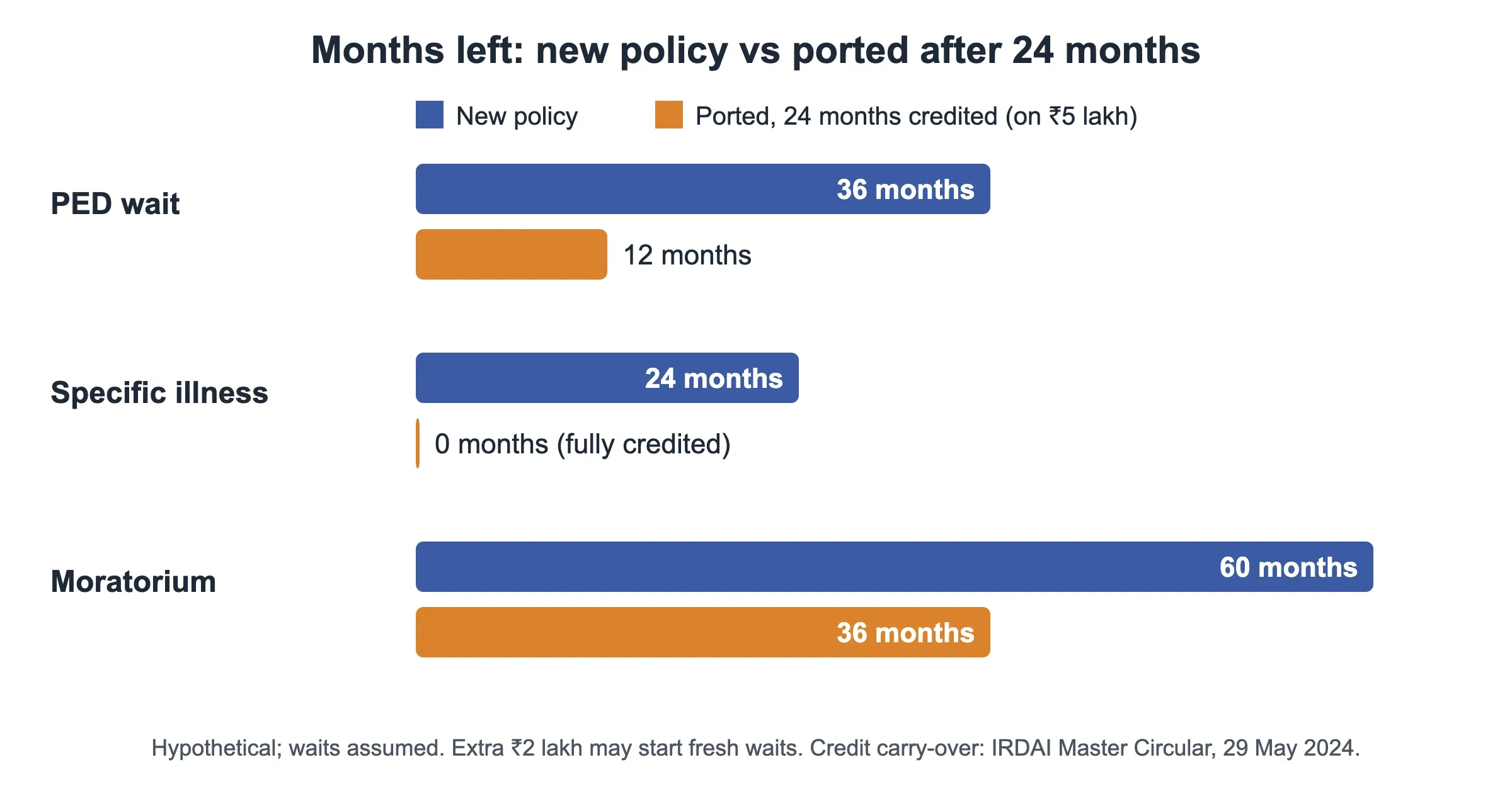
Now assume Pallavi had a two-year-old policy with a ₹5 lakh sum insured and ported to this ₹7 lakh policy on 1 January 2027. The 24 months already served count as credit:
- PED wait on the ported ₹5 lakh: 36 − 24 = 12 months left, so cover from 1 January 2028.
- Specific-illness wait on the ported ₹5 lakh: 24 − 24 = 0 months left.
- Moratorium on the ported ₹5 lakh: 60 − 24 = 36 months left, so 1 January 2030.
- The extra ₹2 lakh (₹7 lakh − ₹5 lakh) is new cover. Insurers commonly apply fresh waiting periods to the increase (check the insurer's portability terms).
Employer group cover: waits often waived, but cover ends with the job
Many employer group policies waive some or all of these waits, including PED and maternity. The catch is that the cover is tied to your job. If you leave, it can stop, and an individual policy bought later starts its own clocks from day one. The circular lets group members carry over credits on migration, but what moves depends on the group terms. Our guide to whether employer health insurance is enough covers the other gaps to check.
Can a waiting period be reduced?
Three routes, none automatic:
- Portability. Credits for waiting periods already served carry over, as the example shows.
- Migration. The same credit carry-over applies when you move to another policy with the same insurer.
- Paid waiver or reduction. Some policies offer an optional add-on that shortens a waiting period for an extra premium. Whether it exists, and on what terms, depends on the product (check the policy wording).
A break in cover can reset the clocks; renewal within the grace period protects them.
Common mistakes to avoid
- Not declaring a condition. A declared PED waits; an undeclared one can get a claim questioned before the moratorium.
- Letting a policy lapse. Renew within the grace period to keep credits.
- Assuming a higher sum insured is covered at once. Fresh waits may apply to the increase.
- Treating group cover as permanent. Plan for the day it ends.
Where to check yours, and where to complain
Start with your CIS, then the policy wording for the full list of specific illnesses and exclusions. If a refused claim is not resolved by the insurer's grievance team, IRDAI's Bima Bharosa portal records and tracks complaints, and the insurer's reply must include Insurance Ombudsman contact details.
Co-payment and deductibles change what you pay even after a wait ends. See what co-payment means and how a super top-up deductible works.
Frequently asked questions
What is the waiting period in health insurance, and why do I have to wait?
It is time after the policy starts when certain claims are not paid. Waits stop people buying cover only once they expect a claim. Your CIS lists each one.
I have thyroid or diabetes. How long before my policy covers it?
If you declared it, claims linked to it are paid after the PED waiting period in your CIS. IRDAI's rules cap this at 36 months; your policy may set less.
Does my company's group health insurance have any waiting period?
Many group policies waive some or all waits, depending on the group terms. The cover usually ends when you leave the job. See whether employer health insurance is enough.
Can I reduce the waiting period by paying extra or porting my policy?
Porting or migrating carries over time already served. Some products sell an add-on that shortens a wait; check the policy wording for terms.
What is the moratorium period? Is it the same as the waiting period?
No. The moratorium is 60 months of continuous cover, after which the insurer cannot contest the policy or a claim for non-disclosure or misrepresentation, except for established fraud. A waiting period decides when a claim becomes payable.
Learn more
Read your CIS line by line, then learn more about putting protection before investing in term insurance before your first SIP.
— Laabh