TDS vs TCS: Who Deducts, Who Collects, and How Both Come Back to You at ITR Time
TDS is cut by the payer, TCS is added by the seller. Both are credits in your PAN, adjusted at ITR time. 2025 Act sections and 2026 TCS rates.
Summarize this article with AI





The short version
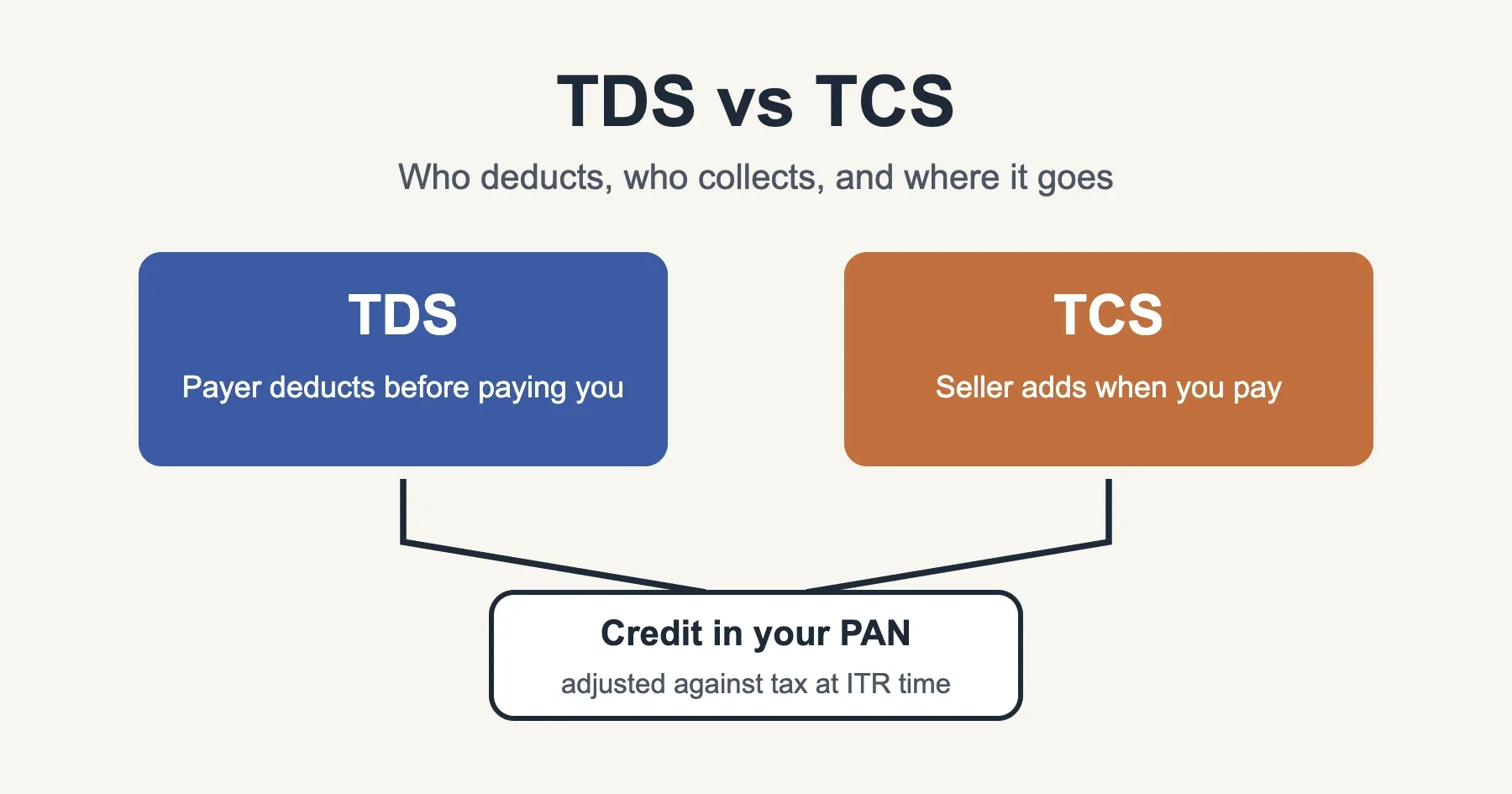
- TDS is cut by the payer before you are paid; TCS is added by the seller or bank when you pay.
- Both are credited to your PAN and adjusted against your final tax for the tax year.
- Under the Income-tax Act, 2025, salary TDS is section 392, other TDS section 393, and TCS section 394.
- TCS on overseas tour packages is 2%, and on LRS education or medical remittances above ₹10 lakh it is 2%.
- Check Form 26AS and AIS before filing, and ask the deductor or collector to fix missing credits.
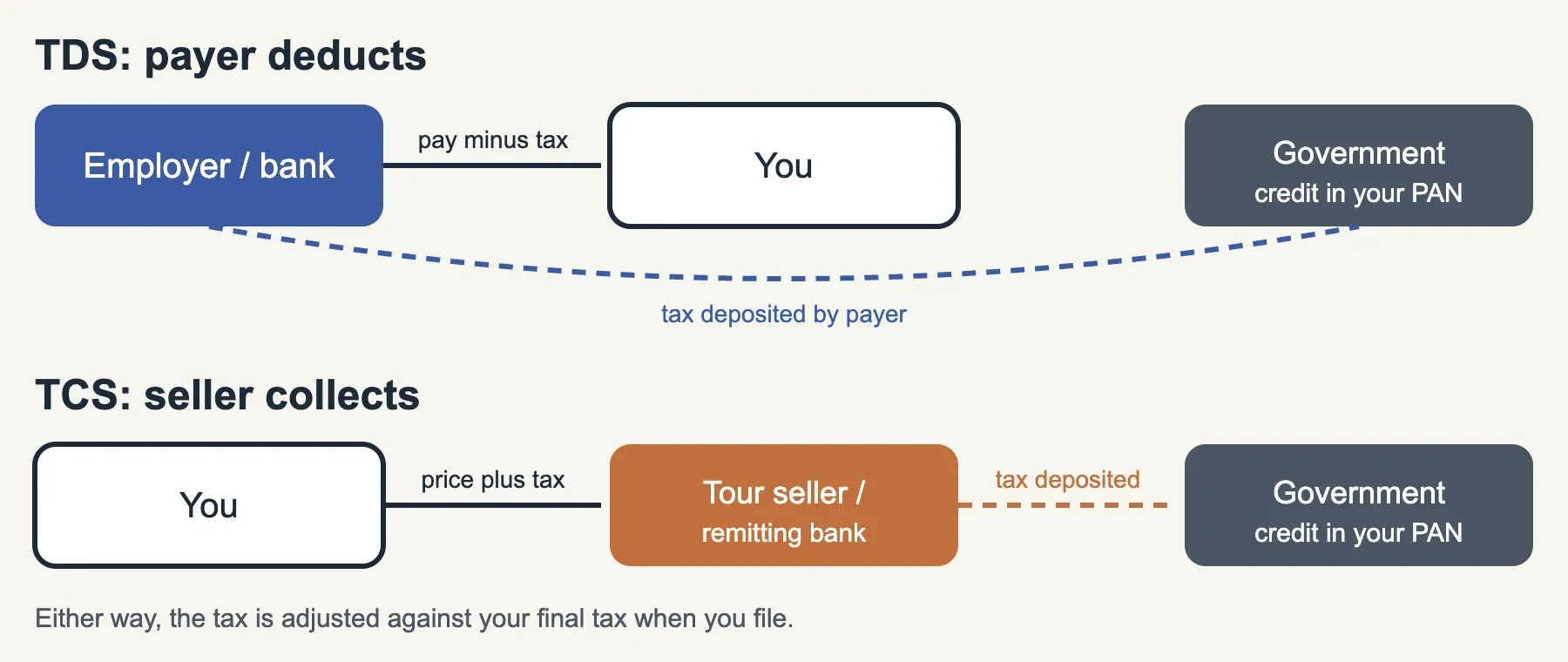
The main difference between TDS and TCS is who acts. With TDS (tax deducted at source), the person paying you, such as your employer or bank, cuts tax before the money reaches you. With TCS (tax collected at source), the seller or bank you are paying adds tax on top of what you pay. In both cases the money is credited to your PAN as tax already paid, and it is adjusted against your final tax when you file your return; if the credits are more than your tax, the excess comes back as a refund.
Aditi, 27, works in Pune. Her payslip and FD statement show TDS, and her overseas holiday booking showed a TCS line she did not expect. Was that TCS money gone for good? No, and her year below shows why.
TDS in one minute: where you meet it
TDS is the deductor's job. The payer cuts the tax from your payment, deposits it against your PAN and files a quarterly statement. You receive the net amount. Where you usually meet it:
- Salary. Under section 392 of the Income-tax Act, 2025, your employer estimates your tax for the year under your chosen regime and spreads it across your monthly pay.
- Bank FD and RD interest. Under section 393, a bank, a co-operative bank or a post office (for notified deposits) deducts TDS once interest in a year crosses ₹50,000 for a non-senior and ₹1,00,000 for a senior citizen, at the "rates in force".
- Rent above ₹50,000 a month paid by certain individuals: 2%. Professional fees paid by a business: 10% above ₹50,000 in the common case.
TCS in one minute: where you meet it
TCS is the collector's job. The seller, or the authorised dealer bank sending your money abroad, adds the tax to your bill, deposits it against your PAN and files its own statement. Section 394 of the Income-tax Act, 2025 lists the cases, including:
- Overseas tour programme package (travel, hotel, boarding or lodging sold as a package): 2%, with no minimum amount.
- Money sent abroad under the Liberalised Remittance Scheme (LRS), once the amount or aggregate for the year exceeds ₹10 lakh: 2% for education or medical treatment, 20% for other purposes. Education remittances funded by a loan from a financial institution are excluded.
- A motor vehicle costing more than ₹10 lakh: 1%, collected by the seller.
TDS vs TCS: side by side
| TDS (tax deducted at source) | TCS (tax collected at source) | |
|---|---|---|
| Who acts | The payer (deductor): employer, bank, tenant, client | The seller or bank receiving your money (collector) |
| When | When they pay or credit you | When they receive your payment or debit your account |
| Your cash | You receive less than the gross amount | You pay more than the price |
| Typical cases | Salary, FD interest, rent, professional fees | Overseas tour packages, LRS remittances above ₹10 lakh, cars above ₹10 lakh |
| Law (Income-tax Act, 2025) | Section 392 for salary; section 393 for other payments | Section 394 |
| What it means for you | A credit against your tax | A credit against your tax |
What the Income-tax Act, 2025 changed from 1 April 2026
The Income-tax Act, 1961 was repealed from 1 April 2026, and the year you earn income in is now the tax year (the old law used "previous year" and "assessment year"); see the new Income Tax Act explained. TDS and TCS work the same way for you; the section numbers and some rates moved.
| What you deal with | Income-tax Act, 1961 | Income-tax Act, 2025 |
|---|---|---|
| TDS on salary | Section 192 | Section 392 |
| TDS on bank interest, rent, fees | Separate sections (e.g. 194A for interest) | Grouped in one table under section 393 |
| TCS | Section 206C | Section 394, "Collection of tax at source" |
| Nil-TDS declaration on interest | Form 15G/15H | A written declaration under section 393(6) |
Budget 2026 (Department of Revenue, "Tax Reforms: List and Gist", February 2026) made two rate cuts:
- Overseas tour packages: TCS cut from 5% or 20% to a flat 2%, with no minimum amount.
- LRS remittances for education and medical treatment: cut from 5% to 2%.
The section 394 table shows both 2% rates.
Worked example: one tax year, three credits, one refund
Hypothetical. Aditi is in the new regime for tax year 2026-27. Budget 2026 kept the new-regime slabs unchanged: nil up to ₹4 lakh, 5% to ₹8 lakh, 10% to ₹12 lakh and 15% to ₹16 lakh, with a ₹75,000 standard deduction, nil tax up to ₹12 lakh after rebate, and 4% cess. The 10% TDS on her interest is the rate banks apply when the depositor has given a PAN. Not sure which regime fits you? See old vs new tax regime.
| Step | Amount |
|---|---|
| Gross salary | ₹14,00,000 |
| Less standard deduction | ₹75,000 |
| Taxable salary | ₹13,25,000 |
| Tax on salary: ₹20,000 + ₹40,000 + ₹18,750 | ₹78,750 |
| Plus 4% cess = salary TDS for the year (₹6,825 a month) | ₹81,900 |
| FD interest ₹60,000 (above ₹50,000), TDS at 10% | ₹6,000 |
| Overseas tour package ₹2,50,000, TCS at 2% | ₹5,000 |
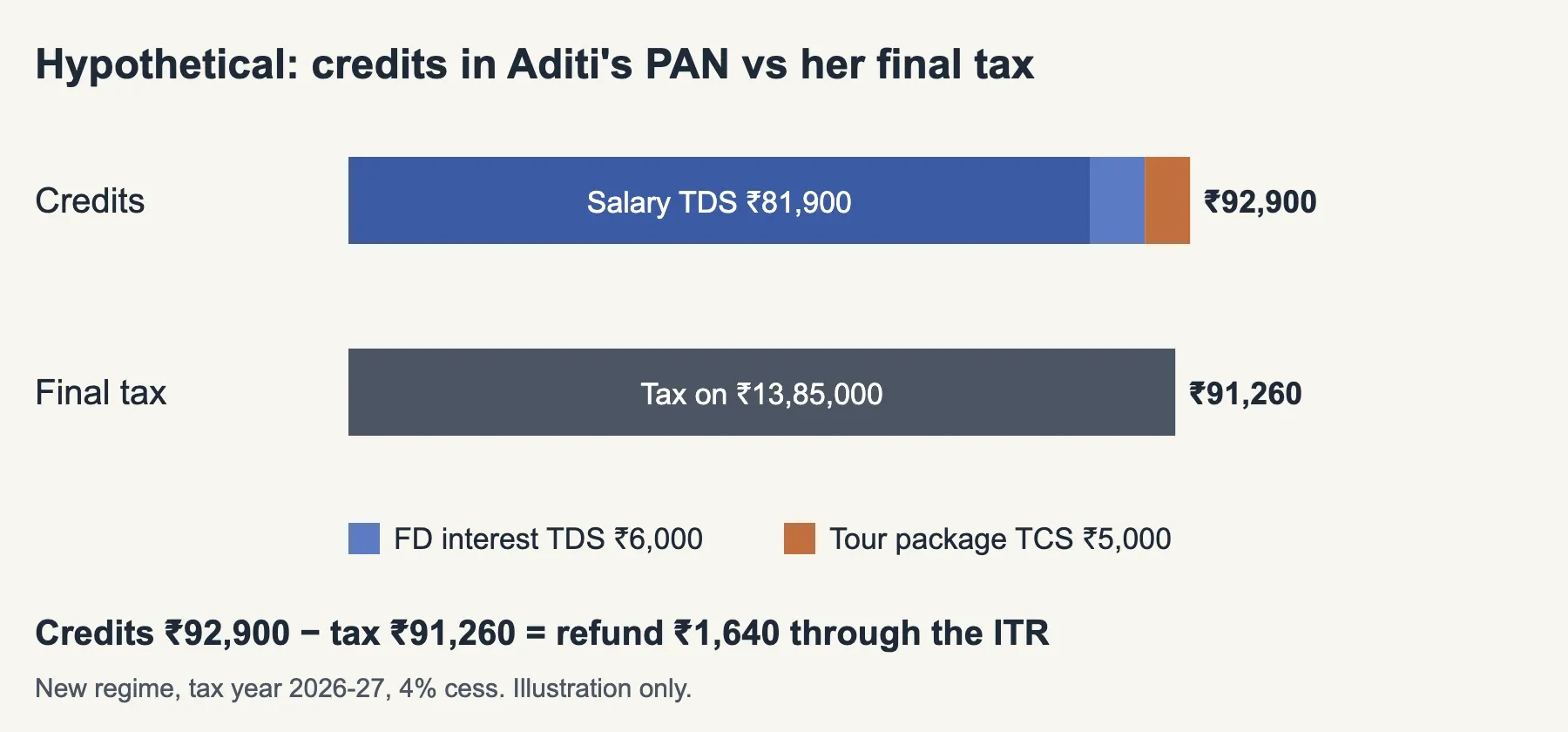
| Total credits in her PAN | ₹92,900 |
At filing time, her total income is salary plus interest: ₹13,25,000 + ₹60,000 = ₹13,85,000. Tax on that is ₹87,750, plus 4% cess = ₹91,260.
Credits of ₹92,900 minus tax of ₹91,260 = refund of ₹1,640, claimed through her return.
- The TCS was not a cost. The ₹5,000 sat in her PAN as tax paid and pushed her credits above her tax.
- Credits can fall short. Without the tour, credits of ₹87,900 against tax of ₹91,260 would leave a ₹3,360 balance for her to pay, because the bank's 10% on her interest was below her 15% slab on that slice.
Had she also sent ₹12 lakh of her own savings abroad for a sibling's fees, the ₹10 lakh threshold would apply and the bank would collect TCS at 2% for education. Check the exact amount on the bank's certificate and in your AIS; it is a credit too.
Where to see your TDS and TCS, and what to do if a credit is missing
On the Income Tax Department's e-filing portal, Form 26AS lists tax deducted and collected against your PAN, and the Annual Information Statement (AIS) shows those credits alongside other reported income, such as interest.
Deductors and collectors also give you certificates. For salary, Form 16 under the old Act is replaced by Form 130 from tax year 2026-27. See Form 16 explained for your first job.
If a credit is missing or wrong, match it against your certificate, payslip or invoice, then ask the deductor or collector to check your PAN and correct their quarterly statement. You cannot edit their filing yourself, so file once the credit appears.
Can you avoid TDS or TCS?
- Nil-TDS declaration on interest. Section 393(6) lets a resident individual whose estimated tax for the tax year is nil give the payer a written declaration in the prescribed form, so no TDS is deducted.
- Lower or nil deduction certificate from the tax department. Budget 2026 proposed an automated process for small taxpayers.
- Loan-funded education remittances. Money sent under LRS out of an education loan from a financial institution is excluded from TCS under section 394(4)(b).
Before you file
Tick off each TDS and TCS line in your AIS and Form 26AS against your own records, and save this checklist for next year.
Frequently asked questions
What is the difference between TDS and TCS?
TDS is tax the payer deducts before paying you, such as your employer or bank. TCS is tax a seller or bank collects from you on top of what you pay. Both go to your PAN as tax paid.
Is TCS on foreign travel refundable?
Not on its own. It counts as tax already paid and is adjusted against your tax when you file; any excess is refunded. In the hypothetical example, ₹5,000 of TCS turned a ₹3,360 balance due into a ₹1,640 refund.
What are the TDS and TCS sections in the new Income-tax Act, 2025?
Salary TDS is in section 392, other TDS (interest, rent, professional fees and similar) in section 393, and TCS in section 394.
How do I check TDS and TCS deducted on my PAN?
Log in to the e-filing portal and open Form 26AS and the Annual Information Statement (AIS). If a credit is missing, ask the deductor or collector to correct their quarterly statement before you file.
Is TDS on salary different from TDS on FD interest?
Yes. Salary TDS follows your estimated tax for the year at your slab rate. Bank interest TDS starts once interest crosses ₹50,000 a year (₹1 lakh for senior citizens) and is cut at the rate in force, whatever your slab.