The New Income Tax Act, 2025 for Salaried Employees: What 'Tax Year' Means and What Actually Changed From April 2026
The Income-tax Act, 2025 applies from 1 April 2026. What 'tax year' means, old vs new section numbers, and which law your ITR uses.
Summarize this article with AI





The short version
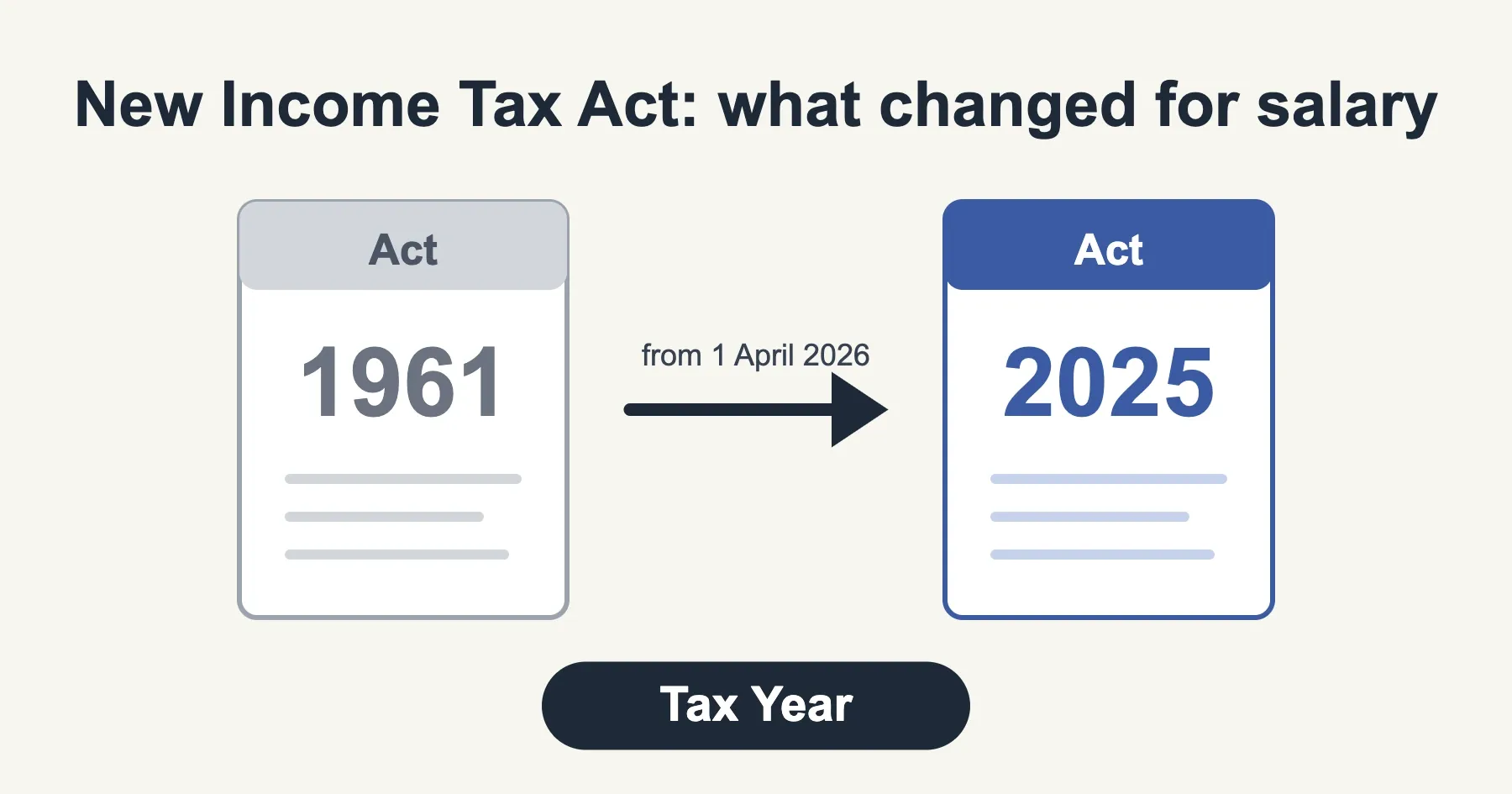
- The Income-tax Act, 2025 replaced the 1961 Act from 1 April 2026.
- "Tax year" replaces "previous year", and "assessment year" is no longer used.
- Many sections are renumbered: the new regime is section 202, and the 80C-type deduction is section 123 (cap ₹1,50,000).
- Rates come from the annual Finance Act; your regime choice carries over.
- Your 2026 return (FY 2025-26) is under the old Act; your return for tax year 2026-27 is under the new Act.
As of 25 November 2026: the Income-tax Act, 2025 replaced the Income-tax Act, 1961 from 1 April 2026. For most salaried employees the practical change is vocabulary and numbering: "tax year" replaces both "previous year" and "assessment year", and familiar sections have new numbers. Your regime choice carries over, and tax rates are still set each year by the Finance Act, not by the new Act itself.
Riya, 24, started her first job in Pune and keeps hearing "new income tax law from April". Her payslip and Form 16 used words like "AY 2026-27" and "80C". This page translates old words into new ones for the documents a salaried person handles, and separates what the new Act changed from what the Budget changes.
Why India replaced the 1961 Act
The Income Tax Department, which works under the Central Board of Direct Taxes (CBDT), describes the aim as "a streamlined, simplified, and modern tax code with reduced compliance burden". The department's FAQ on the new Act says it has 536 sections and 16 schedules, compared with 819 sections and 14 schedules in the 1961 Act, and that the income tax rules were cut from 511 rules with 399 forms to 333 rules with 190 forms. It also says the new Act "does not impose any new tax".
"Tax year" explained
The department defines a tax year as "a period of twelve months contained in a financial year". It replaces the term "previous year", and the use of "assessment year" has been discontinued. The concept applies from 1 April 2026.
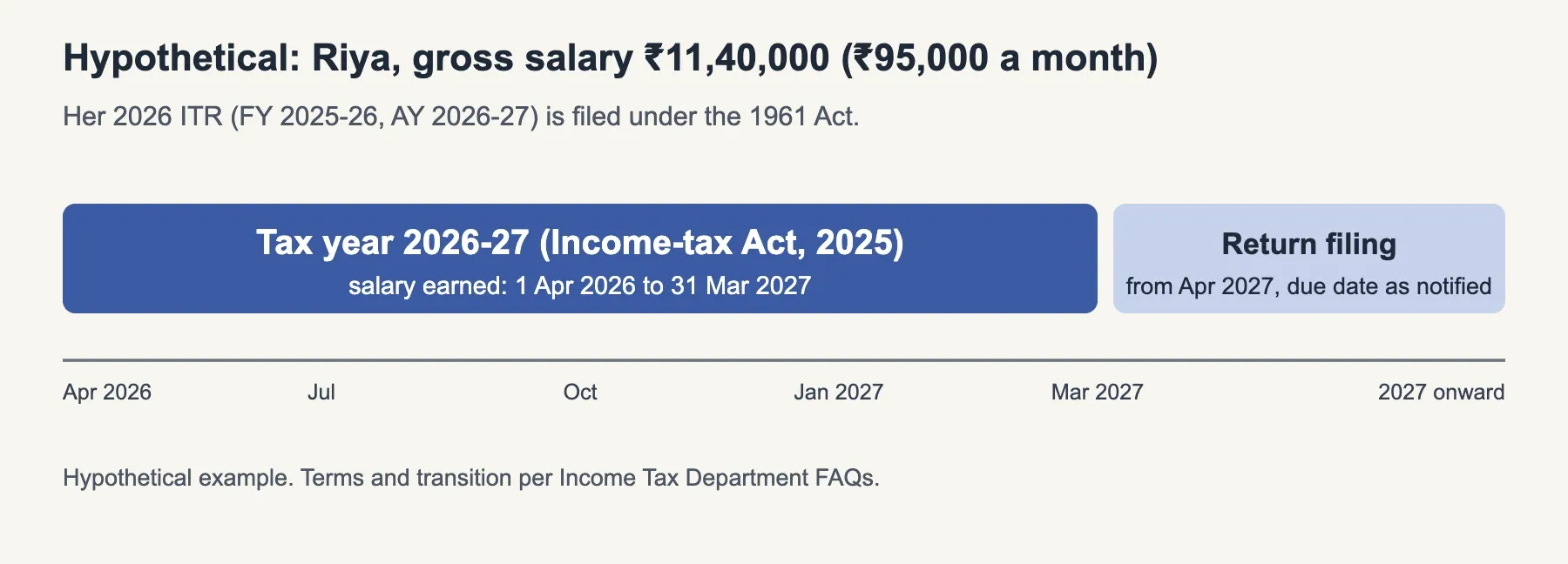
Under the 1961 Act, one set of income had two labels. Salary earned from April 2025 to March 2026 was "previous year 2025-26" (or FY 2025-26), and the return for it was filed in "assessment year 2026-27". Under the new Act there is one label: salary earned from 1 April 2026 to 31 March 2027 belongs to tax year 2026-27, and the return for it is the return for tax year 2026-27.
For a salaried person employed through the year, the tax year and the financial year are the same twelve months. (The FAQ notes a tax year can be shorter when a business or new income source starts mid-year.)
Old term to new term: a translation table
Only mappings found on Income Tax Department pages are filled in; the rest say so.
| What you see on your documents | Under the Income-tax Act, 1961 | Under the Income-tax Act, 2025 |
|---|---|---|
| The year your salary belongs to | Previous year / financial year (e.g. FY 2026-27) | Tax year (e.g. tax year 2026-27) |
| The year you file for it | Assessment year (e.g. AY 2027-28) | Term discontinued; you file for the tax year |
| New tax regime (the default) | Section 115BAC | Section 202 |
| Deduction for life insurance premium, provident fund contributions, etc. (cap ₹1,50,000) | Section 80C | Section 123 |
| Standard deduction from salary | Section 16(ia) | Check the official mapping table |
| HRA exemption | Section 10(13A) | Check the official mapping table |
| Salary TDS certificate | Form 16 | Form 130 (replaces Form 16) |
| PAN | PAN | PAN continues |
Section 123 is headed "Deduction for life insurance premia, deferred annuity, contributions to provident fund, etc" and allows a deduction of amounts "paid or deposited in the tax year", up to ₹1,50,000. That is the deduction most people still call "80C". Section 202, the new regime, does not allow it, so it matters only if you opt for the old regime; we compare the two in the old vs new tax regime guide.
What did not change because of the new Act
Your regime choice. According to the department's FAQ, the new regime (now section 202) remains the default, you can still opt out of it, and choices already made carry over to the new Act. The Act did not decide for you which regime is better.
Tax rates. Under the new Act, rates for a tax year are those "provided for such tax year by any Central Act". In practice, that means the annual Finance Act passed after each Budget. If your slab or rebate changes, that comes from the Finance Act, so read Budget news for rates and this Act for structure.
PAN, TDS and older circulars. The FAQ says PAN, TAN and the faceless frameworks continue, and older circulars and notifications stay valid to the extent they do not conflict with the new Act.
Your salary. The new law does not change your CTC; in-hand pay still depends on salary structure, provident fund and TDS. See CTC vs in-hand salary for that breakdown.
What to check on your payslip, Form 16 and ITR this year
Here is how the hypothetical example plays out. Riya's gross salary in tax year 2026-27 is ₹11,40,000, which is ₹95,000 a month, and she is in the new regime. (Hypothetical, for illustration only. We do not compute her tax here, because the rates come from the Finance Act and differ by regime and deductions.)
- Offer letter. Usually unaffected; it states CTC and components, not the law.
- Payslip. From April 2026 onwards, the year on her payslip may read "FY 2026-27" or "tax year 2026-27". Both refer to the same twelve months, 1 April 2026 to 31 March 2027. Any section references for deductions or exemptions may switch to the new numbers.
- Investment declaration to the employer. If an employee is in the old regime, the proof request may now say "section 123" where it used to say "80C". The cap shown on the department's Section 123 page is ₹1,50,000.
- Salary TDS certificate. The certificate she gets for her FY 2025-26 salary was issued under the 1961 Act as Form 16. For tax year 2026-27, the Income Tax Department's Form 130 FAQ says Form 130 replaces Form 16, and employers issue it by 15 June after the tax year ends. Our Form 16 explainer covers what each part means.
- ITR. The return she files for tax year 2026-27 will refer to that tax year, not to "AY 2027-28".
Returns for FY 2025-26 vs tax year 2026-27: which law applies
- Income earned from April 2025 to March 2026 (FY 2025-26). The department's FAQ says the 1961 Act continues to govern all tax years beginning before 1 April 2026, and that returns for AY 2026-27 filed in 2026 use the forms prescribed under the old Act. So the ITR you file in 2026 is an old-Act return, with assessment year 2026-27 on it. Missed that deadline? See the late fee and the 31 December cut-off.
- Income earned from April 2026 to March 2027 (tax year 2026-27). This is the first year under the new Act. The return for it is filed after the tax year ends, so in 2027, under the new Act. Due dates and forms for it are set by the rules; check the e-filing portal when the forms are notified.
- Anything already pending. The FAQ says the old Act continues to apply to proceedings pending on the date the new Act came in, and a reference to a tax year is read as the corresponding previous year under the old Act.
For Riya: her 2026 filing (FY 2025-26) is under the 1961 Act, and her 2027 filing (tax year 2026-27) is under the 2025 Act.
Frequently asked questions
What is "tax year" in the new Income Tax Act?
A tax year is a twelve-month period contained in a financial year, according to the Income Tax Department. It replaces "previous year", and "assessment year" is no longer used. Salary earned from 1 April 2026 to 31 March 2027 belongs to tax year 2026-27.
When did the Income-tax Act, 2025 come into force?
On 1 April 2026, when the 1961 Act was repealed. Tax years beginning before that date, such as FY 2025-26, are still governed by the 1961 Act.
Did income tax rates change because of the new Act?
The new Act did not change rates on its own; the department says it does not impose any new tax. Rates for each tax year come from the Finance Act passed with the Budget, so any change in slabs is a Budget change, not a new-Act change.
Is the 80C deduction still available under the new law?
The same type of deduction (life insurance premium, provident fund contributions and similar payments) sits in section 123, with a cap of ₹1,50,000. It is not allowed under the new regime (section 202), so it helps only if you opt for the old regime.
Which law applies to the ITR I file in 2026?
The 1961 Act. A return filed in 2026 is for FY 2025-26 (assessment year 2026-27), and the department says these returns use the forms prescribed under the old Act. The new Act applies from tax year 2026-27, whose return is filed in 2027.
Save this page
Save the translation table for when your next payslip or salary TDS certificate arrives, and pair it with the first job money checklist.