Your first Form 16, explained part by part before you file
Form 16 shows your salary and TDS for the year. Learn what each part means, where Form 130 fits from April 2026, and what to check before you file.
Summarize this article with AI





The short version
- Form 16 is your employer's statement of salary paid and TDS, and the basis for your TDS credit.
- Salary paid up to 31 March 2026 gets Form 16 under the 1961 Act. Salary from 1 April 2026 gets Form No. 130 under the 2025 Act, due by 15 June 2027 for tax year 2026-27.
- Check PAN, TAN, period, the amount paid against payslips, and TDS against AIS and Form 26AS before filing.
- Two employers in one year means two certificates and one return: add the salaries and TDS, and claim the standard deduction once.
- Mistakes are fixed by the employer filing a revised TDS statement and issuing a corrected certificate.
Form 16 is the certificate your employer gives you for salary paid and tax deducted at source (TDS) in a year. For salary paid from 1 April 2026, the Income Tax Department lists it as Form No. 130, which replaces Form 16. Check it against your payslips and your Annual Information Statement (AIS) before you file.
Rekha, 23, a hypothetical first-jobber in Hubballi, got her first certificate from HR in June: a PDF of codes, quarters and totals. She saw her name and closed it. This is Form 16 explained for your first job: what each part says, which lines to check, and what changes after two employers in one year.
Rules as of 16 November 2026.
What is Form 16 and why does my employer give it?
When your salary crosses the taxable level, your employer deducts income tax each month and deposits it against your PAN. The certificate is its year-end statement: what it paid you, what it deducted, and how it worked out your taxable salary.
The Income Tax Department's FAQs describe the new form as an annual TDS certificate that summarises salary, tax deducted and deposited, and deductions, and that lets you claim credit for that TDS. When you file your income tax return (ITR), that credit reduces what you owe.
Issuing it is mandatory once tax has been deducted and deposited. The due date is 15 June of the financial year that follows the year in which the salary was paid and tax deducted.
Is Form 16 now called Form 130 under the new Income-tax Act?
Yes for new salary, no for older salary. The Income-tax Act, 2025 came into force on 1 April 2026, and the Income Tax Department's FAQs say Form No. 130 replaces Form 16 issued under the Income-tax Rules, 1962. Which name applies depends on when the salary was paid:
| Salary paid | Law that applies | Certificate | Issued by |
|---|---|---|---|
| Up to 31 March 2026 (financial year 2025-26) | Income-tax Act, 1961 | Form 16 | 15 June 2026 |
| From 1 April 2026 (tax year 2026-27) | Income-tax Act, 2025 | Form No. 130 | 15 June 2027 |
The Department's transition FAQs say income earned in 2025-26 is governed by the 1961 Act, and so is the return for that year. Form 130 is generated only after the employer's quarterly TDS statement in Form No. 138 is processed, and Form 138 starts from the first quarter of tax year 2026-27. The Department's transition FAQs (Q6.15) set out the same split. So if your first salary was paid on or after 1 April 2026, your first certificate will be a Form 130, due by 15 June 2027; salary with TDS paid before that date, for example from January 2026, is covered by a Form 16 due by 15 June 2026. Most people still say "Form 16", so this guide does too.
What is the difference between Part A and Part B?
The two versions split the parts differently, which matters when you compare yours with an older sample online.
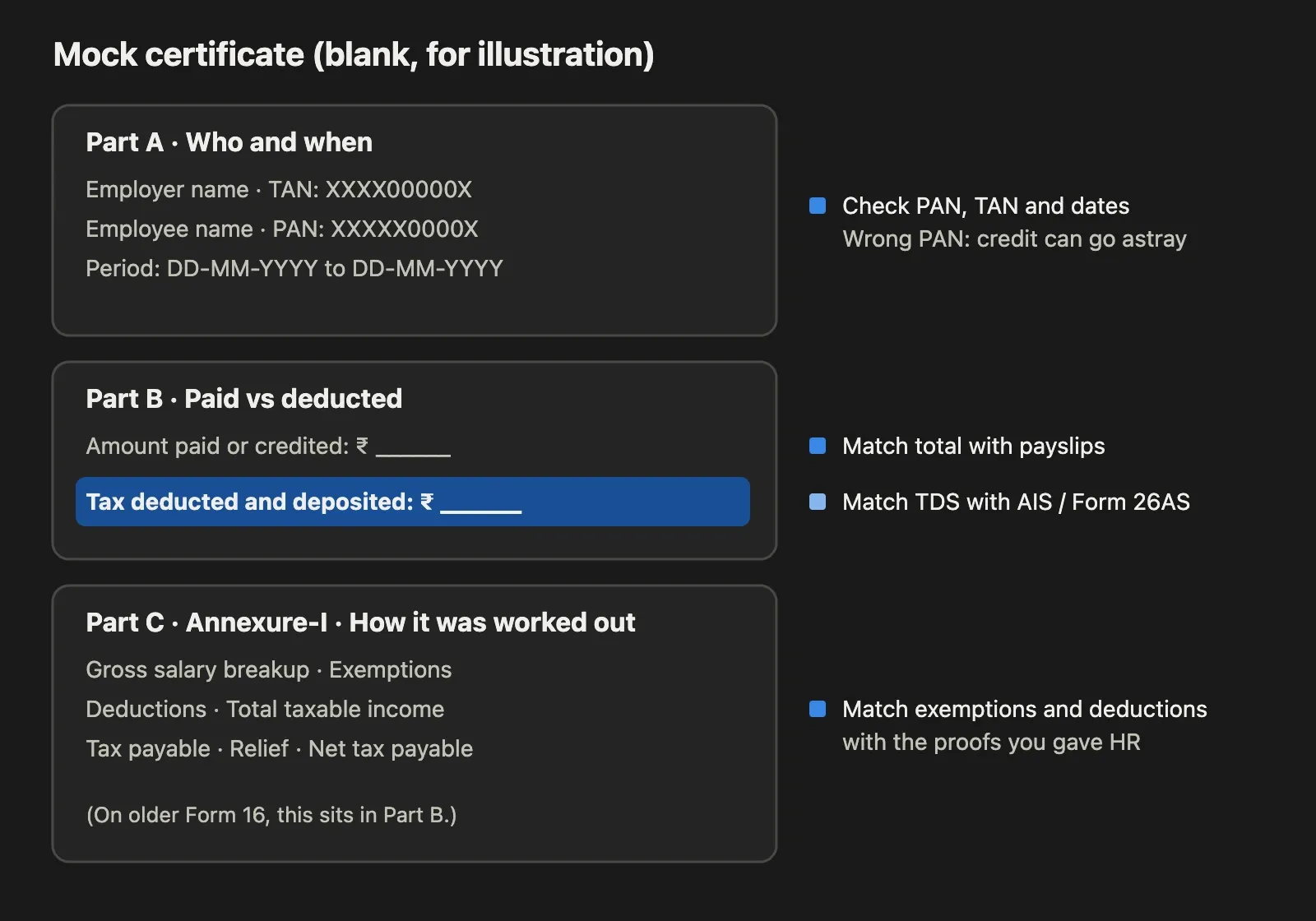
Older Form 16 (salary up to 31 March 2026). Part A carries the employer's and your details (names, PAN, TAN, period) and a quarter-by-quarter summary of tax deducted and deposited. Part B is the annexure that shows how your taxable salary was worked out: gross salary, exemptions, deductions and the tax computed.
Form No. 130 (salary from 1 April 2026). The Department's FAQs describe three parts:
- Part A: details of the employer and of you, the employee.
- Part B: a summary that reconciles the amount paid or credited to you with the tax deducted.
- Part C, Annexure-I: the salary breakup, exemptions, deductions, total taxable income, tax payable, relief under section 157, TDS/TCS paid and net tax payable.
Either way, one part shows what was deducted and deposited; the other shows how your employer got there.
A line-by-line check before you file
Open your payslips, log in to the e-filing portal to see your AIS and Form 26AS, then go through the certificate in this order.
- Your name and PAN. A wrong PAN means the TDS may be credited to someone else. Fix this first.
- Employer name and TAN. The TAN (the employer's tax deduction account number) should match the TDS entry in your AIS or Form 26AS.
- Period of employment. The from and to dates should match your joining date (and leaving date, if you changed jobs).
- Amount paid or credited. Add up the gross pay on your payslips for the same months. The totals should agree, or the gap should be explainable (an arrear, a bonus, a reimbursement).
- Tax deducted and deposited. Compare this figure with the TDS shown against your PAN for that TAN in your AIS and Form 26AS. This is the line that decides how much credit you get.
- The salary breakup. In Annexure-I (or Part B of the older form), check exemptions and deductions against the declarations and proofs you gave HR.
- How it was issued. The FAQs say the certificate must be downloaded from the TRACES website and signed digitally or manually.
If a number is wrong, write to HR with the line and the figure you expected. The FAQs say the employer corrects errors by filing a revised TDS statement and then issuing a corrected certificate.
I switched jobs mid-year: will I get two certificates and how do I file?
The Department's FAQs say each employer issues Part A and Part B for its own period of employment, and Annexure-I of Part C can be issued by each employer or by the last employer, at your option.
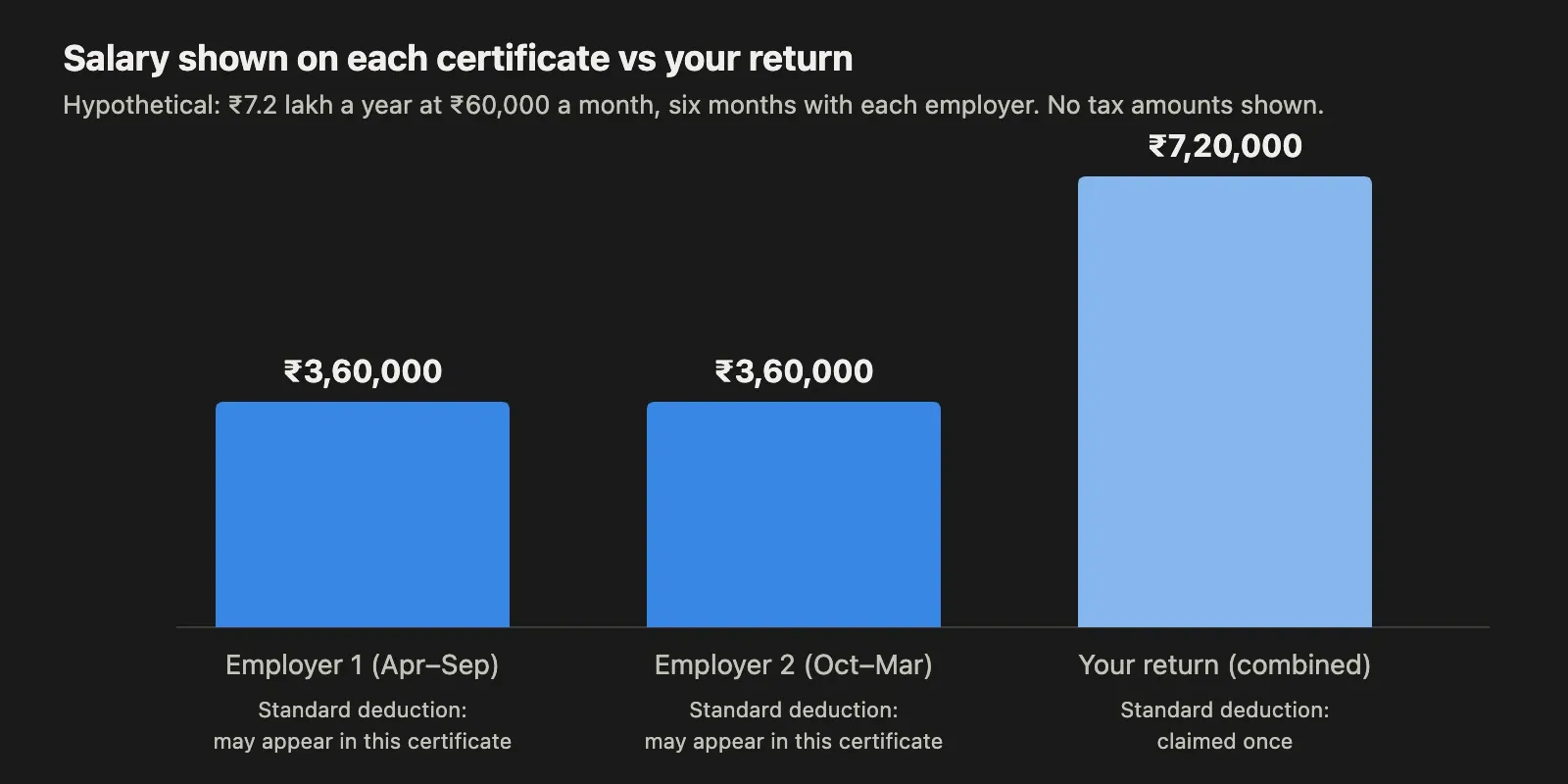
Hypothetical example, for illustration only. Assumptions: annual salary of ₹7.2 lakh, earned evenly at ₹60,000 a month; Employer 1 from April to September (6 months), Employer 2 from October to March (6 months); no bonus, arrears or other income. No tax amounts are shown.
| Employer 1 (Apr–Sep) | Employer 2 (Oct–Mar) | What your return uses | |
|---|---|---|---|
| Salary on the certificate | ₹3,60,000 | ₹3,60,000 | ₹7,20,000 (both added) |
| Standard deduction | May be applied in this certificate | May be applied in this certificate | Claimed once for the year |
| TDS | As shown in this certificate | As shown in this certificate | Both added, matched with AIS |
Each certificate shows only its own ₹3.6 lakh. If neither employer knew about the other, each may have treated ₹3.6 lakh as your full-year salary and applied the standard deduction in its own computation. That is 2 standard deductions on paper, while your return claims it 1 time against ₹7.2 lakh. The combined income can sit in a higher slab than either half, so the tax deducted by the two employers together may fall short of the tax due on the combined figure. If it does, you pay the difference before filing.
To reduce that surprise, share your previous employer's salary and TDS figures with your new employer when you join; ask HR which declaration it uses.
Do I need Form 16 to file my ITR, and what if my employer didn't deduct TDS?
You don't attach it to your return. The FAQs say the certificate need not be attached, but you should keep it for your records. Most salary figures you enter come from it; if it hasn't arrived, your payslips, AIS and Form 26AS let you check the same numbers.
If your employer deducted no tax, for example because your salary for the year stayed below the taxable level, the mandatory-issue rule is tied to tax being deducted and deposited. So you may not receive one. Whether you still need to file a return depends on your income and other conditions for that year. Check the e-filing portal or ask a tax professional.
Frequently asked questions
When will I receive my Form 16 or Form 130?
By 15 June of the financial year after the year in which the salary was paid and tax deducted. For salary from 1 April 2026 to 31 March 2027, that means by 15 June 2027.
What if the TDS on my certificate doesn't match AIS or Form 26AS?
Tell your employer which figure differs. The credit you can claim follows what was deposited and reported against your PAN, so the employer may need to file a revised TDS statement. A corrected certificate can be issued once that is processed.
Does a fresher with no TDS get a Form 16?
Issuing the certificate is mandatory once tax has been deducted and deposited. If no tax was deducted, you may not receive one. Your payslips and AIS still show your salary, and whether you must file depends on your income and other conditions.
Do I attach Form 16 to my income tax return?
No. The Income Tax Department's FAQs say it need not be attached, but you should keep it for your records.
Before you open the certificate again
Haven't decoded your payslip yet? Work out CTC to in-hand first: CTC vs in-hand salary. For the rest of your first-year money list, start with the first job money checklist. When you are ready to plan where the in-hand amount goes, the 50/30/20 rule on an Indian salary is a simple starting split.
— Laabh