Index fund or ETF for your SIP comes down to how each one buys units
An index fund SIP buys fractional units at NAV by auto-debit; an ETF needs demat and buys whole units. See what ₹3,500 a month buys in each.
Summarize this article with AI





The short version
- An index fund SIP is an auto-debit mandate that buys fractional units at NAV, with no demat account.
- An ETF needs a demat account and an exchange order, buys whole units at market price, and can leave cash uninvested.
- Compare total cost at your monthly amount: expense ratio, plus brokerage, depository charges and spread for an ETF.
- Check tracking difference, and for an ETF, liquidity and price versus iNAV.
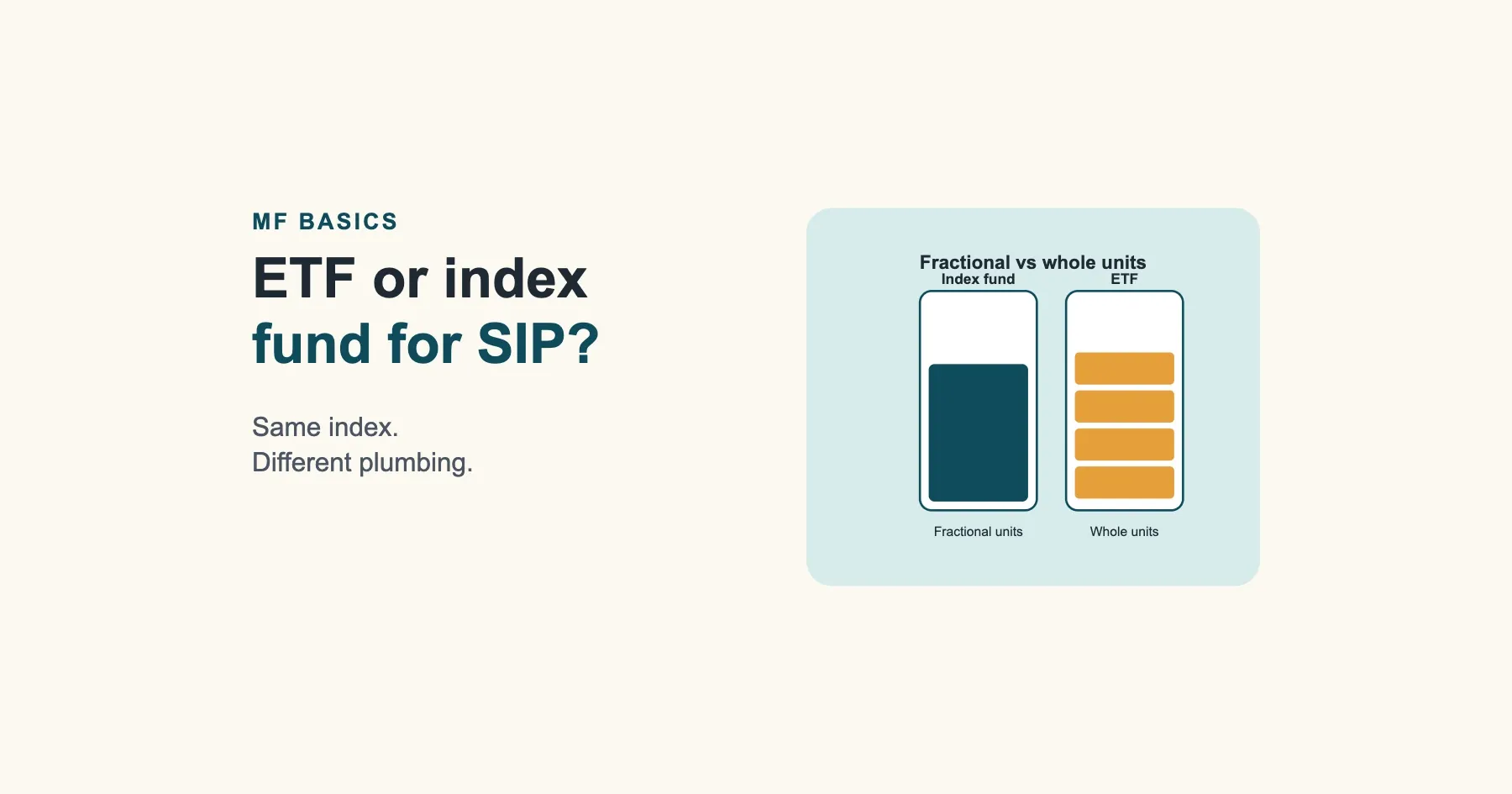
Both an index fund and an ETF can track the same index. An index fund takes a fixed rupee SIP by auto-debit and allots fractional units at the applicable NAV. An ETF is bought on the stock exchange through a demat account, in whole units at the market price, with trading costs on top.
Say you have settled on passive investing and on ₹3,500 a month. That is the real ETF vs index fund for SIP question: the index is the same either way. What changes is the plumbing between your bank account and the units you end up holding. If you're still deciding whether an index fund makes sense at all, start with comparing two index funds.
ETF or index fund: which suits a monthly SIP?
| Index fund | ETF | |
|---|---|---|
| Unit type | Fractional units | Whole units only (minimum 1 unit on the exchange) |
| Account needed | Mutual fund folio; no demat needed | Demat and trading account with a broker |
| How the monthly buy happens | SIP mandate; the bank auto-debits and the fund house allots units | You (or a scheduled broker order) place a buy order on the exchange |
| Price you pay | The applicable day's NAV (set by cut-off time), published after market close | Market price during trading hours, which can sit above or below NAV |
| Cost layers | Expense ratio (plus stamp duty on purchases) | Expense ratio, brokerage, depository and demat charges, bid-ask spread |
| Getting money out | Redeem with the fund house at NAV | Sell on the exchange to another buyer; depends on trading volume |
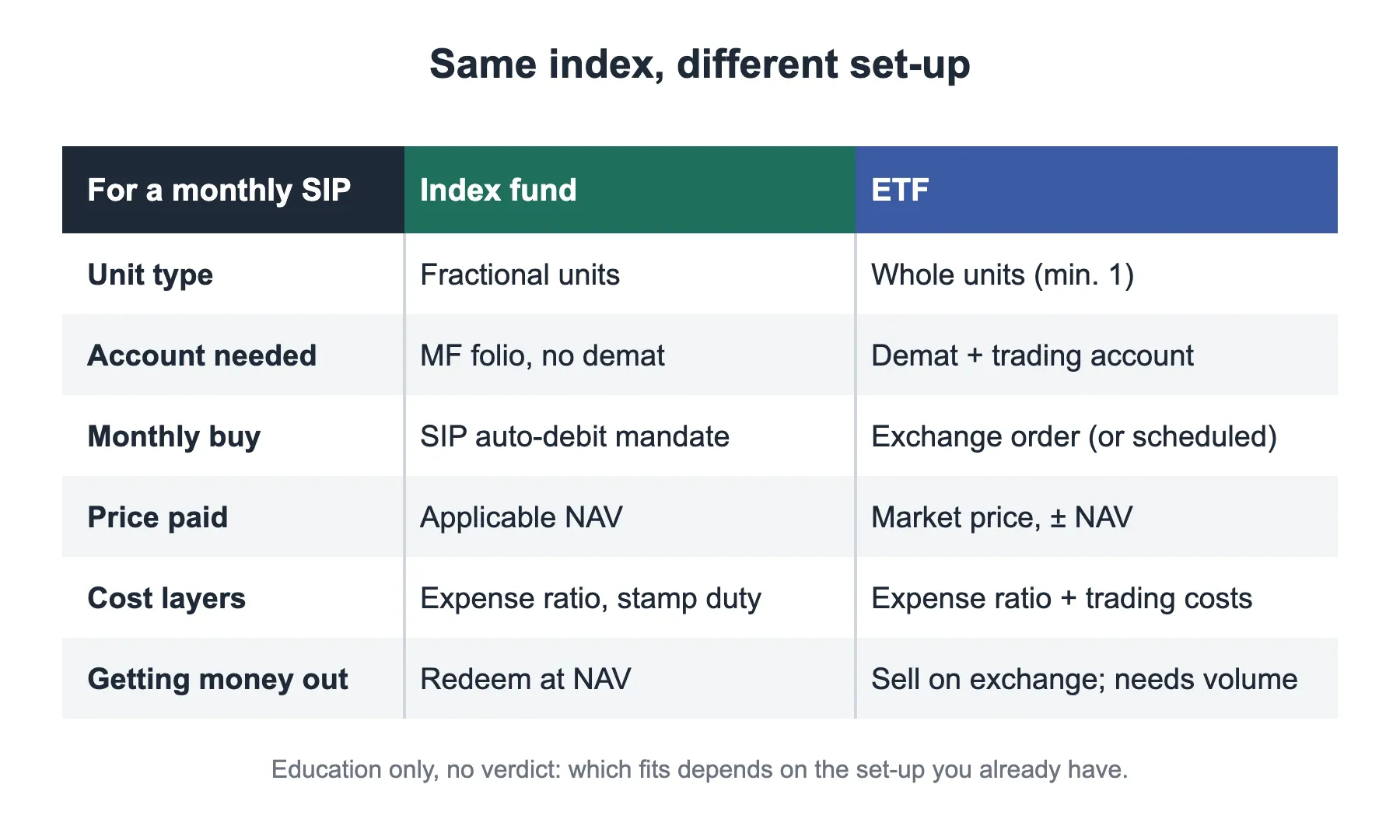
Which suits you depends on the set-up you already have. An index fund fits if you want a rupee amount invested automatically each month, have no demat account, or would rather not place orders. An ETF fits if you already use a demat account, are comfortable placing (or scheduling) exchange orders, and check the ETF's trading costs and liquidity first. Either way, check the expense ratio and tracking difference.
Can I do an SIP in an ETF?
Not in the same way as with an index fund. A mutual fund SIP is a mandate with the fund house: your bank pays a fixed rupee amount on a set date and units are allotted at NAV.
An ETF is bought on NSE or BSE like a share. Some brokers offer an "ETF SIP", but in practice that is a scheduled buy order placed through the broker on a set date, not a mandate with the fund house. How it handles a rupee amount, a price jump or a holiday depends on the broker's rules.
Buying ETF units directly from the fund house is restricted. Under SEBI's rules for passive funds, any order placed directly with the AMC to buy or redeem ETF units must be greater than ₹25 crore. Market makers are exempt. For an ordinary monthly investor, the exchange is the route.
Do I need a demat account to buy an ETF?
Yes, for buying on the exchange. You place a buy order with a stockbroker, and the ETF units are credited to your demat account after settlement.
An index fund needs no demat account. You can invest through the fund house, a registrar or a mutual fund platform, and the units sit in a folio. More in mutual funds without a demat account.
Whole units vs fractional units: what a fixed amount actually buys
Hypothetical prices; actual NAV, prices and charges vary.
Index fund (hypothetical NAV ₹27.40): ₹3,500 ÷ ₹27.40 = about 127.7 units (127.737). The full ₹3,500 is invested, before a small stamp duty.
ETF (hypothetical market price ₹270): ₹3,500 ÷ ₹270 = 12.96, but you can only buy whole units. So 12 units cost ₹3,240, and ₹260 stays uninvested. Broker charges come on top.
| Hypothetical ₹3,500 | Index fund | ETF |
|---|---|---|
| Price | NAV ₹27.40 | Market price ₹270 |
| Units bought | about 127.7 | 12 |
| Amount invested | ₹3,500 | ₹3,240 |
| Left uninvested | ₹0 | ₹260 |
| Extra charges | Stamp duty | Brokerage, depository charges, spread |
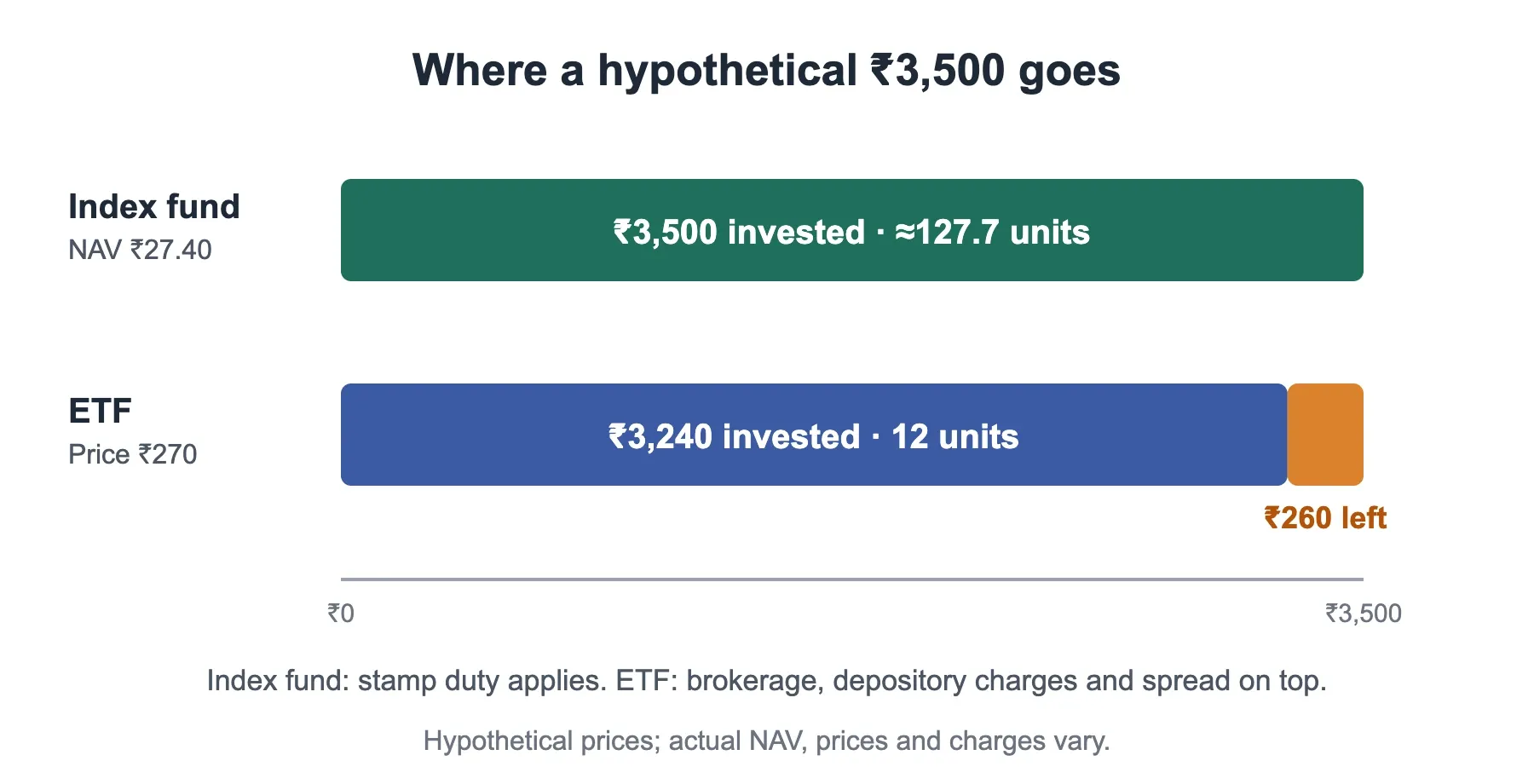
The leftover doesn't vanish. If you add the ₹260 to next month's ₹3,500, you have ₹3,760, which buys 13 units (₹3,510) and leaves ₹250, assuming the price stays at a hypothetical ₹270. Prices move daily, so units and change shift each month. The higher an ETF's unit price relative to your monthly amount, the larger the share that can sit idle.
Costs, layer by layer
Both vehicles charge an expense ratio, taken from the scheme's assets and already reflected in the NAV. More in expense ratio in mutual funds.
An ETF adds layers that sit outside the expense ratio:
- Brokerage on each buy and sell order, which depends on your broker's plan.
- Depository and demat charges, such as annual maintenance and charges when units leave your demat account.
- Bid-ask spread: the gap between the best price buyers offer and sellers ask. It tends to be wider on a thinly traded ETF.
- Statutory charges and taxes on exchange trades.
A fixed per-order charge weighs more on a small order than a large one, so a lower expense ratio alone doesn't settle which is cheaper. Add up every layer at your own monthly amount.
What are tracking error and tracking difference?
Both measure how closely a scheme follows its index. SEBI defines both in its rules for passive funds:
- Tracking error is the annualised standard deviation of the difference in daily returns between the index and the scheme's NAV, measured on one year of rolling data. It shows how steadily a scheme follows the index. For ETFs and index funds, other than debt ones, SEBI sets a 2% limit. Every ETF and index fund must disclose it daily on the AMC's and AMFI's websites.
- Tracking difference is the annualised difference of daily returns between the index and the NAV. It shows how much the scheme lagged (or led) the index over a period. It must be disclosed monthly on the AMC and AMFI websites, for one, three, five and ten years and since the scheme started.
For a long-term SIP, tracking difference is often the more useful check, because it reflects the expense ratio and other frictions in one figure. Compare it between two schemes on the same index over the same period.
Why does an ETF's market price differ from its NAV?
An ETF's price is set by buyers and sellers through the trading day; its NAV reflects the portfolio's value. Above NAV, it trades at a premium; below, at a discount.
Two mechanisms keep the gap in check:
- iNAV (indicative NAV): the per-unit NAV based on the current market value of the portfolio during trading hours. SEBI requires it to be disclosed continuously on the exchange where the ETF is listed; for equity ETFs, with a lag of no more than 15 seconds from the underlying market. Checking it before you order shows whether the price is close to fair value.
- Market makers: SEBI requires each AMC to appoint at least two market makers, who are stock exchange members, to provide liquidity in its ETFs.
Even so, a thinly traded ETF can trade further from iNAV. An index fund avoids this: you buy and redeem at NAV.
Frequently asked questions
Is an ETF or an index fund cheaper overall?
It depends on the full cost, not the expense ratio alone. ETFs often charge a lower expense ratio, but you also pay brokerage, depository charges and the bid-ask spread, which matter more on a small monthly amount.
Can I do an SIP in an ETF?
Not as a fund-house SIP mandate. You buy on the exchange through a broker, and some brokers let you schedule a recurring order. It buys whole units, so part of the amount may stay uninvested.
What are tracking error and tracking difference?
Tracking error measures how steadily a scheme follows its index; tracking difference measures how far its returns ended up from the index over a period. SEBI requires both to be disclosed on AMC and AMFI websites.
Does gold work the same way?
Broadly, yes. A gold ETF is bought on the exchange in whole units through a demat account, while a gold mutual fund can take a rupee SIP without demat. The differences are covered in gold ETF vs gold mutual fund.
Where to go from here
New to index funds? Start with how they work and how to compare two on the same index: comparing two index funds. Choosing between schemes more broadly? Compare approaches in how to choose a mutual fund.
— Laabh



