How to Report Mutual Fund Capital Gains in Your ITR: From Capital Gain Statement to Schedule 112A
Get the CAMS/KFintech capital gain statement, pick ITR-1 or ITR-2, and fill Schedule 112A and Schedule CG, with one worked folio.
Summarize this article with AI





The short version
- An SIP instalment is not taxed when invested; redemptions and switches are.
- Get free capital gain statements from CAMS and KFintech, then sort each sale into equity or debt, short or long term.
- ITR-1 (AY 2026-27) allows section 112A LTCG up to ₹1.25 lakh with no STCG; otherwise use ITR-2.
- In ITR-2, equity LTCG goes in Schedule 112A, everything flows to Schedule CG, and losses to carry forward appear in Schedule CFL.
- Report gains even when they are below ₹1.25 lakh, and match the figures with AIS before you submit.
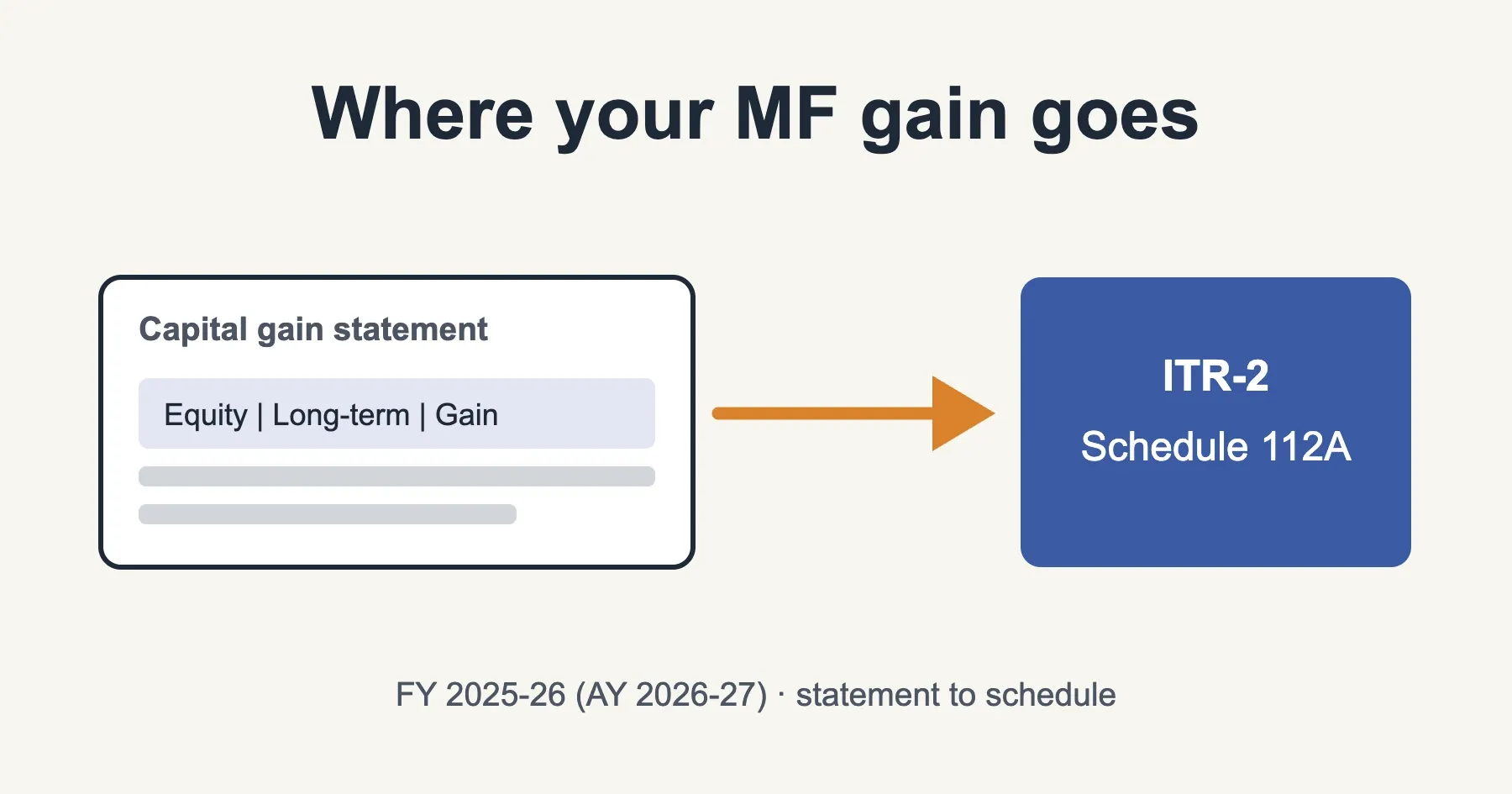
To report mutual fund capital gains in your ITR, download a capital gain statement from CAMS or KFintech, sort each redemption or switch into equity or debt and short-term or long-term, then enter it in the right place. Long-term gains on equity-oriented funds go in Schedule 112A of ITR-2. ITR-1 allows them only up to ₹1.25 lakh, and only if you have no short-term capital gains. Gains below ₹1.25 lakh are still reported; the exemption is applied in the computation, not by leaving them out.
This page explains reporting for FY 2025-26 (AY 2026-27), checked against Income Tax Department help pages.
Riya, 27, a salaried analyst in Pune, redeemed some SIP units this year and has never opened Schedule CG. This guide follows her one folio from statement to schedule.
First check: did you actually redeem or switch anything this financial year?
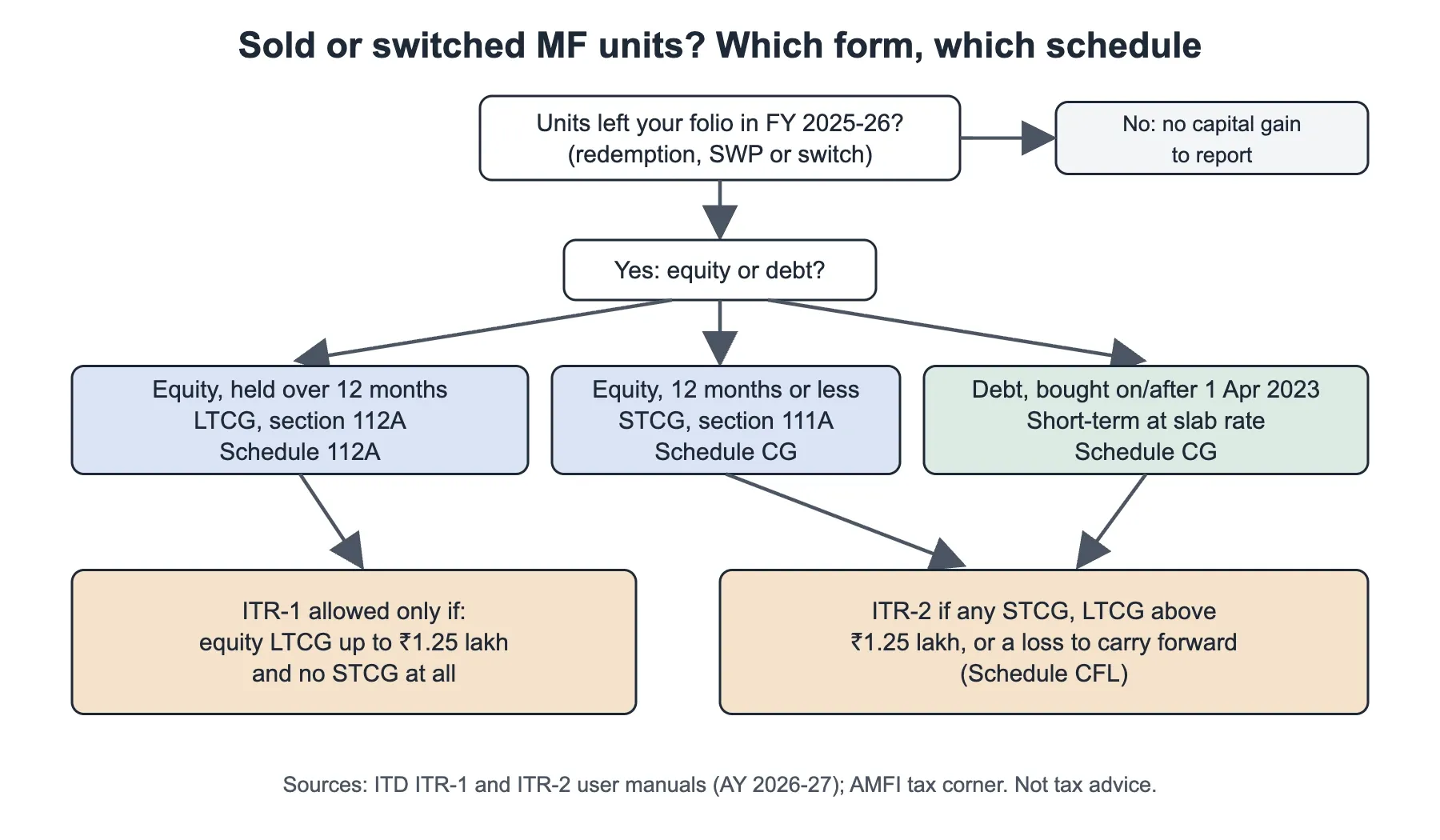
An SIP instalment is a purchase, not a taxable event. Tax arises when units leave your folio: a redemption, a systematic withdrawal or a switch. A switch between schemes is a sale followed by a purchase, and AMFI notes that even a switch from growth to dividend (IDCW) within the same scheme is subject to capital gains tax.
Each instalment buys its own batch of units. A redemption is matched against batches, generally oldest first, so one sale can contain both long-term and short-term units.
If nothing left your folio between 1 April 2025 and 31 March 2026, there is no capital gain to report.
Get the document: your capital gain statement
AMFI's investor education site lists two free routes that cover the funds each registrar services:
- CAMS: choose "Capital Gain/Loss Statement", enter your PAN and registered email, pick the year and "All Mutual Funds"; a password-protected PDF arrives by email.
- KFintech: open "Investor Statement and Report", then "Consolidated Capital Gains Statement".
Pull both if your fund houses use different registrars. Your fund house's own website is another route. Unsure which registrar is which? See what CAMS and KFintech do.
AMFI says the statement shows asset class, long-term or short-term, transaction details and net gain or loss. How it maps to the return:
| Statement column | Where it goes in the ITR |
|---|---|
| Asset class (equity / debt) | Decides 112A route or general Schedule CG lines |
| Purchase date and sale date | Decides short-term or long-term |
| Redemption (sale) value | Full value of consideration |
| Purchase cost | Cost of acquisition |
| Gain or loss | Balance carried to Schedule CG |
Sort each sale into a bucket
Equity-oriented funds. Units held more than 12 months give long-term capital gains (LTCG) under section 112A. For transfers on or after 23 July 2024, AMFI's tax table gives LTCG above ₹1,25,000 a year taxed at 12.5%, and short-term gains (STCG, section 111A) at 20%.
Debt funds bought on or after 1 April 2023. AMFI states gains on these units are deemed short-term and taxed at your slab rate, however long you held them. From FY 2025-26 this rule covers debt-oriented schemes, including fund of funds of that type.
Older debt units. Units bought before 1 April 2023 follow different holding-period rules; use your statement's classification and see how mutual funds are taxed in India.
FY 2025-26 income is still governed by the Income-tax Act, 1961: the department's FAQ says its repeal from 1 April 2026 does not disturb earlier years, so sections 111A and 112A apply to these returns. For what changes from tax year 2026-27, see the new Income Tax Act explained.
Which ITR form: ITR-1 or ITR-2?
The department's ITR-1 user manual for AY 2026-27 lets ITR-1 include long-term capital gain under section 112A up to ₹1.25 lakh. It also says ITR-1 cannot be filed by someone who has short-term capital gains or whose 112A gains exceed ₹1.25 lakh.
So:
- Only equity LTCG, total ₹1.25 lakh or less, no other capital gains: ITR-1 is available, with the gain entered under "Long Term capital gains u/s 112A".
- Any STCG (equity or debt), LTCG above ₹1.25 lakh, or a capital loss you want to carry forward: use ITR-2.
Where it goes in ITR-2: Schedule CG, Schedule 112A and Schedule CFL
Schedule 112A holds long-term gains on equity-oriented fund units. The ITR-2 user manual for AY 2026-27 says scrip-wise details of each transfer are mandatory for holdings bought on or before 31 January 2018. For later purchases, enter the details in the format the utility asks for.
Schedule CG is the summary: short-term equity gains, debt fund gains and Schedule 112A totals all flow here, computed together for assets of the same type.
Schedule CFL shows losses carried to later years. The department's ITR-2 FAQ says capital losses can be carried forward for eight years, long-term losses can be set off only against long-term gains, and the carry-forward depends on filing by the section 139(1) due date. For FY 2025-26 that date has passed for most salaried filers, so a loss reported in a belated return now cannot be carried forward; see late ITR filing and the 31 December cut-off.
Worked example: one folio, three redemptions
Hypothetical, FY 2025-26, not a recommendation; all units bought after 31 January 2018. Riya redeems ₹3,40,000 from one equity-oriented fund in three redemptions.
| Redemption | Type | Sale value | Purchase cost | Gain | Where it goes |
|---|---|---|---|---|---|
| Redemption 1 | Long-term (held over 12 months) | ₹2,00,000 | ₹1,40,000 | ₹60,000 | Schedule 112A, then Schedule CG |
| Redemption 2 | Long-term (held over 12 months) | ₹50,000 | ₹42,000 | ₹8,000 | Schedule 112A, then Schedule CG |
| Redemption 3 | Short-term (held 12 months or less) | ₹90,000 | ₹80,800 | ₹9,200 | Schedule CG (short-term, section 111A rate) |
| Total | ₹3,40,000 | ₹2,62,800 | ₹77,200 |
What happens next:
- LTCG of ₹68,000 goes into Schedule 112A. It is within the ₹1,25,000 exemption, so the tax on it is nil, and ₹57,000 of the limit stays unused for the year.
- STCG of ₹9,200 goes in Schedule CG as short-term gain under section 111A. At the 20% rate that is ₹1,840 before cess, surcharge and any rebate.
- Form: the STCG rules out ITR-1, so Riya files ITR-2.
What-if: an LTCG of ₹1,50,000 alone would also need ITR-2, with 12.5% only on the ₹25,000 above the limit, ₹3,125 before cess.
Cross-check with AIS before you submit
Your Annual Information Statement (AIS) on the e-filing portal lists financial transactions reported against your PAN, including mutual fund information reported by registrars. Match its values with your capital gain statement. If an entry looks wrong or duplicated, submit feedback on it in AIS and file from your correct records. Keep the PDFs. You can also cross-check against your consolidated account statement.
Common mistakes
- Missing switches. A switch is a sale for tax, easy to forget because no money reached your bank.
- Double-counting IDCW. Payouts are taxed at slab rates as income from other sources, not in Schedule CG.
- Leaving out exempt LTCG. A gain under ₹1.25 lakh is still shown; the exemption works inside the computation.
- Pulling one registrar's statement when your funds use both.
- Using ITR-1 with any STCG. The AY 2026-27 manual rules this out.
For the salary side of the same return, see the Form 16 explainer.
Frequently asked questions
Do I need to report mutual fund gains in ITR if they are below ₹1.25 lakh?
Yes. The ₹1.25 lakh exemption for section 112A gains is applied in the computation, so you enter the gain (Schedule 112A in ITR-2, or the 112A field in ITR-1) and the tax on it works out to nil.
Can I use ITR-1 if I sold mutual funds?
Only in a narrow case: the AY 2026-27 ITR-1 manual allows section 112A gains up to ₹1.25 lakh with no short-term capital gains. Otherwise, or with a loss to carry forward, use ITR-2.
Where do I get the capital gain statement for mutual funds?
From CAMS (Capital Gain/Loss Statement) and KFintech (Consolidated Capital Gains Statement), using your PAN and registered email. Pull both if your fund houses use different registrars.
Is an SIP instalment taxed when it is invested?
No. Tax arises when units are redeemed or switched. Redemptions are matched to instalment batches, generally oldest first.
What if AIS shows a different redemption value?
Compare it with your capital gain statement. If the AIS entry is wrong or duplicated, submit feedback in AIS, file from your correct records and keep the statements.
Learn more
Save this checklist for filing season: statement, bucket, form, schedule, AIS check.



