Switching from a regular to a direct mutual fund: exit load, tax, and when it adds up
The exit load on a regular to direct switch is not charged, but a switch is still a sale for tax. See the break-even maths before you move.
Summarize this article with AI





The short version
- The exit load on a regular to direct switch of the same scheme is not charged.
- A switch is a redemption plus a purchase, so capital gains tax can apply, as of FY 2026-27, under the Income-tax Act, 2025.
- In our hypothetical case, a ₹8,750 tax bill against a ₹2,240 yearly saving breaks even in about 3.9 years, ignoring growth.
- Switched ELSS units may start a new lock-in.
Fund houses do not charge exit load when you switch from a regular to a direct mutual fund plan of the same scheme. The switch is still a sale plus a purchase, so capital gains tax can apply, and switched ELSS units may start a new lock-in.
Mutual fund investments are subject to market risks, read all scheme related documents carefully. Tax lines on this page are as of FY 2026-27, under the Income-tax Act, 2025, written on 17 November 2026. Tax rules change; consult a tax professional for your situation.
Say Sameer, 31, in Warangal, has found his old SIP units sitting in a regular plan and wants to move. The exit load is gone. The tax isn't. Here are both, with a hypothetical example you can redo from your own statement.
What changed, and what didn't (dated 17 November 2026)
| Position | Status | |
|---|---|---|
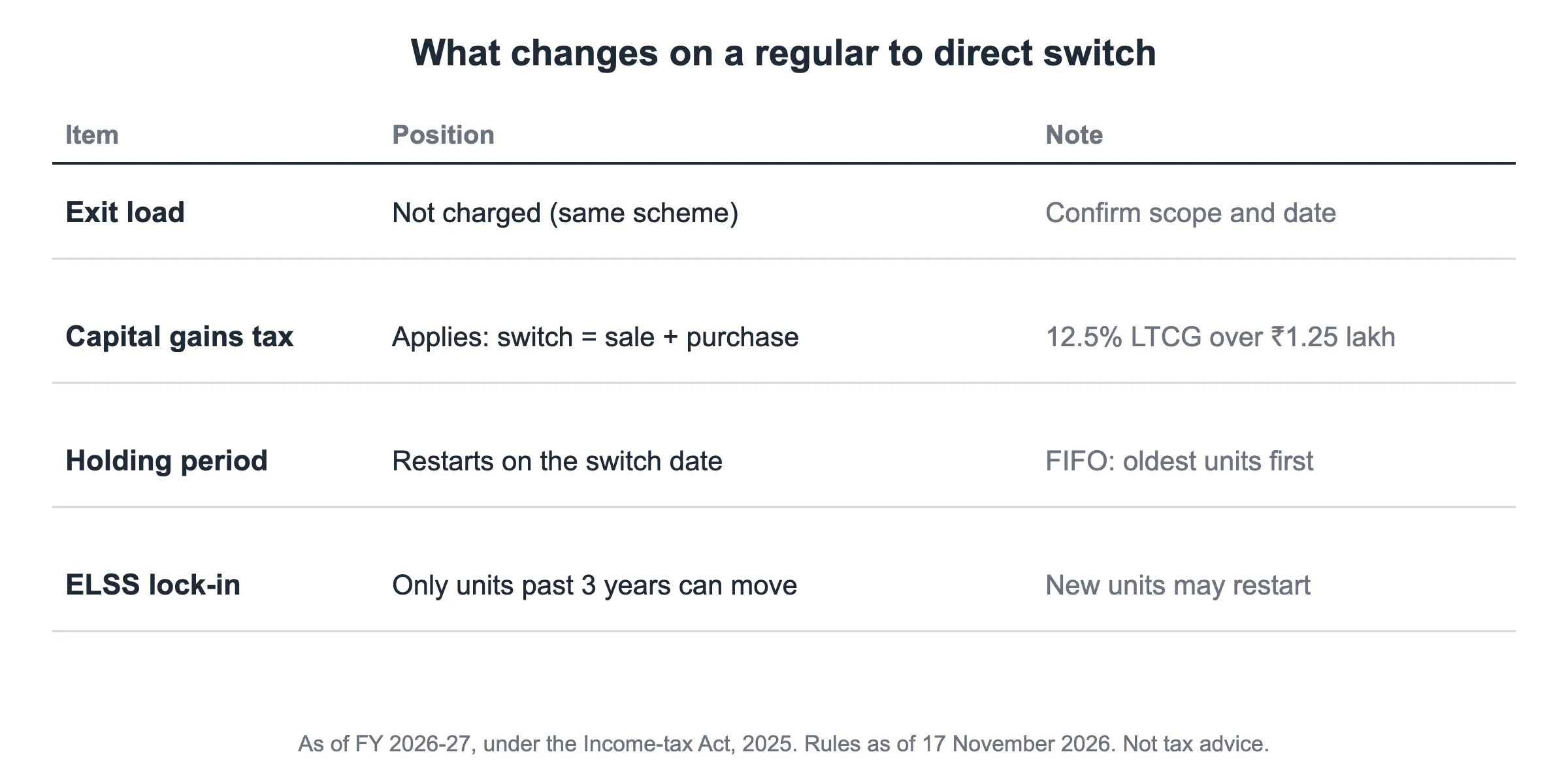
| Exit load on regular to direct switch, same scheme | Not charged | AMFI best-practice guidance issued at SEBI's direction, 2025 |
| Capital gains tax on the switch | Still applies: a switch is a redemption plus a purchase | Unchanged |
| Holding period of switched units | Starts again from the switch date | Follows from the purchase treatment |
| ELSS lock-in | Only units past their 3-year lock-in can usually move; new units may start a fresh lock-in | Check your scheme's SID |
Is there any exit load now if I switch from regular to direct in the same fund?
No. In 2025 SEBI noted that some fund houses were still charging exit load on regular to direct switches and asked AMFI to stop it. AMFI then told fund houses not to charge it, and scheme documents now carry the line that exit load will not be charged on a switch from the regular plan to the direct plan.
Two things to know:
- Same scheme only. This covers a switch from the regular plan to the direct plan of the same scheme. A move into a different scheme is an ordinary redemption, and that scheme's exit load terms apply.
- Check the notice or addendum. Fund houses that changed their terms issued addendums. Your scheme's SID or KIM and any recent notice will show the current position.
Is switching treated as a sale for capital gains tax?
Yes. A switch from the regular plan to the direct plan is treated as a redemption from one plan and a fresh purchase in the other. The gain on the units you switch out is a capital gain in the year of the switch, as of FY 2026-27, under the Income-tax Act, 2025.
How it is taxed depends on how long each unit was held:
- Equity-oriented fund units held more than 12 months are long-term. The Income Tax Department's page on long-term capital gains says gains on these units are taxed at 12.5%, and the first ₹1.25 lakh of such gains in a year is not taxed.
- Units held 12 months or less are short-term. Short-term gains on equity-oriented units are taxed at 20%.
- Debt and other fund types follow different rules; see how mutual funds are taxed in India in 2026.
Units leave on a first-in, first-out basis, so your oldest units are switched first. If you invested through an SIP, each instalment has its own purchase date, so a single switch can mix long-term and short-term units.
A worked example: one-time tax vs yearly saving
All numbers below are hypothetical, for illustration only. They are not tax advice and not a promise; returns vary. Tax figures are as of FY 2026-27, under the Income-tax Act, 2025.
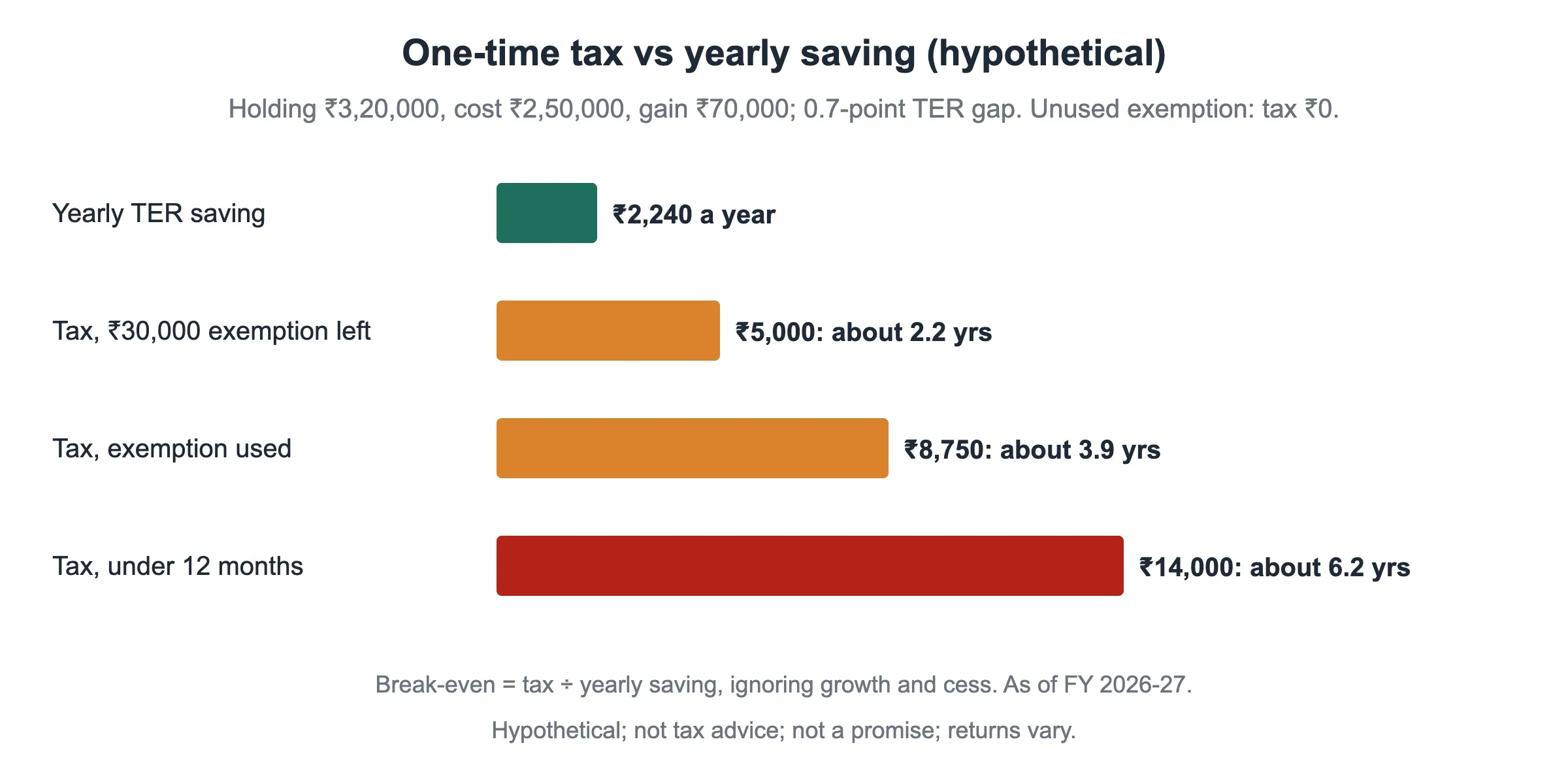
Sameer's regular-plan equity fund units are worth ₹3,20,000. He paid ₹2,50,000 for them, and every unit is more than 12 months old. His long-term gain is ₹70,000.
Assume the direct plan's expense ratio is 0.7 percentage points lower than the regular plan's (a hypothetical gap; check both plans' TER on the fund house website). On ₹3,20,000, that is about ₹2,240 a year that stays invested instead of going to costs.
| Scenario (hypothetical) | Tax on the switch (before cess) | Yearly TER saving | Break-even |
|---|---|---|---|
| ₹1.25 lakh exemption fully unused this year | ₹0 | ₹2,240 | Immediate |
| Only ₹30,000 of exemption left | ₹5,000 on ₹40,000 | ₹2,240 | About 2.2 years |
| Exemption already used | ₹8,750 (12.5% of ₹70,000) | ₹2,240 | About 3.9 years |
| Same gain, but units under 12 months (20%) | ₹14,000 | ₹2,240 | About 6.2 years |
Break-even is the tax divided by the yearly saving. It ignores growth: if the fund grows, the yearly saving grows too, and the break-even comes sooner. If the fund falls, it comes later.
Should I switch existing units or stop the old SIP and start a new direct one?
There are two paths. This page does not recommend either.
Path 1: switch existing units. You pay any capital gains tax now. From the switch date, those units carry the direct plan's lower cost. Holders with a small gain, or unused room in the ₹1.25 lakh exemption, face a smaller tax bill.
Path 2: leave existing units, redirect new money. You stop the regular-plan SIP and start a new SIP in the direct plan. Nothing is sold, so no tax arises now. The old units keep paying the regular plan's expense ratio until you redeem them.
Some investors also move in stages across more than one financial year; how the exemption applies each year is a question for your tax professional. Whichever path you consider, check:
- Your gain per lot, from your consolidated account statement (CAS)
- How much of the ₹1.25 lakh exemption you have already used this year
- How long your remaining units have been held, and whether any are near the 12-month mark
- The TER of both plans of the same scheme today
How do I switch: via the fund house, the RTA or MF Central?
The switch is placed on your folio, not through your existing distributor. Common routes:
- The fund house's own website or app. Log in with your PAN, pick the regular-plan holding, choose switch, select the direct plan of the same scheme, and confirm with an OTP.
- The registrar (RTA). CAMS or KFintech service each fund house's folios through their online portals. Check which registrar handles your fund house first.
- MF Central. A common platform built by the two RTAs, where you can view folios across participating fund houses and place service requests.
A switch can be for all units, a number of units or an amount, so a partial switch is possible. If you are moving new money too, stop the old regular-plan SIP so you don't run both.
If I switch ELSS units, does the 3-year lock-in restart?
First, the lock-in itself. SEBI's investor page on ELSS says the amount is locked in for three years and cannot be withdrawn during that period. Each SIP instalment is a separate purchase, so its three years usually run from its own date.
On switching:
- Units still in lock-in generally cannot be switched, since a switch is a redemption.
- Units past lock-in can be switched. Because the direct plan units are a fresh purchase, they may start a new three-year lock-in from the switch date.
For the tax side of ELSS, see ELSS under the new tax regime whether ELSS is worth it in the new tax regime.
Frequently asked questions
Does the waiver cover other schemes?
It covers switches from the regular plan to the direct plan of the same scheme. A switch into a different scheme follows that scheme's exit load terms. Check your scheme's SID or notice.
Is stamp duty charged on a switch?
A switch-in is a purchase, and stamp duty on mutual fund unit purchases applies to switch-ins at 0.005%. Check your transaction statement.
Can I switch partially?
Yes. You can usually switch a set number of units or an amount, and the oldest units move first.
Does a switch reset my holding period?
Yes. The direct plan units are a new purchase, so their holding period for tax starts on the switch date.
Read next
Work out your gain from your CAS first: how to read your mutual fund CAS shows where each lot's cost and date sit. For the background, see direct vs regular plans and expense ratio in mutual funds.
— Laabh



