First job money checklist: what to do in week 1, month 1 and months 2–6
A first-salary checklist by deadline: payroll paperwork in week 1, tracking your money in month 1, then buffer, insurance and a first SIP.
Summarize this article with AI





The short version
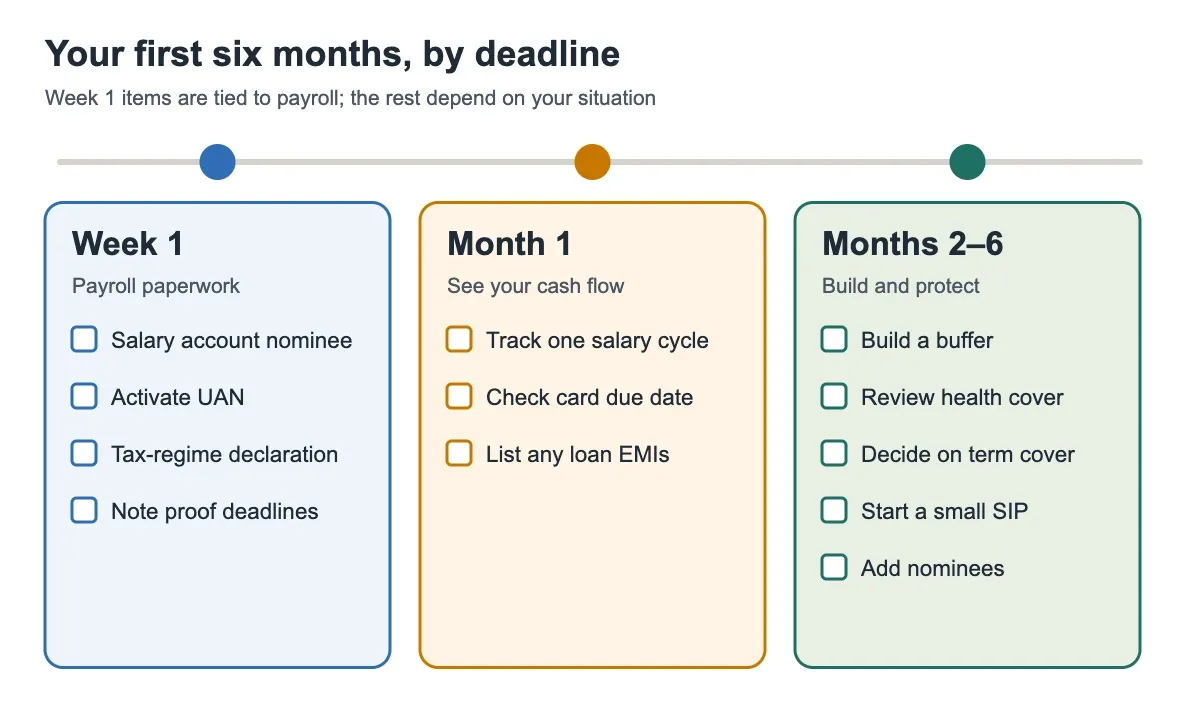
- Week-1 items are tied to payroll: salary account nominee, UAN activation, EPF nomination and your tax-regime declaration.
- Track one salary cycle before deciding anything big; the left-over amount funds every later choice.
- Emergency fund, debt, insurance and investing have no fixed order. Weigh interest rate, job stability, buffer and dependants, and check official answers with EPFO and the Income Tax Department.
The first-week items on a first job money checklist are paperwork tied to payroll: a nominee on your salary account, your UAN and EPF, your tax-regime declaration to your employer, and nominations. Month 1 is about seeing where your salary goes and handling any credit card or loan dues. Months 2–6 are about building a buffer, checking your insurance and starting to invest small, and the order of those bigger choices depends on your situation.
Simran, 23, has just joined a logistics company in Chandigarh as a graduate trainee in its operations team. (She is a fictional composite.) Her salary lands at ₹35,000 in hand. HR wants forms, friends say "start an SIP", a college credit card still carries a balance, and her employer gives her group health cover. This checklist sorts her first six months by deadline and shows what to weigh where there is no single right order.
Facts are as of 7 November 2026; tax lines apply to tax year 2026-27.
Week 1: payroll paperwork
These are tied to payroll, so finish them while HR is onboarding you.
Salary account nominee
Check that a nominee is registered on your salary account. At account opening it takes a line on a form; later, it usually means a separate request to the bank.
Why: a registered nominee makes it simpler for your family to claim the balance if something happens to you.
UAN and EPF
EPFO's FAQs say your employer can generate your UAN, and you activate it online, only once, through "Activate UAN" on the member portal or through the UMANG app. In April 2025, EPFO also described employees generating and activating a UAN themselves in UMANG using Aadhaar face authentication. Routes can change, so ask HR which applies.
After activation, you can download your passbook from the member portal. EPFO also lists SMS and missed-call services. Its FAQs say you can file your EPF nomination (Form 2) online on the portal using Aadhaar-based e-Sign.
Why: the passbook confirms your payslip's PF deduction is reaching your account.
Tax regime declaration to your employer
Rules as of November 2026. The Income-tax Act, 2025 replaced the Income-tax Act, 1961 from 1 April 2026, and income from that date falls in "tax year" 2026-27, according to the Income Tax Department's transition FAQs. Under section 202 of the new Act, the new tax regime applies unless you opt out. For a salaried person with no business income, the opt-out is exercised along with the income tax return.
The Department's regime FAQs, written for the earlier Act, say an employee has to tell the employer which regime they intend to use; if they don't, the employer deducts tax (TDS) under the default new regime. They add that telling your employer is not the opt-out itself. We did not find these FAQs restated for the 2025 Act, so confirm the current process with HR.
Why: your declaration decides how much tax is deducted from each salary.
Tax rules change; consult a tax professional for your situation.
Investment and rent proofs
If you choose the old regime and claim deductions such as rent, HR will ask for a declaration with proofs by a deadline. Some income-tax form numbers changed under the new Act, so use the investment-proof declaration form your employer gives you, and put its deadline in your calendar.
Month 1: see where the money goes
Watch one full salary cycle before deciding anything big. Simran's tracked first month (illustrative, not a budget formula):
| Category | What's in it | ₹ a month |
|---|---|---|
| Fixed | PG rent with meals ₹12,000 · phone and data ₹600 · commute ₹1,400 | ₹14,000 |
| Variable | eating out ₹3,500 · clothes and personal care ₹3,000 · weekend outings ₹2,500 | ₹9,000 |
| Left over | ₹35,000 − ₹14,000 − ₹9,000 | ₹12,000 |
Every later choice draws from the left over, and the ₹14,000 of fixed costs is her yardstick for a buffer.
Credit card basics
Find two dates on your statement: the statement date, when the bill is generated, and the payment due date. Paying only the "minimum amount due" leaves the rest of the balance unpaid, and your card's terms explain the interest charged on it. Take the rate from your own statement, not from figures online.
Simran's card shows ₹6,200 from her final semester, which feeds the next section.
Emergency fund or costly debt: what to weigh
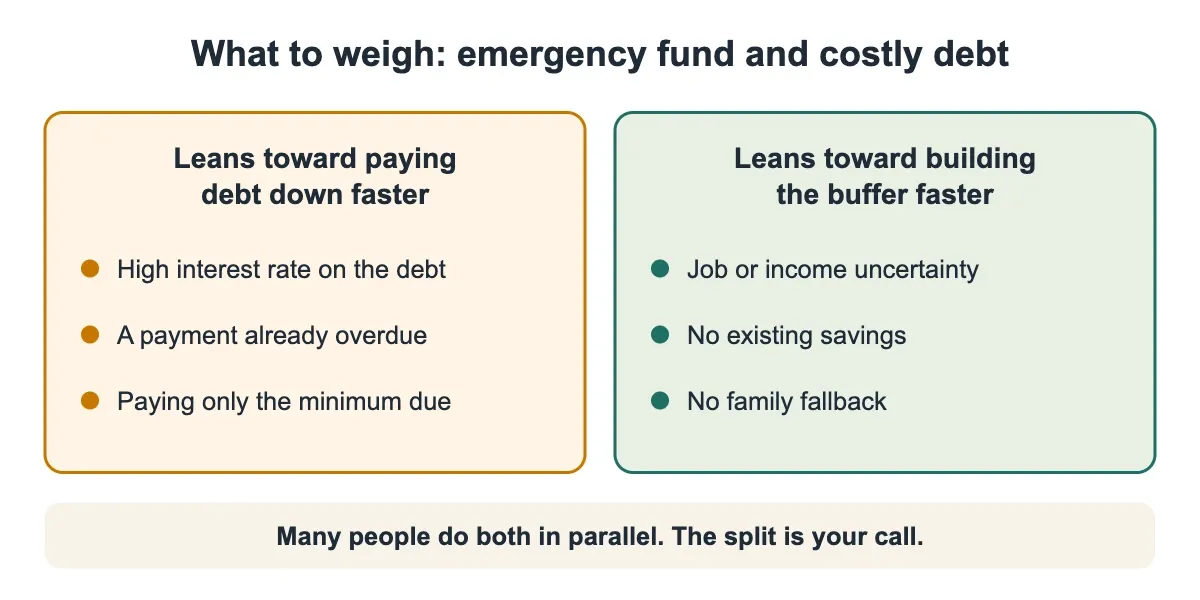
There is no single correct order. These factors tip the balance:
| Factor | Leans toward paying debt down faster | Leans toward building the buffer faster |
|---|---|---|
| Interest rate on the debt | High, such as a revolving card balance | Low or concessional |
| Overdue payments | A payment is already overdue | All payments are current |
| Minimum dues | Paying only the minimum | Full balance paid each month |
| Job stability and notice period | Confirmed role, steady income | Probation, contract or uncertain income |
| Existing buffer | Some savings exist | No savings at all |
| Family support | Family could help in an emergency | No family fallback |
Many people do both in parallel. The split is a personal call.
The arithmetic for Simran: setting aside ₹5,000 a month gives ₹30,000 after six months, just over two months of her ₹14,000 fixed costs. That leaves ₹7,000 a month of her ₹12,000 for the card and everything else. How big a buffer to aim for is covered in How much emergency fund should you have?.
Do you need your own health cover if your employer gives group cover?
Group cover is a real benefit. Whether it is enough depends on your policy summary and situation:
- Continuity: check whether the cover continues if you change jobs or leave.
- Who is covered: only you, or also parents, a spouse or children.
- Sum insured versus local costs: compare it with what a hospital stay costs in your city.
- Age at purchase: if you consider an individual policy, check how its premiums and waiting periods apply at your age now compared with later.
| Employer group health cover | Individual health insurance | |
|---|---|---|
| Who arranges it | Your employer | You |
| Link to your job | Check whether it continues after you leave | Not arranged through your employer |
| Who pays the premium | Check with HR | You |
| Where the terms are | HR's policy summary | Your policy document |
Term insurance in your first job: when it matters
The deciding question is whether anyone would be left short without your income:
- Dependants: does a parent, sibling or partner rely on money you send?
- Loans: would family carry a loan you took, such as an education loan with a parent as co-borrower?
If neither applies, term cover can be a later decision; that is a factor, not a verdict. Simran sends nothing home yet and has no co-borrowed loan, so she notes it to revisit.
Months 2–6: start investing, small and steady
A first SIP
How much depends on your left over, buffer plan and debts; How much SIP with your first salary? works through it. To show the arithmetic only, a hypothetical illustration at an assumed 8% a year: ₹2,000 a month for five years puts in ₹1,20,000 and would come to about ₹1,47,900, with instalments at the start of each month and monthly compounding. The 8% is not a prediction; actual returns can be lower, higher or negative.
Mutual fund investments are subject to market risks, read all scheme related documents carefully.
When markets fall
SIPs run through bad months too. Read what happens to your SIP when the market falls.
Nominations on investments
Add a nominee on each new investment, and check that it is recorded on your statement.
Your printable checklist
Week 1
- Nominee on the salary account
- UAN received from HR or generated
- UAN activated on the EPFO member portal or UMANG
- EPF nomination (Form 2) filed online
- Tax regime told to HR
- Proof-submission deadline noted, if you claim deductions
Month 1
- One full salary cycle tracked: fixed, variable, left over
- Card statement date and due date noted
- Card's interest terms read on your own statement
- Loan EMIs and their dates listed
- EPF passbook checked after the first contribution
Months 2–6
- Buffer and debt split decided, using the factors table
- Group health cover read: continuity, family, sum insured
- Term cover need checked: dependants and shared loans
- A small SIP considered, scheme documents read
- Nominee added on every investment
Frequently asked questions
I just got my first job at about ₹35,000 a month. What should I do with my first salary?
Week 1: nominee, UAN, EPF nomination and tax-regime declaration. Month 1: track one salary cycle and note your card's due date. Months 2–6: weigh buffer against debt, check insurance, consider a small SIP.
Should I build an emergency fund first or pay off my credit card or education loan first?
There is no single right order. A high interest rate or overdue payments lean toward paying debt down faster; job uncertainty and no savings lean toward building the buffer. Many people do both in parallel.
My company gives me group health insurance. Do I still need my own?
It depends: check whether group cover continues after a job change, who it covers, and its sum insured.
Do I need term insurance if nobody depends on my income yet?
It matters most when someone relies on your income or would carry your loans. If neither applies, it can be a later decision.
What is a UAN and how do I check my EPF after joining?
Your EPF member number. Your employer can generate it; you activate it once on EPFO's member portal or UMANG, then download your passbook.
How much of my first salary should go into an SIP?
There is no fixed share; it depends on your left-over amount, buffer plan and debts. Our guide on how much SIP to start with your first salary works through it.
— Laabh