Flexi Cap vs Multi Cap Fund: Same Idea, Different Rules, and What the 25% Small Cap Floor Means for You
Flexi cap vs multi cap fund under SEBI's 2026 rules: 25% each in large, mid and small caps vs a manager-chosen mix. Hypothetical ₹ example inside.
Summarize this article with AI





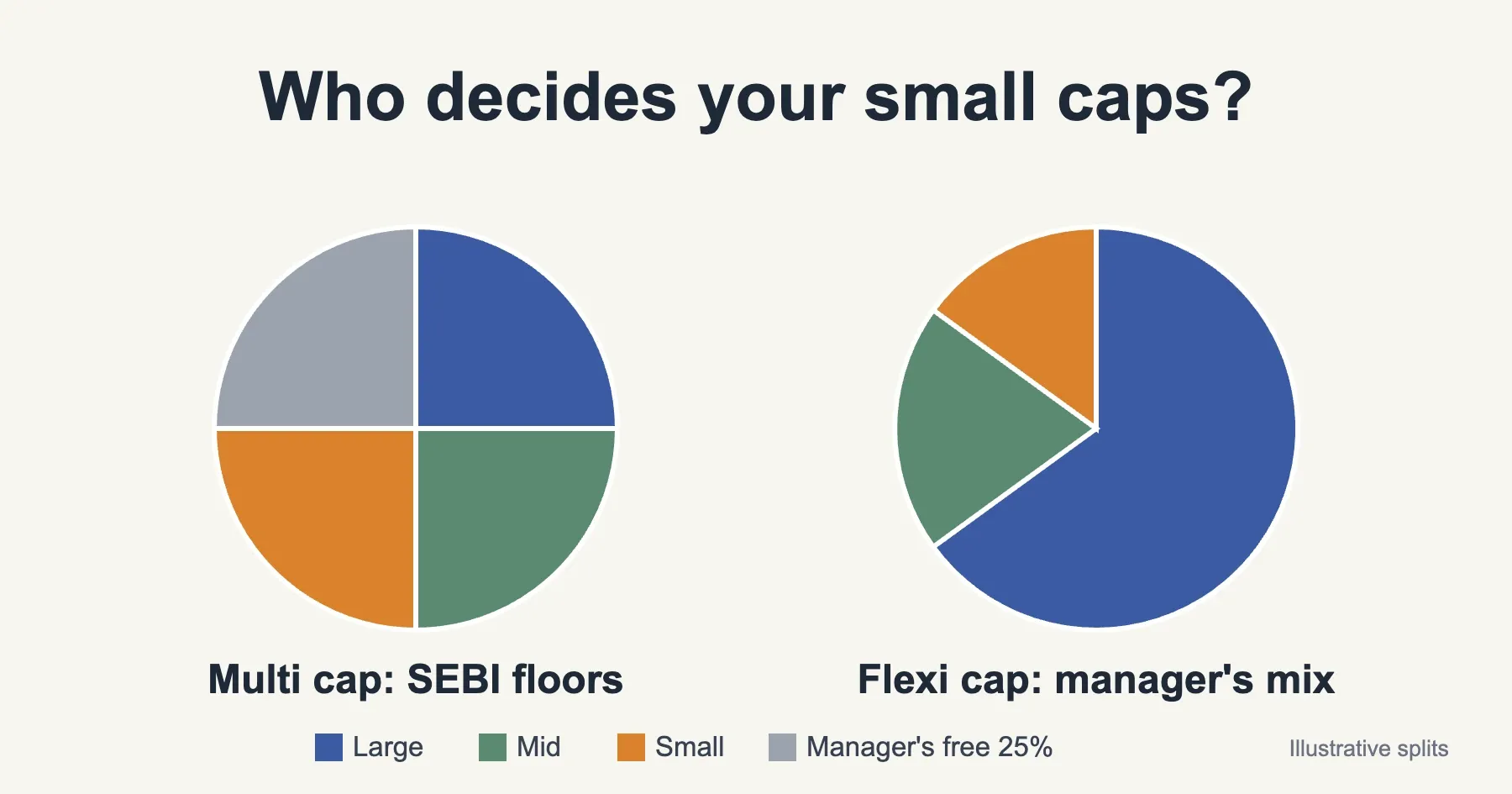
The short version
- Multi cap: at least 25% each in large, mid and small caps. Flexi cap: at least 65% in equity, size mix left to the manager.
- The real difference is who decides your small cap exposure: a rule or a manager.
- A flexi cap can hold more or fewer small caps than a multi cap; the factsheet shows which.
- After a small cap fall, a multi cap at its floor has to add small caps; a flexi cap does not.
- If you hold both, check overlap and your combined small cap share.
As of 22 November 2026, a multi cap fund must keep at least 25% of its assets each in large, mid and small cap companies, while a flexi cap fund must keep at least 65% in equity and its manager decides the split across company sizes. In practice, flexi cap vs multi cap fund comes down to who decides your small cap exposure.
Rohan, 29, in Pune, wants a ₹7,500 monthly SIP for a goal seven or more years away. Return tables will not show him how the two categories are built; the SEBI rule will. This page ends with questions, not a verdict.
The short answer: flexi cap vs multi cap fund in one table
| What the rule covers | Multi cap fund | Flexi cap fund |
|---|---|---|
| Minimum in equity | 75% of total assets | 65% of total assets |
| Minimum in large caps | 25% | None set by the category |
| Minimum in mid caps | 25% | None set by the category |
| Minimum in small caps | 25% | None set by the category |
| Who decides the mix | SEBI fixes three floors; the manager places the remaining 25% | The manager, within the limits in the scheme's own documents |
| What the label tells you about small caps | At least a quarter of the fund, as a standing minimum | Very little: check the latest factsheet |
What SEBI's definitions require
SEBI's circular "Categorization and Rationalization of Mutual Fund Schemes" (No. HO/24/13/15(2)2026-IMD-RAC4/I/5764/2026, dated 26 February 2026) replaced clause 2.6 of the Master Circular for Mutual Funds dated 27 June 2024. It took effect on issue, and existing schemes had six months to align. Under that framework:
- Multi cap fund: a minimum of 75% in equity, with at least 25% of total assets each in large cap, mid cap and small cap companies.
- Flexi cap fund: a minimum of 65% in equity and equity-related instruments, with no minimum for any company size.
For company sizes, the circular points to clause 2.7 of SEBI's Master Circular, which ranks companies by full market capitalisation: 1st to 100th is large cap, 101st to 250th mid cap, 251st onwards small cap. AMFI publishes the list fund houses use. Our mid cap vs small cap guide explains what changes after the 250th company.
The rest of a scheme, its residual portion, can for equity schemes go into more equity, money market instruments, gold and silver instruments as SEBI permits, and InvITs within limits. So a flexi cap's remaining 35% is not necessarily cash; it can be more shares.
Can a flexi cap fund invest 100% in large caps?
The category sets no cap-size minimum, so nothing in the definition stops a heavy large cap tilt, or a heavy small cap one. Each scheme's Scheme Information Document (SID) states its own range, which can be narrower.
What the 25% rule does when small caps fall or rise
Take Rohan's ₹7,500 SIP after 12 months: ₹90,000 invested. To isolate the mix, hold large and mid caps flat and apply a hypothetical 20% fall, then a 20% rise, to small caps only. Costs and taxes are ignored; the splits are illustrative, not real funds.
- Multi cap at its floor: 25/25/25, with the free 25% in large caps, giving 50/25/25.
- Flexi cap A: 65/20/15. Flexi cap B: 45/25/30, more small caps than the multi cap.
| Split (large/mid/small) | Small caps at start (₹) | After a 20% small cap fall (₹) | Change | After a 20% small cap rise (₹) | Change |
|---|---|---|---|---|---|
| Multi cap 50/25/25 | 22,500 | 85,500 | -5.0% | 94,500 | +5.0% |
| Flexi cap A 65/20/15 | 13,500 | 87,300 | -3.0% | 92,700 | +3.0% |
| Flexi cap B 45/25/30 | 27,000 | 84,600 | -6.0% | 95,400 | +6.0% |
Hypothetical illustration: ₹7,500 a month for 12 months, no return assumed on large and mid caps, a 20% move in small caps only. Not a forecast or a recommendation.
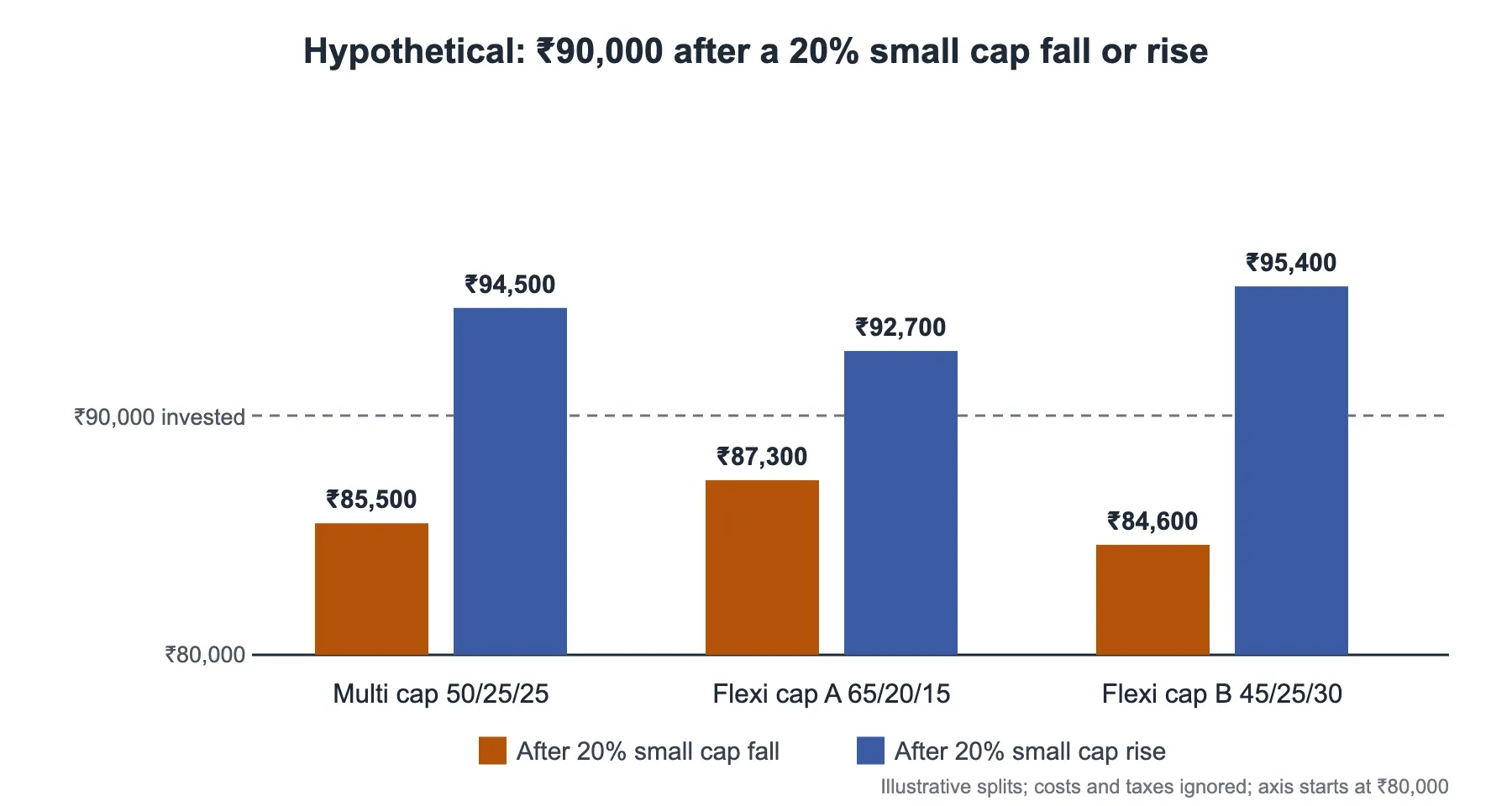
The small cap share drives the swing. Each portfolio moves by its small cap weight times the small cap move. Flexi cap A moved less than the multi cap, flexi cap B more; the label does not say which side a flexi cap is on.
After a fall, the multi cap floor forces a top-up. Small caps shrink to ₹18,000 of ₹85,500, or 21.1% of the fund, below the 25% floor. To get back to 25% (₹21,375), ₹3,375 has to move into small caps after they have fallen. A flexi cap manager can choose to cut, hold or add.
The floor works on the way up too. The multi cap keeps at least a quarter in small caps even if its manager turns cautious on them.
How to see the real split in a factsheet
The factsheet shows what the fund holds today. A five-minute check:
- Open the latest factsheet on the fund house's website and note the month it covers.
- Find the market-cap break-up. Most factsheets show large, mid and small cap percentages, often "as per AMFI classification". Write down the three numbers.
- Find the equity total and the rest: cash, money market, gold or InvITs.
- Compare two or three months. A multi cap should stay at or above 25% in each bucket. A big shift in a flexi cap shows the manager using the category's freedom.
- Read the asset allocation table in the SID. It shows the range the scheme commits to, which can be tighter than the category rule.
Which fits which investor: questions to ask yourself
These are questions, not a recommendation.
- How long can this money stay invested? Both are equity funds. If you may need the money within a few years, ask first whether equity fits at all.
- How would you react to a sharp small cap fall? If a quarter of your fund in small caps during a crash would make you stop your SIP, note that. If you prefer a known small cap minimum, note that too.
- What else do you already hold? If you already have a small or mid cap fund, a multi cap adds more of the same.
- Do you want the manager to decide the mix? A flexi cap relies on the manager's judgement on company sizes; a multi cap removes part of it by rule.
For choosing a first category more broadly, see which type of mutual fund a beginner can start with.
Can you hold both a flexi cap and a multi cap fund?
You can, but check overlap: both buy from the same listed companies, so the same large caps often appear in both, with two expense ratios on many of the same shares.
List each fund's top ten holdings, mark companies in both, and add up the smaller weight of each. A high total means the second fund adds less variety than its label suggests. Also check your combined small cap share. Splitting ₹7,500 equally, ₹3,750 each, between the hypothetical multi cap and flexi cap A gives a blended small cap weight of 20%.
Frequently asked questions
What is the difference between flexi cap and multi cap funds?
As of 22 November 2026, under SEBI's February 2026 circular, a multi cap fund must hold at least 25% each in large, mid and small caps (75% equity minimum). A flexi cap fund must hold at least 65% in equity, split across company sizes as its manager decides.
Which is riskier, flexi cap or multi cap?
Neither is riskier by definition. A multi cap keeps at least 25% in small caps; a flexi cap's small cap share depends on the manager and can be lower or higher. The latest factsheet shows the actual split.
Is a flexi cap fund good for a beginner SIP?
That depends on your horizon, how you would react to falls and what you already hold, not on the category name. Read the scheme's asset allocation and factsheet before you start.
Can a flexi cap fund invest 100% in large caps?
The category sets only a 65% equity minimum and no minimum for any company size, so the rule does not stop a heavy large cap tilt. The scheme's SID may set a narrower range.
Should I hold both a flexi cap and a multi cap fund?
You can, but check overlap first: compare their top holdings and your combined small cap share before adding the second fund.
Learn more
Save this five-step factsheet check for your next fund comparison. To see where flexi cap and multi cap sit among all fund types, read our map of SEBI's mutual fund categories.



