Mutual fund categories explained: SEBI's 2026 map of what each label allows
SEBI's 26 Feb 2026 circular lists 40 mutual fund categories in five groups. See what each label lets a fund hold, what changed, and what it can't tell you.
Summarize this article with AI





The short version
- As of 17 November 2026, SEBI lists 40 categories in five groups: equity 13, debt 17, hybrid 7, life cycle 1, other 2.
- A category label is a rulebook for what a fund must mainly hold, not a quality score.
- Solution-oriented funds are discontinued; life cycle funds are the new group.
- For risk, read the riskometer; for fit, compare the category rules with your goal.
- A rename made to follow the 2026 circular usually needs no action from you.
As of 17 November 2026, SEBI's circular of 26 February 2026 sorts mutual fund schemes into 40 categories across five groups: equity (13), debt (17), hybrid (7), life cycle funds (1) and other schemes (2), which covers index funds, ETFs and fund of funds. Each category sets what a fund must mainly hold. It describes rules, not quality.
Tanvi, 24, in Nashik, is comparing fund pages labelled "Flexi Cap Fund", "Multi Cap Fund" and "Aggressive Hybrid Fund". The names sound like grades. They are not. Each label points to a row in SEBI's rulebook that limits what the fund may buy. This page maps those rows.
How many mutual fund categories are there in India after SEBI's new rules?
There are 40 categories in SEBI's circular "Categorization and Rationalization of Mutual Fund Schemes", dated 26 February 2026. Paragraph 2.6.3 lists them under five headings. The count below is ours, made by counting the rows in each table.
| Group | Categories | What the group mainly holds | Circular reference |
|---|---|---|---|
| A. Equity schemes | 13 | Shares and equity-related instruments | Para 2.6.3, part A |
| B. Debt schemes | 17 | Bonds and money market instruments | Para 2.6.3, part B |
| C. Hybrid schemes | 7 | A mix of equity, debt and, in some, other assets | Para 2.6.3, part C |
| D. Life cycle funds | 1 | A mix that shifts along a glide path to a set maturity | Para 2.6.3, part D; Annexure B |
| E. Other schemes | 2 | Index funds/ETFs, and fund of funds (overseas or domestic) | Para 2.6.3, part E |
Equity covers Multi Cap, Large Cap, Large & Mid Cap, Mid Cap, Small Cap, Flexi Cap, Dividend Yield, Value, Contra, Focused, Sectoral, Thematic and ELSS (Tax Saver). Debt runs from Overnight and Liquid through duration, credit and gilt categories. Hybrid runs from Conservative to Aggressive Hybrid, plus Dynamic Asset Allocation, Multi Asset Allocation, Arbitrage and Equity Savings.
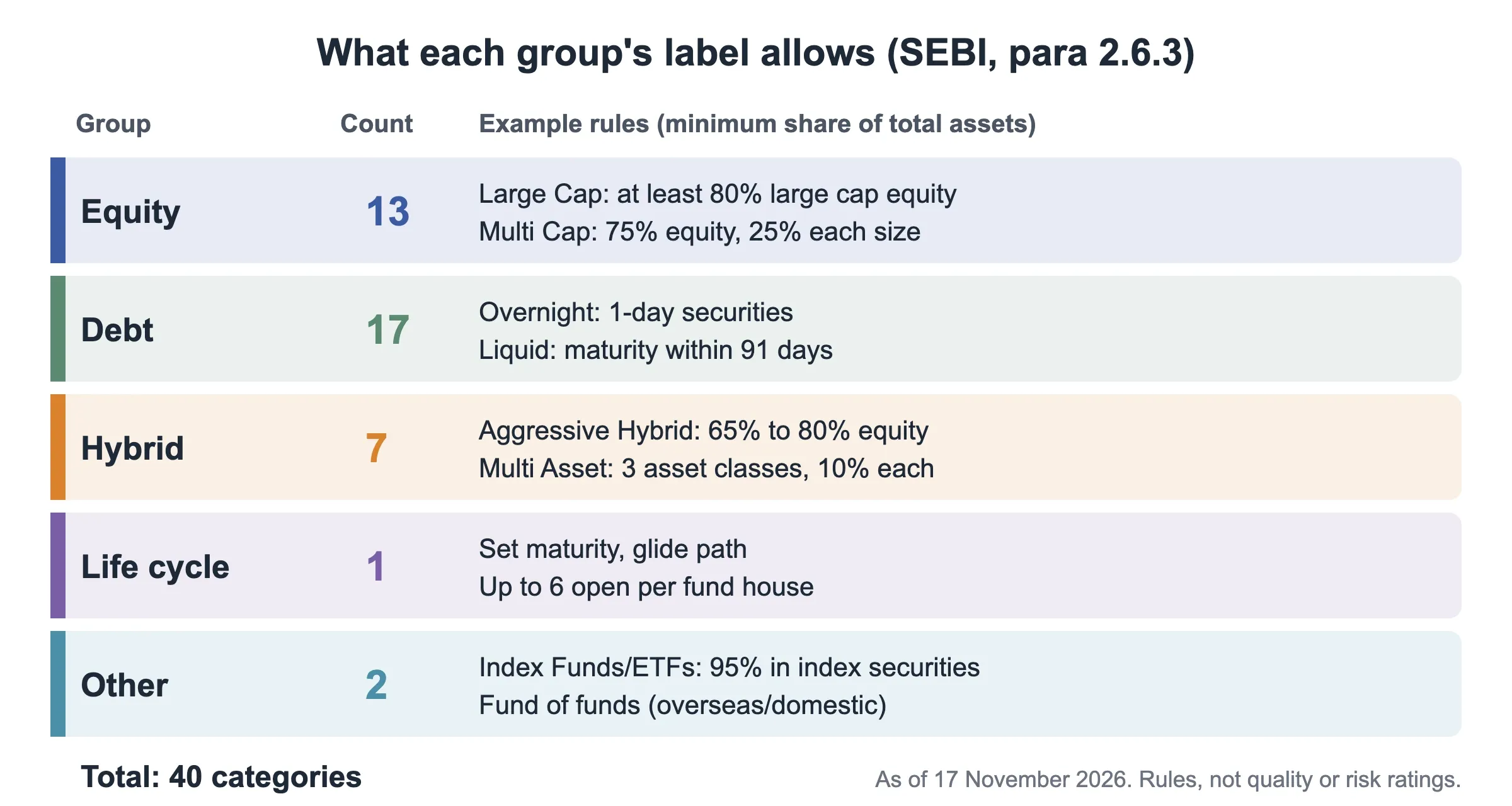
What common categories must mainly hold (as of 17 November 2026)
| Category | Must mainly hold (share of total assets) | Circular reference |
|---|---|---|
| Large Cap | At least 80% in large cap equity | Para 2.6.3, part A |
| Mid Cap / Small Cap | At least 65% in mid cap / small cap equity | Para 2.6.3, part A |
| Large & Mid Cap | At least 35% large cap and 35% mid cap | Para 2.6.3, part A |
| Flexi Cap | At least 65% in equity, across company sizes | Para 2.6.3, part A |
| Multi Cap | At least 75% in equity, with at least 25% each in large, mid and small cap | Para 2.6.3, part A |
| ELSS (Tax Saver) | At least 80% in equity | Para 2.6.3, part A |
| Overnight | Securities maturing in 1 day | Para 2.6.3, part B |
| Liquid | Debt and money market securities maturing within 91 days | Para 2.6.3, part B |
| Aggressive Hybrid | 65% to 80% equity, 20% to 35% debt | Para 2.6.3, part C |
| Multi Asset Allocation | At least three asset classes, at least 10% in each | Para 2.6.3, part C |
| Index Funds/ETFs | At least 95% in the securities of the index tracked | Para 2.6.3, part E |
Large, mid and small cap are ranks. Under clause 2.7 of SEBI's Master Circular, which the 2026 circular refers to, the 1st to 100th companies by full market capitalisation are large cap, the 101st to 250th mid cap, and the rest small cap. AMFI publishes the list every six months.
What changed in SEBI's revised categorisation in 2026?
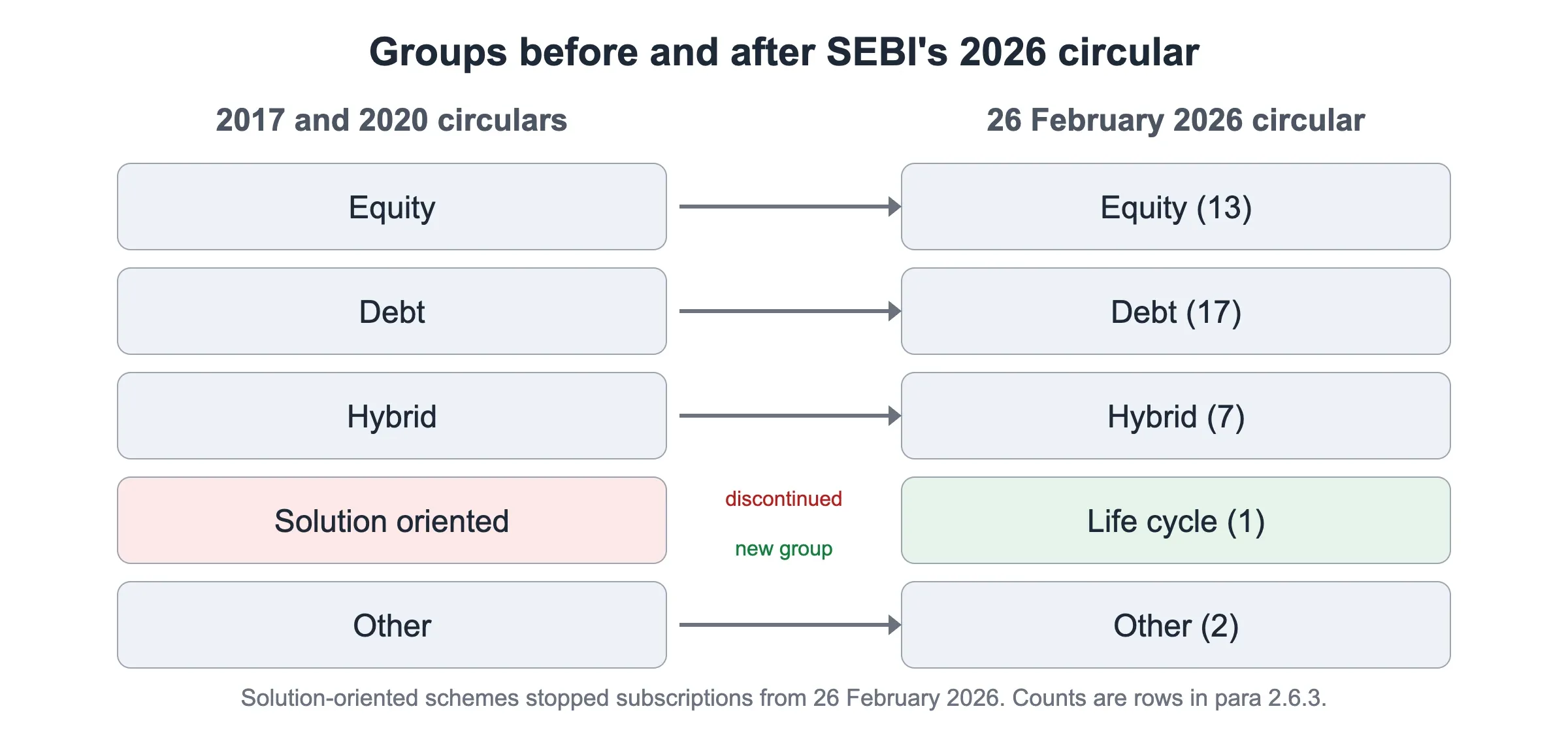
The circular took effect on its date of issue, 26 February 2026. It replaces clause 2.6 of SEBI's Master Circular of 27 June 2024, which had consolidated the circulars of 6 October 2017 and 6 November 2020. What changed:
- A new group. Life cycle funds now sit in their own group (part D).
- One group closed. The solution-oriented category (retirement and children's funds) is discontinued.
- Names must match the category. Para 2.6.5 says "the scheme name shall be the same as the scheme category", and names that stress only returns are not allowed.
- Limits on overlap. Sectoral and thematic schemes must keep their overlap with the fund house's other equity schemes (large cap excepted) at or below 50%, with three years for existing schemes to get there. A Value and a Contra fund can both be offered only if their overlap is at or below 50%.
- More disclosure. Fund houses must publish category-wise portfolio overlap on their websites every month (para 2.6.8).
- A deadline for existing schemes. Para 2.6.7 gave existing schemes 6 months from the date of issue to comply.
Were solution-oriented funds removed, and what are life cycle funds?
Yes. Para 2.6.3.16 says the "Solutions oriented scheme category is being discontinued w.e.f the date of the circular", and existing schemes "shall stop all subscriptions with immediate effect". They are to be merged into schemes with a similar asset allocation and risk profile, with SEBI's prior approval.
Life cycle funds take a different design. Each is open-ended, with a set maturity year and a glide path: its mix shifts on a planned route as the target date nears. A fund house may keep up to 6 open for subscription at a time. See life cycle funds explained.
Equity, debt, hybrid: what does each label tell me about risk, and what doesn't it?
A label tells you the minimum mix. It doesn't tell you how much the value can swing, how good the manager is, or what you will earn.
Hypothetical example. Say ₹9,000 goes into a large cap fund. The 80% rule means at least ₹7,200 must sit in shares of the top 100 companies by market value, leaving up to ₹1,800 for other holdings within the scheme's own rules. Now assume, for illustration only, that the fund's value falls 10%. Your ₹9,000 would be worth ₹8,100, and the rule would still apply: at least ₹6,480 in large caps. The label limits holdings, not losses. (Hypothetical; assumed 10% fall; not a promise; returns vary.)
The same ₹9,000 in a multi cap fund would need at least ₹6,750 in equity, with at least ₹2,250 each in large, mid and small caps.
For risk, look at the riskometer, a separate label on every scheme, from Low to Very High; see what the riskometer levels mean. Then read each group's label this way:
- Equity labels set which shares, by size or style. Any equity fund can fall sharply.
- Debt labels set maturity or credit quality. Debt funds can lose value when rates rise or a borrower defaults.
- Hybrid labels set the equity and debt range, which can shift over time.
My fund's name or category changed. Do I need to do anything with existing units?
Usually, no action is required; your units stay in your folio. Many 2026 renames came from para 2.6.7, which asked existing schemes to align names, objectives, strategy and benchmarks within six months. The circular says these alignment changes are not changes in fundamental attributes.
A real change in a scheme's fundamental attributes is different. Under Regulation 22(9)(c) of the SEBI (Mutual Funds) Regulations, 2026, the fund house must send each unitholder a written communication (email or SMS counts), show the details on its website, and give you an option to exit at the prevailing NAV without any exit load. The notice states the window.
What to do: read the notice, check the new category row above, and ask whether that mix still fits your goal. Any tax on a redemption depends on your holding; tax rules change, so consult a tax professional for your situation.
Frequently asked questions
Is a large cap fund safer than a small cap fund?
Neither label is a safety rating. A large cap fund must hold at least 80% in the top 100 companies, which have tended to swing less than smaller ones, but both can fall. See mid cap vs small cap funds.
Where do index funds and ETFs sit?
They are in part E, "Other schemes", as one category, "Index Funds/ ETFs". They must hold at least 95% of their assets in the securities of the index they track. Our guide to comparing two index funds compares two that track the same index.
Is a liquid fund a debt fund?
Yes. Liquid funds are in the debt group and may hold only debt and money market securities maturing within 91 days. That makes them among the lower-risk categories, not risk-free.
How can a beginner compare categories?
Start with when you need the money. Then compare each category's minimum mix and riskometer against that timeline. See which type of mutual fund a beginner should start with.
What is a balanced advantage fund?
It is the common name for the hybrid category SEBI now calls "Dynamic Asset Allocation Fund", where the split between equity and debt is managed dynamically.
Pick a category to read next
Read which type of mutual fund a beginner should start with, then come back to this map when a fund page shows a label you don't recognise.
— Laabh



