Mid cap vs small cap fund: what changes after the 250th company
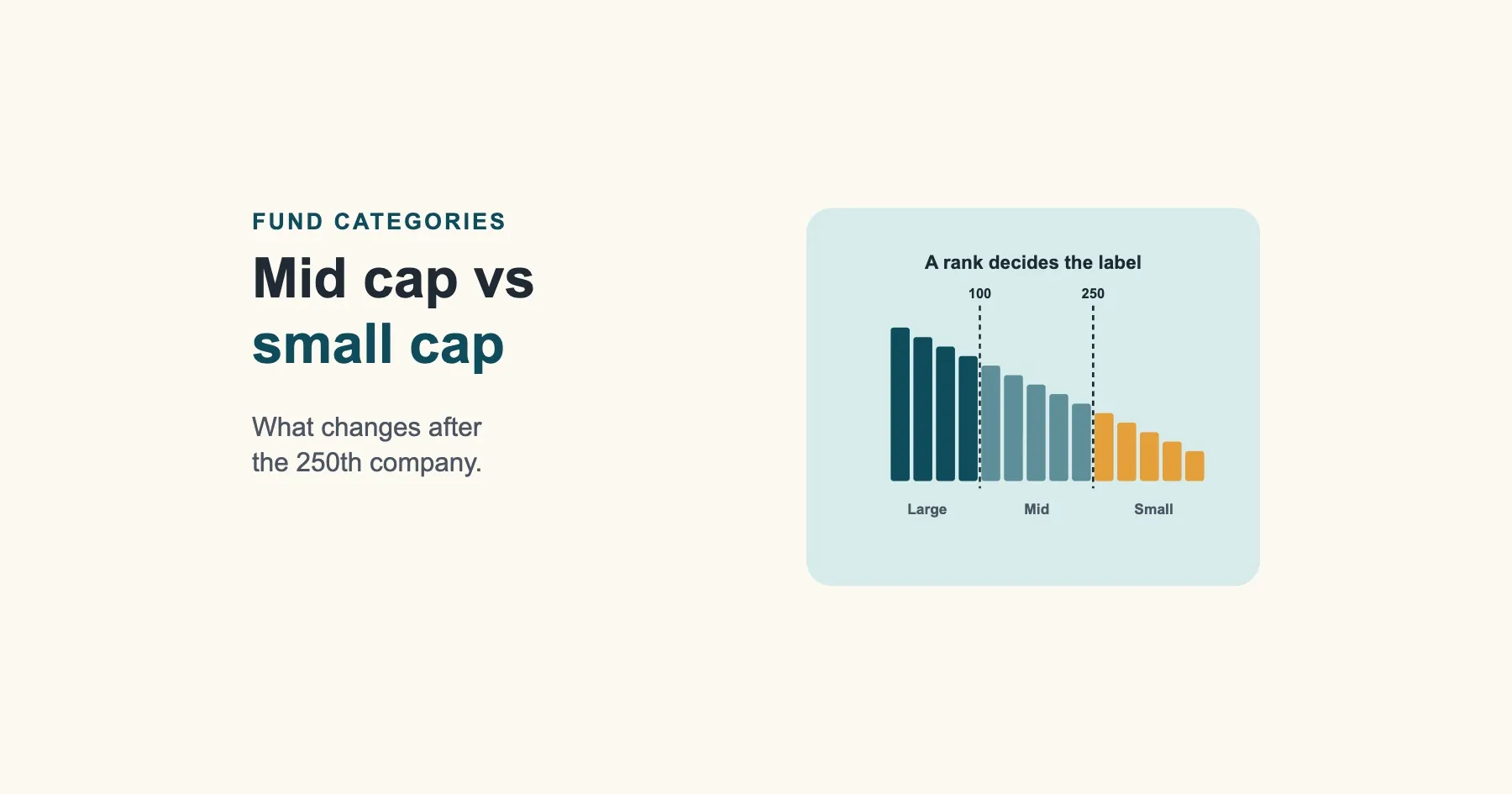
SEBI's line is a rank: mid caps are the 101st–250th companies, small caps 251st onwards. See what that means for risk, falls and a 10-year SIP.
Summarize this article with AI





The short version
- Mid caps are the 101st to 250th companies by full market capitalisation; small caps are the 251st onwards (SEBI, rules as of 13 November 2026).
- Both fund types must hold at least 65% of total assets in their own category.
- AMFI revises the list every six months, so a company can switch categories without the fund changing its strategy.
- Small cap funds draw from a far larger, generally less liquid pool, so falls tend to be deeper.
SEBI defines mid caps as the 101st to 250th companies by full market capitalisation and small caps as the 251st company onwards. A small cap fund therefore holds smaller and typically less liquid companies, so its value tends to swing more. Which one suits you depends on your horizon and how large a fall you can sit through.
Say you started with a large-cap or index fund a year ago and now want a second one. Mid cap and small cap sound like neighbours, but the line between them is one rank in a list of more than 5,000 companies.
What is the difference between mid cap and small cap funds?
A mid cap fund must keep at least 65% of its total assets in mid cap companies; a small cap fund, at least 65% in small cap companies. Both are open-ended equity schemes, and both use the same ranked list from AMFI to decide which company is which.
The real difference is the pool each draws from. AMFI's list for the six months ended 30 June 2026 ranks 5,427 companies. The mid cap band is 150 of them (ranks 101 to 250). The small cap band runs from rank 251 to rank 5,427: more than 5,000 companies, from firms worth tens of thousands of crore to firms worth a few lakh.
| Mid cap fund | Small cap fund | |
|---|---|---|
| Who counts | 101st to 250th company by full market cap | 251st company onwards |
| Pool size (June 2026 list) | 150 companies | More than 5,000 companies |
| Minimum in its category | 65% of total assets | 65% of total assets |
| Liquidity of holdings (general) | Usually easier to trade | Often thinner trading, especially lower down the list |
| How far values tend to swing | Can swing sharply | Tend to swing more |
| Questions to ask | Can I hold through a deep fall? Does it overlap what I own? | Can I hold through a deeper, longer fall? Is my horizon long enough? |
The last three rows describe tendencies; check each scheme's own documents.
How does SEBI define mid cap and small cap companies?
Rules as of 13 November 2026:
- The rank rule. SEBI's rules (clause 2.7 of its 27 June 2024 Master Circular for Mutual Funds, since replaced by the master circular of 20 March 2026) define large caps as the 1st to 100th company by full market capitalisation, mid caps as the 101st to 250th, and small caps as the 251st onwards. The rule first appeared in SEBI's October 2017 categorisation circular.
- The minimum allocation. SEBI's revised categorisation circular of 26 February 2026 keeps the minimum at 65% of total assets in mid cap companies for a mid cap fund, and 65% in small cap companies for a small cap fund. The rest, the residual portion, can go into other permitted assets within limits.
- The AMFI list. Funds use the list AMFI prepares. It is updated every six months with data as on the end of June and December, and published within five calendar days of each period ending. Funds then have one month to rebalance if needed.
AMFI ranks companies by average market capitalisation over the six months, averaged across the exchanges where they are listed. Companies on either side of the cut-off can be close in size, which is why a stock can move between small and mid cap at the next revision without anything changing in the business.
Are small cap funds riskier than mid cap funds?
As a category, small cap funds generally carry more risk, for three connected reasons.
- Liquidity. Shares of smaller companies often trade in smaller volumes. When many investors sell at once, a fund may find it harder to sell without moving the price. From March 2024, following an AMFI letter reported at the time, fund houses began disclosing stress-test results for their mid and small cap schemes, including an estimate of how many days it could take to sell 25% and 50% of the portfolio. Check the scheme's latest disclosure on the fund house's website.
- Volatility. Smaller businesses tend to have less diversified revenue and thinner buffers, so prices can react more sharply to news, interest rates or a slowdown.
- Breadth. With more than 5,000 companies below rank 250, two small cap funds can hold very different portfolios.
"Generally" matters. A particular mid cap fund can be more volatile than a particular small cap fund in some periods. Every scheme carries a riskometer label that can change; our guide to the six riskometer levels explains how to read it.
How much can small cap funds fall in a bad market?
There is no single number. The NSE factsheet we checked (Nifty Smallcap 250, as of 30 October 2026) does not report a maximum drawdown, so we do not quote one. Here is a hypothetical illustration instead.
Hypothetical illustration, not historical data or a prediction; not a promise; returns vary. Asha, 29, in Bengaluru, invests ₹8,000 a month for 10 years: ₹96,000 a year and ₹9.6 lakh in total, whichever category she picks.
- Assume her portfolio grows at a hypothetical 10% a year for five years. After 60 instalments (₹4.8 lakh invested), it would be worth about ₹6.17 lakh.
- In year 6 she adds another ₹96,000, so about ₹7.13 lakh is exposed when a bad year arrives (assuming no growth that year before the fall). She has now invested ₹5.76 lakh.
- If a mid-sized portfolio fell 20–30% that year, it would drop to roughly ₹4.99–5.71 lakh.
- If a small-sized portfolio fell 30–45%, it would drop to roughly ₹3.92–4.99 lakh, which can mean sitting well below the ₹5.76 lakh she has put in.
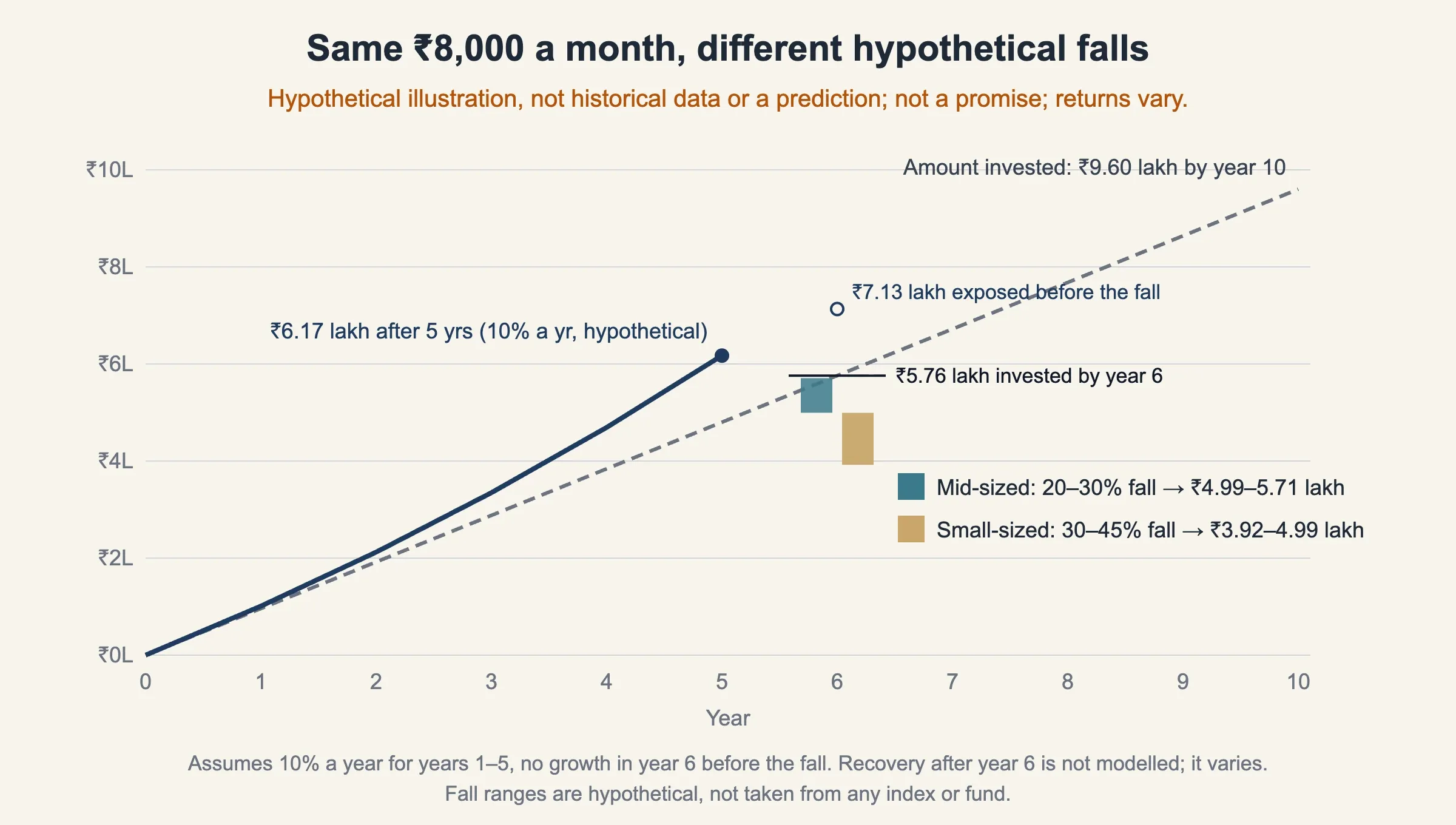
These ranges are not drawn from any index or fund, and recovery time varies; the illustration does not model it. Contributions are identical on both paths. Only the interim value differs, and that is what tests whether you keep the SIP running. See what happens to your SIP when the market falls.
Which suits a 10-year SIP, mid cap or small cap?
Neither suits everyone. Use these as a starting point.
A mid cap fund may fit if:
- you will not need this money for many years,
- you could watch your portfolio fall by a quarter or more without stopping the SIP or selling,
- you want companies beyond the top 100 but prefer a narrower, more traded pool.
A small cap fund may fit if:
- your horizon is long and the money is not earmarked for a fixed date, such as a home down payment in four years,
- you could hold through a deeper fall, possibly well below what you invested, and a slow recovery,
- you already hold a diversified core fund and are adding a smaller satellite, not making small caps your only equity fund.
Check before either:
- What do you already own? A flexi cap or multi cap fund may already hold mid and small caps.
- Does a second category add something? See how many mutual funds a beginner needs.
- Does the scheme match your expectations? Read the SID, riskometer and latest stress-test disclosure.
If none of the "fits if" lines describes you yet, that is useful to know: come back to the question when your horizon or cushion changes.
Next to a first fund: watch the overlap
If your first fund is a large-cap or Nifty 50 index fund, a mid or small cap fund mostly adds companies outside its core holdings. If it is a flexi cap, multi cap or large & mid cap fund, some of that may already be inside it. A multi cap fund, for example, must hold at least 25% each in large, mid and small caps.
To see where these two sit among the other categories, use the beginner's guide to fund types.
Frequently asked questions
Does a stock move from small cap to mid cap?
Yes. AMFI revises its list every six months. A company that climbs into ranks 101 to 250 becomes a mid cap; one that slips below rank 250 becomes a small cap. Funds then have one month to rebalance if needed.
What about large and mid cap funds?
A large & mid cap fund must hold at least 35% of total assets in large caps and at least 35% in mid caps. It sits between a large cap fund and a mid cap fund in what it can hold.
Are small cap funds riskier than mid cap funds?
As a category, generally yes, because small cap companies are typically less liquid and their prices tend to swing more. Individual schemes differ, so check each scheme's riskometer.
Which is better for a 10-year SIP, mid cap or small cap?
Neither is better for everyone. A mid cap fund may fit if you can hold through a fall of a quarter or more; a small cap fund may fit if you can hold through a deeper fall, have no fixed withdrawal date and already own a diversified core fund.
Before you narrow it down
Before narrowing to a category, run the six filters in how to choose a mutual fund.
— Laabh



