The 50/30/20 rule on an Indian salary: 3 ways to make it fit your first paycheque
The 50/30/20 rule splits take-home pay into needs, wants and savings. See how ₹42,000 splits, and how to adjust when rent takes half your salary.
Summarize this article with AI





The short version
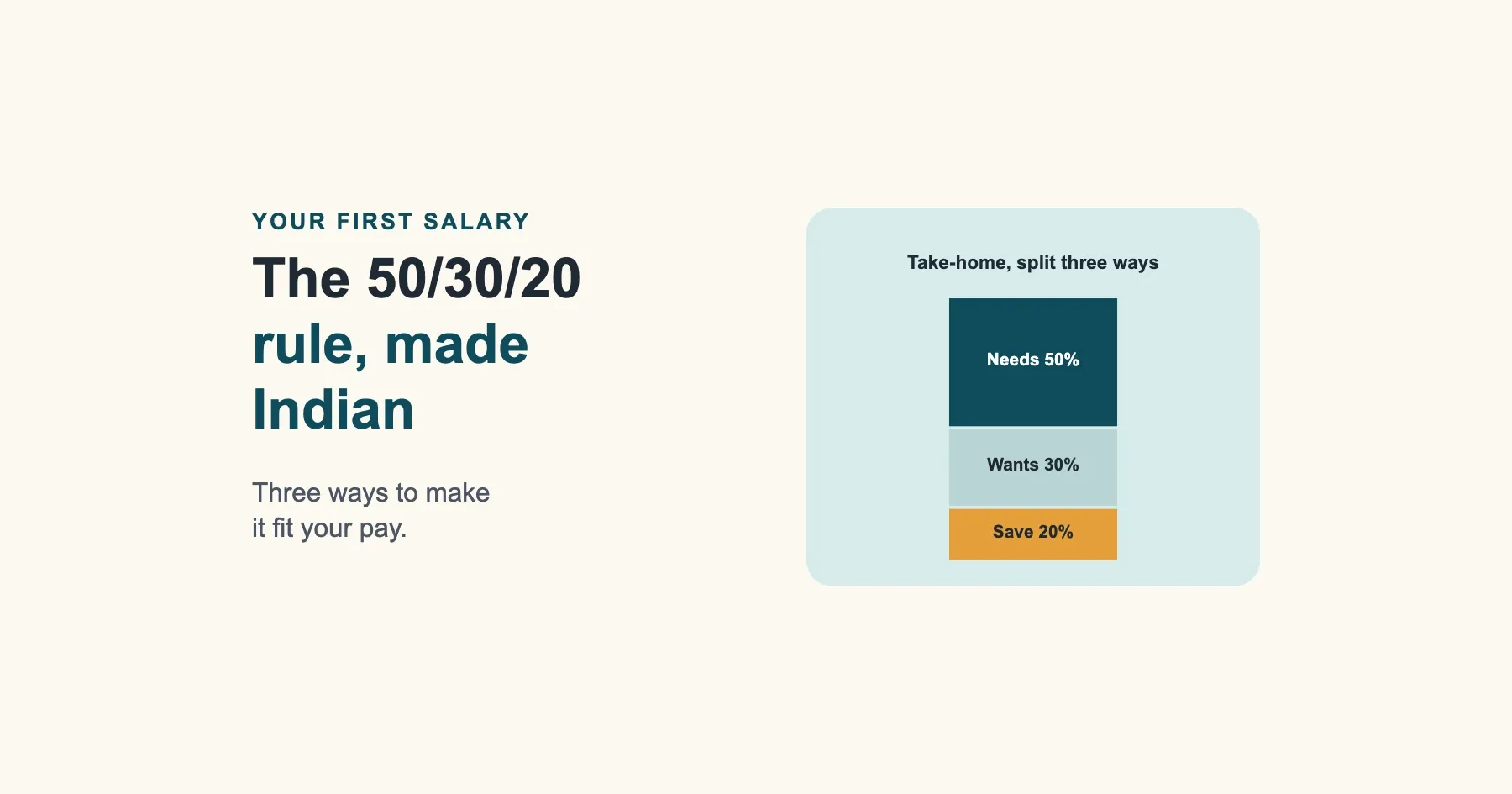
- The 50/30/20 rule is a rule of thumb: about 50% needs, 30% wants and 20% savings and investments, on take-home pay.
- On an Indian first salary, rent, EMIs and family support often push needs above 50%. Adjusting is normal.
- Variants such as 60/20/20 and 70/20/10 trade wants for needs while holding savings steady.
- Within the 20%, many people think about an emergency fund and insurance before investing.
- Track one real month before you choose a split.
₹42,000 lands in your account. The 50/30/20 rule says ₹21,000 for needs, ₹12,600 for wants and ₹8,400 for saving and investing. Here's whether that works.
The 50/30/20 rule is a popular budgeting rule of thumb: about half your take-home pay goes to needs, about 30% to wants and about 20% to savings and investments. It is a starting sketch, not a law. On an Indian first salary, where rent can swallow half the pay and many people send money home, it is commonly adjusted, and protecting the savings share matters more than hitting the exact numbers.
What is the 50/30/20 rule?
The rule sorts every rupee you take home into three buckets:
- Needs (50%): what it costs to live and work. Rent, groceries, bills, commute, loan EMIs.
- Wants (30%): what makes life enjoyable but could be cut in a tight month. Eating out, streaming, shopping, trips.
- Savings and investments (20%): money set aside for your future self. An emergency fund, goal savings, investments.
You'll find the rule described in many places as a simple global framework. We won't credit it to any one person here, because the claim is often repeated without a source.
Use take-home pay, not CTC
The split works on the amount that actually reaches your bank account each month, not the CTC on your offer letter. CTC usually includes items that don't arrive as monthly cash. On many salaries, for example, your EPF (Employees' Provident Fund) contribution is deducted before the money is credited. That deduction is already a form of saving, but it isn't money you can budget with, so leave it out of the 100%.
Your first salary, split three ways (the ₹42,000 example)
Here is the textbook split on a take-home of ₹42,000 a month. The example is illustrative, not a recommendation.
| Bucket | Share | Amount a month |
|---|---|---|
| Needs | 50% | ₹21,000 |
| Wants | 30% | ₹12,600 |
| Savings and investments | 20% | ₹8,400 |
| Total | 100% | ₹42,000 |
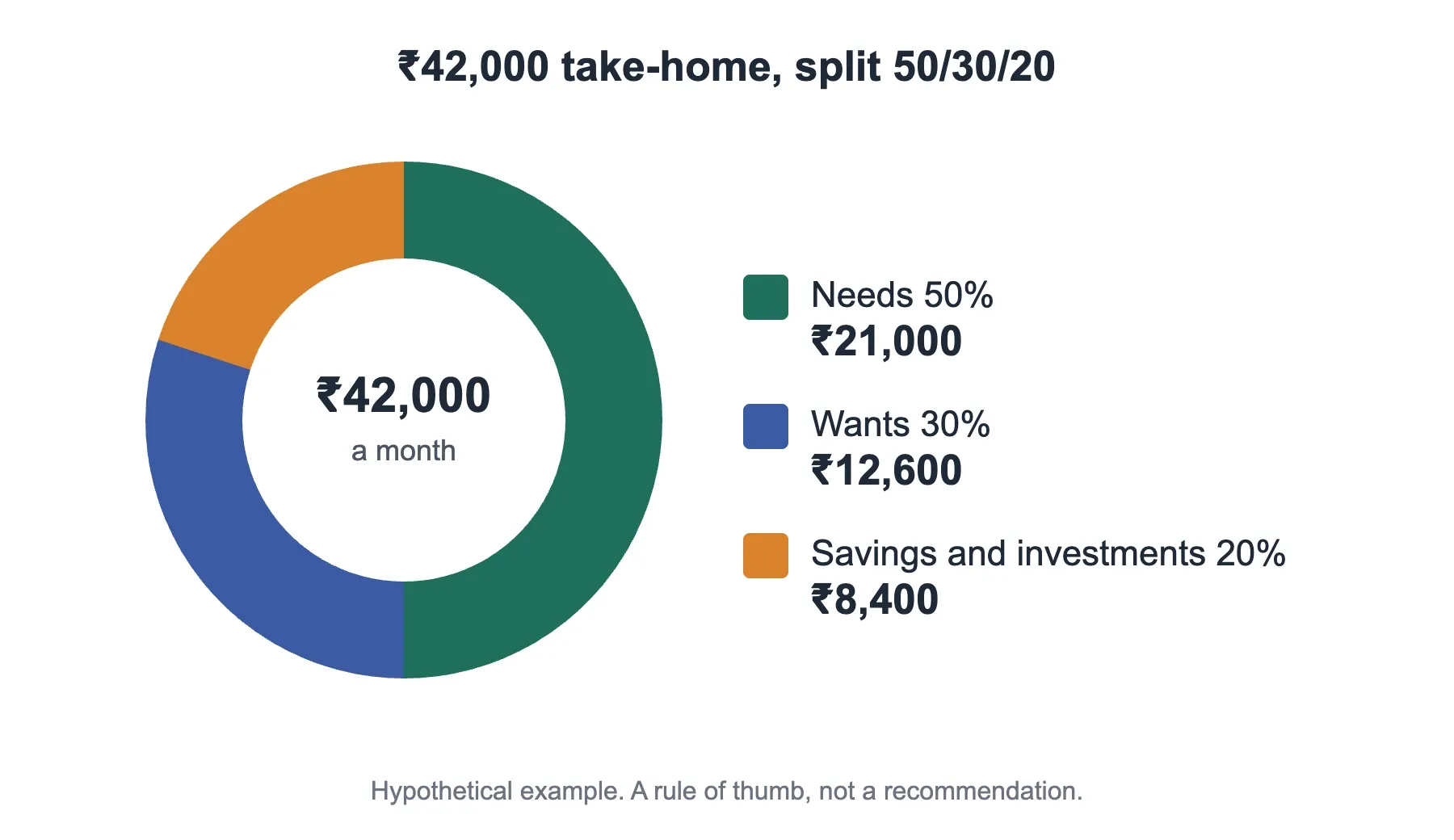
On paper, ₹21,000 for needs looks generous. The real test is your rent.
Needs vs wants in India: where do rent, EMI and family support go?
In India, a few items need a clear home. This starter table is illustrative, not exhaustive:
| Item | Bucket | Why |
|---|---|---|
| Rent or PG | Needs | A roof is not optional |
| Groceries and utilities | Needs | Day-to-day living |
| Commute | Needs | You need to get to work |
| Phone and internet | Needs | Work and banking run on them |
| Loan EMIs (education loan, two-wheeler) | Needs | Missing one has consequences |
| Family support | Needs, for many households | A household commitment, not a lifestyle choice |
| Insurance premiums | Needs | Protection you've already committed to |
| Eating out, food delivery | Wants | Enjoyable, flexible |
| OTT subscriptions | Wants | Easy to pause |
| Shopping, gadget upgrades | Wants | Can wait a month |
| Travel and weekend plans | Wants | Plan for them, but they flex |
| Emergency fund, investments (such as an SIP), goal savings | Savings | Your future self's share |
Family support. If you send money home every month, treat it as a need. It is a commitment you've made, not a spend to trim. There's nothing to feel bad about if it makes the "needs" column look heavy.
Wants are not a problem. The 30% exists so you can enjoy your salary without guilt. The point of sorting is to make spending a choice, not to shame it.
What if rent alone is more than half your salary?
Say your rent is ₹22,000 a month. On a ₹42,000 take-home, that's already more than the ₹21,000 needs bucket before you've bought groceries. This is where the rule gets redrawn.
A common adjustment is to let needs grow and take the space from wants, while holding savings steady. To keep it clear, each bucket is spelled out below.
| Split | Needs | Wants | Savings and investments | When people use it |
|---|---|---|---|---|
| 50/30/20 | ₹21,000 | ₹12,600 | ₹8,400 | Rent is moderate, or you live with family |
| 60/20/20 (needs 60, wants 20, savings 20) | ₹25,200 | ₹8,400 | ₹8,400 | Metro rent, shared flat or PG |
| 70/20/10 (needs 70, savings 20, wants 10) | ₹29,400 | ₹4,200 | ₹8,400 | High rent, family support or an EMI |
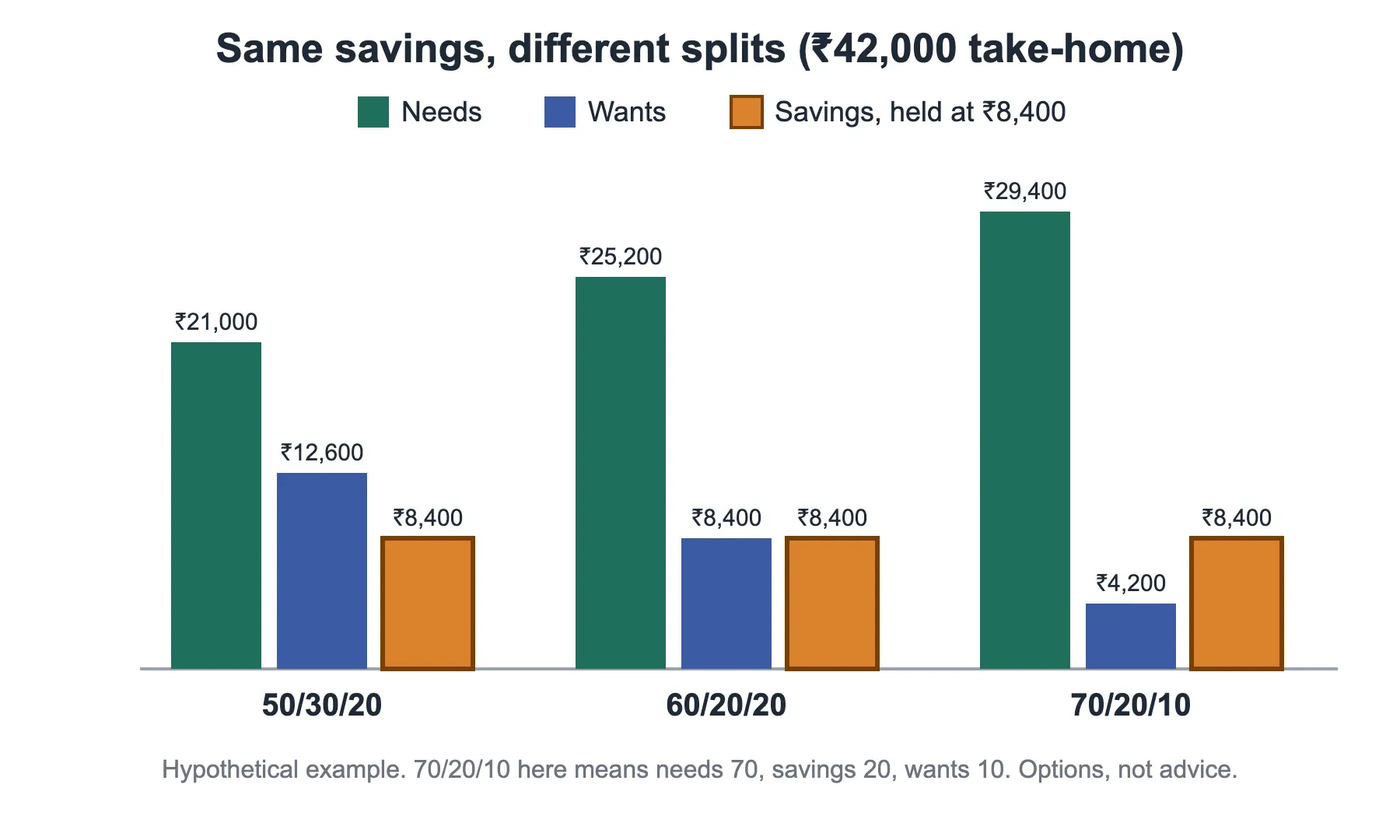
Notice the savings bar. It stays at ₹8,400 in every version. Needs and wants trade places; the future-you share is protected.
The pay-yourself-first approach
A third option drops the percentages for needs and wants altogether. You fix one number for savings, move it out on salary day, and live on the rest. On ₹42,000, that could mean ₹8,400 moved first, leaving ₹33,600 for needs and wants in whatever mix your month demands. People often use this when their expenses swing a lot from month to month.
A fair criticism of all these numbers
Not everyone agrees percentage rules help. A piece in India TV News (8 October 2026) quoted an expert saying "the rule was never built for Indian paychecks and tends to collapse the moment real expenses enter the picture", and added that, according to experts, "swapping it for another percentage rule doesn't really solve the problem". Its suggested order: "Essential expenses and an emergency fund come first."
That's a reasonable view, and it's one reason we show the variants as options rather than answers. Some first salaries leave no room for wants once rent and family support are paid. That's common and often temporary, and it isn't a failure.
What goes in the 20%?
The savings bucket is not a single pot. A common order of thought, presented here as considerations rather than a fixed sequence:
- An emergency fund. A cash buffer for a job gap, a medical bill or a sudden trip home comes before most other goals. See how much emergency fund to keep.
- Insurance basics. If anyone depends on your income, look at protection before investment products.
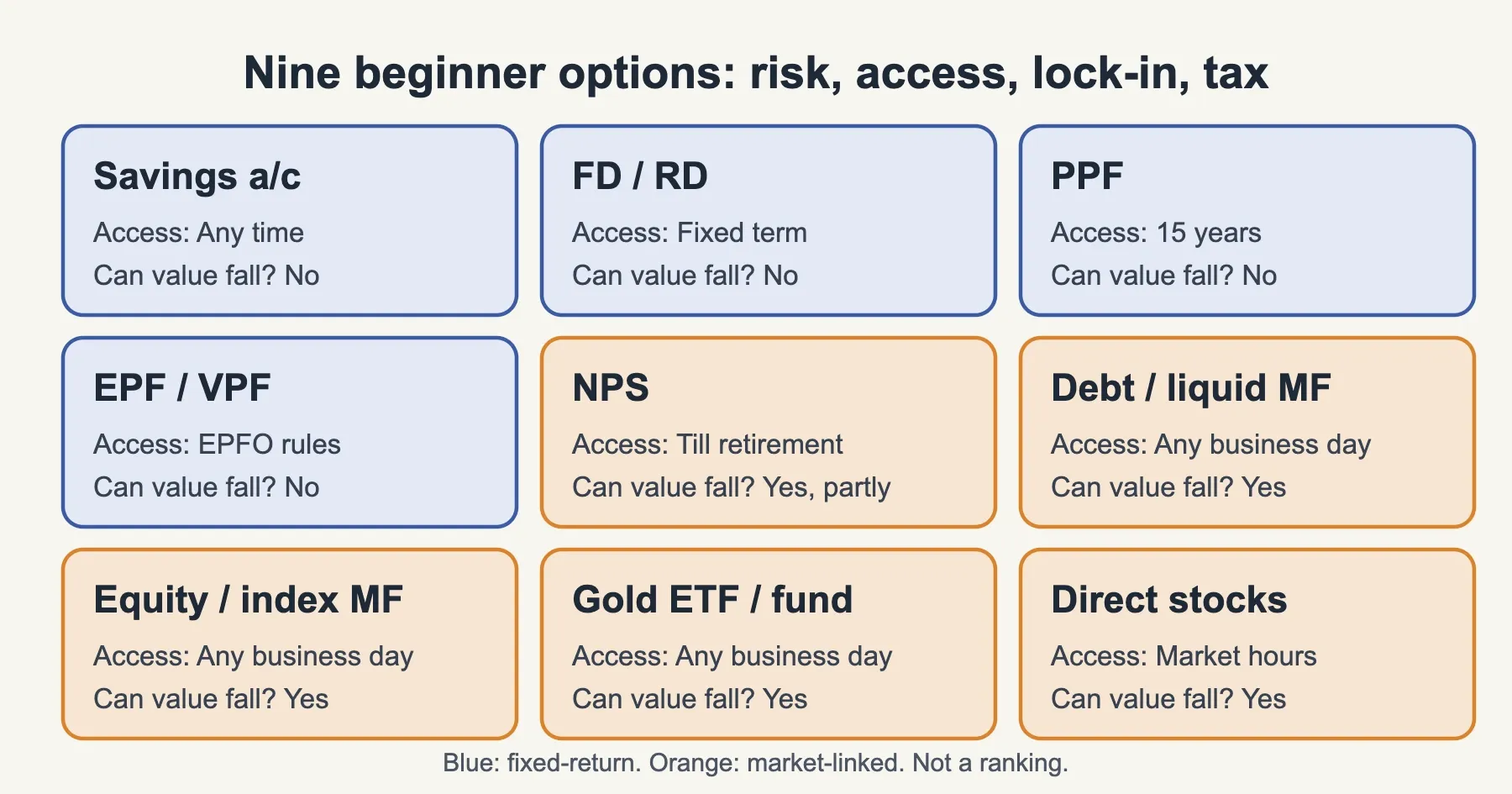
- Investing for longer goals. An SIP (Systematic Investment Plan) in a mutual fund scheme is one way people invest from this bucket, a fixed amount at regular intervals. It is market-linked, so its value can fall as well as rise. How much to put in is a separate question, covered in how much SIP to start with your first salary, and the basics of how an SIP works are in what an SIP is.
If you want a wider view of what to set up in your first job, from accounts to insurance and EPF, that's in the first job money checklist. This page stays with one job: splitting the monthly pay.
Track one month before you set the split
Choosing a split before you know where your money goes is guesswork. Look back first.
- List your fixed debits. Rent, EMIs, family transfers, phone bill, subscriptions.
- Tag last month's spends. Open your bank statement and your UPI and card history. Put each payment into one of three columns: needs, wants, saved.
- Set next month's split. Total each column and work out its share of your take-home. Then choose a split that's close to reality but nudges the saved column up a little.
Your actual numbers might look like 64/26/10. That's a starting point you can move from.
Three common mistakes
Budgeting from CTC. If you split a CTC-based monthly figure, every bucket is inflated and you can run short before month-end. Start from the credited amount.
Treating the 30% as a target. The wants bucket is a ceiling, not a quota to use up. If you spend less, the difference can move to savings.
Saving whatever is left. Waiting until month-end to save often leaves little or nothing. Moving the savings amount on salary day, as the pay-yourself-first approach does, removes the decision from tired, end-of-month you.
Frequently asked questions
What is the 50/30/20 rule of budgeting?
It's a rule of thumb that splits take-home pay into about 50% for needs, 30% for wants and 20% for savings and investments. It is a starting point for a budget, not a fixed rule.
Does the 50/30/20 rule work on an Indian salary?
It can, but many first salaries need an adjusted split, especially in high-rent cities or when you support family. Many people keep the 20% savings share and let needs and wants trade places.
Is rent a need or a want? What about EMIs?
Rent and loan EMIs are usually treated as needs, because missing them has real consequences. Family support is also a need for many households. Eating out, OTT and upgrades are wants.
What if my rent is more than 50% of my salary?
That's common in metros. People often switch to a 60/20/20 (needs, wants, savings) or 70/20/10 (needs 70, savings 20, wants 10) split, or fix a savings amount first and live on the rest.
Where does an SIP fit in the 20%?
An SIP is one option inside the savings and investments bucket, usually considered after an emergency fund and basic insurance. It is market-linked, so its value can go down as well as up.
Should my emergency fund come out of the 20% first?
Many people build an emergency fund from the 20% before investing, because it covers surprises without forcing you to sell investments or borrow. The right order depends on your situation.
Before next payday
This month, sort every spend into three columns: needs, wants, saved. Look at the totals before you change anything.
— Laabh