CTC vs in-hand salary: tracing every rupee from offer letter to bank credit
CTC is what you cost your employer; in-hand is what reaches your bank. A hypothetical ₹7.8 lakh offer traced through PF, PT and TDS.
Summarize this article with AI





The short version
- CTC is the employer's total annual cost; in-hand salary is what reaches your bank after deductions.
- Employer PF, gratuity, insurance and variable pay sit inside CTC but do not arrive as monthly cash.
- Employee PF, professional tax (state-dependent) and TDS come off gross pay, and each appears on the payslip.
- In this hypothetical ₹7,80,000 offer, pay before PT and TDS is about ₹51,760 a month, roughly 79.6% of CTC divided by 12.
- Budget and build your emergency fund from the in-hand figure, not the offer-letter number.
CTC (cost to company) is everything an employer spends on you in a year, including its own PF contribution, gratuity, insurance and variable pay. In-hand salary is what reaches your bank each month after employee PF, professional tax and TDS. Read your payslip from gross to net and the gap between the two numbers explains itself.
An offer letter that says ₹7,80,000 a year invites a quick division: ₹65,000 a month. The first bank credit is usually smaller. Nothing has gone wrong. CTC was the employer's total budget for you, and three layers come off first: employer-side items, your own deductions and income tax. Below, one hypothetical offer is traced through each layer so you can repeat the exercise before budgeting around a number you will never see.
Tax and PF rules as of 16 November 2026.
What is the difference between CTC and in-hand salary?
Three numbers sit between the offer letter and your bank account.
- CTC. The employer's full annual cost of having you: money paid to others on your behalf (EPF, an insurer), money set aside for later (gratuity) and money that depends on performance (variable pay).
- Gross salary. The fixed monthly pay before deductions: basic pay, house rent allowance (HRA), special allowance and similar.
- In-hand (net) salary. Gross minus your deductions: employee PF, professional tax where your state levies it, and TDS.
The arithmetic is two subtractions: CTC minus employer-side items gives gross salary, and gross salary minus deductions gives in-hand salary.
What sits inside CTC but never reaches your account?
- Employer PF contribution. Paid into your EPF account with EPFO. Still your money, just not spendable this month.
- Gratuity. Some employers show a gratuity provision in CTC. Gratuity is a lump sum paid when you leave or retire, only if you meet the eligibility conditions in law, so it is never monthly pay.
- Group insurance premiums. If the employer buys health or life cover for staff, the premium may sit in CTC. You receive cover, not cash.
- Variable or performance pay. Usually paid quarterly or yearly, to the extent targets are met. The offer-letter figure is often a target.
If your offer letter shows only a total, ask HR for the annual breakup.
Is employer PF contribution part of CTC?
In most salary structures, yes. EPFO's scheme page states that both the employee and the employer contribute 12% of basic wages plus dearness allowance (DA), and that the employer's share is split between EPF, the Employees' Pension Scheme (EPS) and Employees' Deposit Linked Insurance (EDLI). The employee's entire 12% goes to EPF.
So PF shows up twice: once as an employer cost inside CTC, and once as a deduction from your gross pay. Both are credited to your EPF account, which you can check in the EPFO passbook.
One detail changes the numbers. EPFO describes contributions as mandatory on wages up to ₹15,000 a month, with a voluntary option above that, so some employers calculate PF on the full basic and others on the ₹15,000 ceiling. Ask HR which base applies to you.
What deductions are taken from salary: PF, professional tax, TDS?
- Employee PF. 12% of basic plus DA, on whichever base your employer uses.
- Professional tax (PT). A state-level tax on employment. Not every state levies it and the amount varies by state, so we have not put a figure on it here.
- TDS (tax deducted at source). Your employer estimates your income tax for the year and deducts it in instalments, based on expected income, your tax regime and any declarations. The Income Tax Department's guidance for salaried individuals lists the new regime as the default, with the old regime available by choice. At year end the employer issues a TDS certificate on salary, known as Form 16 for salary paid up to 31 March 2026 and as Form No. 130 for salary paid from 1 April 2026 under the Income-tax Act, 2025, which our Form 16 guide Form 16 explained covers.
How do I calculate in-hand salary from CTC?
Here is one offer traced line by line. Hypothetical structure; every employer's breakup differs.
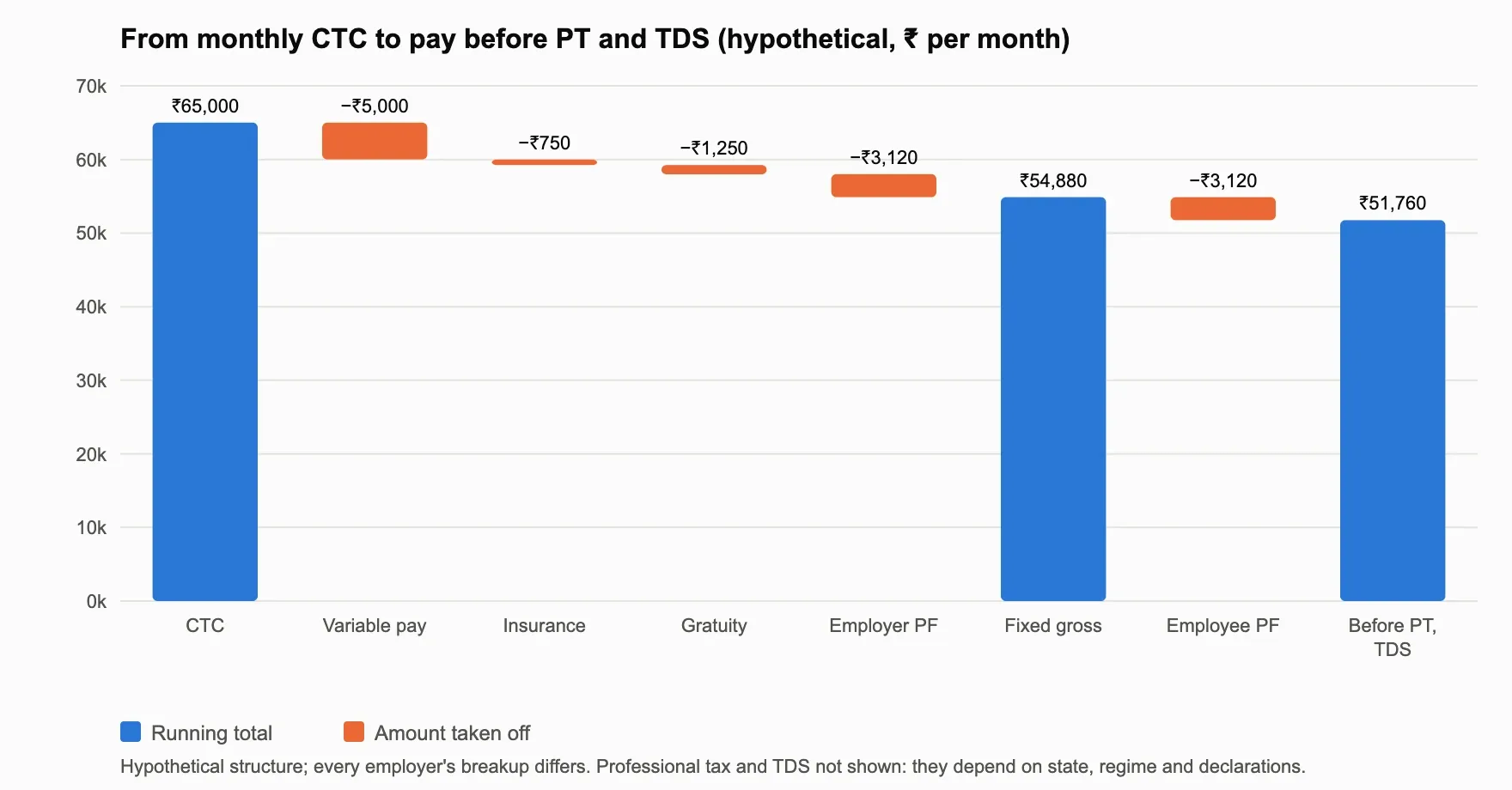
Assumptions: annual CTC ₹7,80,000; basic pay ₹26,000 a month; employer and employee PF each at 12% of the full basic; a gratuity provision of ₹15,000 a year; an employer-paid group insurance premium of ₹9,000 a year; and target variable pay of ₹60,000 a year, paid once a year if earned.
| Line | Per year | Per month |
|---|---|---|
| CTC (offer letter) | ₹7,80,000 | ₹65,000 |
| Less: variable pay (paid later, if earned) | ₹60,000 | ₹5,000 |
| Less: group insurance premium | ₹9,000 | ₹750 |
| Less: gratuity provision | ₹15,000 | ₹1,250 |
| Less: employer PF (12% of ₹26,000) | ₹37,440 | ₹3,120 |
| Fixed gross salary | ₹6,58,560 | ₹54,880 |
| Less: employee PF (12% of ₹26,000) | ₹37,440 | ₹3,120 |
| Before PT and TDS | ₹6,21,120 | ₹51,760 |
| Less: professional tax | Depends on state | Depends on state |
| Less: TDS | Depends on regime and declarations | Depends on regime and declarations |
Before professional tax and TDS, this hypothetical employee would see about ₹51,760 a month, roughly 79.6% of the ₹65,000 a simple division of CTC suggests. The ₹13,240 difference is saved in EPF, held for later (gratuity, variable pay) or spent on cover (insurance).
What about TDS here? Under the new regime, a rebate of up to ₹60,000 applies where total income does not exceed ₹12 lakh, and Budget 2026-27 left this unchanged for tax year 2026-27. This example's salary, including variable pay, totals ₹7,18,560 before any deduction, which is below that line, so on those rules TDS could be nil. Your payroll team works out the TDS on your own income.
If PF is calculated on the ₹15,000 ceiling instead. Keeping the same CTC, employer PF falls to ₹1,800 a month, fixed gross rises to ₹56,200, employee PF falls to ₹1,800, and pay before PT and TDS becomes ₹54,400. That is ₹2,640 more in hand each month and ₹31,680 less going into EPF over the year from both sides combined: a trade-off between cash now and retirement savings, usually set by employer policy.
Why is my in-hand salary so much lower than my CTC?
- Variable pay is in the CTC but not in the payslip. It arrives later, and possibly at a different amount.
- Annual and deferred items are spread through CTC. Insurance and gratuity raise the CTC without raising monthly pay.
- PF is counted on both sides. The employer's share sits inside CTC, and your own share is deducted from gross.
- Tax regime and declarations. Without your regime choice or declarations, TDS may be estimated differently from what you expect; differences are generally settled when you file your return.
- A part month. If you joined mid-month, the first salary is usually paid only for the days worked.
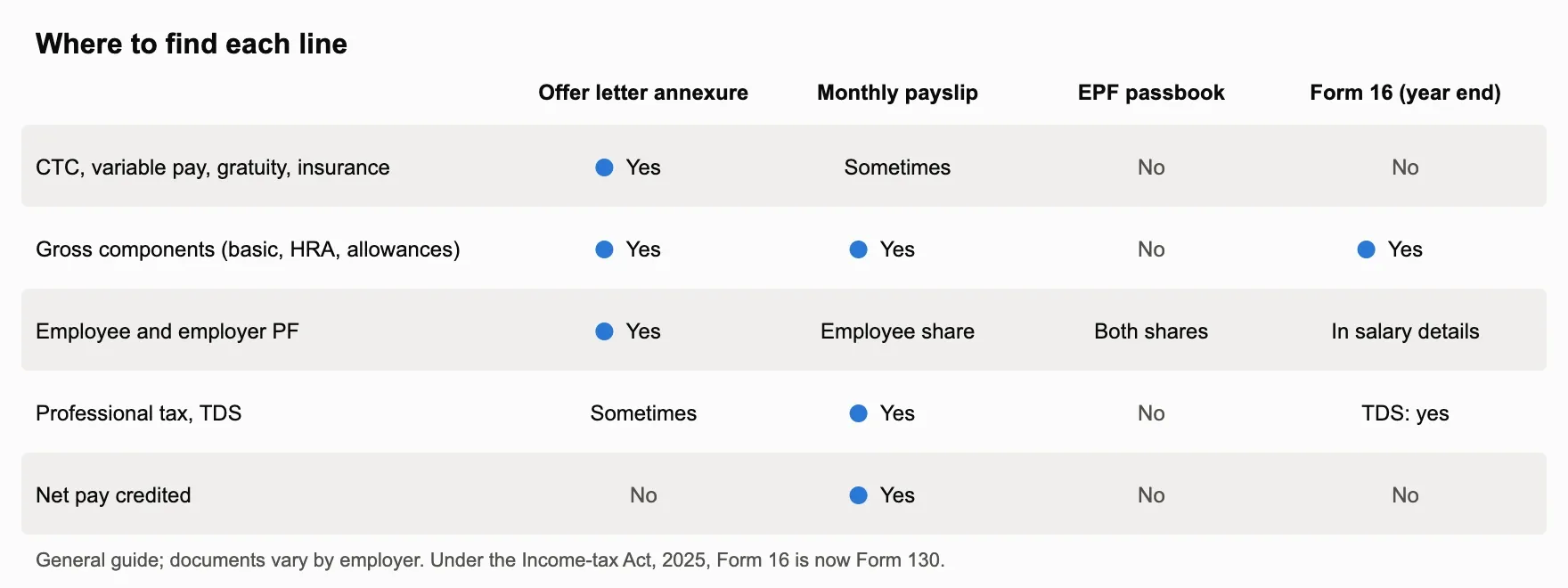
To check each line yourself: CTC items are on the offer letter annexure, gross pay and deductions on the payslip, both PF shares in the EPF passbook, and annual salary with TDS on Form 16 or Form No. 130 (the second chart in this article maps them).
What to do with the first in-hand figure
- Budget from in-hand pay. A simple split such as the 50/30/20 rule on an Indian salary shows where each rupee goes.
- Leave variable pay out of the monthly plan. Treat it as a bonus when it arrives, not as income you rely on.
- Start an emergency fund from in-hand pay. Size it from essential monthly costs; see how much emergency fund you need.
- Check your EPF passbook after a couple of salary cycles to confirm both contributions are credited.
- Work through the rest of month one with the first job money checklist.
Frequently asked questions
Does variable pay come every month?
Usually not. Variable or performance pay is commonly paid quarterly or once a year, and only to the extent targets are met. Leave it out of your monthly budget until it is paid.
Is gratuity paid monthly?
No. Gratuity is a lump sum paid when you leave or retire, and only if you meet the eligibility conditions in law. A gratuity provision inside CTC is one reason CTC exceeds monthly pay.
Where do I see my EPF balance?
In your EPF passbook on EPFO's member services, which show both your contribution and your employer's.
Is employer PF contribution part of CTC?
In most structures, yes. EPFO states the employer contributes 12% of basic wages plus DA. It never reaches your bank, but the EPF portion is credited to your account.
Does a higher CTC always mean a higher in-hand salary?
Not necessarily. Two offers with the same CTC can pay different monthly amounts if one has more variable pay, insurance or gratuity inside it, or calculates PF on a different base. Compare fixed gross and deductions too.
Next step
Got your in-hand figure? Turn it into a monthly plan with the 50/30/20 split.
— Laabh