Mutual fund KYC online: the steps, the documents and what each status lets you do
Mutual fund KYC online for first-time investors: the five steps, documents needed, and what Validated, Registered and On Hold let you do.
Summarize this article with AI





The short version
- KYC is a status, not a form. "KYC Validated" lets you invest with any fund house without repeating KYC.
- You need a PAN, an OVD such as Aadhaar, a photo and a signature.
- "Registered" means a new fund house will ask for documents again.
- KRAs have 2 days from receipt to verify core details; no end-to-end timeline is published.
- Check your KRA status by PAN before your first SIP.
Mutual fund KYC is a one-time identity check recorded with a KYC Registration Agency (KRA). Online, you give your PAN and verify your identity and address, often through Aadhaar, and the record goes to a KRA. The status the KRA shows then decides what you can do: "KYC Validated" lets you invest with any fund house without repeating KYC.
Mutual fund investments are subject to market risks, read all scheme related documents carefully.
Ritika, 24, is a junior analyst in Indore. She has picked a ₹5,000 monthly SIP and wants it running from her next salary. Her first hurdle is KYC: a status line that might read "Registered", "Under Process" or "Validated". This guide walks through the mutual fund KYC process online for first-time investors around one idea: KYC is a status, not a form, and the question is which status lets you invest.
How do I do mutual fund KYC online for the first time with PAN and Aadhaar?
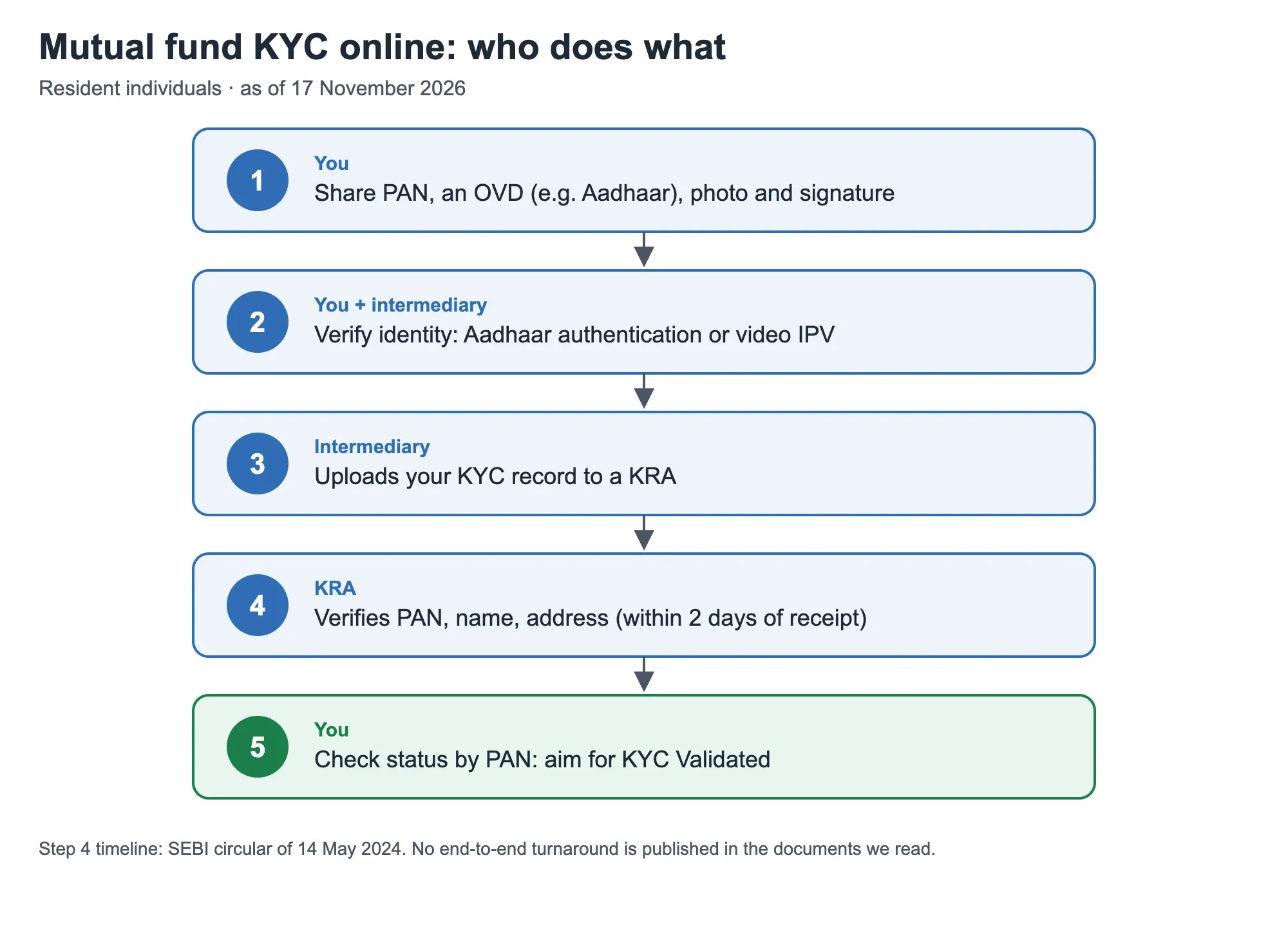
The online route has five steps. Different people do each one.
- You share your details with a KYC intermediary, such as the fund house, its registrar or a distributor: PAN, an identity and address document, a photo and a signature.
- Your identity is verified. With Aadhaar, this is done through UIDAI's authentication. SEBI's investor material also describes video in-person verification (VIPV) as an option for online KYC.
- The intermediary uploads your record to a KRA, which keeps KYC records for the securities market.
- The KRA verifies it. SEBI's circular of 14 May 2024 says KRAs "shall verify" PAN, name and address "within 2 days of receipt of KYC records". SEBI's KYC FAQ adds mobile number and email to the attributes checked (FAQ 40).
- You check the status by PAN on a KRA website (SEBI FAQ 43).
What documents do I need for MF KYC, and is a selfie or video KYC mandatory?
PAN is compulsory (SEBI FAQ 11), but it is not an officially valid document (OVD) for proving identity (FAQ 10), so you need one more document.
One OVD for identity and address. SEBI's FAQ lists proof of possession of Aadhaar, passport, driving licence and voter ID among the accepted documents (FAQ 16). If your OVD lacks your current address, a utility bill not more than two months old can stand in, with an updated OVD due within three months (FAQ 17).
A photograph and a signature. Online, a filled form can be signed with Aadhaar-based e-Sign (FAQ 28).
Selfie or video? SEBI's investor material (updated 30 September 2022, written for trading and demat accounts) says in-person verification is not needed when KYC is done through Aadhaar authentication, or online with documents verified through DigiLocker. Where it is needed, video verification can replace a physical visit. Some online forms still ask for a live photo or a short video; ask the intermediary if a step fails.
Is PAN–Aadhaar linking required? SEBI's FAQ notes the government has made linking mandatory, with exceptions. Without verified linking you can still transact with your existing intermediary using a valid PAN, but your KYC is not portable (FAQ 12). A Validated record requires verified linkage (FAQ 40).
My KYC shows "registered" but not "validated": can I still start an SIP?
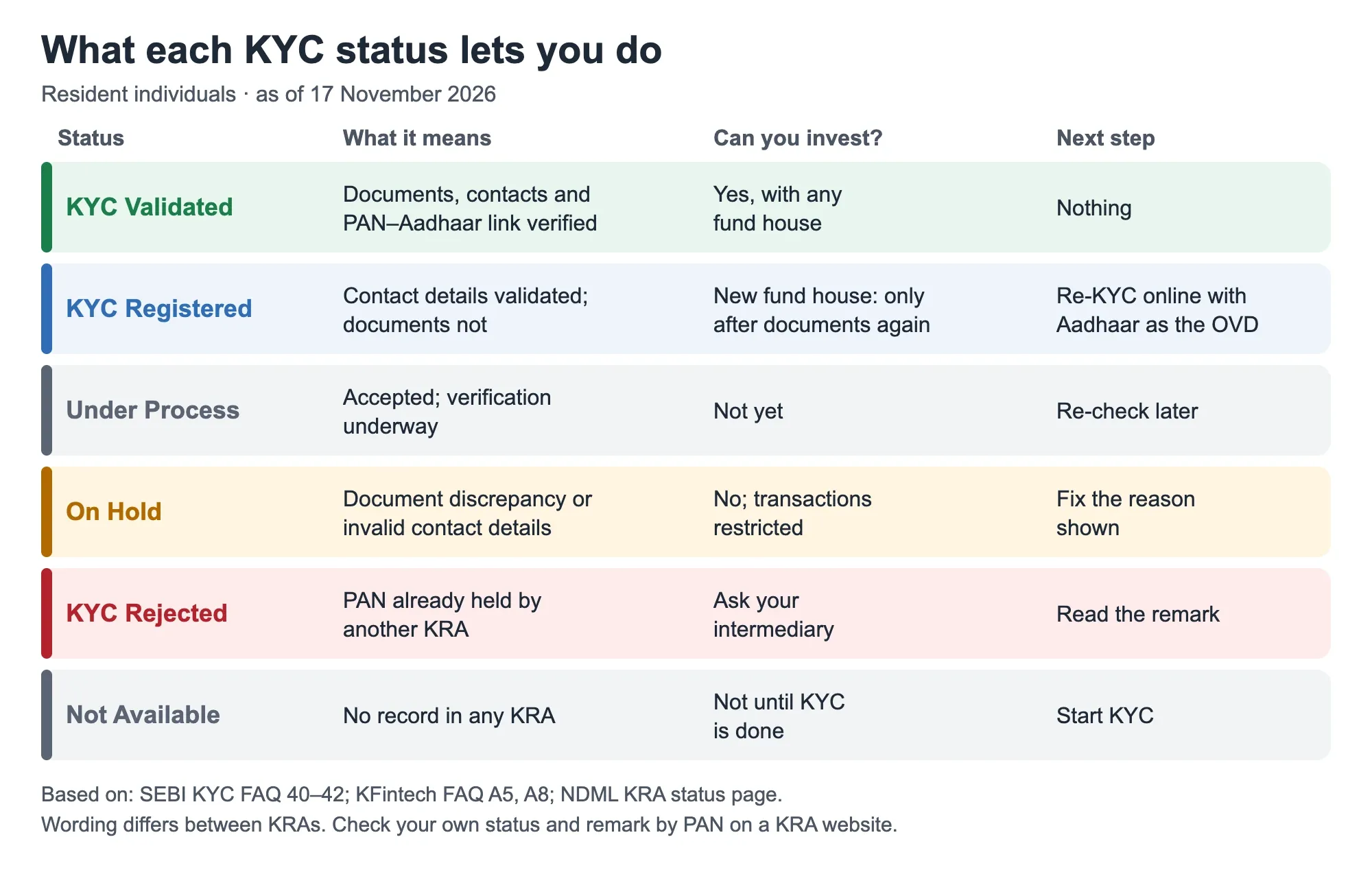
Here is what each label means, as SEBI, NDML KRA and the registrar KFintech describe it. KRA wording varies; the remark on your own record is the final word.
| Status | What it means | Can you invest? | Next step |
|---|---|---|---|
| KYC Validated | Documents, contact details and PAN–Aadhaar link verified | Yes, with any fund house | Nothing |
| KYC Registered | Contact details validated; documents not | New fund house: only after giving documents again | Re-KYC online with Aadhaar as the OVD |
| Under Process | Accepted; verification underway | Not yet | Re-check later |
| On Hold | Document discrepancy or invalid contact details | No; transactions restricted | Fix the reason shown |
| KYC Rejected | PAN already held by another KRA | Ask your intermediary | Read the remark |
| Not Available | No record in any KRA | Not until KYC is done | Start KYC |
So for a first SIP with a new fund house, "Registered" is not enough on its own. KFintech's FAQ says you can transact with a new intermediary "by producing the KYC documents again", and recommends KYC "using Aadhaar as OVD through Online mode" (A5, A8). If your record is on hold, the fix depends on the remark; our guide to mutual fund KYC on hold covers each reason.
Ritika's day-one SIP: a hypothetical
Ritika sets up her ₹5,000 SIP on the day she submits KYC. Her record shows "Under Process", then "Registered", because her documents don't validate. Depending on the fund house's rules, her first order may be held or rejected (verify with the fund house). Her money isn't invested until the status allows it.
Say one instalment is skipped while the status is fixed. Over her first year, she invests ₹55,000 (11 instalments) instead of ₹60,000 (12 instalments), a gap of ₹5,000. Hypothetical; process illustration only. No return is assumed, and nothing here is a promise; returns vary. Checking the status first helps avoid this.
How many days does KYC take to become validated with the KRA?
SEBI's circular gives KRAs 2 days from receipt of the record to verify PAN, name and address. That clock starts when the KRA receives your record, and the documents we read give no end-to-end turnaround from your submission to "Validated". If the record moves to "Registered" or "On Hold", more work is needed. Treat any specific number of days as unverified, and plan your first SIP date after the status reads "Validated" (timelines as of 17 November 2026).
I did KYC with my bank or broker earlier: do I need to do it again for mutual funds?
Possibly not. Check your status by PAN first.
- Broker or another fund house: same KRA system. If your record is "Validated", SEBI's FAQ says you "need not undergo the KYC process again" and a new intermediary can fetch it (FAQ 41). If it is "Registered", a new fund house will ask for documents (KFintech A5).
- Bank: a different system. CKYC vs KRA, in one line: the Central KYC Records Registry (CKYCR), run by CERSAI, is a cross-sector registry built so KYC records can be reused across the financial sector (SEBI FAQ 49), while a KRA holds your securities-market KYC status. Don't assume bank KYC carries over; look up your PAN on a KRA website first.
- Address or name changed? SEBI's FAQ says you must update your KYC record when your details change (FAQ 18). This is usually a modification request sent through any intermediary (KFintech A14), not a fresh KYC.
Before your first SIP: a four-point check
- Status by PAN reads "KYC Validated". "Registered" usually means documents again with a new fund house.
- PAN–Aadhaar linking is verified, unless you fall within an exception; otherwise the record isn't portable.
- Your own mobile number and email are on the record, not a parent's. KRAs verify both.
- Your name matches across PAN, Aadhaar and your bank account. Correct any mismatch at the source first.
Most mutual fund routes don't need a demat account (mutual funds without a demat account). Once your folio is open, add a nominee.
Frequently asked questions
What is a KRA?
A KYC Registration Agency keeps securities-market KYC records, so one intermediary's record can be used by another. KRAs verify your details against official databases and show your status on their websites (SEBI FAQ 40, 43).
Is PAN–Aadhaar linking required for mutual fund KYC?
The government has made linking mandatory, with exceptions. Without verified linking you can still transact with your existing intermediary using a valid PAN, but your KYC is not portable and cannot be "Validated" (SEBI FAQ 12, 40).
How do I check my KYC status?
Search with your PAN on a KRA's KYC enquiry page, and note the status, the remark and which KRA holds your record (SEBI FAQ 43, 44).
Does an address change need fresh KYC?
You must update your record when details change (SEBI FAQ 18), usually through a modification request with a document showing the new address, not a full fresh KYC.
Is video KYC mandatory for mutual funds?
Not always. SEBI's investor material says in-person verification is not needed when KYC is done through Aadhaar authentication; video verification is an option where it is needed. Your intermediary decides which step it asks for.
Read next
Check your KYC status before your first SIP, then read how to start an SIP online, step by step.
— Laabh



