Liquid ETF vs Liquid Fund: Where Idle Cash Should Sit Depends on Where It Already Is and How Long It Stays
Liquid ETF vs liquid fund: same short-term debt, different route. SEBI's exit load table, a ₹2 lakh 3 vs 30-day cost example, and tax. As of 22 Nov 2026.
Summarize this article with AI





The short version
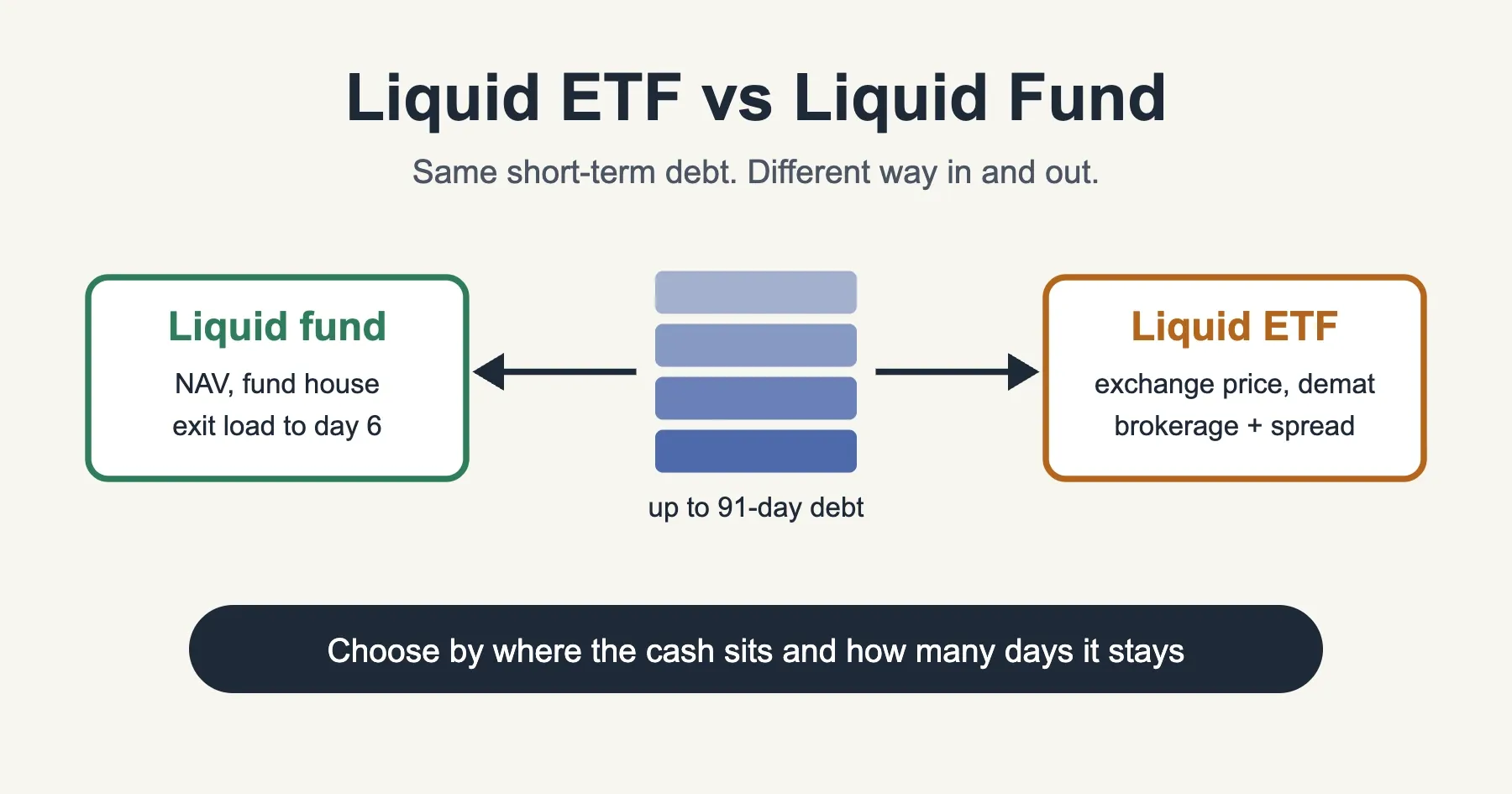
- A liquid fund and a liquid ETF hold the same kind of very short-term debt; the difference is the route in and out.
- Liquid fund: NAV with the fund house, graded exit load from 0.0070% on day 1 to nil from day 7 (SEBI, 2019 letter, listed as on 20 March 2026).
- Liquid ETF: exchange trade at market price, T+1 settlement, brokerage and spread on every trade; check the price against iNAV.
- In a hypothetical ₹2 lakh example, ETF costs took 77.3% of a 3-day return but 7.7% of a 30-day return.
- Gains on liquid funds bought on or after 1 April 2023 are taxed at slab rate (section 76, Income-tax Act, 2025).
As of 22 November 2026: a liquid ETF and a liquid fund both put your money in very short-term debt and money-market securities, so their underlying returns tend to be similar. The difference is the route. A liquid fund is bought and redeemed at NAV with the fund house and carries a small graded exit load for the first six days; a liquid ETF is bought and sold on NSE or BSE at market price through your demat account, so you pay brokerage and the bid-ask spread on every trade. Which one fits depends on where your cash already sits and how many days it will stay.
Zubin, 29, in Kochi, has sold some shares and has ₹2 lakh sitting in his trading account. Some of it is for a flat deposit in about a month; some weeks he only needs a place for a few days. This page compares the two routes with numbers. It does not pick a product for him.
What a liquid fund holds and how you get your money back
A liquid fund is an open-ended debt mutual fund scheme that, under SEBI's categorisation framework, invests in debt and money-market securities with a maturity of up to 91 days. You buy and redeem units at NAV with the fund house.
- Payout. The scheme document states how quickly redemption money reaches your bank. Under Regulation 46 of the SEBI (Mutual Funds) Regulations, 2026, if the fund house transfers proceeds late, it must pay you interest at 15% a year for the delay.
- Exit load. Liquid funds charge a small exit load if you leave within six days (table below).
- Instant access. Some liquid funds offer an optional instant access facility that credits a capped amount within minutes; the scheme's documents give the current limit.
- Risk. Short maturities keep price swings small, but a liquid fund can still lose value if a security it holds is downgraded or defaults. It is not a savings account.
For the basics, see what is a liquid fund.
What a liquid ETF is
A liquid ETF is an exchange traded fund that invests in the same kind of very short-term instruments, but its units are listed on NSE and BSE. You need a demat and trading account, you order units like a share, and the trade settles on T+1, the next trading day.
Two features keep the market price close to the value of the holdings:
- iNAV. SEBI's 2022 circular on passive funds requires an indicative NAV to be published on the stock exchanges during trading hours (for debt ETFs such as liquid ETFs, at least four times a day), so you can compare the price you are offered with what the units are worth.
- Market makers. The same circular requires the fund house to appoint at least two market makers, who keep buy and sell quotes running for at least 75% of market hours.
Dealing directly with the fund house is meant for large amounts (above ₹25 crore under the same circular); small investors use the exchange. New to the account side? See what is a demat account.
Two kinds of liquid ETF: dividend units or growth
Most comparisons skip this. Liquid ETFs come in two structures:
- Daily dividend, paid as extra units. The scheme declares income daily, so the unit price stays roughly flat, and your earnings arrive as additional units in your demat account at the interval the scheme sets. Your unit count grows; the price does not.
- Growth. No dividend is declared. Income stays inside the fund and the unit price rises over time, much like the growth option of a liquid fund.
The structure changes how your return shows up and how it is taxed. The scheme information document (SID) says which one a scheme uses.
Liquid ETF vs liquid fund: side by side
| What you compare | Liquid fund | Liquid ETF |
|---|---|---|
| Where you transact | With the fund house, at NAV | On NSE/BSE, at market price |
| Account needed | Mutual fund folio (demat optional) | Demat and trading account |
| Price you get | That day's NAV, per cut-off rules | Market price; check it against iNAV |
| Trading costs | No brokerage or spread; a small stamp duty on purchase | Brokerage, bid-ask spread, statutory and exchange charges, any DP charge on sale |
| Exit load | Graded, day 1 to day 6; nil from day 7 | None, because you sell to another buyer |
| Money back | Bank account, per the scheme's payout timeline | Sale settles T+1 into your trading account |
| How returns reach you | Rising NAV (growth option) | Extra units (daily dividend) or rising price (growth) |
| Pledge as margin | Depends on your broker and holding mode | Units in demat can often be pledged, after a haircut |
| Minimum | Scheme minimum in the SID | One unit at market price, plus charges |
Do liquid funds have an exit load? SEBI's graded table
Yes, for the first six days. In October 2019 SEBI asked AMFI to set a minimum graded exit load for liquid funds; the letter is still in SEBI's compilation of policy letters as on 20 March 2026. The load is a percentage of redemption proceeds:
| You exit on | Exit load (% of redemption proceeds) | On about ₹2 lakh (hypothetical) |
|---|---|---|
| Day 1 | 0.0070% | ₹14.00 |
| Day 2 | 0.0065% | ₹13.00 |
| Day 3 | 0.0060% | ₹12.01 |
| Day 4 | 0.0055% | ₹11.01 |
| Day 5 | 0.0050% | ₹10.01 |
| Day 6 | 0.0045% | ₹9.01 |
| Day 7 onwards | 0.0000% | Nil |
The amounts are small. The point is that the load ends on day 7, while an ETF's trading costs apply on every trade, however long you hold. For the wider rules, see exit load and SEBI's 3% ceiling.
Worked example: ₹2 lakh parked for 3 days vs 30 days
Assumptions (hypothetical, for illustration only): ₹2,00,000; both routes earn the same 6.5% a year before costs, which is not a promise of any return; ETF brokerage of ₹20 on each side; a spread cost of 0.01% of trade value on each side. Stamp duty on purchase (on both routes), statutory and exchange charges and any DP debit charge are left out, so real costs would be a little higher, more so on the ETF route.
| 3 days | 30 days | |
|---|---|---|
| Return before costs (either route) | ₹103.55 | ₹1,037.89 |
| Liquid fund: exit load | ₹12.01 (day 3, 0.0060%) | Nil |
| Liquid fund: net | ₹91.54 | ₹1,037.89 |
| Liquid ETF: brokerage + spread | ₹80.01 | ₹80.10 |
| Liquid ETF: net | ₹23.54 | ₹957.78 |
| ETF costs as a share of the return | 77.3% | 7.7% |
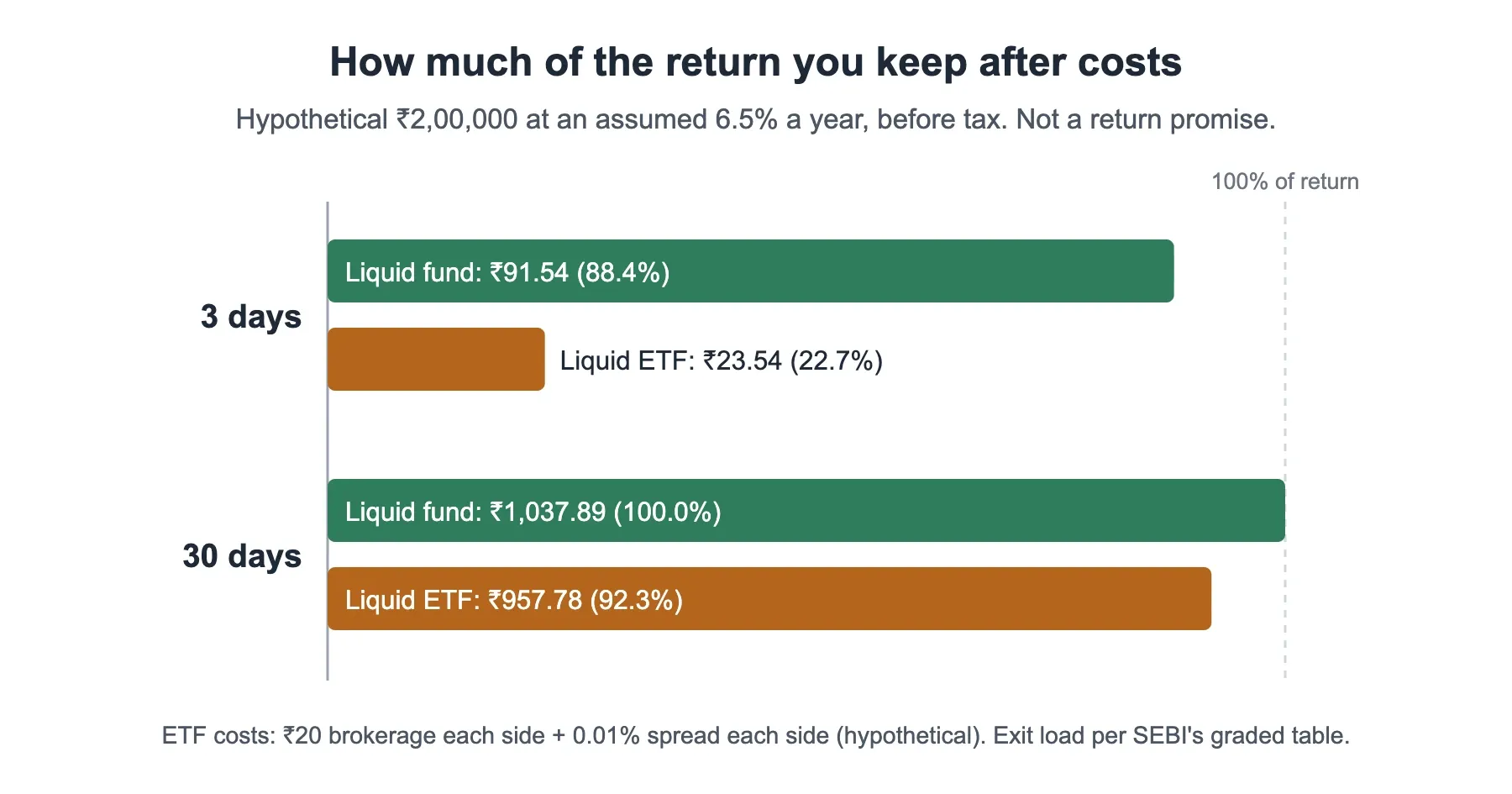
Over 3 days, fixed trading costs eat about three-quarters of the ETF route's return. Over 30 days, the same costs are under a tenth of it.
The table leaves out the cash's starting point. Zubin's ₹2 lakh is already in his trading account. To use a liquid fund, he would withdraw it to his bank, invest, and reverse the trip before his next trade, earning nothing while the money moves. That convenience, and any need to pledge units as margin, are his to weigh.
How each is taxed (as of 22 November 2026)
Gains. Under section 76 of the Income-tax Act, 2025, gains on units of a "specified mutual fund" (more than 65% in debt and money-market instruments) bought on or after 1 April 2023 are treated as short-term capital gains, whatever the holding period, and taxed at your slab rate. Liquid funds and liquid ETFs generally fall in this group; the scheme's tax note confirms it.
In the example, at a hypothetical 30% slab, tax on the liquid fund's ₹1,037.89 gain over 30 days would be about ₹311.37 (before cess).
Dividend units. With a daily-dividend liquid ETF, the extra units are dividend income, taxable at your slab rate in the year they are credited; the fund may deduct TDS above a threshold. Selling those units later is a separate capital-gains calculation.
Which fits your situation: a decision table
| Your situation | Factor that tends to matter most |
|---|---|
| Cash already in trading account, needed back for trades within days | Avoiding bank transfers; but ETF costs may exceed the return |
| Cash already in trading account, staying 7 to 90 days | ETF costs shrink as a share of return; compare against moving cash to a fund |
| Cash in bank, needed within 6 days | Exit load is tiny, but so is the return; leaving it in the bank may be simpler |
| Cash in bank, staying 7 to 90 days | Fund route has no exit load, brokerage or spread |
| You want to pledge the holding as margin | Check what your broker accepts and the haircut |
| Emergency fund | Quick access matters more than a few rupees; see how much emergency fund |
These are factors, not recommendations. For how ETFs and fund units differ when you invest regularly, see ETF vs index fund for SIP.
Frequently asked questions
What is the difference between a liquid ETF and a liquid fund?
Both invest in very short-term debt and money-market securities. A liquid fund is bought and redeemed at NAV with the fund house and has a small graded exit load up to day 6; a liquid ETF is traded on NSE or BSE at market price through a demat account, with brokerage and spread on each trade.
Is a liquid ETF better than a liquid fund for idle money in a demat account?
Neither is better in general; it depends on where the cash sits, how long it stays and whether you need to pledge it. In a hypothetical ₹2 lakh example at 6.5% a year, the ETF route kept ₹23.54 of a ₹103.55 return over 3 days but ₹957.78 of ₹1,037.89 over 30 days, because its trading costs are fixed per trade.
Do liquid funds have an exit load?
Yes, for six days. Under SEBI's letter of 15 October 2019 (still listed in SEBI's compilation as on 20 March 2026), the load is 0.0070% of redemption proceeds on day 1, falling by 0.0005 points a day to 0.0045% on day 6, and nil from day 7. As of 22 November 2026.
How are liquid ETF returns paid: dividend or growth?
It depends on the scheme. Some declare a daily dividend and credit it as extra units, so the price stays roughly flat; others use a growth structure where the price rises. Dividend units are taxed as income in the year credited, while growth is taxed when you sell. The SID states the structure. Tax rules change; consult a tax professional for your situation.
How is a liquid fund taxed in 2026?
As of 22 November 2026, under section 76 of the Income-tax Act, 2025, gains on units of a fund with more than 65% in debt and money-market instruments, bought on or after 1 April 2023, are treated as short-term capital gains and taxed at your slab rate, whatever the holding period. Tax rules change; consult a tax professional for your situation.
Save this table
Save this table for the next time cash sits idle between goals.



