What is a liquid fund? How fast you can withdraw, what can go wrong, and how it's taxed
A liquid fund holds debt maturing within 91 days. See how fast you can withdraw, the ₹50,000 instant cap, the 7-day exit load and how gains are taxed.
Summarize this article with AI





The short version
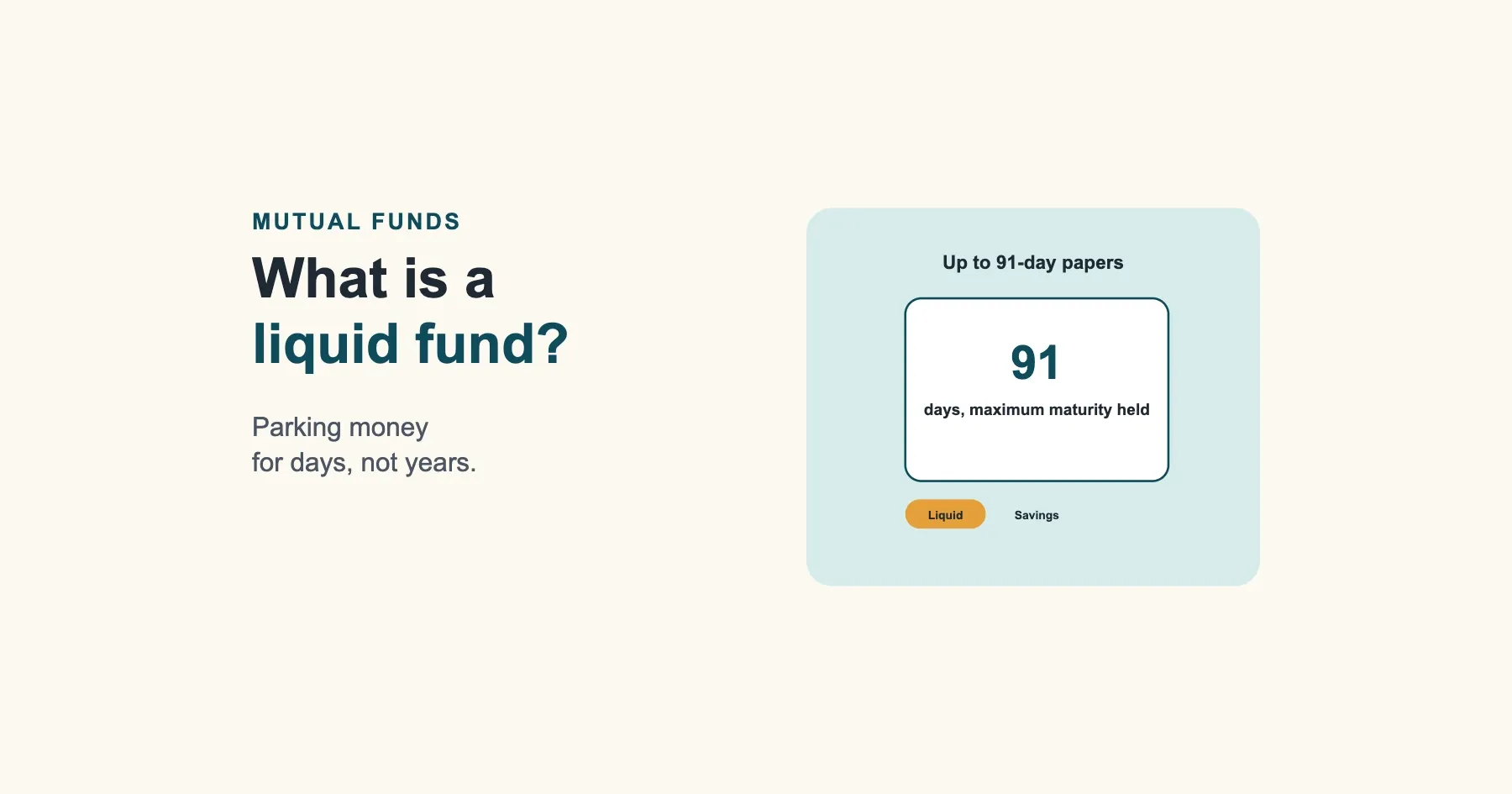
- A liquid fund holds only debt and money-market instruments maturing within 91 days (SEBI, 26 February 2026).
- It is among the lower-risk fund categories, not risk-free, and DICGC does not cover it.
- Regular redemptions are typically paid the next business day; the instant facility, where offered, is capped at ₹50,000 or 90%, whichever is lower, per day.
- Gains on units bought from 1 April 2023 are taxed at your slab rate when you redeem.
A liquid fund is a debt mutual fund that invests only in debt and money-market instruments maturing within 91 days. Redemptions are usually paid the next business day, and some schemes offer an instant facility capped at ₹50,000 or 90% of your investment, whichever is lower. It is among the lower-risk fund categories, not risk-free, and gains on units bought from 1 April 2023 are taxed at your slab rate.
Say Aditya, 29, in Thane, keeps ₹1,35,000 of emergency money in one liquid scheme. On a Saturday, a ₹64,000 bill lands. How much can he get that day, what could go wrong, and what tax follows? Here are SEBI's rules, written out.
What is a liquid fund and how is it different from a savings account?
SEBI's categorisation circular of 26 February 2026 lists the liquid fund as a debt category that invests only in debt and money-market securities with maturity of up to 91 days. Think treasury bills, commercial paper and certificates of deposit: short loans to the government, companies and banks. Short maturities mean the value moves far less than a long-term bond fund's.
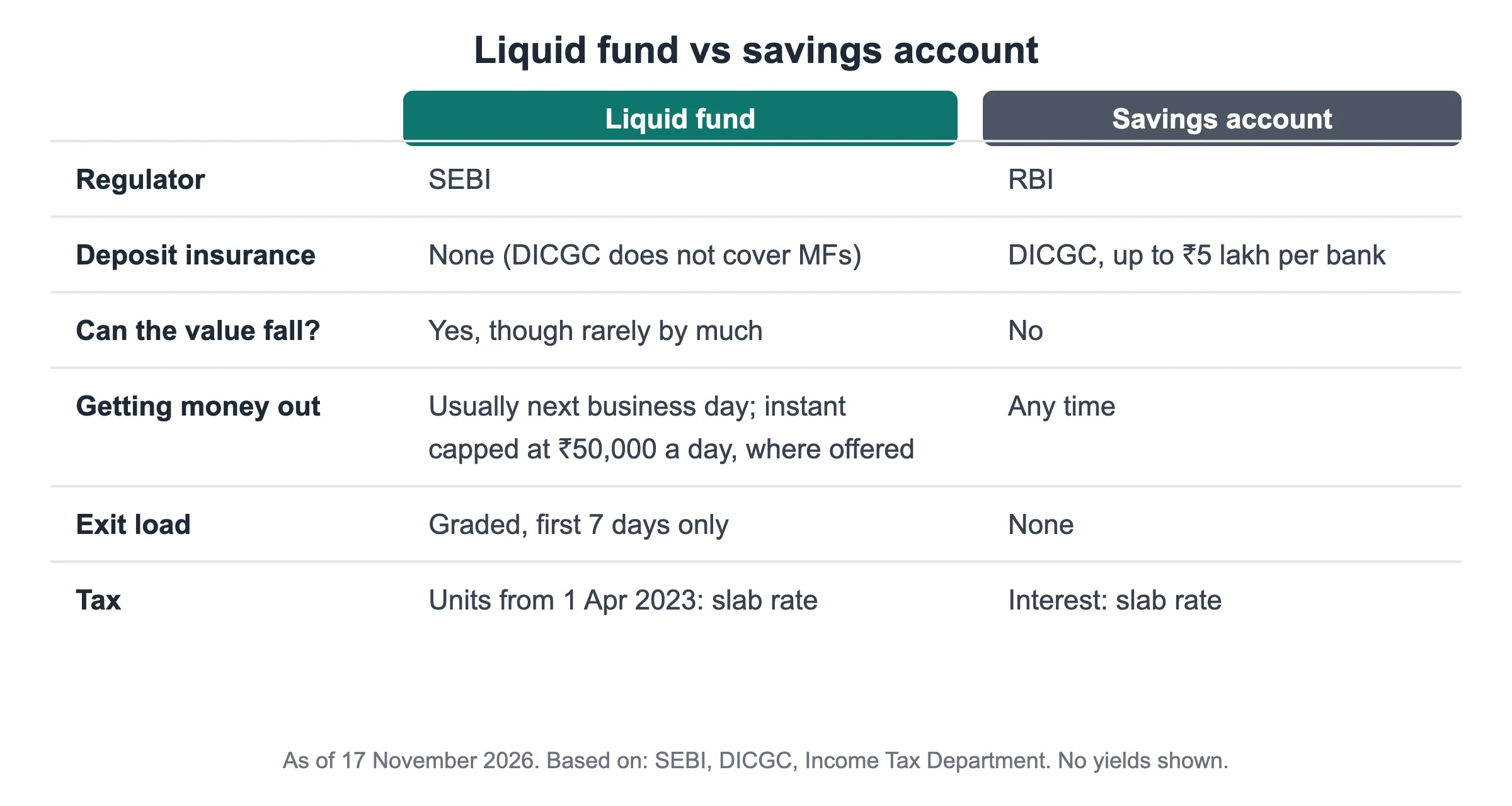
A savings account is a bank deposit, with different protection:
| Liquid fund | Savings account | |
|---|---|---|
| What it is | Debt mutual fund unit, priced at NAV | Bank deposit |
| Regulator | SEBI | RBI |
| Deposit insurance | None. DICGC does not cover mutual funds | DICGC covers up to ₹5 lakh per depositor, per bank (principal and interest) |
| Can the value fall? | Yes, though rarely by much | No, the balance does not move with markets |
| Getting money out | Regular redemption, usually paid next business day; instant facility capped at ₹50,000 a day, where offered | Any time, through the bank |
| Exit load | Graded, only in the first 7 days | None |
| Tax | Gains on units bought from 1 April 2023 at your slab rate, on redemption | Interest at your slab rate |
Fact table as of 17 November 2026. Based on: SEBI circulars of 8 May 2017, 20 September 2019 and 26 February 2026; DICGC; Income Tax Department. No yield column: past or current yields are not a guide to what you will earn.
Is a liquid fund safe, and can I lose money?
A liquid fund is among the lower-risk fund categories, but low risk is not no risk. Two things can push its NAV down:
- Credit events. If a company whose paper the fund holds is downgraded or misses a payment, that paper is marked down and the NAV falls. This is the bigger risk in short-term debt.
- Interest-rate moves. When rates rise, existing bonds lose some value. With maturities of 91 days or less, the effect is small, not zero.
SEBI's circular of 20 September 2019 also requires liquid funds to keep at least 20% of assets in liquid assets such as cash and government securities, to help meet redemptions.
Before choosing a scheme, read its riskometer and potential risk class (PRC); our mutual fund riskometer guide explains the levels. For how debt funds lose value, see what a debt mutual fund is.
How fast can I get my money back, and is instant withdrawal possible?
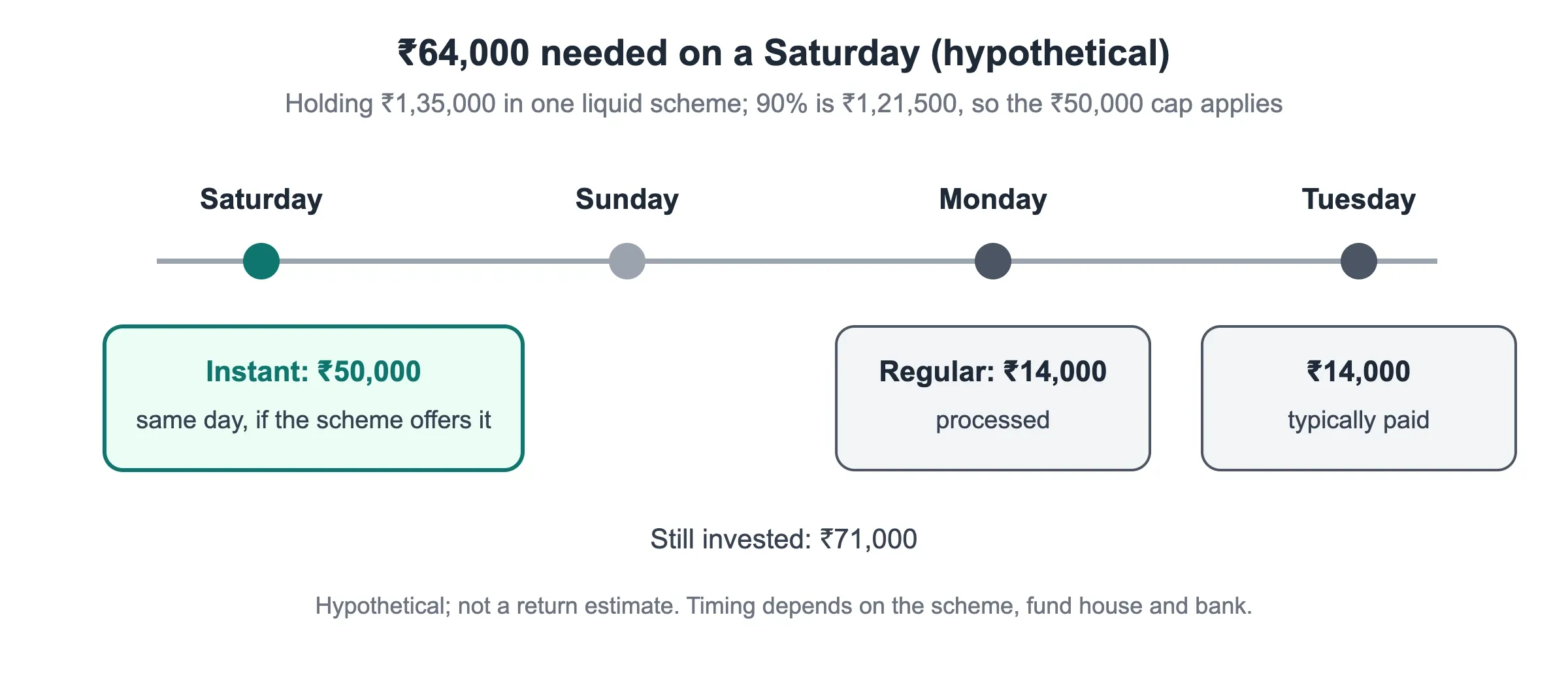
Regular redemption. You place a request and units are redeemed at the NAV that applies to your request time (the fund house's cut-off time is in the scheme documents). The money typically reaches your bank the next business day (T+1). Weekends matter: a request placed on Saturday is processed on Monday, the next business day, and typically paid the business day after, around Tuesday.
Instant Access Facility (IAF). SEBI's circular of 8 May 2017 allows instant redemption only in liquid schemes, online, for resident individual investors. The limit is "INR 50,000/- or 90% of latest value of investment in the scheme, whichever is lower", per day, per scheme, per investor. Not every scheme offers it, so check the scheme page.
Back to Aditya, as a hypothetical example. 90% of his ₹1,35,000 is ₹1,21,500, so the lower limit of ₹50,000 applies.
- Instant: up to ₹50,000 could reach his account the same day, if his scheme offers IAF.
- Regular: the remaining ₹14,000, processed on the next business day and typically paid the business day after (check the cut-off times in the scheme documents).
- Left invested: ₹71,000.
Hypothetical; not a return estimate. Actual timing depends on the scheme, the fund house and the bank.
The exit load. Liquid funds carry a graded exit load if you redeem within 7 days of investing, under SEBI's circular of 20 September 2019 and the grid AMFI set. It starts at 0.0070% for a redemption on day 1, falls each day, and is nil from day 7. If Aditya had invested only the day before, a 0.0070% load on ₹64,000 would be ₹4.48. The SID gives the exact grid.
Should I keep my emergency fund in a liquid fund or a savings account?
This is a trade-off, not a verdict:
- Savings account: access at any hour, a balance that does not move, and DICGC cover up to ₹5 lakh per bank. It suits money you may need the same day in full.
- Liquid fund: generally quick access, but the instant part is capped at ₹50,000 a day per scheme, the rest takes a business day or more, and the value can dip in a credit event.
Some people split the two: enough in the bank for the first days of an emergency, the rest where it can be reached in a day or two. The split depends on your costs and how fast they could hit.
How are liquid fund gains taxed after the 2023 changes?
Rules as of 17 November 2026 (FY 2026-27, under the Income-tax Act, 2025).
A liquid fund is a "specified mutual fund" under section 76 of the Income-tax Act, 2025: one investing more than 65% of its proceeds in debt and money-market instruments. Gains on units acquired on or after 1 April 2023 are treated as short-term capital gains, however long you hold them. The Income Tax Department's capital gains page says such short-term gains on debt-oriented fund units are taxed at your normal slab rate. There is no indexation. Units bought before 1 April 2023 may follow older holding-period rules.
Tax is triggered when you redeem. Hypothetical example: Aditya's redemption carries a gain of ₹3,400, and his slab rate is 20% (assumed).
- Tax at 20%: ₹680
- Health and education cess at 4%: ₹27.20
- Total: ₹707.20, before any surcharge
Hypothetical; not a return estimate; as of FY 2026-27, under the Income-tax Act, 2025. For how other fund types are taxed, see how mutual funds are taxed in India.
Tax rules change; consult a tax professional for your situation.
Frequently asked questions
Is there an exit load on a liquid fund?
Yes, but only in the first 7 days. SEBI requires a graded exit load, and the grid AMFI set starts at 0.0070% for redemption on day 1 and falls each day to nil from day 7. The exact grid is in the scheme's SID.
Is a liquid fund covered by DICGC?
No. DICGC insures bank deposits up to ₹5 lakh per depositor, per bank. Mutual funds, including liquid funds, are not covered.
Can I withdraw my whole liquid fund balance instantly?
Usually not. The instant facility is capped at ₹50,000 or 90% of your investment in the scheme, whichever is lower, per day. The rest goes through regular redemption.
How long does a liquid fund redemption take on a weekend?
A regular request placed on Saturday or Sunday is processed on Monday and typically paid the business day after. The instant facility, where offered, can pay up to the cap sooner.
Read next
Work out how much emergency money you need first: How much emergency fund should you have? To see where liquid funds sit among all categories, read SEBI's map of mutual fund categories. For lock-ins and exit loads across funds, see Can you withdraw your SIP money anytime?
— Laabh



