ELSS lock-in for an SIP: every instalment gets its own 3 years (with a date-by-date unlock table)
Each ELSS SIP instalment is locked for 3 years from its own allotment date. See a 12-row unlock table, what stopping does, and which units go first.
Summarize this article with AI





The short version
- Each ELSS SIP instalment is locked for three years from its own allotment date.
- A 12-month SIP from April 2026 to March 2027 unlocks in 12 steps, from April 2029 to March 2030 (hypothetical).
- Units are not redeemed automatically after three years; they stay invested until you ask.
- Stopping the SIP stops new instalments but does not unlock old ones.
- The ELSS tax deduction applies only in the old regime, as of 19 November 2026, FY 2026-27, under the Income-tax Act, 2025.
Each ELSS SIP instalment is locked for three years from its own allotment date, not from the date of your first SIP. Twelve monthly instalments therefore unlock on twelve different dates. Units are not redeemed automatically when the lock-in ends, and stopping the SIP does not release the instalments already invested.
Mutual fund investments are subject to market risks, read all scheme related documents carefully.
Mehul, 25, started his first job in Shillong this year and set up an ELSS SIP in April to save tax. His friend told him the money would be "free after three years". That is only partly right. The first instalment is free after three years. The last one he pays in March is free three years after March. This page shows exactly when each rupee unlocks, using a hypothetical example, so you can plan around it.
Lock-in: lump sum vs SIP
An Equity Linked Savings Scheme (ELSS) is a mutual fund category that carries a three-year lock-in. Scheme information documents (SIDs) for ELSS funds word it along these lines: redemption or switch-out of units can be made only after three years "from the date of allotment" of the units being redeemed.
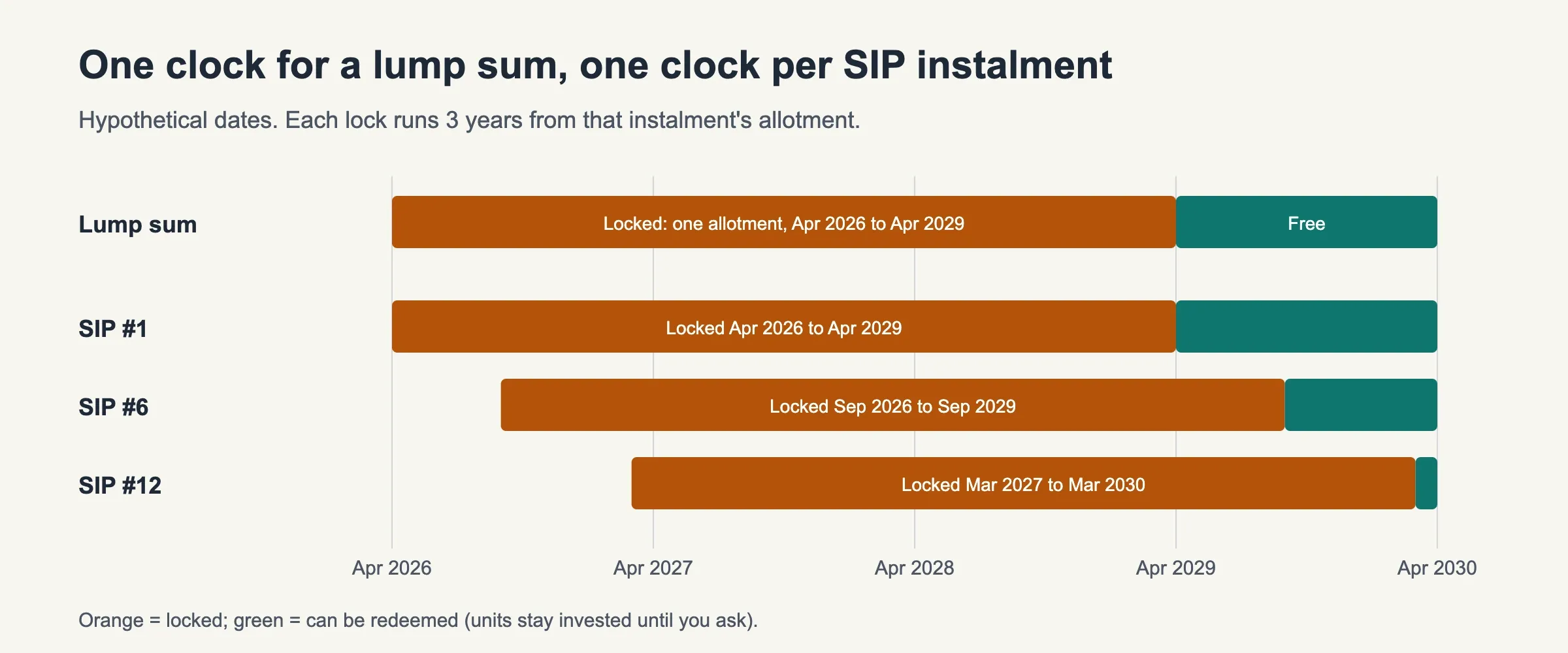
That wording is why lump sum and SIP behave differently:
- Lump sum: you invest once, units are allotted once, and the whole amount has one unlock date three years later.
- SIP: every instalment buys a fresh batch of units with its own allotment date. Each batch starts its own three-year clock.
So an ELSS SIP is not one lock-in. It is twelve separate three-year clocks a year, one for each monthly instalment.
One detail: the clock runs from the allotment date, not the day money leaves your bank. Scheme documents say SIP units get the NAV of the day the funds are available to the scheme, which can be a day or more after the debit. Your account statement shows the actual allotment date for each instalment.
The unlock table: 12 instalments, 12 dates
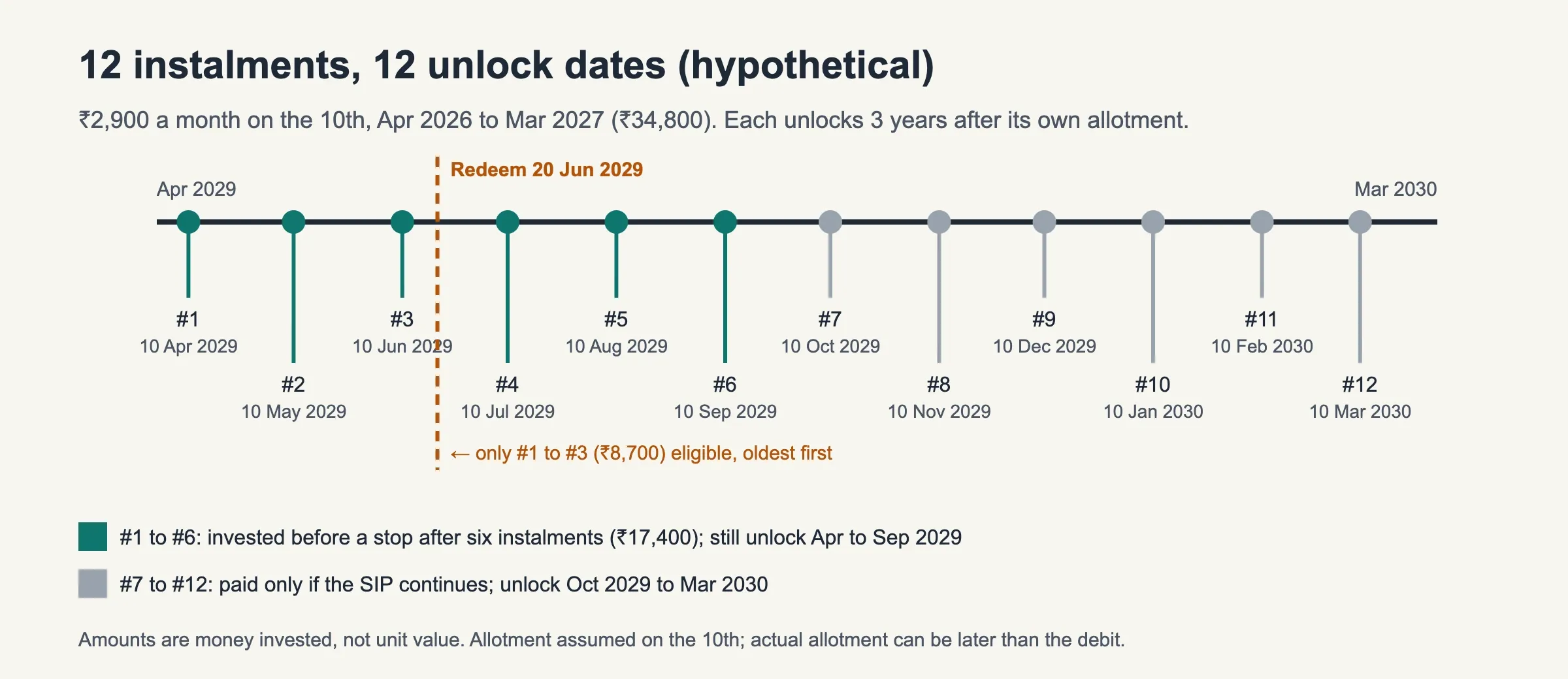
Here is a hypothetical ELSS SIP of ₹2,900 a month on the 10th, from April 2026 to March 2027. That is 12 instalments and ₹34,800 in total. To keep it simple, the table assumes each instalment is allotted on the 10th. No return rate is used, because the point is the dates, not the value.
| Instalment | Allotment date (assumed) | Amount | Total invested so far | Earliest redemption date |
|---|---|---|---|---|
| 1 | 10 April 2026 | ₹2,900 | ₹2,900 | 10 April 2029 |
| 2 | 10 May 2026 | ₹2,900 | ₹5,800 | 10 May 2029 |
| 3 | 10 June 2026 | ₹2,900 | ₹8,700 | 10 June 2029 |
| 4 | 10 July 2026 | ₹2,900 | ₹11,600 | 10 July 2029 |
| 5 | 10 August 2026 | ₹2,900 | ₹14,500 | 10 August 2029 |
| 6 | 10 September 2026 | ₹2,900 | ₹17,400 | 10 September 2029 |
| 7 | 10 October 2026 | ₹2,900 | ₹20,300 | 10 October 2029 |
| 8 | 10 November 2026 | ₹2,900 | ₹23,200 | 10 November 2029 |
| 9 | 10 December 2026 | ₹2,900 | ₹26,100 | 10 December 2029 |
| 10 | 10 January 2027 | ₹2,900 | ₹29,000 | 10 January 2030 |
| 11 | 10 February 2027 | ₹2,900 | ₹31,900 | 10 February 2030 |
| 12 | 10 March 2027 | ₹2,900 | ₹34,800 | 10 March 2030 |
Hypothetical example. Amounts are money invested, not the value of the units, which will rise or fall with the market.
Two things stand out. The first instalment can be redeemed from 10 April 2029. The whole ₹34,800 is not free until 10 March 2030, almost four years after the SIP began. If the SIP keeps running into a second and third year, a new batch locks up every month, and part of the money is always within its three-year window.
Which units go out first? FIFO on redemption
When you redeem ELSS units, only units past their own three-year mark can go out. In practice the oldest units are the first to become eligible, so redemptions draw on the earliest instalments first. Mutual fund registrars generally apply first-in, first-out (FIFO) to redemptions.
Using the table above: if Mehul asks to redeem on 20 June 2029, only instalments 1 to 3 have crossed their unlock dates. That is ₹8,700 of the money he put in, worth whatever those units are worth that day. Instalment 4 stays locked until 10 July 2029, and the rest follow month by month.
FIFO also matters for tax. Units sold are matched to the oldest purchases, and the holding period for each batch counts from its own allotment date.
What happens after 3 years?
Nothing happens automatically. The lock-in ending only means you are allowed to redeem. Scheme documents describe redemption as something that "can be made" after three years; they do not describe an automatic payout. Units stay invested in the scheme, and their value keeps moving with the market until you choose to redeem or switch.
This makes an ELSS different from a fixed deposit with a maturity date. There is no maturity amount, and no money arrives in your bank account on the unlock date. If you want the money, you place a redemption request.
Stopping an ELSS SIP early: what stays locked
You can stop an ELSS SIP at any time. Stopping ends future instalments. It does not change the lock-in on instalments already allotted.
Say Mehul stops after six instalments, in September 2026. He has invested ₹17,400. Those six batches still unlock on their own dates, from 10 April 2029 to 10 September 2029. Stopping does not bring any of them forward. For how stopping and pausing differ, and what each does to your mandate, see our guide on whether to pausing vs stopping an SIP.
A lock-in is the main reason ELSS money behaves differently from other SIPs. A regular equity fund SIP can usually be redeemed at any time, subject to any exit load; withdrawing your SIP money explains that side.
Tax in one paragraph
ELSS is linked to a tax deduction, as of 19 November 2026, FY 2026-27, under the Income-tax Act, 2025. The deduction that used to sit under Section 80C of the Income-tax Act, 1961 is now in section 123 of the Income-tax Act, 2025, with a combined limit of ₹1.5 lakh a year across eligible investments. It can be claimed only in the old tax regime; the new regime does not allow it. Whether that makes ELSS worth it for you is covered in whether ELSS is worth it in the new tax regime, and the regime choice itself in old vs new tax regime for salaried employees. On redemption, gains on units held for more than 12 months are long-term capital gains. These are taxed at 12.5% (plus any applicable surcharge and cess) on gains above ₹1.25 lakh a year under section 198 of the Income-tax Act, 2025, which replaced section 112A. Because every unit is locked for three years, any ELSS gain you can redeem will already be long-term. Our guide to how mutual funds are taxed in India covers the rest. Tax rules change; consult a tax professional for your situation.
Common mistakes to avoid
- Counting from the first SIP date. Each instalment has its own clock. Plan withdrawals from the last instalment's date, not the first.
- Using the debit date. The allotment date on your statement is what counts.
- Expecting a payout. Nothing is credited on the unlock date. Units stay invested until you redeem.
- Stopping the SIP to get money out. Stopping does not unlock anything already invested.
- Earmarking ELSS money for a near goal. If you may need the money within about four years of starting a one-year SIP, the staggered unlocks can leave part of it out of reach.
Frequently asked questions
Does the 3-year ELSS lock-in apply to each SIP instalment or from the first one?
To each instalment. Every instalment is a separate allotment of units, and ELSS scheme documents set the lock-in at three years from the date of allotment. Twelve instalments mean twelve unlock dates.
I started an ELSS SIP in April 2024. When can I withdraw all of it?
The April 2024 instalment can be redeemed from about April 2027, based on its allotment date. All of it depends on the last instalment. If the SIP is still running, part of the money will always be inside its three-year window. If you stopped it, add three years to the allotment date of the final instalment.
What happens to my ELSS SIP units after 3 years? Do they get auto-redeemed?
No. Once the lock-in ends you are allowed to redeem, but the units stay invested and keep moving with the market until you place a redemption request.
Can I stop my ELSS SIP before 3 years, and what happens to the money already in?
Yes, you can stop it. The money already invested stays locked, and each instalment unlocks on its own date three years after allotment. See pausing vs stopping an SIP.
If I redeem ELSS, which units go out first?
Only units past their three-year lock-in can be redeemed, and those are the oldest. Registrars generally apply first-in, first-out, so the earliest instalments go out first. Check your scheme's SID for its exact wording.
Learn more
Before you start or stop an ELSS SIP, read whether it fits your tax regime in whether ELSS is worth it in the new tax regime.
— Laabh



