Mutual fund riskometer: what the six levels mean and why your fund's label can change
The riskometer shows a scheme's risk on six levels, Low to Very High. It's evaluated monthly, so it can change. What it means and what it doesn't.
Summarize this article with AI





The short version
- The riskometer has six levels, from Low Risk to Very High Risk, as named in SEBI's 5 October 2020 circular.
- The fund house assigns the level from the portfolio using SEBI's method and evaluates it monthly, so it can change after you invest.
- A change is communicated through a notice cum addendum and an email or SMS to unitholders.
- The label describes the portfolio's risk; it is not a return forecast, a loss limit or a deposit-like promise.
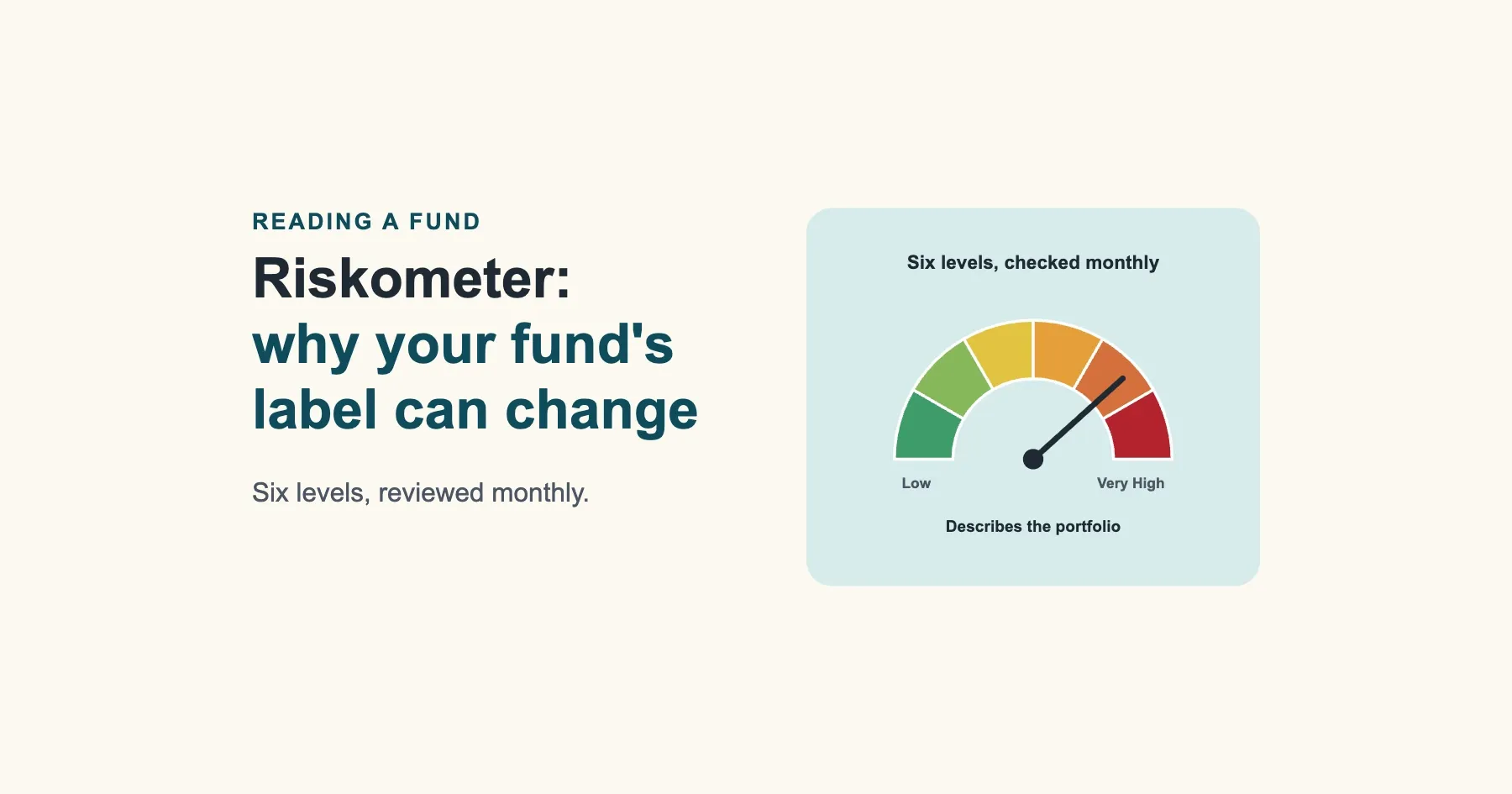
The mutual fund riskometer shows a scheme's risk level on a six-level scale, from Low Risk to Very High Risk. The fund house assigns the level using a method SEBI specified, and under SEBI's circular of 5 October 2020 (in force from 1 January 2021) the riskometer is evaluated every month, so a scheme's label can change after you invest. It describes the scheme's portfolio, not the returns you will get.
If an email just told you a scheme you hold moved from "High Risk" to "Very High Risk", nothing has been done to your units. Here's what the label means and what it cannot tell you.
Rules quoted from SEBI's circular SEBI/HO/IMD/DF3/CIR/P/2020/197 as issued on 5 October 2020. Last checked 11 November 2026.
The six riskometer levels
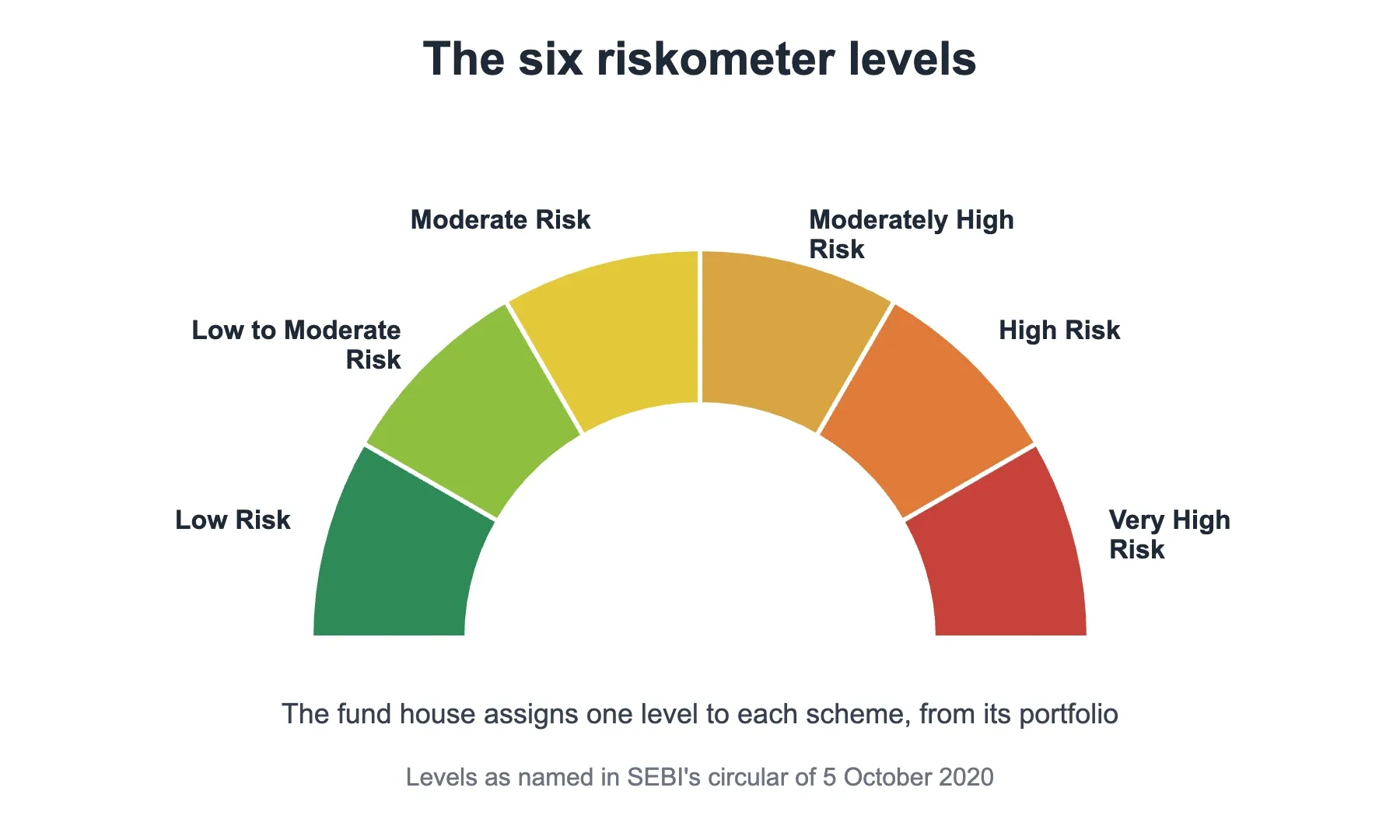
SEBI's circular calls it the "risk-o-meter"; we use riskometer. Para 2(c) of the 2020 circular says: "Risk-o-meter shall have following six levels of risk for mutual fund schemes:" and names them as below.
| Level (SEBI's name) | What it usually signals (our interpretation) |
|---|---|
| Low Risk | The portfolio scores lowest on the risk factors SEBI's method measures |
| Low to Moderate Risk | Somewhat more exposure to those factors; NAV movements usually still modest |
| Moderate Risk | A middle reading; noticeable ups and downs are possible |
| Moderately High Risk | Meaningful exposure to price swings, credit or interest-rate risk |
| High Risk | Larger NAV swings are likely to be part of the ride |
| Very High Risk | The top of the scale on the factors measured; the widest ups and downs |
The right-hand column is our reading, not SEBI's wording. The circular attaches no return or loss figure to any level, and neither do we.
Who decides your fund's level, and how
The fund house (the asset management company, or AMC) assigns the level; SEBI sets the method.
- From the portfolio. The 2020 circular refers to the "calculation of risk value of the scheme portfolio based on the methodology specified in Annexure A". Annexure A lists the factors: for equity, market capitalisation, volatility and impact cost; for debt, credit risk, interest rate risk and liquidity risk.
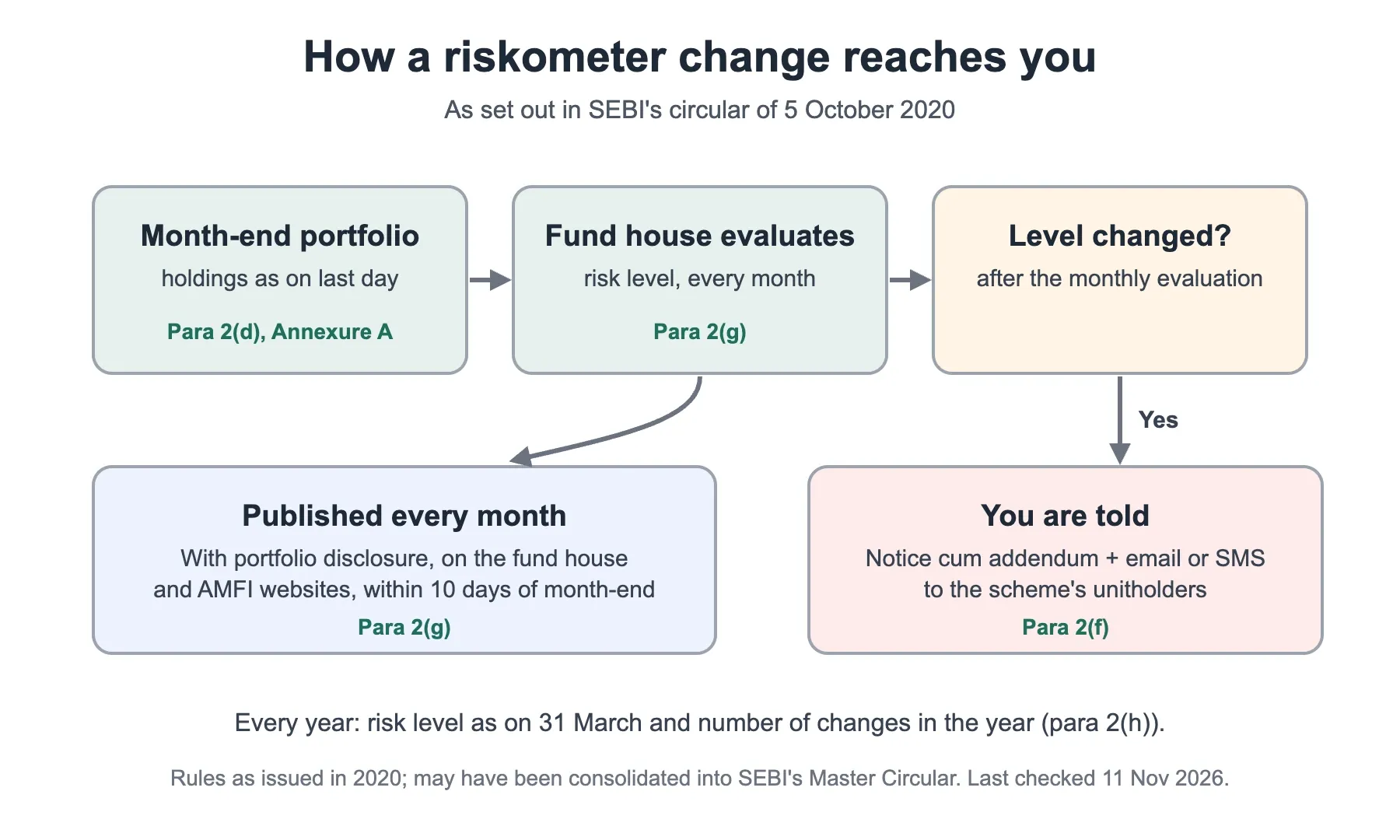
- Using month-end holdings. Annexure A says: "AUM of the security forming part of the scheme portfolio shall be as on last day of the given month."
- From day one. Para 2(e): "Based on the scheme characteristics, Mutual Funds shall assign risk level for schemes at the time of launch of scheme/New Fund Offer."
SEBI's investor-education page on the riskometer (undated) adds that "It is mandatory for asset management companies to display the Riskometer on their schemes as per guidelines by SEBI" and that "Fund houses must include the Riskometer in their fact sheets and promotional materials."
Why did my fund's riskometer change?
Because the portfolio is re-measured every month. Para 2(g) of the 2020 circular says: "Risk-o-meter shall be evaluated on a monthly basis". SEBI's investor page puts it more loosely: "The risk levels are reviewed periodically and updated based on changing market conditions."
What moves the reading, in our interpretation of Annexure A: a change in what the scheme holds, or in how risky those holdings measure. For equity, that might be a shift towards smaller companies or higher volatility; for debt, longer maturities or lower-rated papers. The scheme's objective can stay the same while the reading moves.
In our reading, a change in level is an expected result of a monthly review; on its own, it does not mean something has gone wrong with a scheme.
How you're told
Para 2(f): "Any change in risk-o-meter shall be communicated by way of Notice cum Addendum and by way of an e-mail or SMS" to the scheme's unitholders. So if you hold the scheme, you should hear about it directly.
Where it's published
Para 2(g) also requires fund houses to disclose the riskometer with the portfolio disclosure for all schemes, on their own website and on the AMFI website, "within 10 days from the close of each month". Para 2(h) adds a yearly view: "Mutual Funds shall disclose the risk level of schemes as on March 31 of every year", together with the number of times the level changed during the year.
SEBI has since consolidated many mutual fund circulars into a Master Circular; we have not verified whether this wording has changed there. Check the fund's latest scheme documents.
Scheme riskometer vs benchmark riskometer
Fund factsheets and fund house notices often show two meters: one for the scheme and one for its benchmark index. The benchmark meter lets you see whether the scheme's portfolio is reading riskier or less risky than the index it measures itself against.
The 2020 circular we read does not mention a benchmark riskometer, and we did not locate the SEBI text that governs it. So we describe it without attributing a rule to SEBI. The scheme's factsheet and SID explain what each meter shows.
What the riskometer does not tell you
| The riskometer tells you | It does not tell you |
|---|---|
| The fund house's monthly risk level for the scheme's portfolio | What return you will earn |
| Which of six SEBI-named levels the portfolio sits in | How much you could lose, or a limit on losses |
| That the level was measured on the factors in SEBI's method | Whether the scheme fits your goal or time horizon |
| When the level changes (through the notice and disclosures) | Whether you should buy, hold or sell |
"Very High Risk" does not mean you will lose everything. It means the portfolio sits at the top of the scale on the factors measured, so its NAV can swing more widely than lower-level schemes. That is information about the ride, not a forecast of where it ends. Equally, no level promises that losses will stay small.
"Low Risk" is not a fixed deposit. A fixed deposit is a different product. A Low Risk scheme is still market-linked: its NAV can fall, and the label does not mean your capital is protected.
Using the riskometer when you choose your first fund
Treat the level as one honest input:
- Start with your time horizon. Money needed soon and money left for many years can sensibly sit at different points on the scale.
- Ask how much movement you can sit through. If a sharp fall would make you stop, a higher level may not suit you.
- Read the SID. It explains what the scheme may invest in, and so how far its level could move.
Worked example: a ₹7,500 monthly SIP when the label changes
Hypothetical illustration; no assumed return used.
Say you start a ₹7,500 monthly SIP in a scheme labelled High Risk. After month 5, the fund house's monthly evaluation moves it to Very High Risk, and you receive the notice and an email.
| Month | SIP instalment | Label shown | What changed for you |
|---|---|---|---|
| 1 to 5 | ₹7,500 each (₹37,500 in all) | High Risk | Units bought at each month's NAV |
| 6 | ₹7,500 | Very High Risk | You receive a notice cum addendum and an email or SMS |
| 7 onward | ₹7,500 each | Very High Risk | SIP continues on the same terms |
The units from months 1 to 5 are unchanged, and so is the way NAV is calculated. What has changed is information about the portfolio. The useful question is: does this portfolio still fit how long I plan to stay invested? If markets fall while you are thinking it over, our guide on whether to stop your SIP when the market falls may help.
A quick checklist when you get a riskometer-change notice
- Read the notice cum addendum and note the change in level.
- Check the month's portfolio disclosure on the fund house's website.
- Compare the new level with your time horizon and comfort with ups and downs.
- If unsure, ask the fund house or a SEBI-registered investment adviser before acting.
Frequently asked questions
What do the six riskometer levels mean?
They run from Low Risk through Low to Moderate, Moderate, Moderately High and High to Very High Risk. Each is the fund house's reading of the portfolio's risk on SEBI's method; higher levels usually mean wider NAV swings.
Why did my fund's riskometer change from High to Very High?
Under SEBI's 5 October 2020 circular, the riskometer is evaluated monthly from the scheme's portfolio. A change in holdings, or in how risky those holdings measure, can move the level. It does not change the units you already own.
How often is the riskometer updated, and how will I be told?
The 2020 circular says it is evaluated monthly and disclosed on the fund house and AMFI websites within 10 days of month-end. Any change is communicated by a notice cum addendum and an email or SMS to the scheme's unitholders.
What is the difference between a scheme riskometer and a benchmark riskometer?
The scheme riskometer reads the scheme's own portfolio; the benchmark riskometer reads the index it is compared with. The 2020 circular we read does not cover the benchmark meter, so check the factsheet or SID.
Does "Very High" risk mean I can lose all my money?
No. It means the portfolio is at the top of the scale on the factors measured, so its value can swing more widely. It is not a forecast, and it also does not cap how much a scheme can fall.
Is a "Low" risk mutual fund the same as a fixed deposit?
No. A fixed deposit is a different product. A Low Risk mutual fund scheme is still market-linked; its NAV can fall, and the label does not mean your capital is protected.
Your next step
Open the factsheet of a fund you hold or are considering, and find its riskometer and its benchmark's. Do they match your time horizon?
Related reading: What is NAV in a mutual fund? · Which type of mutual fund should a beginner start with?
— Laabh



