NFO or existing mutual fund? What the ₹10 price really means for a first-time investor
A ₹10 NFO isn't cheaper. See the arithmetic, how a new fund compares with an existing one, and 6 questions to ask before you invest.
Summarize this article with AI





The short version
- A ₹10 offer price doesn't make a fund cheaper; returns depend on the percentage change in NAV.
- For most first SIPs, an existing fund in the same category is easier to judge.
- An NFO earns a look when it offers something you can't already buy.
- Thematic, sector and index NFOs carry concentration or index risk, with no track record.
- Open-ended schemes can be bought later. A countdown is not a reason to decide.
Should you invest in an NFO or an existing mutual fund? For most first-time investors, an existing fund in the same category is the simpler choice, because you can see its track record, its portfolio, its costs and how it behaved when markets fell. A New Fund Offer (NFO) is worth a look mainly when it offers a strategy or category you can't already buy. Its ₹10 offer price does not make it cheaper.
Faisal, 25, works in Kochi and is four months into his first SIP. One evening his banking app shows a banner for a brand-new fund "at just ₹10 per unit", with a countdown to the day the offer closes. The fund he already holds is at ₹250 a unit. The new one looks cheaper, newer and slightly urgent. Should he move his next instalment there?
That urgency is worth examining first. Below are the arithmetic behind the ₹10, a side-by-side comparison, and six questions you can run on any NFO yourself.
What an NFO actually is
A New Fund Offer (NFO) is the first subscription offer of a new mutual fund scheme, usually at ₹10 per unit, open for a fixed period. SEBI's investor page adds that once the offer closes, units are bought and redeemed at the prevailing net asset value (NAV), the per-unit value of the scheme's net assets, declared each business day.
- Open-ended fund: a scheme you can buy and redeem at NAV on any business day after the NFO.
- Close-ended fund: a scheme with a fixed maturity. AMFI explains that you can buy units from the fund house only during the NFO and can't redeem with the fund before maturity. The units are listed on a stock exchange, where they can trade above or below NAV.
Why ₹10 doesn't mean cheaper (the arithmetic)
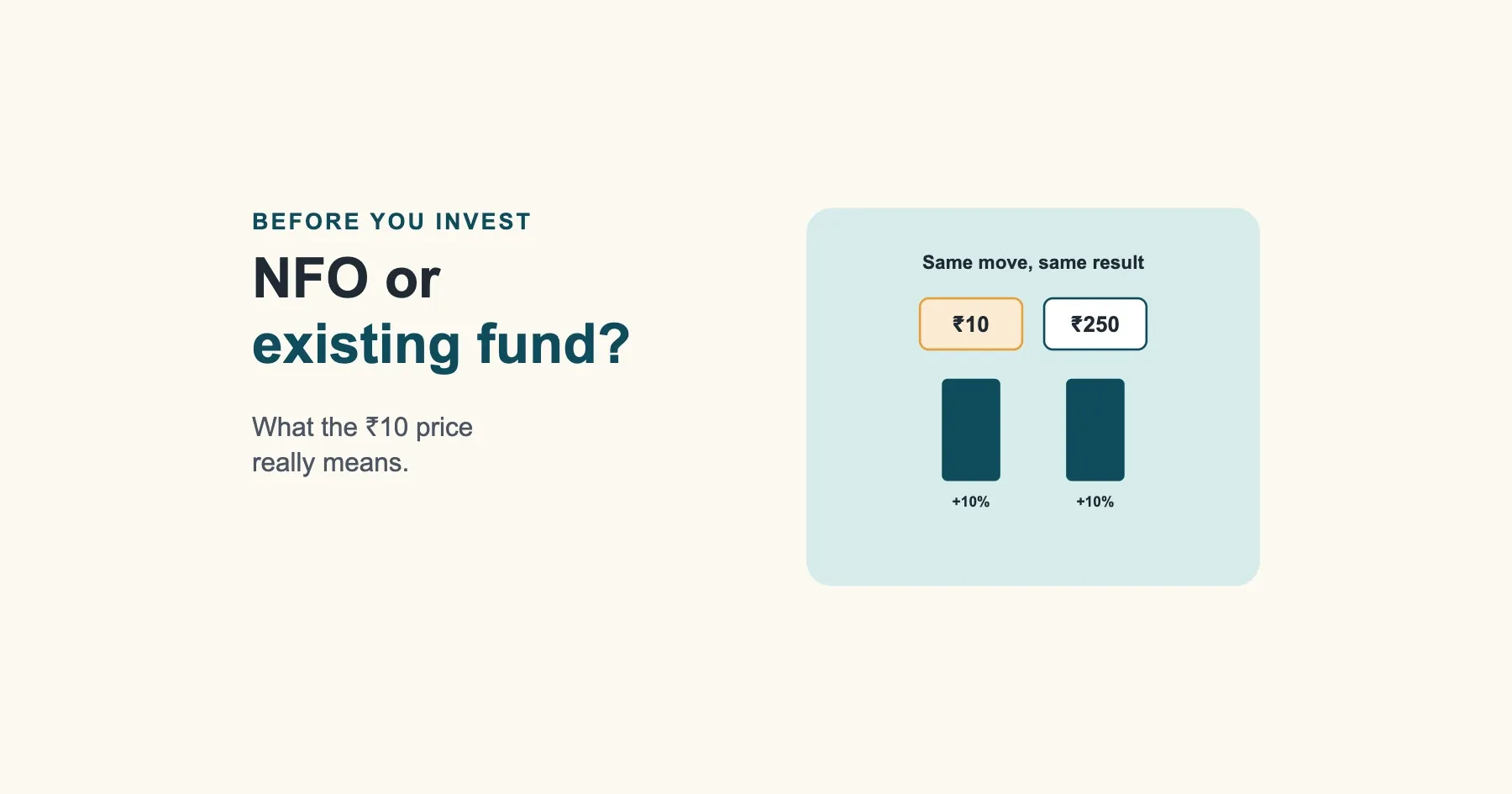
The ₹10 is a starting offer price, not a discount. Your gain or loss depends on the percentage change in NAV, not on how many units you hold.
Hypothetical illustration. Two funds hold identical portfolios, and you put ₹10,000 into each. The 10% moves are assumed for illustration and are not a forecast.
| New fund (NFO) | Existing fund | |
|---|---|---|
| Price per unit when you invest | ₹10 | ₹250 |
| Units for ₹10,000 | 10,000 ÷ 10 = 1,000 | 10,000 ÷ 250 = 40 |
| If both rise 10% | 1,000 × ₹11 = ₹11,000 | 40 × ₹275 = ₹11,000 |
| If both fall 10% | 1,000 × ₹9 = ₹9,000 | 40 × ₹225 = ₹9,000 |
More units did not mean more money, up or down. (The example ignores expenses and transaction costs.) As Value Research noted in September 2026, a low NAV says nothing about future returns. What matters is what the fund owns and how it is managed.
NFO vs existing mutual fund, side by side
| What you're checking | NFO | Existing fund |
|---|---|---|
| What you can see before investing | The strategy on paper, in the Scheme Information Document (SID) | Its track record and portfolio history |
| How it behaved in a market fall | Unknown | Visible in its history |
| Costs | Expense limits in the SID; the actual expense ratio shows only once it runs | Its current expense ratio |
| Price per unit | Irrelevant to returns | Irrelevant to returns |
| Can you invest later? | Open-ended: yes, at NAV. Close-ended: usually only in the NFO | Open-ended: yes, at NAV |
| Lock-in | Close-ended: until maturity. Some categories carry one either way (check the SID) | Same category rules |
| Fit for a first SIP | Harder to judge without history | Easier to judge where years of data exist |
Neither column is "better". One gives you evidence to read; the other asks you to judge a plan.
When an NFO can make sense, and when it usually doesn't
An NFO is worth a look when it is a genuinely new strategy or category you can't already buy. A 2026 example: SEBI's categorisation circular of 26 February 2026 created life cycle funds, open-ended funds with a set target date and a pre-defined glide path. When that category first appeared, an NFO was the only way to buy one. Now that several life cycle funds are running, a new one mostly adds a different target year, so the same checks apply.
It usually doesn't make sense when it copies a category you can already buy. As Value Research put it in a piece last updated in June 2026, new rarely means better, and many NFOs are small variations on existing schemes.
How to tell if an NFO is really new
Look up two things in its SID or Key Information Memorandum (KIM): its SEBI category and its benchmark index. Then check whether funds you can already buy sit in the same category or track the same index. If several do, the NFO is new only in date. Even a new category stops being new once its first funds are running. See SEBI's map of mutual fund categories.
Thematic and sector NFOs: what a first-timer should know
A sector fund invests mainly in one sector, such as pharma; a thematic fund invests across several sectors linked by one theme, such as infrastructure. By design, they concentrate risk. Business Standard's January 2025 review of these NFOs flagged three issues:
- Concentration: many recent thematic launches are narrow, sometimes one or two sectors.
- Timing: themes are cyclical, and investors often arrive after a sector has done well.
- No track record: you can't see how the fund is managed through a fall.
Cyclical themes can fall hard (see how a market fall affects your SIP). For a first SIP, a diversified fund is usually easier to hold. A narrow theme, if you want one at all, is a small satellite to add once you understand it; see thematic and sectoral funds.
At the time of writing (late October 2026), several new single-sector or thematic index funds, and some multi-asset funds of funds, are open for subscription. The questions below apply to all of them.
Is an index-fund NFO lower-risk?
It removes one risk only: judging a fund manager's stock picks. You still carry index risk, and a narrow index stays narrow. A new index fund also has no history yet of tracking difference (how far its return differs from the index's) or tracking error (how much that gap varies).
Rules that protect you as an NFO investor
These are SEBI rules for fund houses, as they stand on 27 October 2026.
- NFO money must be put to work on time. Under SEBI's circular of 27 February 2025 (in effect from 1 April 2025), a fund house must deploy NFO money as per the scheme's asset allocation within 30 business days of allotting units. Its investment committee can extend this by 30 business days, with written reasons. If the money still isn't deployed after 60 business days, the scheme can't take fresh money or charge an exit load to investors who leave, and NFO investors must be told they can exit without one.
- The offer window is fixed and limited. The dates are in the offer documents.
- The riskometer must be shown upfront. It rates each scheme on six levels, from Low to Very High, and AMFI says scheme documents must display it clearly. At NFO stage, the level reflects the fund's intended portfolio, so check it again once the fund is invested.
- The SID and KIM are your source for strategy, benchmark, asset allocation, costs and exit load.
Before you decide: 6 questions to ask about any NFO
The catch (whichever you choose)
- An existing fund's track record is history, not a promise. Past performance may not be repeated.
- Managers and portfolios change. The fund you study today may be run differently in three years.
- NFO money may sit uninvested for a while, up to 30 business days, or 60 with an extension.
- A genuinely new idea can still do well, or badly. Nobody knows in advance.
- Equity funds of either kind can fall, sometimes sharply.
Choose the option you can understand and judge, not the one that feels cheaper or newer.
Can I invest after the NFO closes?
For open-ended schemes, yes: once the scheme reopens for ongoing purchases, usually shortly after the NFO closes, you can invest or start an SIP at NAV. Close-ended schemes usually can't be bought from the fund after the NFO, though they are listed on a stock exchange.
For an open-ended fund, waiting mainly costs you the feeling of urgency, and it lets you see how the new fund is actually run. A close-ended fund is different: the NFO is usually your only chance to buy from the fund house.
Frequently asked questions
Is a fund with ₹10 NAV cheaper than one with ₹250 NAV?
No. At ₹10 you get more units, but each is worth less. In a hypothetical example, ₹10,000 becomes ₹11,000 in either fund if both rise 10%, and ₹9,000 in either if both fall 10%. What you earn depends on what the fund holds and the percentage change in its NAV.
NFO lena chahiye ya purana fund? ₹10 wala sasta hai kya?
₹10 wala fund sasta nahi hota. Aapka return units ki ginti se nahi, balki NAV kitne percent badhta ya girta hai, usse banta hai. Pehli SIP ke liye usi category ka existing fund samajhna aksar aasaan hota hai, kyunki uska track record aur portfolio dikhta hai. NFO tab dekhiye jab woh kuch aisa de jo aap abhi khareed nahi sakte.
How do I tell if an NFO is really new or a copy of a fund I can already buy?
Check its SEBI category and benchmark index in the SID or KIM. Then see whether funds you can already buy sit in the same category or track the same index. If several do, the NFO is new only in its launch date, and an existing fund with years of history may be easier to judge.
If I miss the NFO window, can I still invest later?
Yes, if the scheme is open-ended. Once it reopens for ongoing purchases, usually shortly after the NFO closes, you can invest or start an SIP at NAV. Close-ended schemes usually can't be bought from the fund after the NFO, though their units are listed on a stock exchange.
Is an index-fund NFO less risky, since there's no fund manager to judge?
Not automatically. It removes the risk of a fund manager's stock choices, but it still carries the risk of the index it tracks, and a narrow index stays narrow. A new index fund also has no tracking-difference or tracking-error history yet. Judge it by its index, its costs and its fit for you.
Your next step
Save the "Before you decide" checklist above and run it the next time a new fund appears in your app. Next read: what happens to your SIP when the market falls.
— Laabh



