Are thematic and sectoral funds good for beginners? What SEBI's definition tells you about the risk
SEBI requires sectoral and thematic funds to hold at least 80% in one sector or theme. See what that concentration means before you consider one.
Summarize this article with AI





The short version
- SEBI requires sectoral and thematic funds to hold at least 80% in one sector or theme (circular of 26 February 2026).
- That concentration is the design, so results lean on one part of the economy.
- A thematic fund is wider than a sectoral fund, but both are narrow next to a diversified fund.
- The riskometer shows a scheme's risk level, not its concentration; read both.
- How much exposure you have decides how much a fall in one theme can cost.
As of 19 November 2026, SEBI's rules say a sectoral fund must keep at least 80% of its total assets in one sector, and a thematic fund at least 80% in one theme. That concentration is the design, so its returns lean on one part of the economy. A diversified fund spreads money across sectors; a theme fund doesn't, so its swings can be sharper.
Mutual fund investments are subject to market risks, read all scheme related documents carefully.
So, are thematic and sectoral funds good for beginners? The label alone can't answer that for you. What it can do is tell you how concentrated the fund must be, and that is the part to understand before considering one.
Irfan, 26, in Bhopal, is about to start his first SIP of ₹5,300 a month. His feed is full of a new defence fund and an EV fund, both with short, exciting stories. Before choosing, he wants to know what those labels actually commit the fund to. This page reads the rule with him.
What SEBI's category rule says about sectoral and thematic funds
SEBI's circular "Categorization and Rationalization of Mutual Fund Schemes", dated 26 February 2026, lists Sectoral Fund and Thematic Fund as two separate rows in the equity table (para 2.6.3). In SEBI's words:
- Sectoral Fund: "Minimum investment in equity & equity related instruments of a particular sector - 80% of total assets."
- Thematic Fund: minimum investment in equity and equity related instruments "of a particular theme", also 80% of total assets. A note adds: "A theme may be a combination of two or more sectors."
The same circular adds an overlap rule. Under para 2.6.3.5, no more than 50% of a sectoral or thematic scheme's portfolio may overlap with the fund house's other equity schemes, large cap schemes excepted. Overlap is measured quarterly from daily values (para 2.6.3.6). Existing schemes get 3 years to comply, and schemes that still can't meet the limit must be merged (para 2.6.3.7).
Our reading: the overlap rule pushes a theme fund to actually be different from the same fund house's broader funds. That is good for honesty of labels. It also means the theme fund is meant to behave differently, in both directions.
For the full map of categories, see SEBI's map of mutual fund categories.
Sectoral vs thematic fund: one sector or one idea
The difference is width. SEBI's investor FAQ puts it simply: a sectoral fund "invests in stocks belonging to specific sector of the economy", while thematic funds "invest in stocks across a specific theme".
- A sectoral fund stays inside one sector, such as banking or pharma.
- A thematic fund follows an idea that can cut across sectors. An "EV" theme might touch auto makers, battery makers, power and metals. A "consumption" theme might span retail, FMCG and autos.
A theme is wider than a sector, but both are narrow next to a diversified equity fund. Both are equity schemes, so both carry equity risk on top of their concentration.
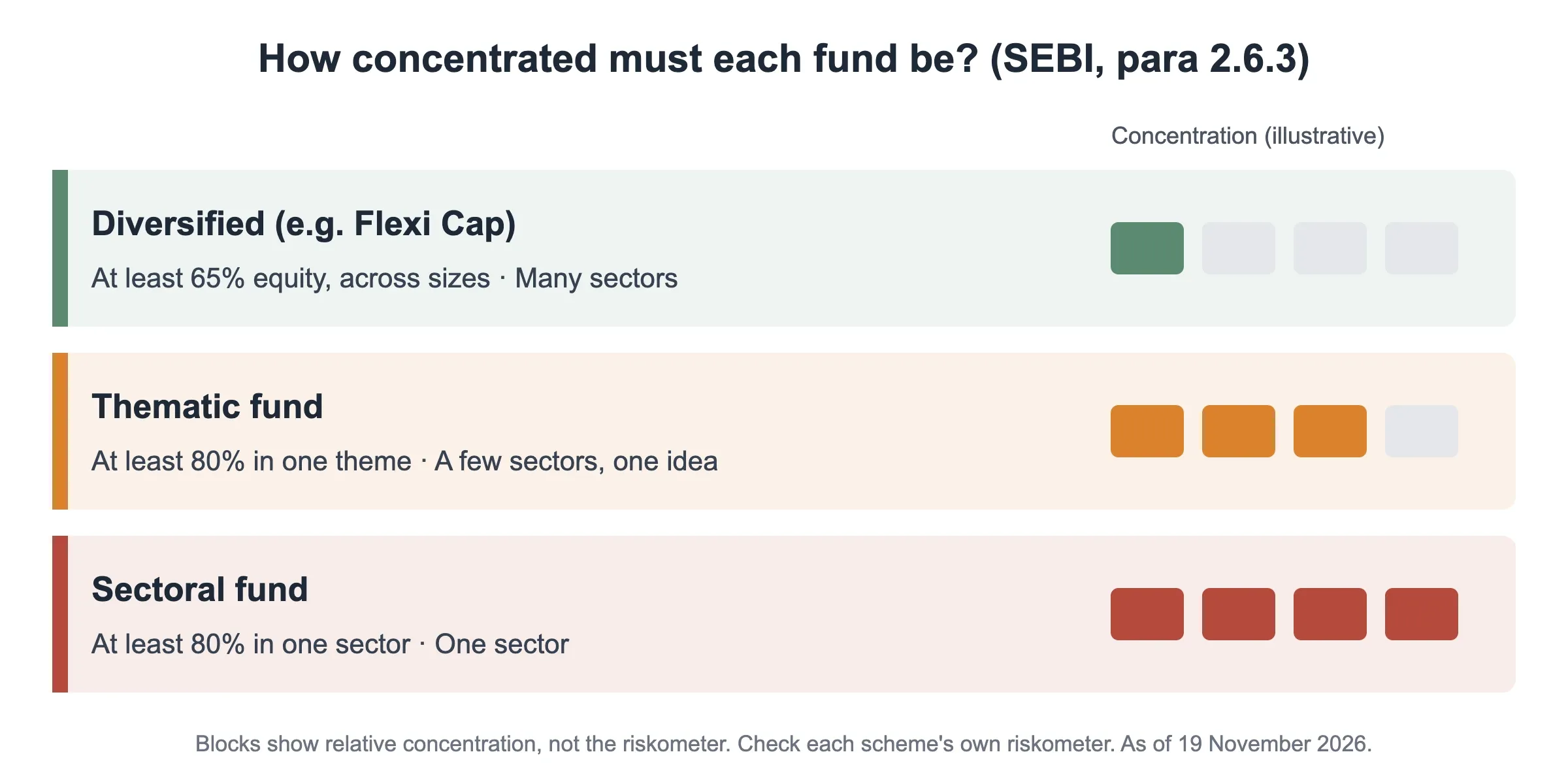
| Diversified equity (e.g. Flexi Cap) | Sectoral fund | Thematic fund | |
|---|---|---|---|
| What it must mainly hold | At least 65% in equity, across company sizes | At least 80% in one sector | At least 80% in one theme (can span sectors) |
| How many parts of the economy | Many | One | A few, linked by one idea |
| Concentration | Lower | Highest | High |
| Where to read its risk | The scheme's riskometer | The scheme's riskometer | The scheme's riskometer |
Are thematic funds risky? Concentration, shown simply
Concentration means one story drives most of the result. When a sector is in favour, a theme fund can run ahead of a diversified fund. When it falls out of favour, there is little else in the portfolio to cushion it, and a sector can lag for long stretches.
At Irfan's ₹5,300 a month for a year, he would put in ₹63,600. In a sectoral fund, at least ₹50,880 of that (80%) would sit in one sector, leaving at most ₹12,720 for anything else the scheme's rules allow.
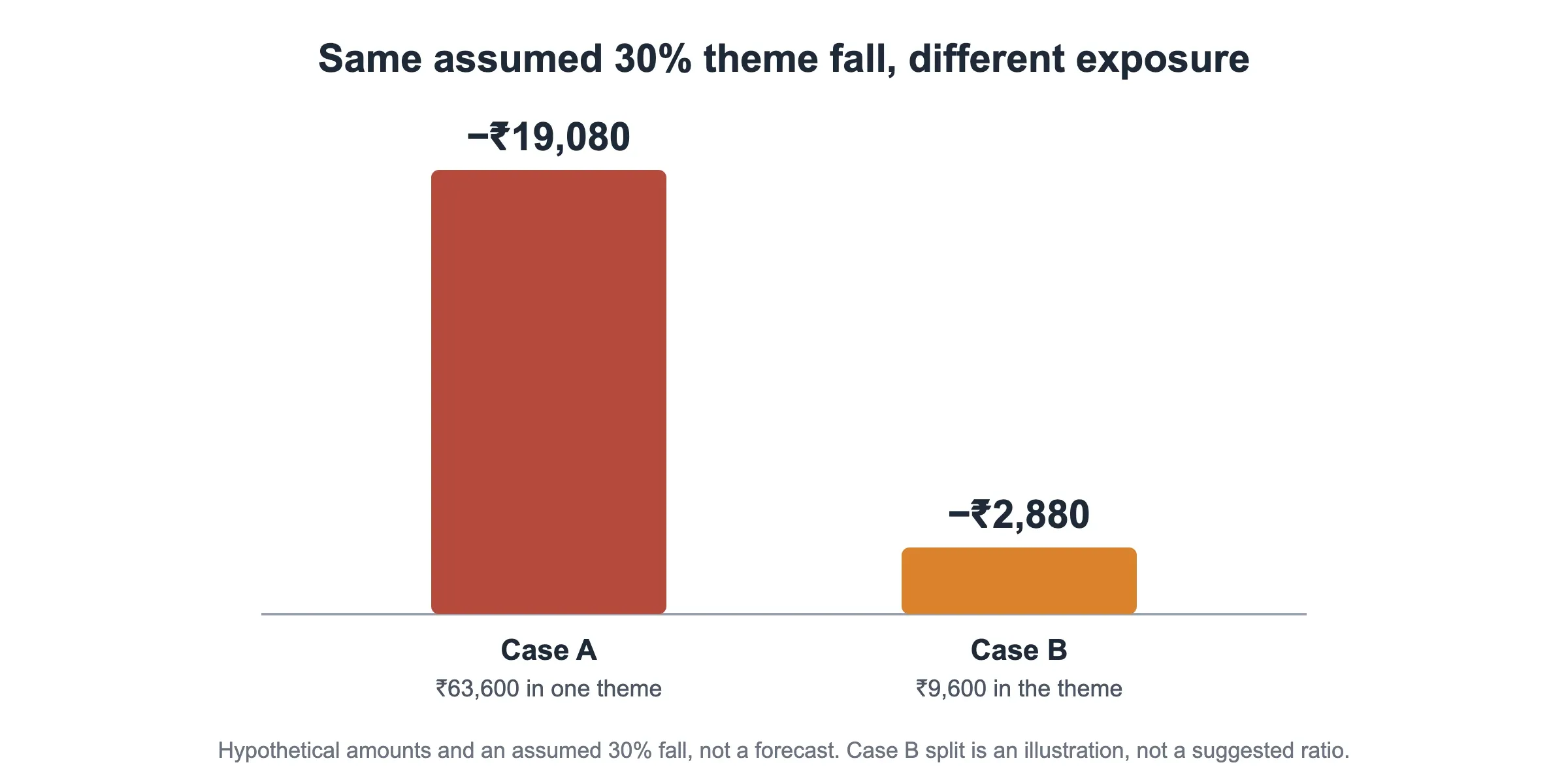
Worked example (hypothetical amounts and an assumed fall, not a forecast). Compare two ways of putting the same ₹5,300 a month for 12 months, ₹63,600 in all. Assume, for illustration only, that the theme holding falls 30%, and ignore timing and any movement in the other fund.
| Case A | Case B | |
|---|---|---|
| Monthly split | ₹5,300 in one theme fund | ₹4,500 diversified + ₹800 theme |
| Money in the theme after 12 months | ₹63,600 | ₹9,600 |
| Theme holding after an assumed 30% fall | ₹44,520 | ₹6,720 |
| Rupee fall | ₹19,080 | ₹2,880 |
Case B's split is an illustration, not a suggested ratio. The point is the size of exposure: the same assumed fall costs ₹19,080 in Case A and ₹2,880 in Case B, because Case A has more money in the one theme. Real outcomes depend on timing, the actual fund and the market; the diversified part can also fall.
Why thematic NFOs often follow rallies
New fund offers (NFOs) for a theme often appear after that theme has had a strong run and is in the news. Demand is easiest to find when a story is already popular. That timing can feed recency bias: assuming the last year's trend will carry on.
Two things help. First, a new fund has no track record of its own, so you can't see how it handled a bad patch. Second, an NFO's ₹10 price isn't "cheap"; it is just a starting NAV.
The riskometer: read it, don't skip it
Every scheme carries a riskometer. SEBI's investor site lists six levels: Low, Low to Moderate, Moderate, Moderately High, High and Very High. It describes Very High as "highly volatile and risky investments". Fund houses must show it on their schemes, fact sheets and promotional material, and the level is reviewed and can change.
Read the label on the specific scheme, not on the category. Then remember what it doesn't show: concentration. Two funds can share a level while one depends on a single sector. Our guide to what the riskometer levels mean explains each level.
Core and satellite: where a theme can fit, if at all
Some investors think of a portfolio as a core and satellites. The core is diversified and meant to be held for the goal. A satellite is a smaller, narrower holding, such as a sector or theme, kept small enough that a bad stretch doesn't derail the goal.
This is a way of thinking, not a rule, and there is no correct share for a satellite. The trade-off is direct: the larger the theme holding, the more your total result depends on that one theme, for better or worse. If a theme fund overlaps with what your core already owns, you may be adding less variety than you think.
If you haven't yet chosen a core, start with which type of mutual fund a beginner should start with or comparing two index funds.
Before you consider one: a 4-question checklist
- Horizon. Could you leave this money alone through several years of the theme lagging?
- Overlap. Does the fund's portfolio repeat what you already own? Check its holdings against your current funds.
- Patience. If the theme fell 30% while the wider market rose, would you stay or exit at the worst moment?
- Understanding. Can you explain, in two lines, what drives this sector or theme, and what could hurt it?
If any answer is unclear, that is the part to work on first. Read the scheme information document (SID) and key information memorandum (KIM); SEBI's FAQ advises investors to "carefully read all the scheme related documents before investing".
Frequently asked questions
Are thematic funds risky for someone just starting SIPs?
They are equity funds that must hold at least 80% in one theme, so they can swing more than a fund spread across sectors. An SIP spreads your buying over time, but it doesn't remove that concentration. Check the scheme's riskometer and ask whether you could hold through a long lag.
What's the difference between a sectoral fund and a thematic fund?
A sectoral fund holds at least 80% in one sector, such as banking. A thematic fund holds at least 80% in one theme, which SEBI says may combine two or more sectors. Both are concentrated equity funds.
What should I check before making a defence or EV theme fund my first fund?
Use the four checks: horizon, overlap, patience and understanding. Also check whether you already have a diversified core. See which type of mutual fund a beginner should start with.
Why do so many thematic NFOs launch right after a sector has rallied?
A theme in the news is easier to explain and market. That timing can feed recency bias, the habit of expecting a recent trend to continue. A new fund also has no record of how it handles a bad patch.
How much of my portfolio can go into thematic funds?
There is no single right share, and this page doesn't suggest one. The trade-off is that a bigger theme holding makes your total result depend more on that theme. The worked example shows how the same fall costs more as exposure rises.
Read next
Next, read how SEBI's full category map fits together in SEBI's map of mutual fund categories.
— Laabh



