PPF or SIP? Why the better question is what each rupee is for
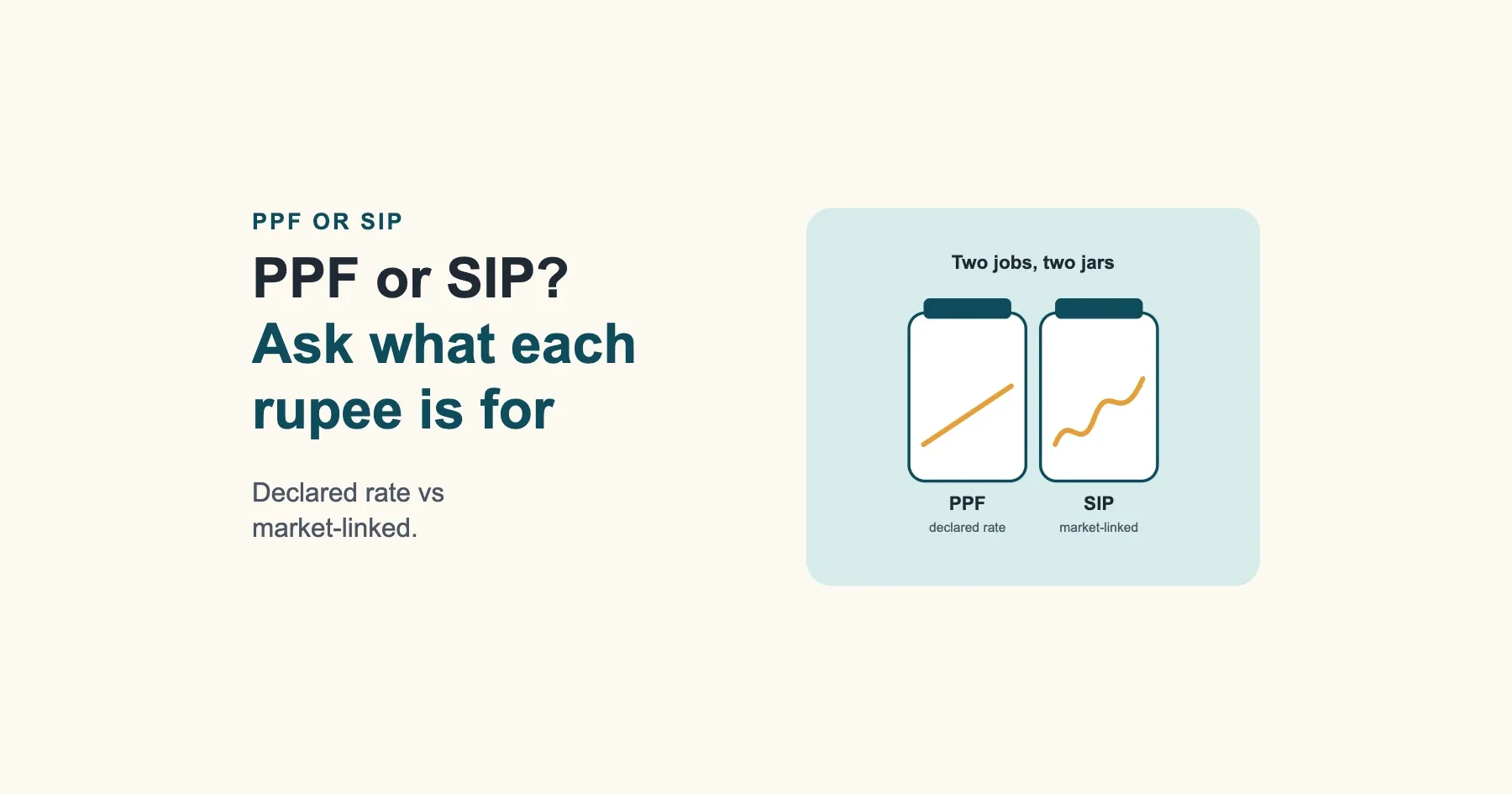
PPF pays a declared rate (7.1% as of 12 Nov 2026) with a 15-year term; an SIP is market-linked. See how they differ and why many use both.
Summarize this article with AI





The short version
- PPF pays a government-declared rate (7.1% a year, compounded yearly, per India Post as of the date above), reviewed quarterly.
- An SIP's value moves with markets; it can grow faster or end below what you invested.
- PPF has a 15-year term, with partial withdrawals and loans only under the scheme's rules; open-ended mutual fund units can generally be redeemed.
- PPF's 80C deduction is an old-regime benefit; mutual fund gains are taxed as capital gains.
- Many people use both, each for a different goal.
PPF vs SIP is usually framed as a contest. It's closer to choosing between two different tools.
The Public Provident Fund (PPF) is a government small-savings scheme that pays a declared interest rate: 7.1% a year, compounded yearly, as shown on India Post's page (updated 30 Oct 2026) on 12 Nov 2026. Rates are reviewed quarterly, so check the current rate. An SIP (Systematic Investment Plan) is a way to invest a fixed amount regularly in a mutual fund scheme, so its value moves with markets and no return is assured. Neither is better in general; they differ in certainty, access to your money and growth potential.
If your parents say PPF and your colleagues say SIP, both camps are describing something real. This guide quotes the official rules so you can match each to a job.
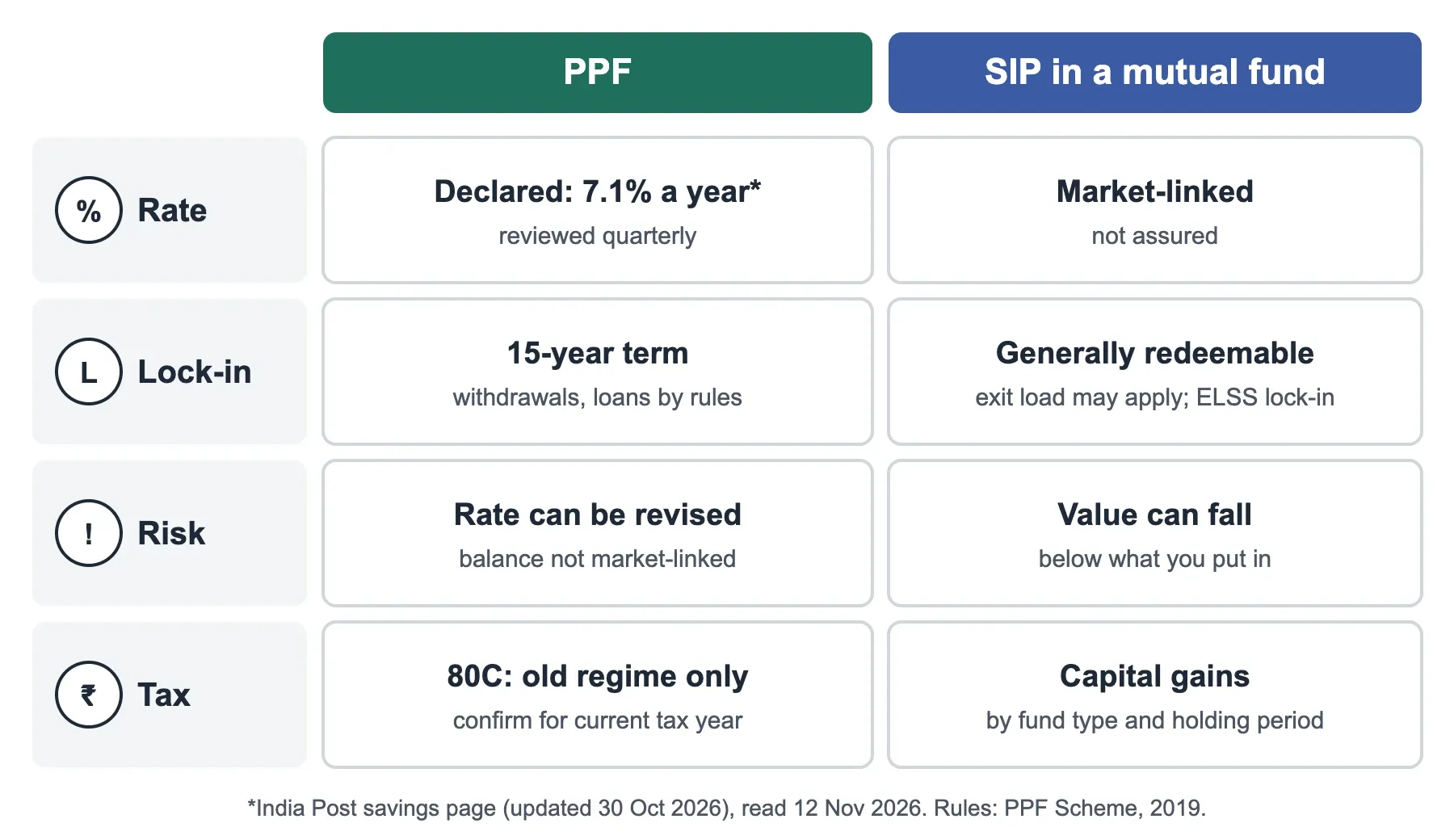
PPF vs SIP at a glance
| PPF | SIP in a mutual fund | |
|---|---|---|
| What it is | A government small-savings scheme (PPF Scheme, 2019) | A way to invest regularly in a mutual fund scheme |
| Return | Declared rate: 7.1% a year, compounded yearly (India Post, see date above); reviewed quarterly | Market-linked; not assured |
| Can the value fall? | Interest rate is set by the government and can be revised | Yes; the value can fall below what you put in |
| Yearly deposit | ₹500 to ₹1,50,000, in multiples of ₹50 (PPF Scheme, 2019) | Set by each scheme; check its documents |
| Lock-in and access | 15-year term; partial withdrawals and loans under set rules | Open-ended schemes can generally be redeemed; exit load may apply; ELSS has a lock-in |
| Tax | Section 80C deduction (old tax regime only, per the Income Tax Department) and Section 10(11) exemption; details below | Gains taxed as capital gains, depending on fund type and holding period |
| Where you open it | Post office; some banks also offer it (confirm on India Post) | Fund house or a mutual fund platform |
How the PPF rate works, and why 7.1% isn't a 15-year promise
India Post's savings schemes page shows "Rate of Interest: 7.1% per annum" for PPF, "(compounded yearly)". The page was last updated on 30 October 2026 and does not state which quarter the rate applies to.
The government reviews small-savings rates every quarter. Business Today reported on 30 September 2026 that rates were unchanged for October to December 2026. That is a media report; we could not locate the government notification itself.
The practical point: the PPF rate can be revised each quarter. Anyone who calculates 15 years of PPF at 7.1% is assuming the rate never changes, which nobody can promise. What stays steady is the structure: your balance earns whatever rate is declared, and it doesn't fall with markets.
How an SIP's value moves
An SIP buys units of a mutual fund scheme at that day's NAV. Your holding is worth the units you own multiplied by the current NAV, so it rises and falls with the scheme's investments. An SIP can end below what you put in, especially over short periods. Our guide to what an SIP is covers the basics.
That movement is the trade-off for growth potential. If you want to see how an SIP behaves in a falling market, read what happens to your SIP when markets fall.
Lock-in and access: when can you get the money?
This is where the two differ most. The PPF rules below are quoted from the Public Provident Fund Scheme, 2019 notification (G.S.R. 915(E), 12 December 2019), as hosted by India Post. Rules can be amended, so confirm on India Post before you act on them.
PPF term. The account can be closed "Any time after the expiry of fifteen years from the end of the year in which the account was opened". You can also extend it "for a further block period of five years".
Partial withdrawal. Allowed "Any time after the expiry of five years from the end of the year in which the account was opened", up to "fifty per cent. of the amount that stood to his credit at the end of the fourth year", and "only once in a year".
Loan. Possible "after the expiry of one year from the end of the year in which the initial subscription was made", up to "twenty-five per cent. of the amount that stood to his credit at the end of the second year". There is "only one loan in a year".
Premature closure. Only on specific grounds, such as "treatment of life threatening disease", "higher education" or a change in residency status, and not before five years. If you close early, interest is allowed "at a rate which shall be lower by one per cent."
SIP side. Units of open-ended schemes can generally be redeemed on any business day, but an exit load may apply if you redeem within a period set by the scheme. ELSS schemes carry a lock-in. Redeeming during a market fall means selling at a lower NAV. More in withdrawing your SIP money.
Tax: how each is treated
As shown on the Income Tax Department's benefits page for individuals (assessment year 2026-27, read 12 November 2026):
- Deduction: "Contribution to Public Provident Fund Account" is listed under Section 80C, "Up to 1,50,000 (Subject to overall limit of Rs. 1,50,000 under Section 80C, 80CCC and 80CCD(1))".
- Exemption: "Payment from Public Provident Fund or Statutory Provident Fund" is listed under Section 10(11) as "Exempt Subject to certain conditions".
Old regime only. The Department's page on section 115BAC (the new tax regime) says income under that regime is computed without deductions "under any of the provisions of Chapter VI-A other than the provisions of sub-section (2) of section 80CCD" (or section 80JJAA). Section 80C sits in Chapter VI-A, so on that text the PPF deduction is available only if you file under the old regime.
That page shows no revision date and tax law can change, so confirm this for the current tax year before counting on the deduction.
On the mutual fund side, gains are taxed as capital gains, depending on the fund type and how long you held the units.
Tax rules change; consult a tax professional for your situation.
The same ₹5,000 a month, two ways
Here is one way to see the difference in numbers. It is a hypothetical illustration, not a forecast.
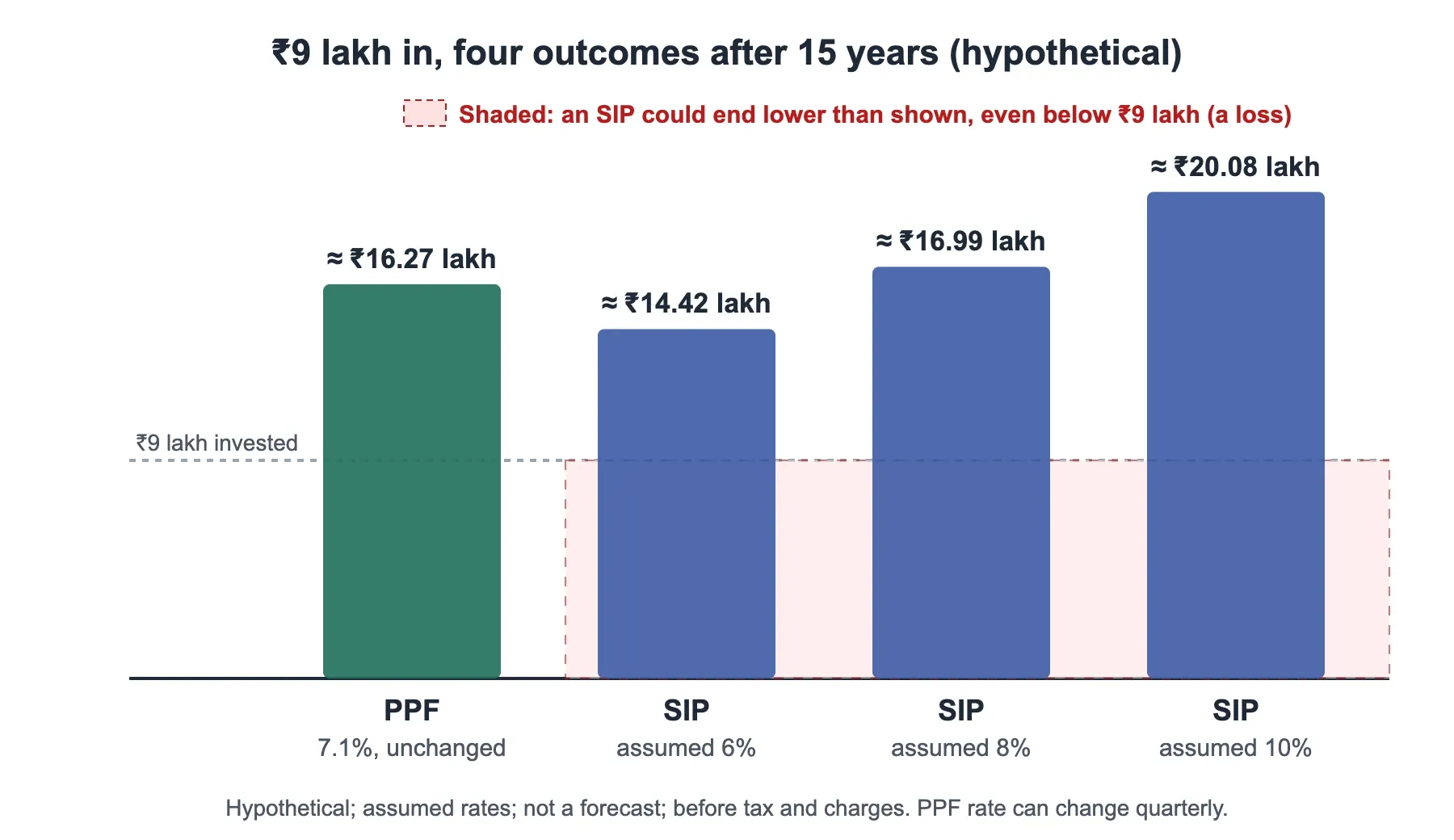
- PPF: ₹60,000 deposited at the start of each year for 15 years. If the rate stayed at 7.1% throughout, which is not assured, the balance would be about ₹16.27 lakh.
- SIP: ₹5,000 at the start of each month for 15 years, at assumed annual rates of 6%, 8% and 10%. The values would be about ₹14.42 lakh, ₹16.99 lakh and ₹20.08 lakh.
- Invested in each case: ₹9 lakh.
| Scenario (hypothetical) | Rate used | Value after 15 years |
|---|---|---|
| PPF, rate unchanged | 7.1% (not assured) | ≈ ₹16.27 lakh |
| SIP | assumed 6% | ≈ ₹14.42 lakh |
| SIP | assumed 8% | ≈ ₹16.99 lakh |
| SIP | assumed 10% | ≈ ₹20.08 lakh |
Notice the 6% case: the SIP ends below the PPF figure. Actual SIP results can be lower than any of these, including a loss. And the PPF figure itself depends on a rate that can change every quarter.
Hypothetical; assumed rates; not a forecast; before tax and charges. PPF deposit timing simplified; actual interest crediting rules apply. The SIP uses the monthly equivalent of each annual rate.
Can you do both? Matching each to a job
Yes. Nothing stops you from holding a PPF account and running an SIP at the same time, and many people do. The more useful question is which job each rupee is meant to do:
- A long horizon where you'd rather the balance didn't move with markets. A declared-rate scheme with a long lock-in fits this kind of goal, provided you won't need the money before the withdrawal rules allow it.
- A long horizon where you can sit through ups and downs. An SIP in a suitable scheme gives market-linked growth potential, with the risk that comes with it.
- Money you'll need in one to three years. Neither fits well. PPF locks it up; an SIP can be down when you need it. That money belongs in an emergency fund. See how much emergency fund to keep.
How much goes to each depends on your goals, income and comfort with risk, so we don't suggest a split. If you're also weighing fixed deposits and recurring deposits, see SIP vs FD vs RD.
Frequently asked questions
PPF vs SIP: which is better for a salaried beginner?
Neither is better in general. PPF suits money you want at a declared, government-set rate and can lock away for long; an SIP suits long-term money that can ride market ups and downs. The answer depends on the job you give each rupee.
What is the PPF interest rate right now, and how often does it change?
India Post's page showed 7.1% a year, compounded yearly, on 12 November 2026 (page updated 30 October 2026). The government reviews small-savings rates quarterly, so check the current rate before you invest.
Is PPF safer than an SIP?
They carry different risks. A PPF balance doesn't move with markets, but its interest rate can be revised and your money is locked in for years. An SIP's value can fall, including below what you invested, in exchange for growth potential.
Can I invest in both PPF and an SIP at the same time?
Yes. There is no rule against holding both, and many people use PPF and SIPs for different goals.
How does PPF's lock-in compare with an SIP's liquidity?
PPF has a 15-year term, with partial withdrawals allowed after five years from the end of the opening year, and loans under set rules, per the PPF Scheme, 2019. Open-ended mutual fund units can generally be redeemed any business day, though an exit load may apply and ELSS has a lock-in.
How are PPF and mutual fund SIPs taxed?
The Income Tax Department lists PPF contributions under Section 80C and PPF payments as exempt under Section 10(11), subject to conditions, for assessment year 2026-27. Its section 115BAC page excludes Chapter VI-A deductions, which include Section 80C, under the new tax regime, so the PPF deduction applies only under the old regime. Mutual fund gains are taxed as capital gains by fund type and holding period. Confirm the rules for the current tax year.
A two-column exercise
Write two columns, "money I want kept out of market swings" and "money that can ride ups and downs", and put each goal in one. The tool usually follows from the column.
— Laabh



