Is ELSS worth it in the new tax regime? Decide your regime first, then the lock-in
In the new tax regime ELSS gives no 80C-type deduction, so it is an equity fund with a 3-year lock-in per instalment. Decide your regime, then the lock-in.
Summarize this article with AI





The short version
- Pick your regime first. In the new regime, ELSS gives no Section 123 (old 80C) deduction.
- Without the deduction, ELSS is an equity fund with a three-year lock-in, so the real question is whether you want that lock-in.
- Each SIP instalment has its own three-year lock-in.
- In the old regime, the hypothetical ₹36,000 example lowers tax by ₹7,488 at a 20% slab plus cess; in the new regime, by ₹0.
- Stopping an ELSS SIP does not unlock units you already hold.
Short answer: In the new tax regime, ELSS gives you no 80C-type deduction (as of FY 2026-27, under the Income-tax Act, 2025). ELSS then works like any equity fund with a three-year lock-in on each instalment. Some investors may still choose it for the enforced holding period. In the old regime, the deduction still applies.
Mutual fund investments are subject to market risks, read all scheme related documents carefully. Tax lines in this article are as of 17 November 2026, for FY 2026-27 under the Income-tax Act, 2025. Tax rules change; consult a tax professional for your situation.
Shreya, 25, in Belagavi, started a ₹3,000 monthly ELSS SIP in April 2026. In July her payroll team asked her to pick a regime, and the new one came out cheaper. So is ELSS worth it under the new tax regime? Answer the regime question first. Then decide whether you want the lock-in.
I've chosen the new tax regime: is there any point investing in ELSS now?
Under the Income-tax Act, 2025, which applies from 1 April 2026, the new regime sits in Section 202 and the old Section 80C deductions sit in Section 123. Section 123 covers PF, life insurance premiums, ELSS and PPF, and these deductions are not allowed under the new regime. The Income Tax Department's help page lists Section 80C among deductions for taxpayers "opting for the Old Tax Regime".
With the deduction gone, ELSS is an equity mutual fund that locks your money in for three years. So: do you want the lock-in?
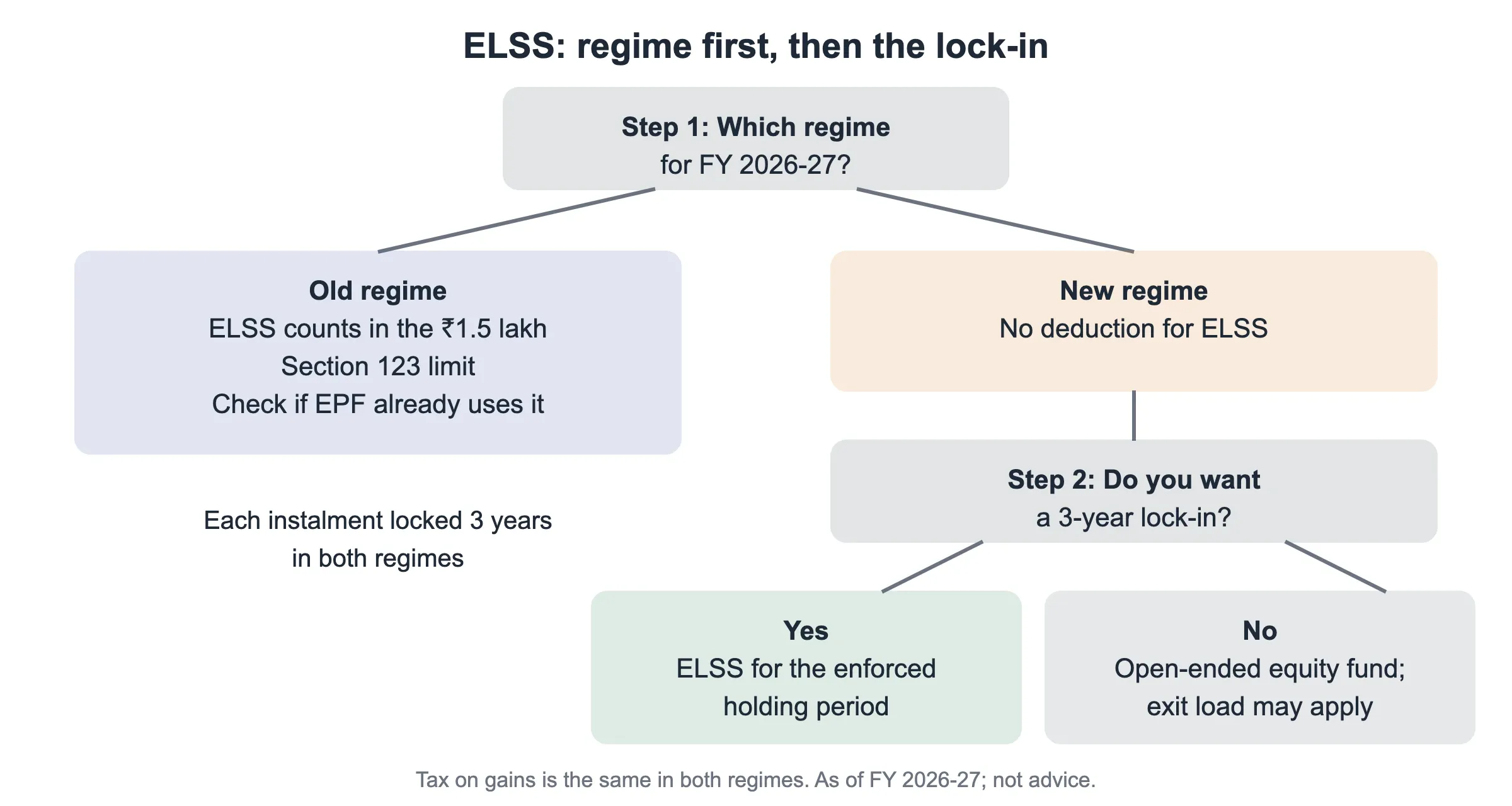
Some investors still choose ELSS for the enforced holding period: if you might redeem in a panic when markets fall, a three-year rule can act as a commitment device. Others want the freedom to redeem, which an open-ended equity fund without a lock-in gives, though an exit load may apply (check the scheme documents).
Questions to ask yourself:
- Do I want to be unable to touch this money for three years? If yes, the lock-in is a feature. If no, it is a cost.
- Could I need this money within three years? Locked units cannot be redeemed for it.
Can I keep my ELSS SIP running without the 80C deduction?
Yes. Your regime choice is made in your tax return or declared to your employer; it does not touch your SIP mandate. Units keep being allotted each month. In the new regime, those instalments simply do not reduce your taxable income.
Tax on the way out does not depend on the regime. Because every ELSS unit is held for at least three years, its gains are long-term equity gains (rate in the FAQ below).
In an ELSS SIP, does every instalment have its own 3-year lock-in?
Yes. The three-year lock-in runs from the date each unit is allotted, not from the date your SIP started. A 12-month SIP therefore creates 12 separate unlock dates.
A worked example in ₹ (hypothetical)
Take Shreya's SIP: ₹3,000 a month from April 2026 to March 2027, a total of ₹36,000. This is a hypothetical example. No return is assumed, so it is not a promise; returns vary.
| Instalment | Amount | Units can be redeemed from |
|---|---|---|
| April 2026 | ₹3,000 | April 2029 |
| September 2026 | ₹3,000 | September 2029 |
| March 2027 | ₹3,000 | March 2030 |
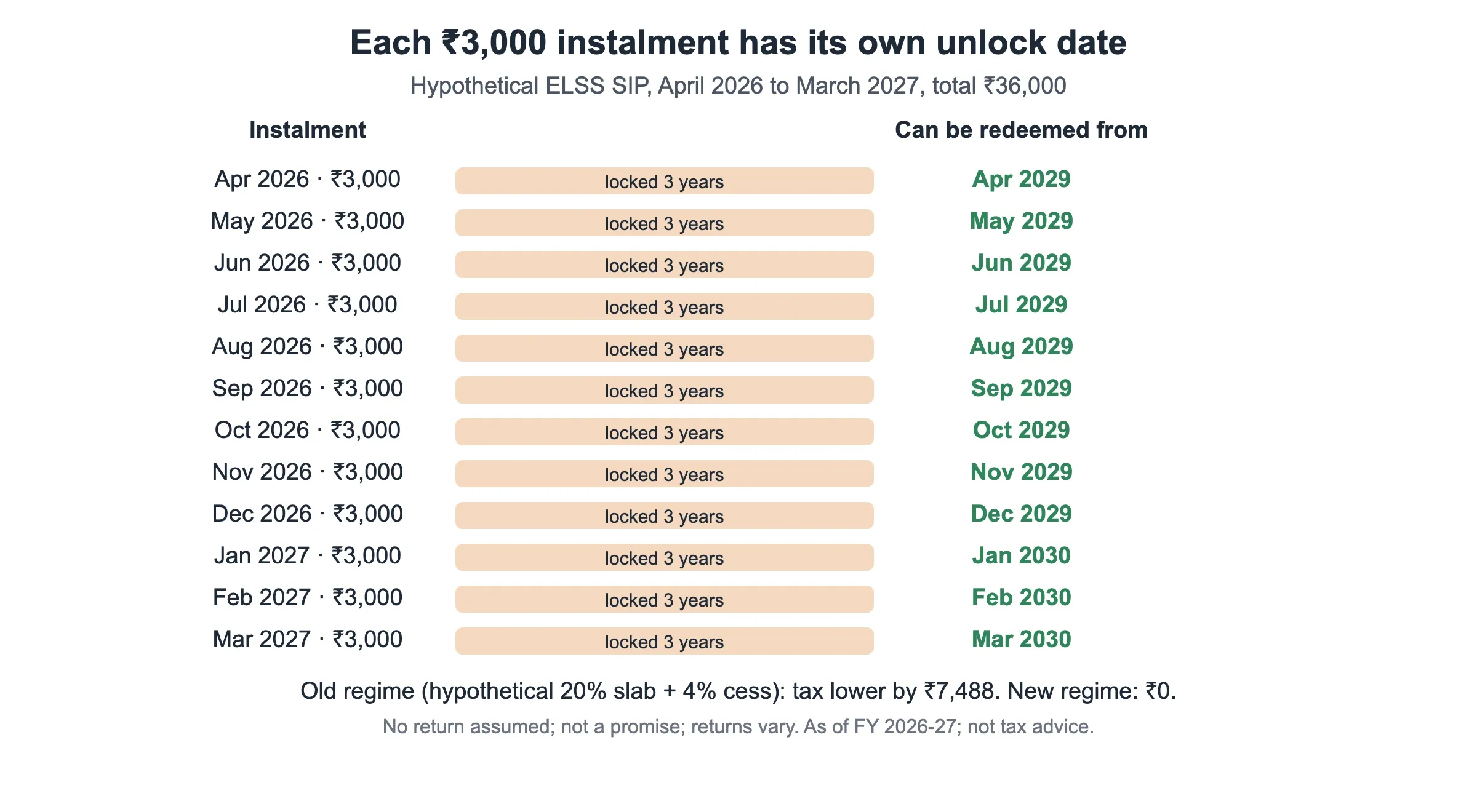
If Shreya wanted all her units in April 2029, only the April 2026 instalment would be free; the last stays locked until March 2030. This is the detail many people miss when they think of an ELSS SIP as a "three-year product". Our guide to withdrawing SIP money covers lock-in and exit load across fund types.
Now the tax side of the same ₹36,000, at a hypothetical 20% slab rate plus 4% cess:
- Old regime: a deduction of ₹36,000 lowers tax by ₹7,200, plus ₹288 of cess on that amount, so ₹7,488 in total. This holds only if EPF and other items have not already used the ₹1.5 lakh Section 123 limit.
- New regime: the deduction is ₹0. The units are still locked on the same dates.
This is hypothetical and not tax advice; tax figures are as of FY 2026-27, under the Income-tax Act, 2025.
ELSS vs PPF: how do they compare if I stay in the old regime?
If you stay in the old regime, both ELSS and PPF count towards the same ₹1.5 lakh limit. They differ on almost everything else.
| ELSS | PPF | |
|---|---|---|
| What it is | Equity mutual fund | Government-backed small savings scheme |
| Lock-in | 3 years per instalment | 15-year account; partial withdrawals allowed in limited cases after some years |
| Returns | Market-linked; can fall | Interest rate set by the government each quarter; 7.1% a year for October to December 2026 |
| Tax on the way out | Long-term gains above ₹1.25 lakh a year taxed (at 12.5%) | Interest and maturity tax-exempt |
| Deduction in old regime | Yes, within ₹1.5 lakh | Yes, within ₹1.5 lakh |
| Deduction in new regime | No | No |
PPF is a long commitment at a government-set rate; ELSS is a shorter lock-in on a market-linked investment that can fall as well as rise. For that trade-off, see PPF or SIP?.
Should I stop my ELSS SIP after moving to the new regime, or switch?
This is your decision. Here is how each option works.
- Continue: new instalments keep buying units, each with its own three-year lock-in. There is no deduction in the new regime.
- Stop: future debits end. Units already allotted stay invested and stay locked until their own unlock dates. Stopping does not trigger tax or exit load by itself.
- Switch: you cannot move locked units. Once a unit's lock-in ends, moving it to another scheme counts as a redemption, so capital gains tax may apply (see switching from regular to direct for how switches of ELSS units work). A future SIP can go into any fund category you choose.
A practical check: if you might return to the old regime next year, the Section 123 limit may matter again. If not, the comparison with a non-locked equity fund comes down to the lock-in.
Frequently asked questions
Can I switch between the old and new tax regime every year?
If you have no business or professional income, the Income Tax Department's guidance says the choice can be made every year directly in your return. People with business income follow a different, more limited route through a separate form. This is the position as of 17 November 2026.
Is ELSS taxed when I redeem?
Yes. ELSS is an equity-oriented fund, so gains on redemption are long-term capital gains because every unit is held for at least three years. As of FY 2026-27, such gains are taxed at 12.5% on the amount above ₹1.25 lakh a year. This applies in both regimes.
Can I redeem ELSS units before three years?
Generally, no. Each unit is locked for three years from the date it was allotted, and you can redeem it only after that date. Stopping the SIP does not shorten the lock-in on units you already hold.
Does the ₹12 lakh rebate change the ELSS question?
It changes the regime question, which comes first. In the new regime, a rebate of up to ₹60,000 can make taxable income up to ₹12 lakh nil-tax (as of FY 2026-27). The rebate is not linked to ELSS. If the new regime leaves you with lower tax, ELSS adds no deduction on top.
Does my EPF contribution count towards the same ₹1.5 lakh limit?
In the old regime, employee PF contributions, PPF, life insurance premiums and ELSS share one combined deduction limit of ₹1.5 lakh. Check how much of it your EPF already uses before deciding whether an ELSS deduction would add anything.
Read next: pick your regime first
The ELSS question only makes sense once you know your regime. Start with old vs new tax regime for salaried employees, then read how mutual funds are taxed in India in 2026.
— Laabh



