How to Buy Government Bonds Through RBI Retail Direct: Steps, What You Can Buy, and the Interest-Rate Risk to Understand
How to buy government bonds through RBI Retail Direct: free account, what you can buy, bidding, selling early and interest-rate risk.
Summarize this article with AI





The short version
- RBI's FAQ says an RDG account is opened and maintained free of cost; payment gateway charges apply when you fund purchases.
- Through Retail Direct you can buy T-bills, dated G-secs and SDLs (minimum ₹10,000), and SGBs only when RBI opens a window.
- Retail investors bid only in the non-competitive segment and get the weighted average price of successful competitive bids.
- Government backing makes default risk very low; it does not protect the price if yields rise and you sell before maturity.
- RBI's June 2026 Master Direction on secondary market G-sec trading is still a draft; treat its proposals as draft until final rules are issued.
As of 25 November 2026, you can buy government bonds directly from the Reserve Bank of India by opening a free Retail Direct Gilt (RDG) account under the RBI Retail Direct scheme, then bidding in the non-competitive segment of primary auctions or buying on the secondary market. The government backing makes the risk of not being repaid very low. It does not protect you from price falls if interest rates rise and you sell before maturity.
What RBI Retail Direct is
RBI Retail Direct lets individuals hold government securities (G-secs) in an account kept with RBI itself. A government FAQ dated 16 November 2021 describes it as a way to open an RDG account and buy and sell G-secs in both the primary and secondary markets through an online portal.
Per RBI's Retail Direct FAQ (page updated 21 November 2026):
- Who can open: resident individuals, and non-resident retail investors eligible to invest in government securities under the Foreign Exchange Management Act, 1999. One person can hold only one RDG account, singly or jointly with another eligible investor.
- What you need: a rupee savings bank account in India, PAN, an officially valid document for KYC, an email address and a registered mobile number.
- Cost: "RDG Account can be opened and maintained with RBI free of cost." RBI charges no fee for submitting a bid, but payment gateway charges apply when you fund a purchase.
- Nomination: mandatory, with up to two nominees.
What you can buy
RBI's FAQ lists four eligible types.
| Security | Issued by | Typical maturity | How you earn | Usual auction day (RBI FAQ) |
|---|---|---|---|---|
| Treasury bill (T-bill) | Government of India | Under one year (91, 182 or 364 days) | Bought at a discount, repaid at face value; no coupon | Wednesday |
| Dated G-sec | Government of India | Longer term, often many years | Fixed coupon, usually paid every six months, face value at maturity | Friday |
| State development loan (SDL) | A state government | Longer term | Coupon, usually half-yearly, face value at maturity | Tuesday |
| Sovereign Gold Bond (SGB) | Government of India, issued by RBI | Set per tranche | Linked to gold price; only when RBI opens a window | Announced window |
RBI's FAQ sets a minimum of ₹10,000 for T-bills, dated G-secs and SDLs (figures stated as on 12 November 2021), and caps a single investor at ₹2 crore face value per dated G-sec per auction.
Opening the account, step by step
- Go to the Retail Direct portal linked from RBI's website and choose to register.
- Enter your PAN, email address and mobile number. RBI's FAQ lists an Aadhaar number with a linked mobile number as mandatory; OTPs go to that mobile.
- Complete KYC with an officially valid document and upload a scan of your signature.
- Link your rupee savings bank account in India. This account pays for purchases and receives interest and maturity amounts.
- Add at least one nominee (up to two). For a joint account, both holders complete KYC with their own PAN, email and phone.
- Once active, your RDG account appears in the portal. RBI's FAQ notes that demat holdings with NSDL or CDSL are separate from RDG holdings.
Buying in an auction: non-competitive bidding explained
In auctions, institutions place competitive bids naming a yield or price. Retail Direct investors bid only in the non-competitive segment: you state how much, not the price. Per RBI's FAQ:
- You place one final bid per security per auction for T-bills, dated G-secs and SDLs.
- You pay through a payment gateway using UPI (transfer or block) or net banking.
- If allotted, you get the security at the weighted average price of the successful competitive bids. You accept the market's price rather than setting your own.
- Any excess amount is "refunded to your linked bank account within two business days from the date of auction."
You do not name a yield, and you learn your price only after the auction.
Selling before maturity: the secondary market (NDS-OM) and liquidity
You can hold to maturity or sell earlier. Retail Direct connects to NDS-OM (Negotiated Dealing System, Order Matching), RBI's secondary market platform, where you can place buy quotes and sell securities already in your account.
Two practical points:
- Liquidity varies. Some securities trade often; others rarely. You may not find a buyer at the price you want on the day you need the money.
- The price is set by the market. It moves with current yields, not with what you paid. That is the interest-rate risk below.
If you might need the money early, match the maturity to your timeline. Emergency money is usually kept somewhere you can reach quickly; see how much emergency fund you need.
Interest-rate risk with a ₹ example
A bond's coupon is fixed at issue. If market yields rise, new bonds pay more, so your older, lower-coupon bond is worth less to a buyer and its price falls. If yields fall, the opposite happens: a see-saw.
Hypothetical example (all rates illustrative, not a forecast): You put ₹25,000 into a 10-year government bond with a 7% coupon, bought at face value, with coupons paid twice a year. Soon after you buy, market yields for similar bonds rise to 7.5%.
| Market yield soon after purchase | Approximate price of your ₹25,000 bond | Change if you sell |
|---|---|---|
| 6.5% (yields fall) | ₹25,909 | +₹909 (about +3.6%) |
| 7.0% (unchanged) | ₹25,000 | ₹0 |
| 7.5% (yields rise) | ₹24,131 | −₹869 (about −3.5%) |
| 8.0% (yields rise more) | ₹23,301 | −₹1,699 (about −6.8%) |
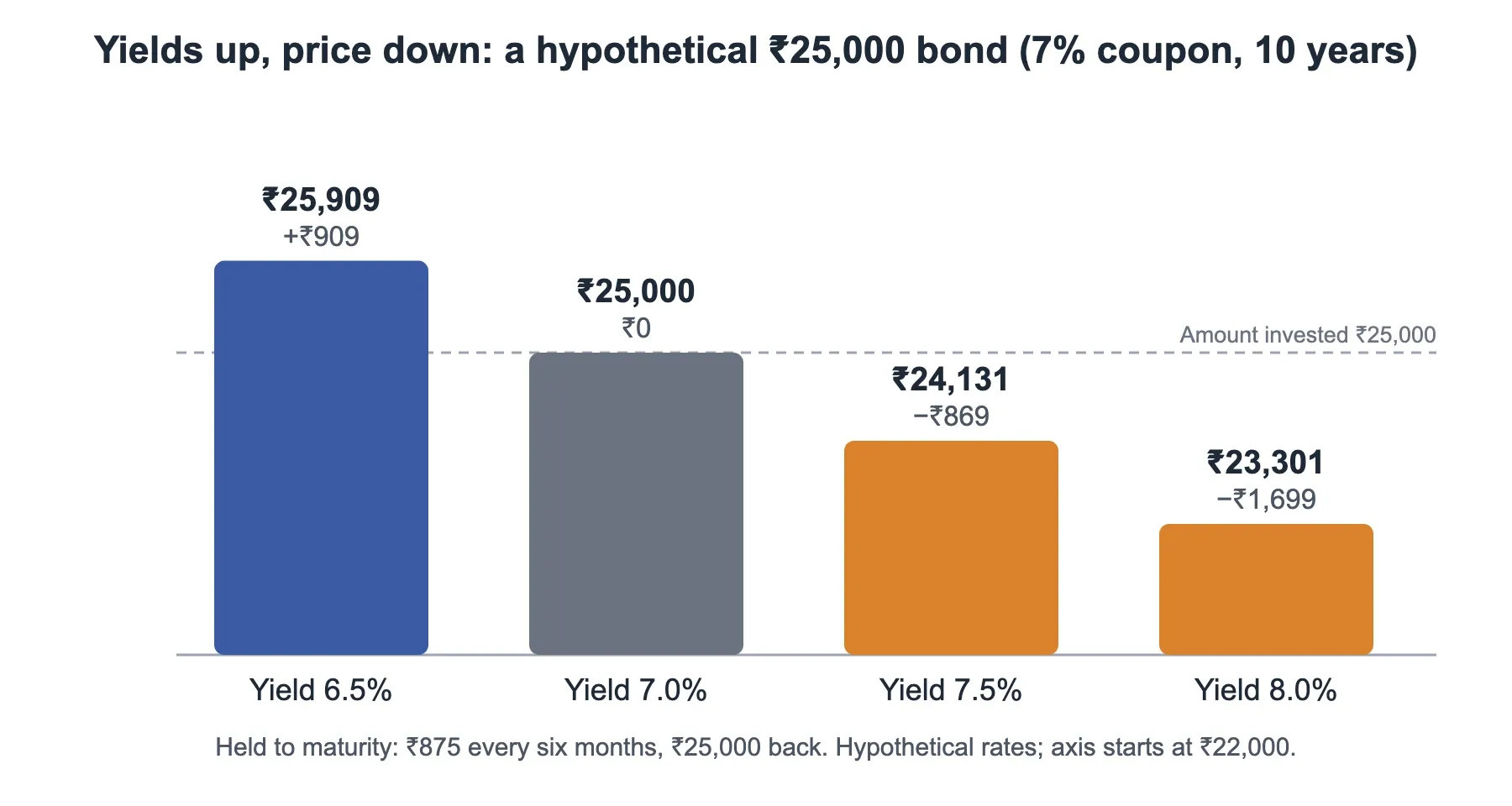
Prices are present values of the remaining coupons and face value at each yield, with 10 years left. Real bids start at ₹10,000 face value, so ₹25,000 is purely illustrative.
If you hold to maturity instead, the price swings do not change what you receive. You get ₹875 every six months (₹1,750 a year, ₹17,500 over 10 years) and ₹25,000 back at maturity, assuming the government pays as scheduled. What you give up is the chance to earn the higher 7.5% that new bonds offer.
The sovereign promise covers repayment at maturity, not the price someone pays you before then. Longer maturities swing more for the same yield change, so a T-bill moves far less than a 10-year bond.
How interest and gains are taxed (as of 22 November 2026)
In broad terms:
- Coupons on G-secs and SDLs are interest income, added to your income and taxed at your slab rate.
- T-bill returns come from the discount, not a coupon. How that difference is classified for tax is a point to confirm with a tax professional.
- Selling before maturity can produce a capital gain or loss, taxed by holding period under current capital gains rules, which were revised in recent years.
What RBI proposed in 2026 (draft, not final)
On 25 June 2026, RBI released a draft Master Direction on secondary market transactions in government securities and invited comments by 17 July 2026. It consolidates existing instructions.
Business Today reported on 26 June 2026 that the draft names Retail Direct and demat accounts with eligible depository participant banks as routes for individuals. Other reported proposals include a ₹10,000 minimum face value in multiples of ₹10,000, and trading from 9:00 am to 5:00 pm on Mumbai working days.
As of 25 November 2026, RBI's website still lists these Directions as a draft. Treat these points as proposals until RBI publishes final rules.
How this compares with other options
G-secs can also be bought through a demat account or held indirectly through a debt fund, which carries its own interest-rate and credit risks; see what is a debt mutual fund. If you are still weighing deposits against market-linked options, start with when you need the money: SIP vs FD vs RD.
Frequently asked questions
How can I buy government bonds directly from RBI?
Open a free RDG account on RBI's Retail Direct portal with PAN, KYC, email, mobile and an Indian savings account. Then place a non-competitive bid in a T-bill, dated G-sec or SDL auction and pay by UPI or net banking, or buy on NDS-OM.
Is there any charge for an RBI Retail Direct account?
RBI's FAQ says the account is opened and maintained free of cost, and RBI charges no fee for bids. Payment gateway charges apply when you fund a purchase.
Are government bonds completely safe?
Default risk is very low because a government stands behind repayment. Interest-rate risk (prices fall when yields rise) and liquidity risk (if you sell early) remain.
Can I sell my G-sec before maturity?
Yes. You can sell on NDS-OM through the portal, but the price depends on current yields and on whether buyers are active. You could get less than you paid.
What changed in RBI Retail Direct in 2026?
RBI released a draft Master Direction on secondary market G-sec transactions on 25 June 2026, with comments due by 17 July 2026. As of 25 November 2026, RBI lists it as a draft, so treat its proposals as draft until final rules are issued.
Save this checklist
Save this page as a checklist for when you open your account.