What is a debt mutual fund? What it holds, how it can lose money, and how it's taxed now
A debt mutual fund lends to governments and companies. See how rate rises and defaults can cut its NAV, how it compares with an FD, and how it's taxed.
Summarize this article with AI





The short version
- A debt mutual fund lends money through G-secs, corporate bonds and money-market instruments; it doesn't own shares.
- Its NAV can fall when rates rise (interest-rate risk) or a borrower is downgraded or defaults (credit risk).
- The PRC matrix shows the maximum interest-rate and credit risk a scheme may take.
- Bank deposits carry DICGC cover up to ₹5,00,000 per depositor per bank; mutual funds are not covered.
- Gains on debt fund units bought from 1 April 2023 are taxed at slab rate, so tax no longer tilts the FD comparison.
A debt mutual fund pools money to lend to governments, companies and banks through bonds and money-market instruments. Its NAV can fall when interest rates rise or a borrower defaults, so it is not guaranteed like an insured bank deposit. Gains on units bought from 1 April 2023 are taxed at your slab rate.
Mutual fund investments are subject to market risks, read all scheme related documents carefully.
Say you are 27, with ₹2,40,000 set aside for a goal two or three years away, and a colleague says a debt fund is "like an FD but better". Here is what a debt mutual fund is, explained by risk rather than returns: what it holds, how it can lose money, and how it is taxed now.
What is a debt mutual fund in simple words, and where does it invest my money?
A debt mutual fund lends your money. Instead of shares, it buys instruments where a borrower promises interest and repayment on a set date. The fund earns that interest, and the market value of its holdings changes daily, so its NAV moves.
Most debt funds hold a mix of three things:
- Government securities (G-secs) and treasury bills: loans to the central or state governments.
- Corporate bonds and debentures: loans to companies, banks and public sector undertakings, each usually carrying a credit rating.
- Money-market instruments: very short loans, such as certificates of deposit and commercial paper, that mature within a year.
SEBI's categorisation circular of 26 February 2026 lists 17 debt categories. Some are defined by how long holdings run (overnight, liquid, money market, short to long term). Others by what they hold: corporate bond (at least 80% in AA+ and above rated bonds), credit risk (at least 65% in AA and below), banking and PSU, and gilt (at least 80% in G-secs).
Can a debt mutual fund lose money? What are interest-rate and credit risk?
Yes. If its NAV falls and you redeem, you get back less than you put in. There are two main reasons.
Interest-rate risk: the seesaw
When rates rise, new bonds pay more, so older, lower-paying bonds lose value. The longer a bond has left to run, the bigger the fall. A fund's duration (in years) is a measure of this sensitivity. A rough rule: for a small rate change, the NAV moves by about the fund's modified duration multiplied by the rate change, in the opposite direction.
Credit risk: the borrower who doesn't pay
If a borrower is downgraded or defaults, its bond is marked down and the NAV falls. Lower-rated holdings mean more of this risk.
A worked ₹ example (hypothetical)
Take ₹2,40,000 in a debt fund with a modified duration of 4 years. These are hypothetical scenarios, not a forecast; not a promise; returns vary.
| Scenario (hypothetical) | Approximate fall | In ₹ | Value after |
|---|---|---|---|
| Rates rise by 0.5 percentage point | 4 × 0.5% ≈ 2% | ₹4,800 | ₹2,35,200 |
| A bond worth 5% of the fund (₹12,000) is marked down by half | 5% × 50% ≈ 2.5% | ₹6,000 | ₹2,34,000 |
| Both happen together | about 4.5% | ₹10,800 | ₹2,29,200 |
Hypothetical; duration approximation for small rate moves, ignoring the interest the fund keeps earning; assumed rate change 0.5 percentage point; not a promise; returns vary.
The exact figure matters less than the mechanism: duration and credit quality tell you how far the value could drop.
The Potential Risk Class (PRC) matrix
SEBI asks every debt scheme to show these two risks together in a 3×3 grid called the Potential Risk Class matrix (SEBI circular of 7 June 2021). One axis measures interest-rate risk by the portfolio's Macaulay duration: Class I (up to 1 year), Class II (up to 3 years) and Class III (any duration). The other measures credit risk by a weighted average Credit Risk Value: Class A (12 or more, lower risk), Class B (10 or more) and Class C (below 10, higher risk).
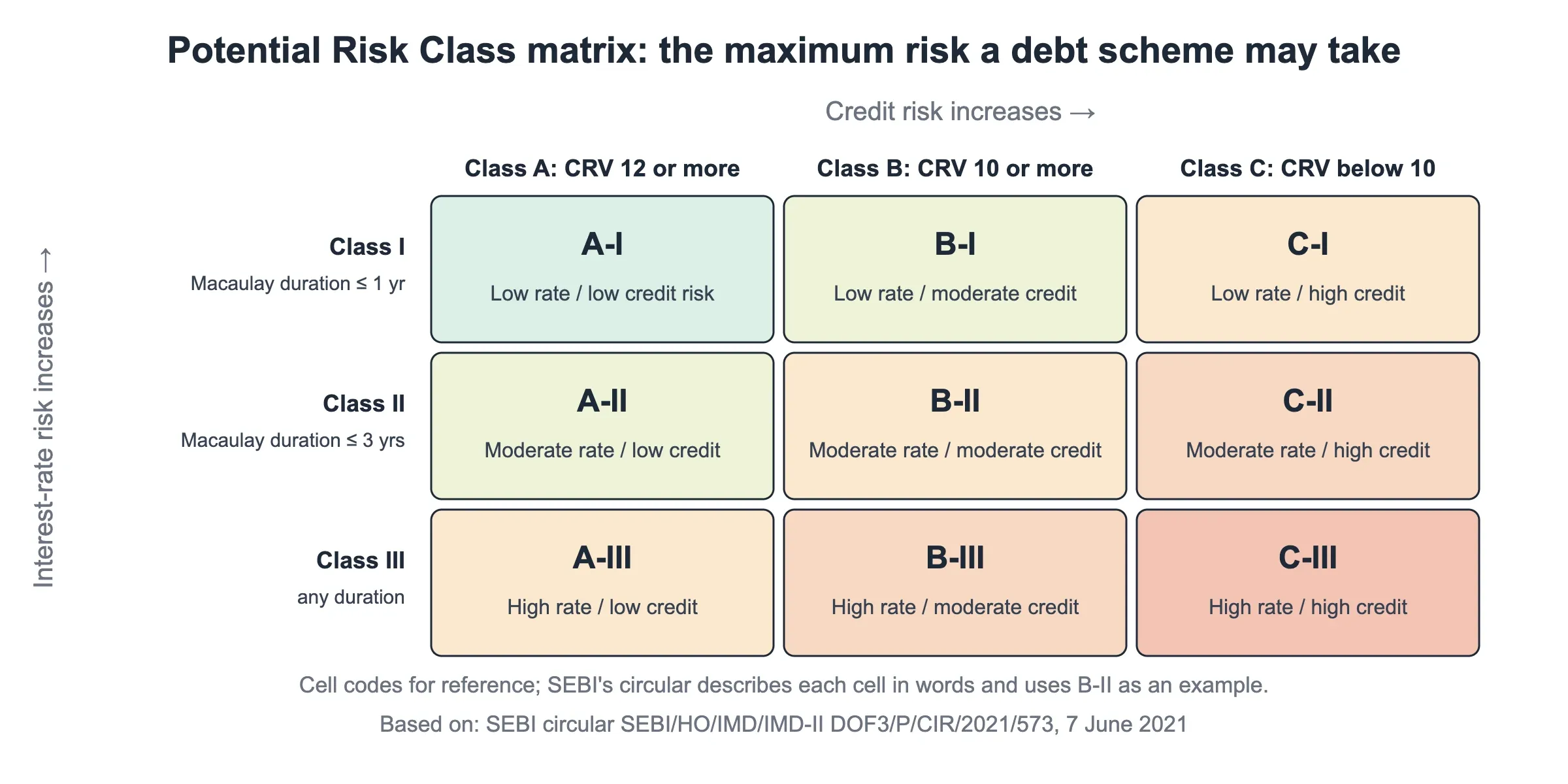
A scheme's cell shows the maximum risk it is allowed to take, not what it holds today. Under the circular, moving to a riskier cell counts as a change in fundamental attribute, and unitholders must be told. Read it alongside the riskometer, which shows the scheme's current risk level.
Debt fund vs FD: which is safer, and how do post-tax returns compare?
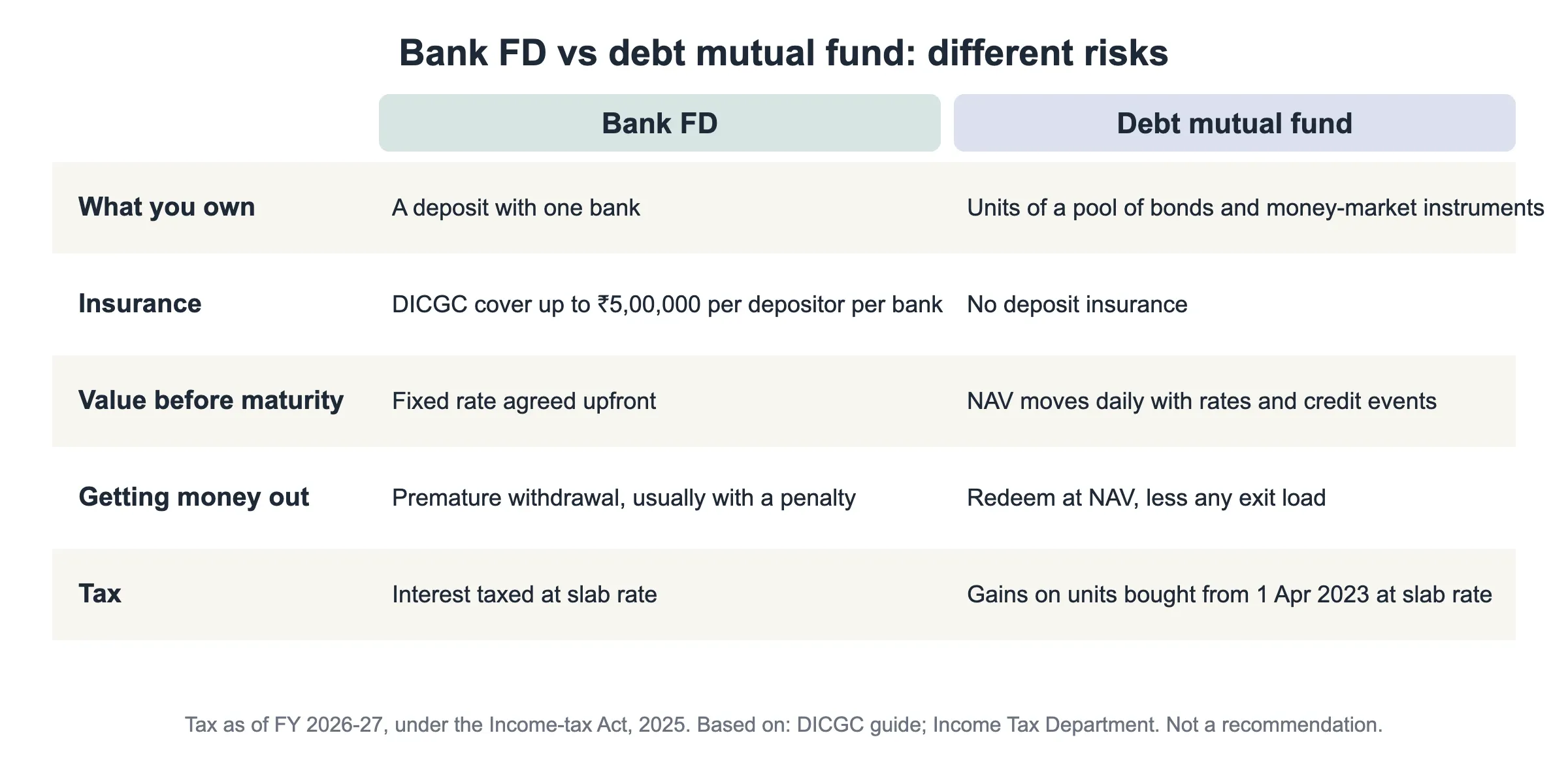
They carry different kinds of risk, so "safer" depends on which risk you mean.
A bank fixed deposit is insured by DICGC, a wholly owned subsidiary of the RBI, up to ₹5,00,000 per depositor per bank, covering principal and interest together. DICGC's own guide lists mutual funds under "What's not covered". A debt fund has no such cover; its value depends on its holdings.
| Bank FD | Debt mutual fund | |
|---|---|---|
| What you own | A deposit with one bank | Units of a pool of bonds and money-market instruments |
| Insurance | DICGC cover up to ₹5,00,000 per depositor per bank | No deposit insurance |
| Value before maturity | Fixed rate agreed upfront | NAV moves daily with rates and credit events |
| Getting money out | Premature withdrawal, usually with a penalty | Redeem at NAV, less any exit load in the scheme documents |
| Tax | Interest taxed at slab rate | Gains on units bought from 1 April 2023 taxed at slab rate |
Post-tax returns can't be compared in advance, because a debt fund's return isn't fixed. For units bought from 1 April 2023, both FD interest and debt fund gains are taxed at your slab rate, so the old tax edge no longer applies. Timing still differs: FD interest is generally taxed year by year, fund gains when you redeem. Compare risk, liquidity and costs, not a headline yield.
How are debt mutual funds taxed if I buy in 2026?
This section reflects the rules as of FY 2026-27, under the Income-tax Act, 2025, as of 17 November 2026.
- Units bought on or after 1 April 2023 in a debt fund that counts as a "specified mutual fund" are taxed as short-term gains at your slab rate, however long you hold them. The Income Tax Department's capital gains page (1961 Act, as amended by the Finance Act, 2026) says short-term gains on debt-oriented fund units are taxed at the normal rate. Under the Income-tax Act, 2025, this rule sits in section 76.
- No indexation applies to these gains.
- Units bought before 1 April 2023 may follow older holding-period rules.
Hypothetical example: you redeem with a gain of ₹12,000 and your slab rate is 20% (hypothetical). Tax ≈ ₹2,400, plus 4% cess of ₹96, about ₹2,496 in all, before any surcharge. Hypothetical; as of FY 2026-27, under the Income-tax Act, 2025; not a promise; returns vary.
Tax rules change; consult a tax professional for your situation.
Which debt fund categories are built for very short holding periods?
SEBI's February 2026 categorisation circular defines three categories by very short maturities:
| Category | What SEBI's definition says it holds |
|---|---|
| Overnight fund | Securities maturing in 1 day (up to 5% of net assets may sit in G-secs or T-bills of up to 30 days for margin) |
| Liquid fund | Only debt and money-market securities maturing in up to 91 days |
| Money market fund | Money-market instruments maturing in up to 1 year |
Short maturities mean low duration, so interest-rate risk is small but not zero, and credit risk depends on who the fund lends to. Before using any of them for money you may need soon, check the scheme's PRC cell, exit load and expense ratio in the SID and KIM. For emergency money, start with how much emergency fund you need.
Frequently asked questions
What is the PRC matrix?
It is a 3×3 grid SEBI requires debt schemes to disclose. It combines interest-rate risk (Class I to III, by Macaulay duration) with credit risk (Class A to C, by Credit Risk Value) and shows the maximum risk a scheme may take.
What is duration?
Duration, in years, measures how sensitive a bond or fund is to interest-rate changes. As a rough guide, a modified duration of 4 means a 0.5 percentage point rate rise lowers the value by about 2%.
Is a liquid fund a debt fund?
Yes. SEBI lists the liquid fund as a debt category that invests only in debt and money-market securities maturing in up to 91 days.
Do debt funds have exit loads?
Some do. The exit load, if any, and the period it applies for are set out in each scheme's SID and KIM, so check them before you invest.
Are debt funds covered by DICGC?
No. DICGC insures bank deposits up to ₹5,00,000 per depositor per bank, and its guide lists mutual funds among what is not covered.
Read next
See how fund gains are taxed by type in how mutual funds are taxed in India in 2026, or see where debt funds sit among which type of mutual fund a beginner can start with.
— Laabh



