SEBI's Mutual Fund Regulations 2026: The Clauses That Change Things for a SIP Investor
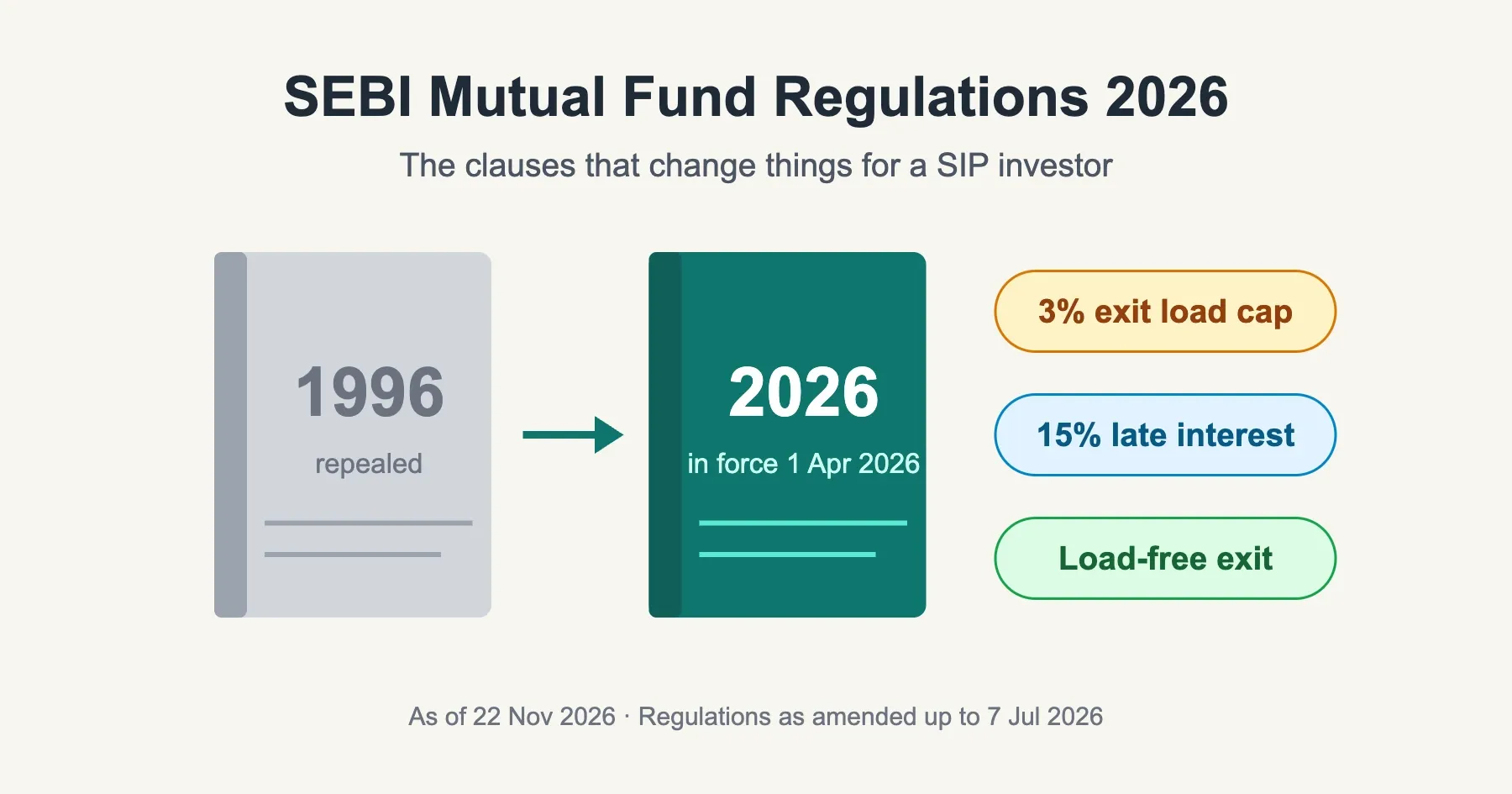
SEBI mutual fund regulations 2026, clause by clause: 3% exit load cap, 15% interest on late payouts, load-free exit.
Summarize this article with AI





The short version
- The SEBI (Mutual Funds) Regulations, 2026 came into force on 1 April 2026 and repealed the 1996 Regulations (Regs 1(2), 85).
- Exit load on open-ended schemes cannot exceed 3% of NAV (Reg 44(4)); your scheme's actual load is in its SID/KIM.
- Late redemption or dividend payouts carry 15% a year interest for the delay (Reg 46(2)).
- Changes to fees or fundamental attributes need written notice and a load-free exit at NAV (Reg 22(9)(c)).
- Your monthly CAS must show distribution commission (Reg 34); SIFs are a separate, ₹10 lakh-minimum, high-risk product.
As of 22 November 2026: the SEBI mutual fund regulations 2026, formally the Securities and Exchange Board of India (Mutual Funds) Regulations, 2026, came into force on 1 April 2026 and repealed the SEBI (Mutual Funds) Regulations, 1996. For an SIP investor it is mostly a consolidation; the clauses you are most likely to notice are a 3% ceiling on exit load, 15% a year interest if your money is paid late, a monthly statement that shows distributor commission, and a load-free exit if your scheme changes its fees or basic features.
Only the exit-load ceiling is a clearly new number; interest on late payouts and the load-free exit already applied under the 1996 Regulations or SEBI circulars, and the 2026 text now writes them into one rulebook. This page reads the Regulations as amended up to 7 July 2026. For each point we give the clause, what it says (fact) and what you are likely to notice (our interpretation).
Say Shreya, 27, in Indore, saw a "new SEBI MF rules" headline and wonders whether her SIP needs any action. Mostly, no. Here is why.
What happened and when
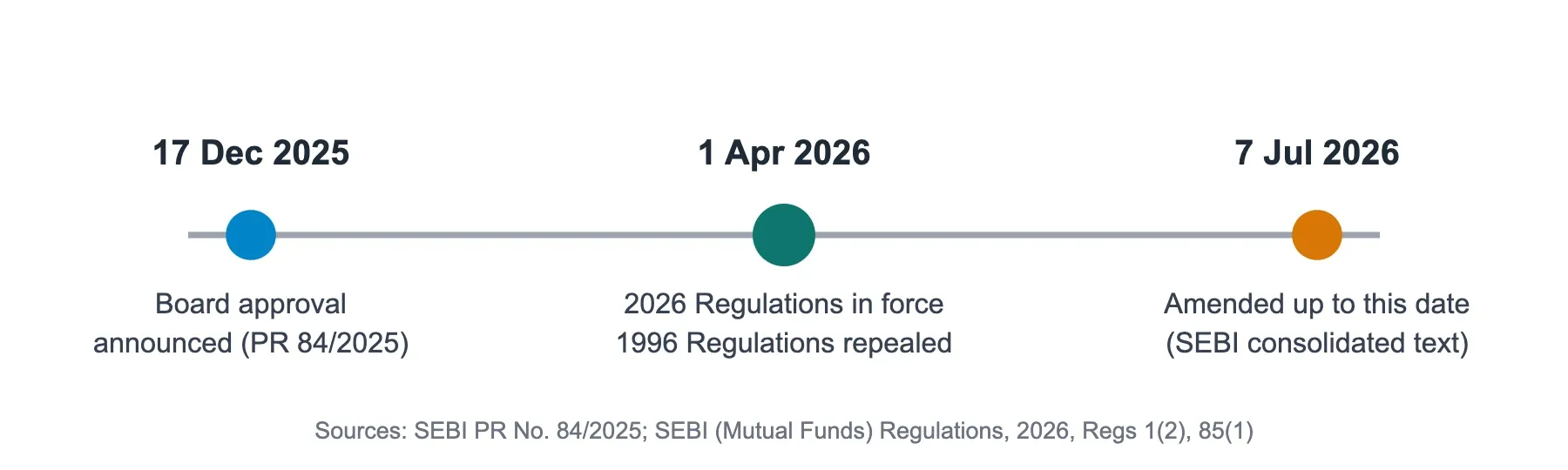
SEBI's board approval of the new rulebook was announced on 17 December 2025 (PR No. 84/2025). The stated aim was "greater clarity, improved readability, and enhanced structural coherence", with investor safeguards kept. The text shrinks from 162 pages to 88, and from about 67,000 words to 31,000.
- 17 December 2025: SEBI board approval announced.
- 1 April 2026: the 2026 Regulations come into force (Regulation 1(2)).
- Same date: the 1996 Regulations "stand repealed" (Regulation 85(1)). Earlier registrations, approvals and pending matters carry over (Regulation 85(2)).
- 7 July 2026: the latest amendment reflected in SEBI's consolidated text.
Your existing folios, units and SIPs continue; nothing in the repeal clause asks investors to re-register.
The investor-facing clauses at a glance
| Clause | What the rule says (fact) | What you may notice (interpretation) |
|---|---|---|
| Reg 44(4) | Exit load of an open-ended scheme cannot exceed 3% of NAV | Lower ceiling on early-redemption charges |
| Reg 46(2) | Late redemption or dividend payment: 15% a year interest for the delay | Compensation if money arrives late |
| Reg 22(9)(c) | Changes to fundamental attributes or fees need written notice and an exit at NAV without exit load | A notice and a load-free exit window |
| Reg 34 | Monthly consolidated account statement (CAS) incl. distribution commission | You see what your distributor earns |
| Reg 27 | AMC must offer every unitholder a nomination option | Nomination stays part of your folio set-up |
| Reg 22(8)(d) | Unit Holder Protection Committee; compliance with SEBI's Investor Charter | Named investor-protection governance at the AMC |
| Reg 49(1), 55(1) | Specialized Investment Fund (SIF): ₹10 lakh minimum; high-risk disclosure | Not a beginner SIP product |
Exit load capped at 3% (Regulation 44(4))
Regulation 44(4) says the exit load of an open-ended mutual fund scheme "shall not exceed three per cent" of the Net Asset Value. News reports (September 2025, August 2026) describe this as a cut from 5%.
Hypothetical example: if you redeem units worth ₹80,000, a 3% load works out to ₹2,400. That is the legal ceiling, not what you will pay. Your scheme's actual load and its holding period are in its Scheme Information Document (SID) and Key Information Memorandum (KIM), and may be lower or nil. Check the current SID, since reports have not said when every existing scheme document adopts the new ceiling. For how exit load is worked out on each SIP instalment, see exit load in mutual funds.
15% a year interest on delayed payouts (Regulation 46(2))
Regulation 46(1) requires redemption and dividend payments within the period SEBI specifies from time to time. If the AMC misses it, Regulation 46(2) makes it "liable to pay interest to the unitholder" at 15% per annum for the period of the delay. The 1996 Regulations left the rate to SEBI to specify; the 2026 text writes 15% into the regulation itself.
Hypothetical example (simple interest, 365-day year assumed):
- Redemption amount: ₹80,000, paid 4 days after the deadline
- Interest per day: ₹80,000 × 15% ÷ 365 = ₹32.88
- For 4 days: ₹80,000 × 15% × 4 ÷ 365 = ₹131.51, or about ₹132
Small, but it puts a cost on the AMC for paying late. If a payout is late, approach the AMC first; Regulation 71(1) asks AMCs to redress grievances within 21 calendar days. If unsatisfied, AMFI's investor page says you may complain to SEBI through SCORES (scores.sebi.gov.in).
Notice and a load-free exit when your scheme changes (Regulation 22(9)(c))
An AMC cannot change a scheme's fundamental attributes, fees and expenses, or anything else that modifies the scheme and affects unitholders, unless it sends written notice to each unitholder and gives an option to exit "at the prevailing Net Asset Value" without any exit load.
What you will notice: a notice from the AMC and a window to leave without exit load. Staying is also an option; you choose.
A CAS that shows commission (Regulation 34) and nomination (Regulation 27)
Regulation 34 requires the AMC to ensure a consolidated account statement is issued for each calendar month to every investor whose folio had a transaction that month, detailing transactions and holdings, "including distribution commission paid to its distributor". In a regular plan, this shows that cost in rupees.
Regulation 27 requires the AMC to provide every unitholder an option to nominate. Check that each folio has a nominee; our guide on how to add a nominee walks through it.
Specialized Investment Funds are separate, with a ₹10 lakh minimum (Regulations 49(1), 55(1))
The Regulations set separate rules for Specialized Investment Funds (SIFs). Regulation 49(1) says a SIF "shall not accept an investment amount of less than ten lakh rupees" across its investment strategies, except from accredited investors. Regulation 55(1) requires SIF offer documents to highlight "the high-risk nature of the product".
For a beginner with a small monthly SIP, a SIF is a different product. Also, Regulation 22(8)(d) requires each AMC to set up a Unit Holder Protection Committee and comply with SEBI's Investor Charter. For what protects your money if an AMC itself runs into trouble, see are mutual funds safe if an AMC shuts down.
What the Regulations don't settle on their own
Not every "new SEBI rule" headline is a change to the Regulations. Three things need separate reading:
- Expense ratio (TER) limits. The December 2025 board decision also changed how expense limits are expressed (statutory levies now sit outside the base expense ratio). See expense ratio explained; we have not mapped each limit to a clause here.
- Scheme categories. What each fund label may hold is set by SEBI's categorisation rules. See mutual fund categories explained.
- Payout deadlines. Regulation 46(1) refers to periods "specified by the Board", so the number of days sits outside the regulation text.
What you need to do
For most SIP investors, nothing urgent. A five-minute check:
- Open your latest CAS. Confirm holdings; find the commission line if you use a regular plan.
- Check nomination. Make sure a nominee is registered on each folio.
- Read AMC notices. If one mentions a change in fundamental attributes or fees, note the exit window.
- Look up your exit load. It is in your scheme's SID or KIM.
- Know the complaint route. AMC first, then SCORES if unresolved.
Frequently asked questions
What are the new SEBI mutual fund regulations 2026?
They are the Securities and Exchange Board of India (Mutual Funds) Regulations, 2026, in force from 1 April 2026. They repealed the SEBI (Mutual Funds) Regulations, 1996 and consolidate the rules for AMCs, trustees and schemes. SEBI's consolidated text is amended up to 7 July 2026.
What is the maximum exit load under the new SEBI rules?
Regulation 44(4) says the exit load of an open-ended scheme cannot exceed 3% of NAV. That is a ceiling; your scheme's SID or KIM states its actual load, which may be lower or nil.
What happens if my mutual fund redemption is delayed?
If the AMC misses SEBI's payout deadline, Regulation 46(2) makes it liable to pay you interest at 15% a year for the delay. Raise the issue with the AMC first; if it is not resolved, you may complain to SEBI through SCORES.
Do I need to do anything for my existing SIP?
Generally, no. Your units and SIP continue. Check your CAS and nomination, and read any AMC notice about scheme changes, since it comes with a load-free exit option.
Is a Specialized Investment Fund the same as a mutual fund?
No. The Regulations set separate rules for SIFs: a minimum investment of ₹10 lakh (except for accredited investors) and offer documents that must highlight the product's high-risk nature.
Save this checklist
Save this checklist for the next "new MF rules" headline, and join Laabh updates for more plain-language guides.



