What happens to your mutual fund money if the AMC shuts down?
Your units sit in your folio and scheme assets are held in trust, with a custodian. What SEBI's 2026 rules say if an AMC exits, and what they don't cover.
Summarize this article with AI





The short version
- An AMC manages a scheme's money; the scheme's property is held in trust for unitholders.
- A custodian appointed by the trustees keeps the securities; RTAs keep unitholder records.
- Changing a scheme's AMC needs SEBI's prior approval (Reg 19(2)); winding up follows Regs 36 and 38.
- On a winding up you get a proportionate share of the scheme's value after liabilities and costs, not a fixed amount.
- Structure protects ownership, not value. Market risk remains.
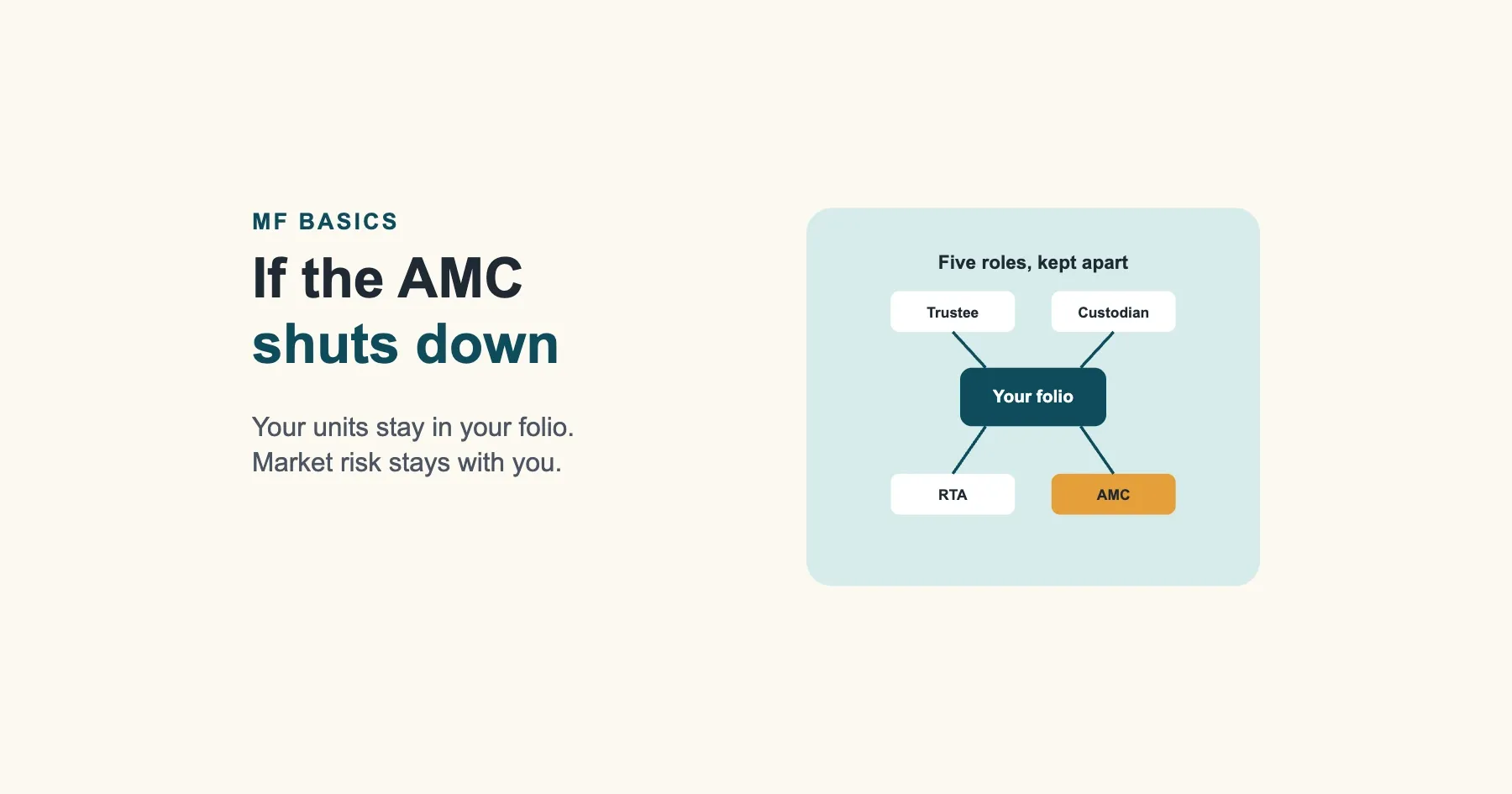
The structure is built so a fund house's exit doesn't erase your units. They sit in your folio, the scheme's property is held in trust for unitholders, and a separate custodian keeps the securities. SEBI's rules set how a scheme moves to a new AMC or is wound up. Market risk stays with you.
That is the short answer to "are mutual funds safe if the AMC shuts down?" Below: who holds what, the SEBI rule behind each role, and three scenarios.
Rules as of 13 November 2026, from the SEBI (Mutual Funds) Regulations, 2026, in force from 1 April 2026.
What happens to my mutual fund money if the AMC shuts down?
An asset management company (AMC) manages a scheme's money. It does not own it. The money belongs to the scheme, held in trust for its unitholders. If an AMC stops managing a scheme, the regulations leave two broad routes:
- A new manager. Regulation 19(2): any change in the appointment of the AMC "shall require prior approval from the Board", meaning SEBI.
- Winding up. Regulation 36(2) allows it on an event that, "in the opinion of the trustees, requires the scheme to be wound up"; if 75% of the scheme's unitholders pass a resolution; or "if the Board so directs in the interest of the unitholders."
On a winding up, Regulation 38(1)(d) says proceeds are "first, utilised towards discharging all liabilities that are due and payable under the scheme", then, after winding-up expenses, "paid to the unitholders in proportion to their respective interest in the assets of the scheme."
So you get your share of what the assets are worth then, after liabilities and costs. That is not the same as getting back what you put in.
A worked example with ₹60,000
Say you invested ₹60,000 when a scheme's NAV was ₹40. You hold 1,500 units in your folio (₹60,000 ÷ ₹40). The NAV and the moves below are hypothetical, for illustration only.
| Situation | NAV per unit | Your units | Value of your units |
|---|---|---|---|
| When you invested | ₹40 | 1,500 | ₹60,000 |
| Hypothetical NAV rise of 10% | ₹44 | 1,500 | ₹66,000 |
| Hypothetical NAV fall of 10% | ₹36 | 1,500 | ₹54,000 |
Your record is 1,500 units, not a ₹60,000 balance held by the fund house or app. Their value still moves with the NAV.
Who actually holds my mutual fund units: the AMC, the custodian or the app?
None of them owns your units. Five roles split the work, and the regulations keep them apart.
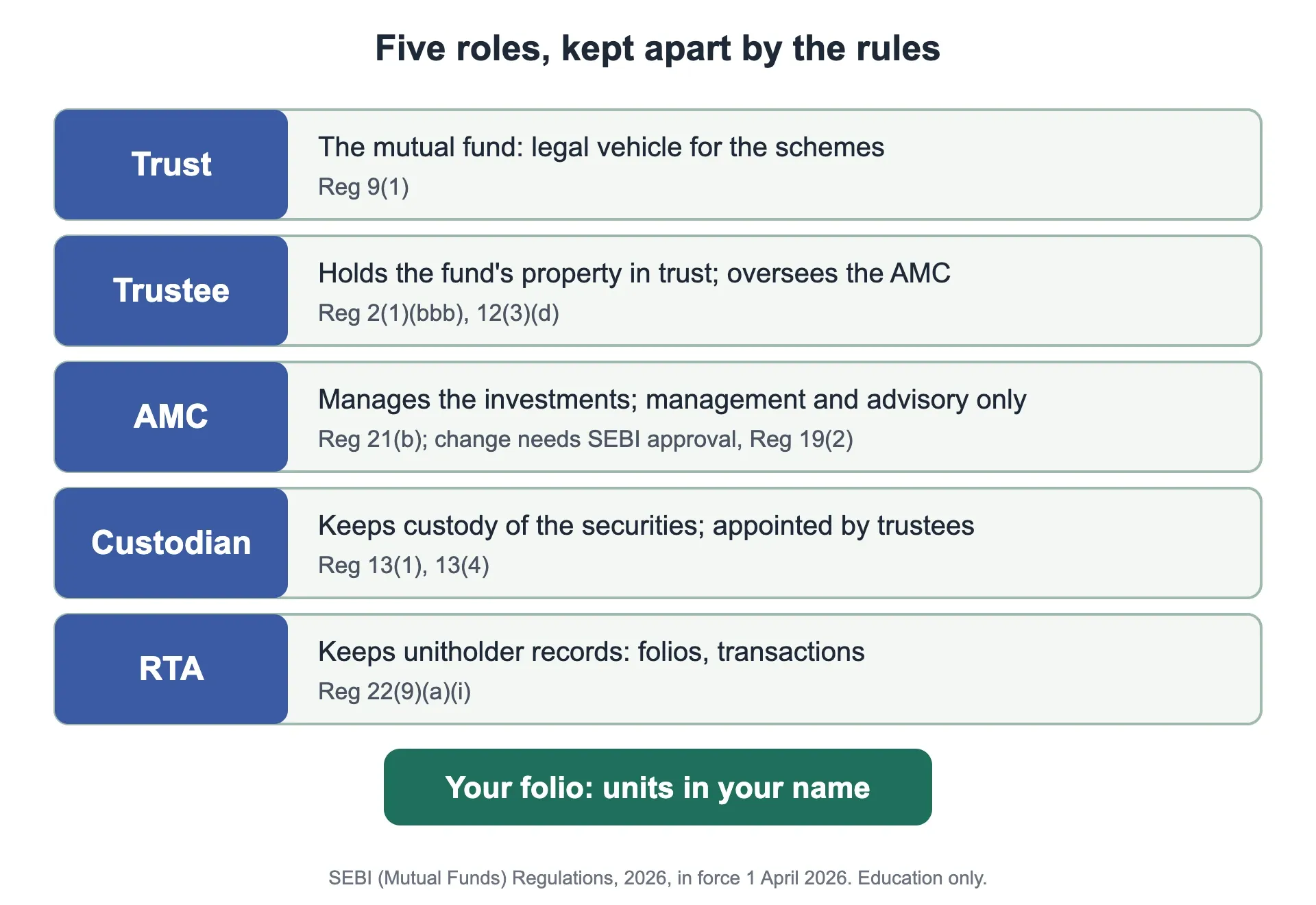
| Role | What it does | Rule (SEBI MF Regulations, 2026) |
|---|---|---|
| Trust (the mutual fund) | The legal vehicle for the schemes | Reg 9(1): "A mutual fund shall be constituted in the form of a trust" |
| Trustee (trustee company) | Holds the fund's property in trust; oversees the AMC | Reg 2(1)(bbb); Reg 12(3)(d) |
| AMC | Manages the investments | Reg 21(b): only management and advisory business; Reg 19 on changing the AMC |
| Custodian | Keeps custody of the securities | Reg 13(1): "The trustees shall appoint a custodian" |
| RTA | Keeps unitholder records: folios, transactions | Reg 22(9)(a)(i): RTAs "shall be registered with the Board" |
Your units are recorded in a folio, your account number in the fund house's records, or in your demat account if you hold them there. The app you used is a route in, not the place your units live.
What do the trustee and the RTA do for my investment?
The trustee is the least visible of the five. The regulations define the trustees as "the trustee company that holds the property of the mutual fund in trust", and Regulation 12(3)(d) says they "shall be accountable for and be the custodian of the funds and property of the respective schemes". The trustees appoint the custodian (Reg 13(1)), and Regulation 19(1) lists the routes by which the AMC's appointment can be ended, including a decision of the trustee company's board, a SEBI direction and a unitholders' resolution.
The RTA (registrar and share transfer agent) keeps the books on the investor side. CAMS and KFintech are two such registrars; AMFI's CAS page names both. If the AMC changes, this record shows who owns how many units.
None of this removes risk. It spreads responsibility, so no single company both manages the money and keeps the only record of who owns it.
Can a mutual fund company run away with my money?
The structure is designed to make that very hard. The AMC picks investments; a custodian the trustees appoint holds the securities. Regulation 13(4) bars a custodian from acting for a fund where half or more of its directors represent the interest of that fund's sponsor or its associates, and Regulation 13(5) sets conditions where the sponsor or its associates hold 50% or more of the custodian's voting rights.
Two honest limits: rules reduce risk but cannot rule out fraud or error, and they work only as well as SEBI and the trustees enforce them. "Very hard by design" is accurate. "Impossible" is not something any regulation promises.
If an AMC exits or merges
The regulations don't describe a fund house "shutting down" in one step. They cover a change of manager (Reg 19) and a winding up (Regs 36 to 38), where Reg 36(3) says the trustees "shall, within one day, give notice".
If you receive a notice about a change of AMC, a merger or a winding up, read it in full. Whether you get an exit option, and on what terms, will be in that notice. Confirm it with the fund house rather than relying on a summary, including this one.
What happens to my SIPs if the investing app I used shuts down?
This is how the structure works, not a quoted rule. Units bought through an app or distributor are allotted by the fund house and recorded with its RTA in your folio, or in your demat account. An app closing does not, by itself, change that record.
SIP instalments run on a bank mandate, and whether they continue after an app exits depends on how it was set up. Check directly:
- Your holdings: a Consolidated Account Statement (CAS) shows your mutual fund transactions across fund houses. AMFI's investor page says you can request it through the registrars or view it on the MFCentral portal. See how to read your CAS.
- Your SIPs: ask the fund house or its RTA which SIPs are active on your folio and which mandate they use.
What structure does not protect you from
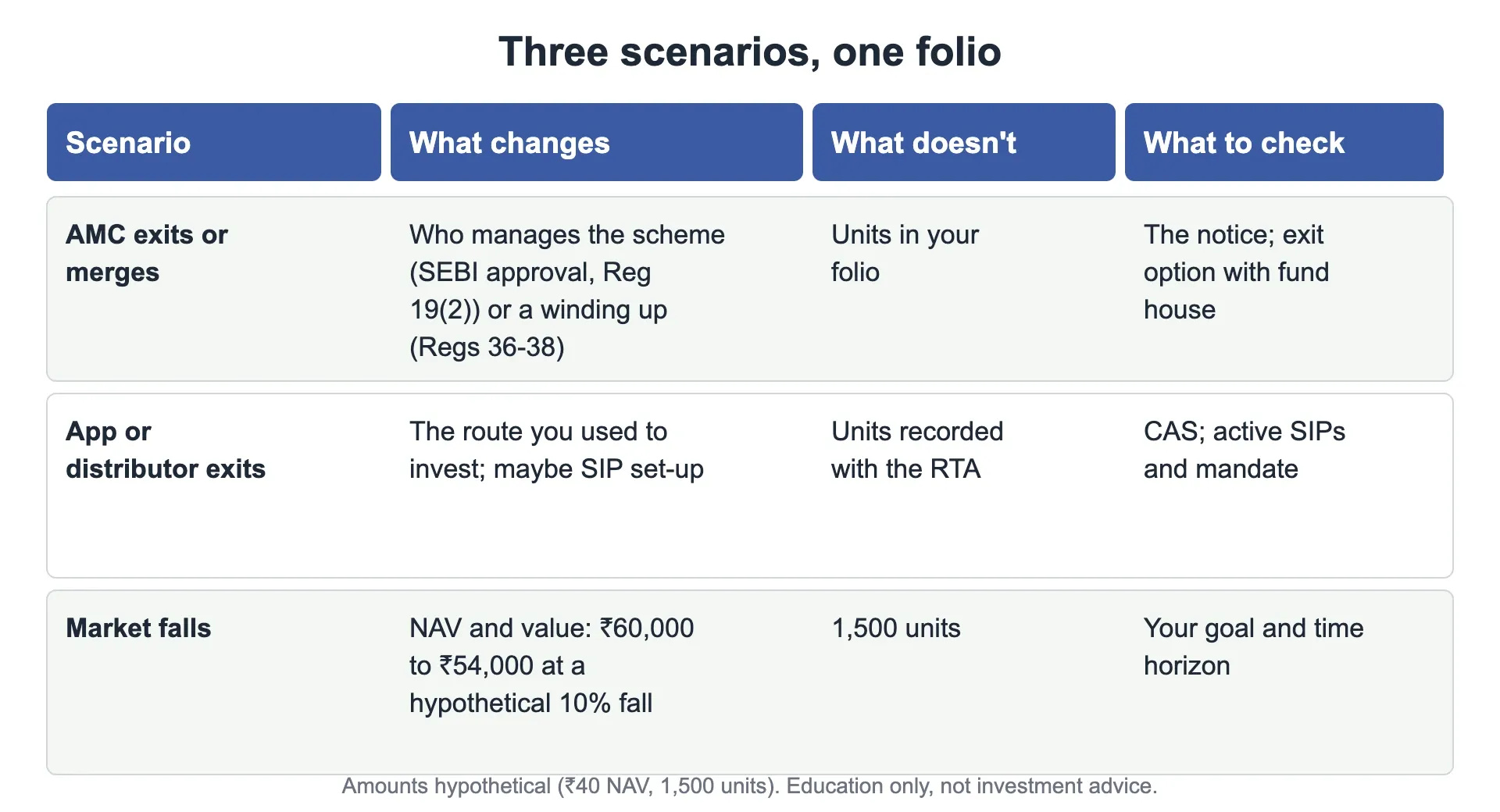
The trust structure protects ownership, not value. If the market falls, the NAV and your holding can fall. In the ₹60,000 example, a hypothetical 10% fall leaves the same 1,500 units worth ₹54,000.
Nothing in the regulations above promises a return or your original amount back. If market falls concern you more than fund house exits, read what happens to your SIP when the market falls.
Three checks worth doing instead
| Check | Why it helps | Where to go |
|---|---|---|
| Your CAS | Confirms which folios and units are in your name | The registrars or MFCentral, per AMFI |
| Your nominee | Decides who can claim your units if something happens to you | The fund house or RTA |
| A debit freeze | Blocks redemptions on a folio you aren't using | The fund house or RTA |
Frequently asked questions
Is my mutual fund money insured like a bank deposit?
No. Mutual fund units are not bank deposits, and the regulations do not promise a minimum value. What they provide is structure: property held in trust, a custodian, and SEBI oversight.
How do I find all my mutual fund folios?
Get a Consolidated Account Statement (CAS). AMFI's investor page says it can be requested through the registrars or viewed on the MFCentral portal after registering.
What does a custodian do in a mutual fund?
It keeps custody of the scheme's securities under an agreement with the trustees (Reg 13(1)). Regs 13(4) and 13(5) limit how closely a custodian can be tied to the fund's sponsor.
What happens to my units if two fund houses merge?
Your units stay in your folio. A change in who manages a scheme needs SEBI's prior approval (Reg 19(2)). Read the notice you receive and confirm any exit option with the fund house.
Next: add the next layer of protection
Add the next layer of protection: check how a mutual fund debit freeze locks a folio you aren't using, or start with what an SIP is.
— Laabh



