Sukanya Samriddhi Yojana vs SIP for your daughter: two tools for two different jobs
SSY vs SIP for your daughter: SSY's deposit, withdrawal and maturity rules, the current rate, tax points and how an SIP differs. As of 19 Nov 2026.
Summarize this article with AI





The short version
- SSY is a government small savings account for a girl child under 10, with deposits for 15 years and maturity at 21 years from opening.
- Its rate is notified every quarter; the rate is 8.2% a year for October to December 2026, which is not a promise for future quarters.
- An SIP has no notified rate, no guaranteed return and usually no lock-in.
- Tax treatment differs and depends on your regime; check the current provisions under the Income-tax Act, 2025.
- Decide by matching each tool's rules to the dates your daughter's goals fall on.
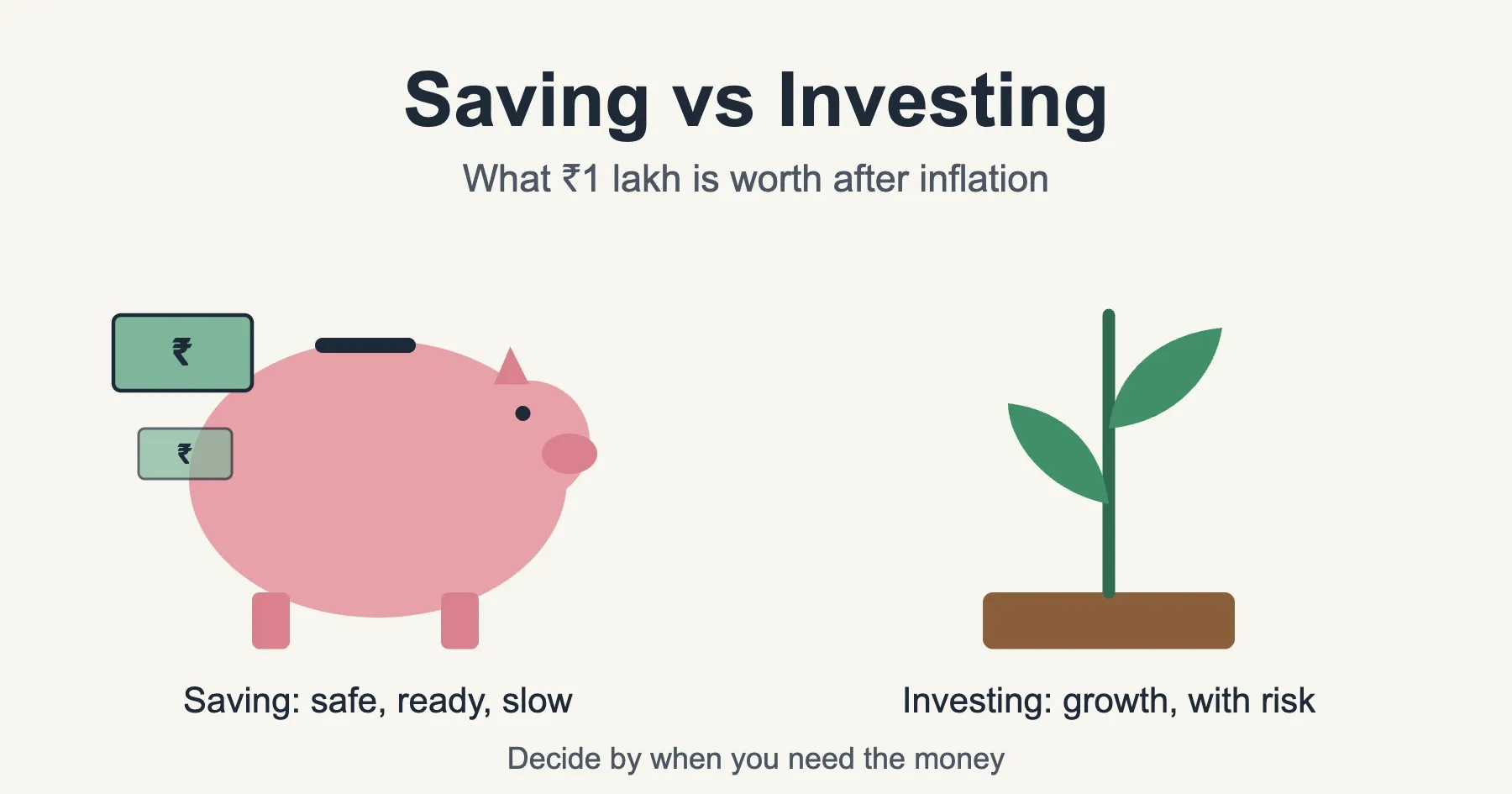
Sukanya Samriddhi Yojana (SSY) is a government small-savings account for a girl child under 10, earning a rate the government notifies quarterly, with fixed rules on deposits, withdrawal and maturity. A mutual fund SIP is market-linked, has no guaranteed return and is usually more flexible. The two can do different jobs.
Meenal and Rohit, 31 and 33, live in Erode. Their daughter Ira turned two this year. A relative says "open Sukanya"; a colleague says "start an SIP". Neither answers the real question: what job is this money for, and when? This page sets out each tool's rules as of 19 November 2026.
Sukanya Samriddhi Yojana rules in one table
SSY runs under the Sukanya Samriddhi Account Scheme, 2019 (G.S.R. 914(E), 12 December 2019, amended by G.S.R. 288(E), 5 May 2020). The rules below come from the scheme text published by the National Savings Institute (NSI).
| Rule | What the scheme says | Scheme para |
|---|---|---|
| Who can open | A guardian, in the name of a girl child who has not turned 10 on the date of opening | 3(1) |
| How many | One account per girl; up to two girls per family, with exceptions for twins or triplets | 3(2), 3(4) |
| Deposits | Minimum ₹250 a financial year; maximum ₹1,50,000 a financial year | 4(1), 4(2) |
| Deposit period | Deposits can be made until 15 years from opening | 4(3) |
| Interest | Calculated monthly on the lowest balance, credited at the end of each financial year | 5(2) |
| Who operates | The guardian until 18; the girl herself after that | 6(1) |
| Partial withdrawal | Up to 50% of the balance at the end of the preceding financial year, after she turns 18 or passes Class 10, whichever is earlier, for education | 8(1) |
| Early closure | On death; on extreme compassionate grounds after 5 years; for her intended marriage after she turns 18, not earlier than one month before it | 7, 9(2) |
| Maturity | 21 years from the date of opening | 9(1) |
Two details shape most decisions: maturity is fixed by the opening date, not by when money is needed, and the only routine early exit is the 50% education withdrawal.
The SSY rate: how it is set, and the current figure
The SSY rate is not fixed for the life of the account. The Ministry of Finance notifies small savings rates every quarter, and the rate can rise, fall or stay the same.
How an SIP for a child's goal works
A systematic investment plan (SIP) invests a fixed amount in a mutual fund scheme at regular intervals, usually monthly, buying units at that day's NAV. Their value rises and falls with the scheme's holdings: there is no notified rate and no guaranteed return.
For a child's goal, an SIP can run in a parent's name or in the child's name through a minor folio; see an SIP in your child's name.
Most open-ended schemes other than ELSS have no lock-in, though an exit load may apply on early redemption. You can usually pause or stop an SIP, which also means nothing ring-fences the money.
SSY vs SIP side by side
| Sukanya Samriddhi Yojana | Mutual fund SIP | |
|---|---|---|
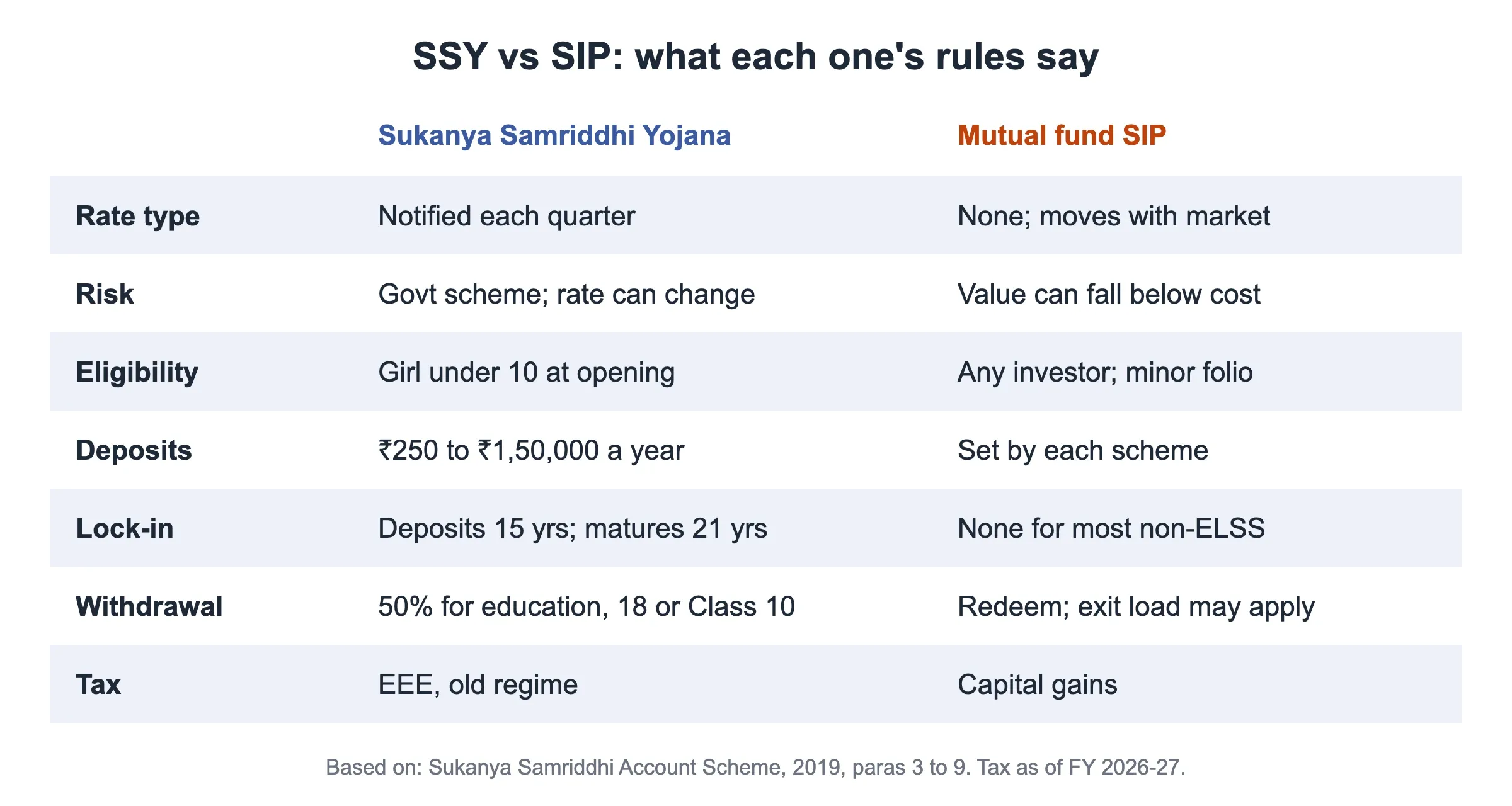
| Rate type | Notified by the government each quarter | None; value moves with the market |
| Risk | Government small savings scheme; rate can change each quarter | Market risk; value can fall below what you put in |
| Who can use it | A girl child under 10 at opening | Any investor; a child via a minor folio |
| Deposit limits | ₹250 to ₹1,50,000 a financial year | Set by each scheme |
| Lock-in | Deposits for 15 years; maturity at 21 years | None for most non-ELSS schemes; exit load may apply |
| Getting money out | 50% for education after 18 or Class 10; early closure only on set grounds | Redeem units, subject to exit load and tax |
| Tax (old regime) | See tax section | Capital gains tax on redemption |
Tax: SSY vs mutual fund gains
Tax points here are as of 19 November 2026, FY 2026-27, under the Income-tax Act, 2025.
- SSY deposits: deposits have qualified for the deduction for specified savings (section 80C under the Income-tax Act, 1961) within its ₹1.5 lakh limit, in the old regime only.
- SSY interest and maturity: treated as exempt, hence the label EEE (exempt at deposit, interest and withdrawal).
- Mutual fund SIP: each instalment is a separate purchase, taxed as capital gains on redemption; the rate depends on scheme type and holding period.
In the new regime, the SSY deduction is not available.
Tax rules change; consult a tax professional for your situation.
Worked example: ₹6,400 a month, contributions only
Hypothetical: contributions and rules only. Not a recommended amount or split, and no projected value.
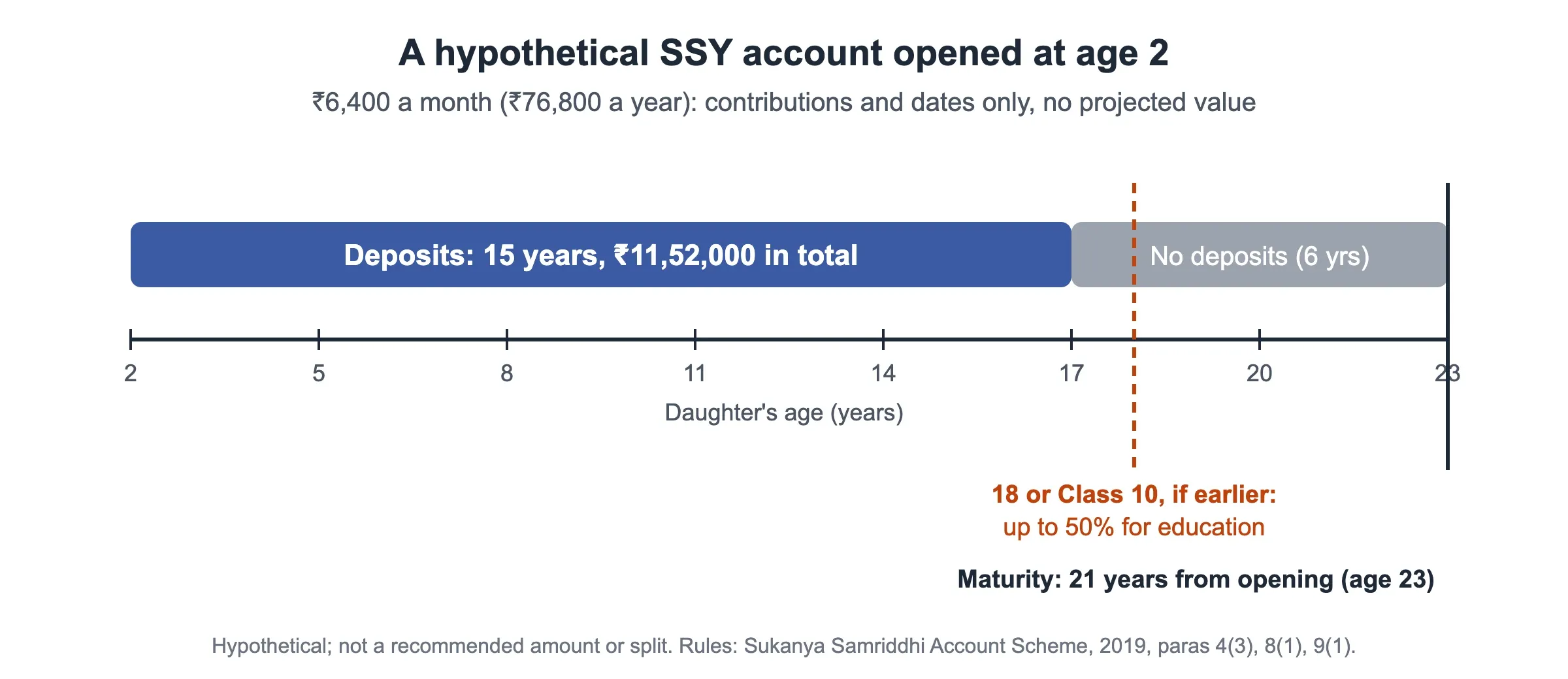
Say Meenal and Rohit set aside ₹6,400 a month, or ₹76,800 a year, for Ira.
- Within SSY limits? ₹76,800 is above the ₹250 annual minimum and below the ₹1,50,000 annual maximum, leaving ₹73,200 of unused room in a year.
- Total contributions over the deposit period: ₹76,800 × 15 years = ₹11,52,000 (₹11.52 lakh). That is money put in, not money you would get back.
- Timeline if the account is opened at age 2 (hypothetical): deposits run for 15 years, ending when Ira is about 17. The account then waits 6 more years with no deposits and matures when she is about 23. Partial withdrawal for education opens after she turns 18 or passes Class 10, whichever is earlier.
- The same ₹76,800 a year through an SIP for 15 years: contributions are again ₹11,52,000. What they are worth at any point depends on the market and cannot be known in advance. There is no fixed maturity date.
The ages are the useful part. If the big education bill arrives at 17 or 18, SSY's 50% withdrawal and maturity at about 23 limit what is available then. An SIP has no such dates, and no such guardrails.
Using both: match each tool to a timeline
"Which is better?" has no single answer, because the two do different jobs. List the dates money will be needed and check each tool's rules against them.
- A dated, rules-bound goal (higher education, a wedding many years out): check whether SSY's 50% education withdrawal, its 21-year maturity and the marriage-closure rule fit that date.
- Flexible or uncertain needs (coaching fees, a course whose timing may shift): check whether you need access before SSY allows it.
- Risk you can carry: an SIP's value can be below your contributions when you need the money.
This page does not suggest a split; that depends on your income, goals and tax regime. For the same "both, for different jobs" approach applied to PPF, read PPF vs SIP.
Frequently asked questions
For my daughter's education, how does Sukanya Samriddhi compare with a mutual fund SIP?
They do different jobs. SSY offers a quarterly notified rate with fixed rules: partial withdrawal of up to 50% for education after 18 or Class 10, and maturity at 21 years. An SIP is market-linked with no guaranteed return, but money can usually be taken out at any time.
Can I invest in both SSY and an SIP for my daughter?
Yes. Nothing in the SSY scheme stops a parent from also running an SIP. SSY deposits are capped at ₹1,50,000 a financial year per account, while SIP amounts depend on the scheme.
What is the lock-in and maturity of a Sukanya Samriddhi account?
Deposits can be made for 15 years from opening, and the account matures 21 years from opening. Before that, money can come out through the 50% education withdrawal or early closure on specific grounds, such as her intended marriage.
What is the current SSY interest rate, and does it change?
As of 19 November 2026, the rate is 8.2% a year, compounded yearly, for October to December 2026. The government reviews the rate every quarter, so it can change.
Is SSY maturity tax-free, and is SIP money taxed?
SSY has been treated as EEE: deposits deductible in the old regime, with interest and maturity exempt. Gains on SIP units are taxed as capital gains when you redeem. Tax rules change; consult a tax professional for your situation.
Learn more
For how PPF interest is worked out, read how PPF interest is calculated.
— Laabh