SWP in mutual funds: how planned withdrawals work, how each payout is taxed, and how long the money can last
An SWP sells mutual fund units on a schedule. See how each payout splits into capital and gain, how the gain is taxed, and how an early fall shortens it.
Summarize this article with AI





The short version
- An SWP is a scheduled sale of units, not interest.
- Each payout returns part of your capital and may include a gain or a loss; only a gain is taxable.
- In our hypothetical example, a ₹6,500 payout at NAV ₹30 is ₹5,416.67 capital and ₹1,083.33 gain; at NAV ₹20 it is a loss.
- An early fall shortens how long a corpus lasts more than the same fall later.
- Minimums, frequencies and exit load are set per scheme; read the SID.
A systematic withdrawal plan (SWP) redeems a fixed amount from a mutual fund at regular intervals. Each payout sells units at that day's NAV, so each payout returns part of your capital and may include a gain (or a loss); only a gain is taxable. Withdrawals that outpace returns, especially after an early fall, use the corpus up sooner.
Mutual fund investments are subject to market risks, read all scheme related documents carefully.
Prakash, 52, lives in Nagpur (a fictional example). His daughter starts college in another city next year, and her hostel and mess bills will come to about ₹6,500 a month. He has ₹9,00,000 in one equity-oriented fund and wonders whether an SWP could pay them. Here is what SWP in a mutual fund means, unit by unit.
What is SWP in mutual funds and how does it work?
An SWP is an instruction to the fund house to redeem (sell back) a fixed rupee amount from your folio on a set date. SEBI's FAQ for mutual fund investors says an SWP "allows the investor/unitholder to withdraw a specified sum of money each month/quarter/half-yearly/yearly".
Think of it as an SIP in reverse. An SIP buys units with a fixed amount; an SWP sells units to raise a fixed amount. Units sold = payout ÷ NAV on the redemption date. A higher NAV means fewer units go; a lower NAV means more. The units left stay invested and keep moving with the market.
So an SWP is not interest: it sells part of what you own on a schedule. Our guide on what NAV means explains the price side.
A worked example: what one payout is made of
These numbers are hypothetical; NAVs are illustrative, and no payout or return is assured.
- Prakash invested ₹9,00,000 at a NAV of ₹25, so he holds 36,000 units.
- The NAV is now ₹30, so his units are worth ₹10,80,000.
- His SWP pays ₹6,500 a month.
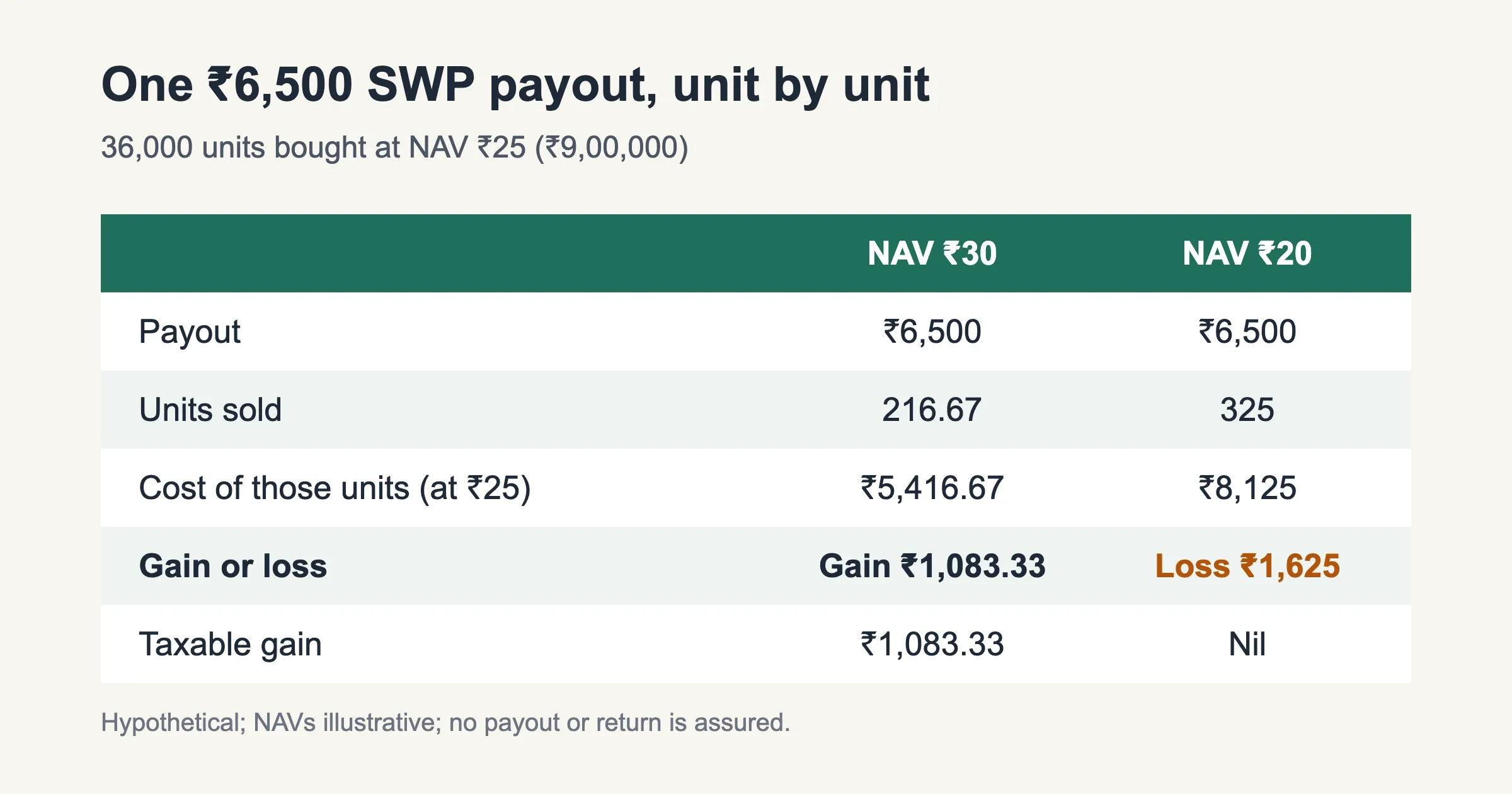
At NAV ₹30, each payout sells 6,500 ÷ 30 = 216.67 units. Those units cost him 216.67 × ₹25 = ₹5,416.67, which is his own capital coming back. The remaining ₹1,083.33 is gain.
If the NAV falls to ₹20, the same ₹6,500 needs 325 units. They cost ₹8,125, so this redemption is at a loss of ₹1,625, and no gain is taxed on it.
| NAV ₹30 | NAV ₹20 | |
|---|---|---|
| Units sold for ₹6,500 | 216.67 | 325 |
| Cost of those units (at ₹25) | ₹5,416.67 | ₹8,125 |
| Gain or loss | Gain ₹1,083.33 | Loss ₹1,625 |
| Taxable gain | ₹1,083.33 | Nil |
What is the difference between SIP, SWP and IDCW?
These are different mechanisms, so none is ranked here.
| SIP | SWP | IDCW | |
|---|---|---|---|
| Direction | Money goes in | Money comes out | Money comes out |
| Who sets amount and date | You | You | The fund |
| Units | New units bought | Units redeemed | Count unchanged; NAV falls by the payout |
| Tax point | None when buying | Capital gains on each redemption | Income in the year it is paid |
IDCW (Income Distribution cum Capital Withdrawal) is a scheme option, not a plan you set up. AMFI's investor-education page says a fund can distribute when it "has a distributable surplus", that a distribution "includes both income distribution and capital distribution", and that the NAV "decreases by the amount of the payout". Amounts and dates are not fixed.
Is the money I get from SWP taxable, and how is the tax calculated?
Tax applies to the gain inside each payout, not the whole payout. As of FY 2026-27, under the Income-tax Act, 2025 (rules as of 16 November 2026), for resident individuals and equity-oriented funds, the Income Tax Department's pages show:
- Short-term gains are taxed at 20% (section 196). Units count as short-term if held 12 months or less.
- Long-term gains are taxed at 12.5% on the year's total long-term gains from listed equity shares and equity-oriented fund units above ₹1,25,000 (section 198).
- TDS: none on mutual fund income that is a capital gain (section 393(4)). IDCW differs: 10% TDS once a resident's payouts from the same mutual fund cross ₹10,000 in the tax year (section 393(1)).
- Debt-oriented funds follow different rules (section 76).
For Prakash, if the units sold are long-term, 12 payouts at NAV ₹30 carry 12 × ₹1,083.33 = ₹13,000 of gain; any tax depends on his other long-term equity gains that year. If they were short-term, 20% of ₹1,083.33 is ₹216.67 per payout, before cess.
A corpus built through an SIP has a different cost and date for each instalment. Units are generally treated as redeemed oldest first (first in, first out), and your account statement shows each lot's cost.
Tax rules change; consult a tax professional for your situation.
How long can an SWP corpus last if the market falls?
An SWP lasts as long as the units do. That depends on the withdrawal amount and on the order in which returns arrive, called sequence-of-returns risk. A fall early on forces the plan to sell more units at low NAVs, and those units are gone when prices recover.
Here is a hypothetical run from Prakash's ₹10,80,000, withdrawing ₹6,500 at each month end. Not a promise; returns vary. The 6% a year is an assumed rate, not a typical return.
| Path (hypothetical) | Full ₹6,500 payouts | About |
|---|---|---|
| Steady 6% a year | 340 | 28 years 4 months |
| 20% fall in year 10, otherwise 6% a year | 258 | 21 years 6 months |
| 20% fall in year 1, otherwise 6% a year | 197 | 16 years 5 months |
| No growth (0%) | 166 | 13 years 10 months |
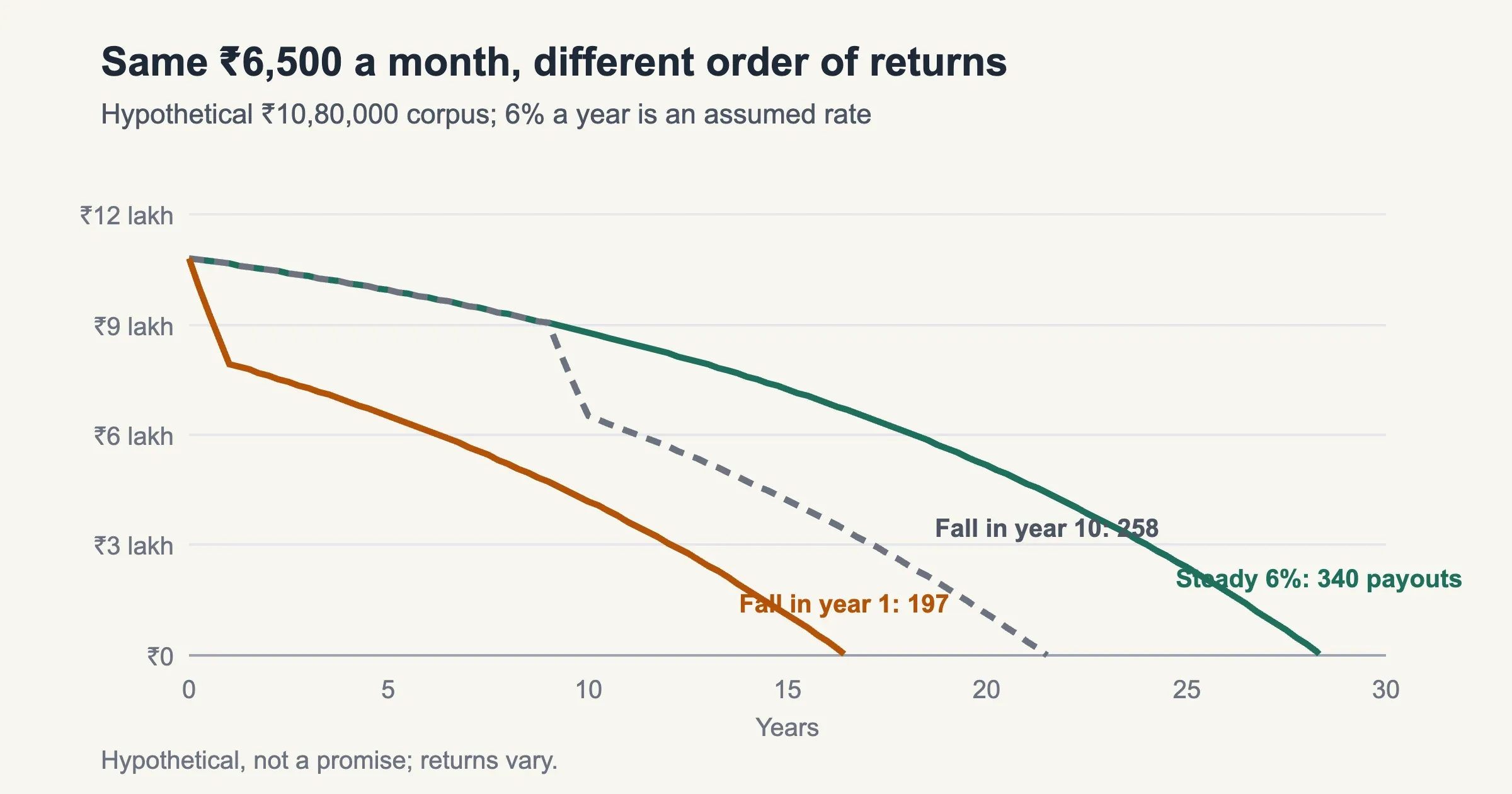
The same 20% fall costs more when it comes first. After year 1 of that path the corpus is about ₹7,93,438, against about ₹10,64,678 on the steady path. The rupees withdrawn were identical; the units left were not.
This shows the mechanism, not a forecast. Over Prakash's four college years, 48 payouts total ₹3,12,000; what remains depends on the market's path.
Can I start an SWP from my existing mutual fund, and is there a minimum amount?
Usually, yes: an SWP can generally be set up on units you already hold in an open-ended scheme. If your units are held in demat, SEBI's circular of 17 July 2026 extends SWP standing instructions to demat units in phases, due by 31 January 2027 and 30 April 2027, so check what your depository participant offers. Check the Scheme Information Document (SID) or Key Information Memorandum (KIM) for:
- Minimum amount and frequencies. Each scheme sets its own; we quote no figure because they differ.
- Exit load. SEBI's FAQ defines it as "a fee or charge imposed on investors by a mutual fund when investors redeem/sell their units". Each SWP payout is a redemption, so units inside the exit-load window may attract it unless the SID says otherwise.
- Lock-in. ELSS units cannot be redeemed until their lock-in ends.
- Notice period for starting, changing or stopping the plan.
Our guide to withdrawing SIP money explains exit load and lock-in per instalment.
Frequently asked questions
Is SWP the same as interest?
No. Interest is paid on top of a deposit. An SWP sells some of your units for each payout, so your unit balance falls every time.
Does exit load apply to SWP?
It can. Each SWP payout is a redemption, so units inside the scheme's exit-load window may attract the load unless the SID sets different terms. Check the load section of the SID or KIM.
Can I stop or change an SWP?
Generally yes, by a request to the fund house or the platform you invest through. The SID states the notice needed.
Monthly or quarterly SWP: how do I pick a frequency?
SEBI's FAQ lists monthly, quarterly, half-yearly and yearly withdrawals. Matching the frequency to when your bills fall due is one way to think about it; each SID lists the options it offers.
SWP or IDCW: what is the difference?
With an SWP you choose the amount and date, and units are sold. With IDCW the fund decides whether, when and how much to distribute from distributable surplus, and the NAV falls by the payout. They are different mechanisms, taxed differently.
Compare SWP with the IDCW option
See how the IDCW option pays out by comparison in Growth or IDCW? How to choose the option on your first fund page.
— Laabh



