UPI Transaction Failed but Money Debited? The Refund Clock, the ₹100-a-Day Rule, and Who to Complain to
UPI failed but money debited? RBI's rule: reversal by T+1 (P2P) or T+5 (merchant), else ₹100 a day. Day-count example and complaint steps.
Summarize this article with AI





The short version
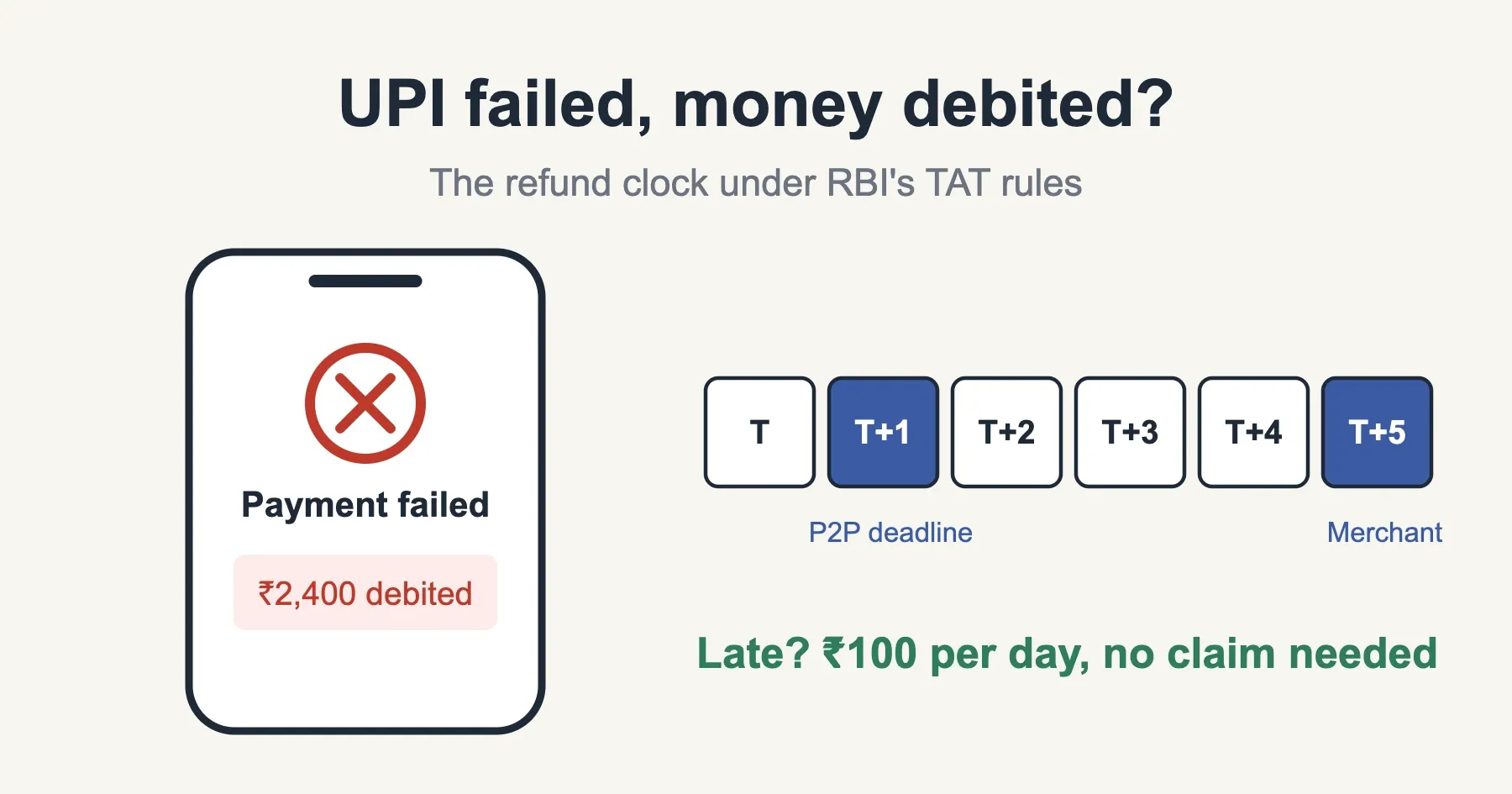
- If UPI debits you but the payment fails, RBI's framework sets reversal by T+1 for a transfer to a person and within T+5 for a merchant payment.
- Late reversal means ₹100 per day of delay, credited to your account without a claim (wrong credits and fraud excluded).
- Check the status and note the UTR before doing anything; retrying a pending payment can leave several debits stuck.
- Escalate in order: UPI app, PSP bank, your bank, NPCI, then the RBI Ombudsman after 30 days without a satisfactory reply.
- Under the RB-IOS 2026 scheme, file with the Ombudsman within 90 days at cms.rbi.org.in; filing is free.
As of 22 November 2026: if a UPI transaction failed but money was debited, RBI's framework says the amount must be reversed by T+1 (one calendar day after the transaction) for a transfer to a person, and within T+5 for a payment to a merchant. If the reversal is later than that, ₹100 for each day of delay is to be credited to your account without you having to claim it. The rule comes from RBI's circular of 20 September 2019 on Turn Around Time (TAT) for failed transactions, in force since 15 October 2019.
UPI (Unified Payments Interface) is run by NPCI and regulated by RBI. Below: the first ten minutes, how to count the days, and how to escalate.
First 10 minutes: check the status, note the UTR, don't pay again
Deepika, 27, in Nagpur, sees "failed" in her UPI app while her bank SMS says the money left her account. What helps in that moment:
- Open the transaction in your UPI app and read the status: success, failed or pending.
- Note the UTR / transaction reference number and screenshot the screen. Keep the bank SMS.
- Ask the other side whether the money reached them. If it did, there is nothing to reverse.
- Do not pay again until the status is clear (see the retry trap below).
- Do not share your UPI PIN or OTP. Nobody needs your PIN to send money back to you.
'Failed', 'pending' and 'debited' are not the same thing
- Failed: the transaction did not complete. RBI defines a failed transaction as one not fully completed for a reason not attributable to the customer, such as a failure in communication links. A debit with this status is the case the framework covers.
- Pending: the outcome is not yet confirmed and can still become a success or a failure. Check again before acting.
- Debited: this describes your account, not the transaction. A debit next to a failed status is what the refund rule covers, and the clock counts from T, the day of the transaction.
The refund deadlines, in one table
| Scenario (UPI) | What you see | Reversal deadline | Compensation if late |
|---|---|---|---|
| Transfer to a person (P2P) | Your account debited, the beneficiary's account not credited | If the beneficiary bank cannot credit the money, it must auto-reverse it latest on T+1 | ₹100 per day of delay beyond T+1 |
| Payment to a merchant | Your account debited, the merchant gets no confirmation | Auto-reversal within T+5 | ₹100 per day of delay beyond T+5 |
The circular adds that compensation is to be credited "without waiting for a complaint or claim from the customer", that the TAT is an outer limit (faster is expected), and that it covers domestic transactions. NPCI's settlement annexure puts the cost on the bank that caused the delay: the beneficiary bank for a P2P credit it could not complete, the merchant's (acquiring) bank for a late merchant refund. Your complaint still goes to your app and your bank.
Worked example: counting the days
Hypothetical illustration. Compensation of ₹100 per day of delay as per RBI's framework; the day counts below treat "days of delay" as the reversal day minus the deadline day.
P2P case. On day T, Deepika sends ₹2,400 to a friend. Her account is debited; her friend's is not credited. Deadline T+1; money back on T+4; days late 4 − 1 = 3; compensation 3 × ₹100 = ₹300, credited without a claim.
Merchant case. On another day T, she pays a shop ₹1,850. Her account is debited, but the shop's terminal shows no confirmation. Deadline T+5; refund on T+7; days late 7 − 5 = 2; compensation 2 × ₹100 = ₹200.
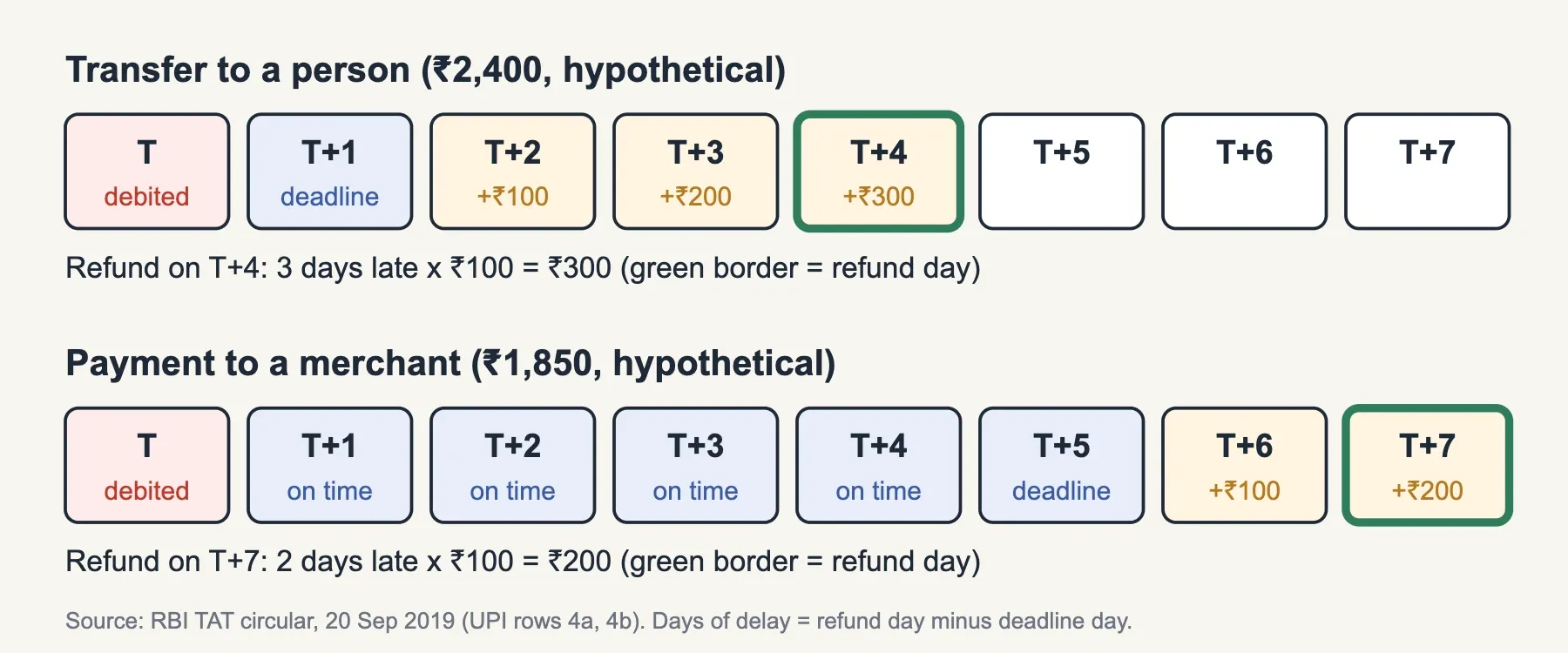
A reversal on or before the deadline earns no compensation. The annex does not spell out whether the reversal day itself counts, so check how your bank applied it if the amount differs.
The retry trap
Suppose Deepika, stuck at a shop counter, taps "pay" 3 times for the same ₹1,850 bill. One goes through; 2 debit her and hang.
- Total debited: 3 × ₹1,850 = ₹5,550.
- Actually paid to the shop: ₹1,850.
- Stuck in two separate refund cases: 2 × ₹1,850 = ₹3,700, each with its own T+5 clock and its own complaint.
Check the status first, ask whether the merchant's side shows the money, and pay another way if you must leave.
How to complain about a failed UPI transaction, step by step
NPCI's dispute redressal page sets the order: the UPI app, the app's PSP bank, the bank where you hold your account, then NPCI. It covers fund transfers and merchant payments.
1. In the UPI app
Open the transaction, raise a complaint or dispute, and save the complaint ID. NPCI says the app should keep you informed of its status.
2. Your bank
If the app does not resolve it, complain to your bank. Quote the UTR, date, amount and app complaint ID, and ask for a reference number.
3. NPCI
NPCI's dispute redressal page has an online complaint form that asks for the transaction reference number.
4. RBI Ombudsman
Under the Reserve Bank - Integrated Ombudsman Scheme, 2026 (in force since 1 July 2026; it replaced the 2021 scheme for new complaints), you can approach the Ombudsman if:
- your bank has not replied within 30 days of your complaint (or any longer period set under RBI or NPCI rules), or
- you are not satisfied with its reply.
File within 90 days of the end of that period or of the bank's last reply, whichever is later, at cms.rbi.org.in or crpc@rbi.org.in. Filing is free. The toll-free number 14448 is for guidance only, not for filing.
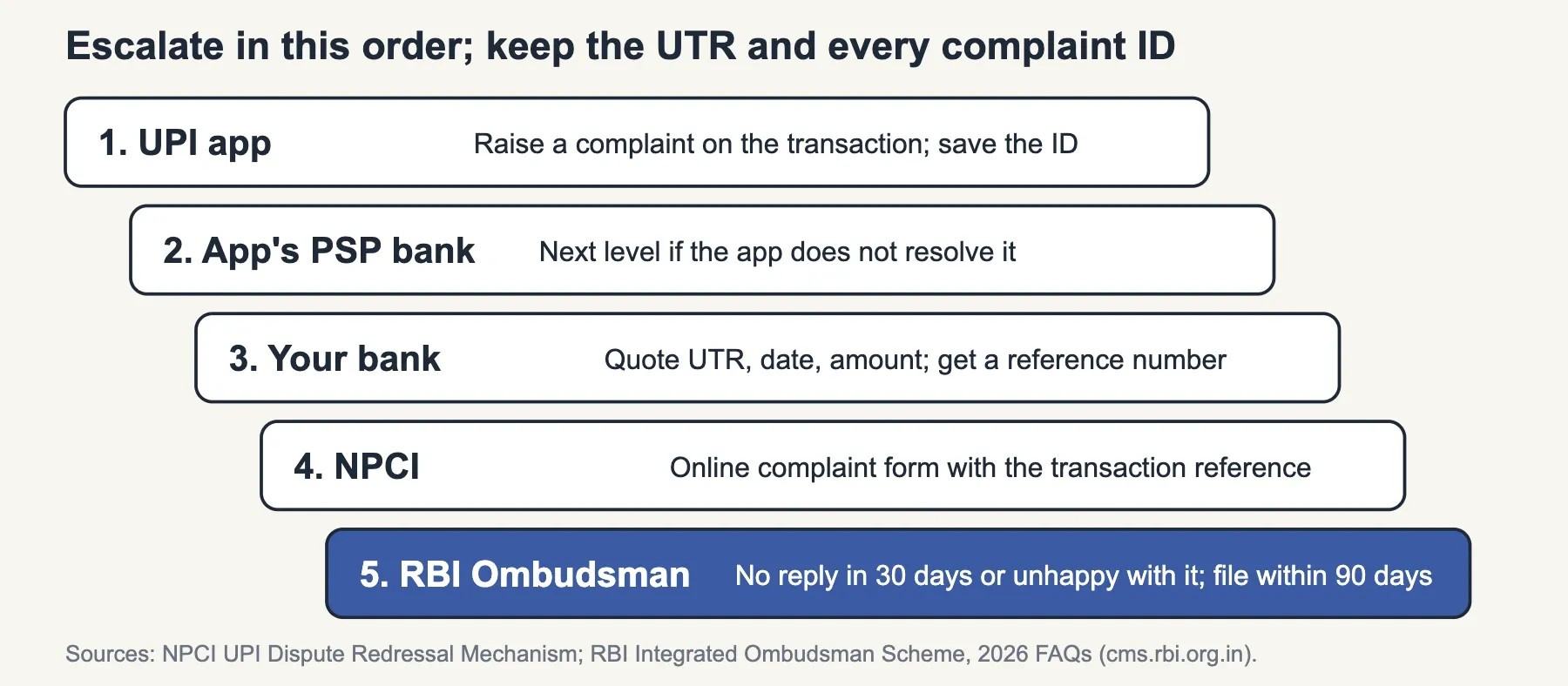
Keep throughout: the UTR, screenshots, the bank SMS, every complaint ID and date, and every reply.
When the rule does not apply
The T+1 / T+5 framework is about transactions that failed for reasons that are not yours. It does not cover:
- Money sent to the wrong UPI ID. The transaction succeeded, so there is nothing to auto-reverse. Raise it with your app and bank straight away. NPCI's annexure says compensation does not apply to wrong credits.
- Fraud, including a payment you approved for a scammer. Tell your bank at once and report on the National Cyber Crime Reporting Portal (cybercrime.gov.in) or helpline 1930. NPCI's annexure excludes fraudulent transactions from compensation too.
If it was an SIP AutoPay or an IPO mandate
SIP mandates (UPI AutoPay) and IPO applications follow their own steps. See what happens when you miss an SIP instalment, and for IPO money that is blocked rather than debited, when IPO money is unblocked. New to managing a salary account? Save the first job money checklist.
Frequently asked questions
UPI transaction failed but money debited, when will I get a refund?
Under RBI's 20 September 2019 TAT circular, by T+1 for a transfer to a person and within T+5 for a merchant payment, where T is the calendar date of the transaction. If it is later, ₹100 per day of delay is due.
Will the bank pay compensation if my UPI refund is late?
Yes, under RBI's framework: ₹100 for each day beyond the deadline, credited to your account without a claim. Example (hypothetical): a P2P reversal due by T+1 that lands on T+4 is 3 days late, so ₹300. It does not apply to wrong credits or fraud.
How do I complain about a failed UPI transaction?
Raise it in the UPI app, then with the PSP bank and your bank, then through NPCI's complaint form. If your bank does not reply within 30 days or the reply does not resolve it, file with the RBI Ombudsman at cms.rbi.org.in within 90 days. Keep the UTR, screenshots and complaint IDs.
Should I retry a UPI payment that shows pending?
Check the status first. Pending can still become a success. Retrying can debit you twice: three tries at ₹1,850 with two hanging leaves ₹3,700 stuck in two refund cases.
Is sending money to the wrong UPI ID covered by the refund rule?
No. That transaction succeeded, so the auto-reversal and ₹100-a-day rule do not apply. Contact your app and bank immediately. For fraud, report on cybercrime.gov.in or call 1930.
Save this page
Save the deadlines table and the escalation order for the next time a payment hangs.