What is FII and DII? Who they are, and why their flows aren't a signal for your SIP
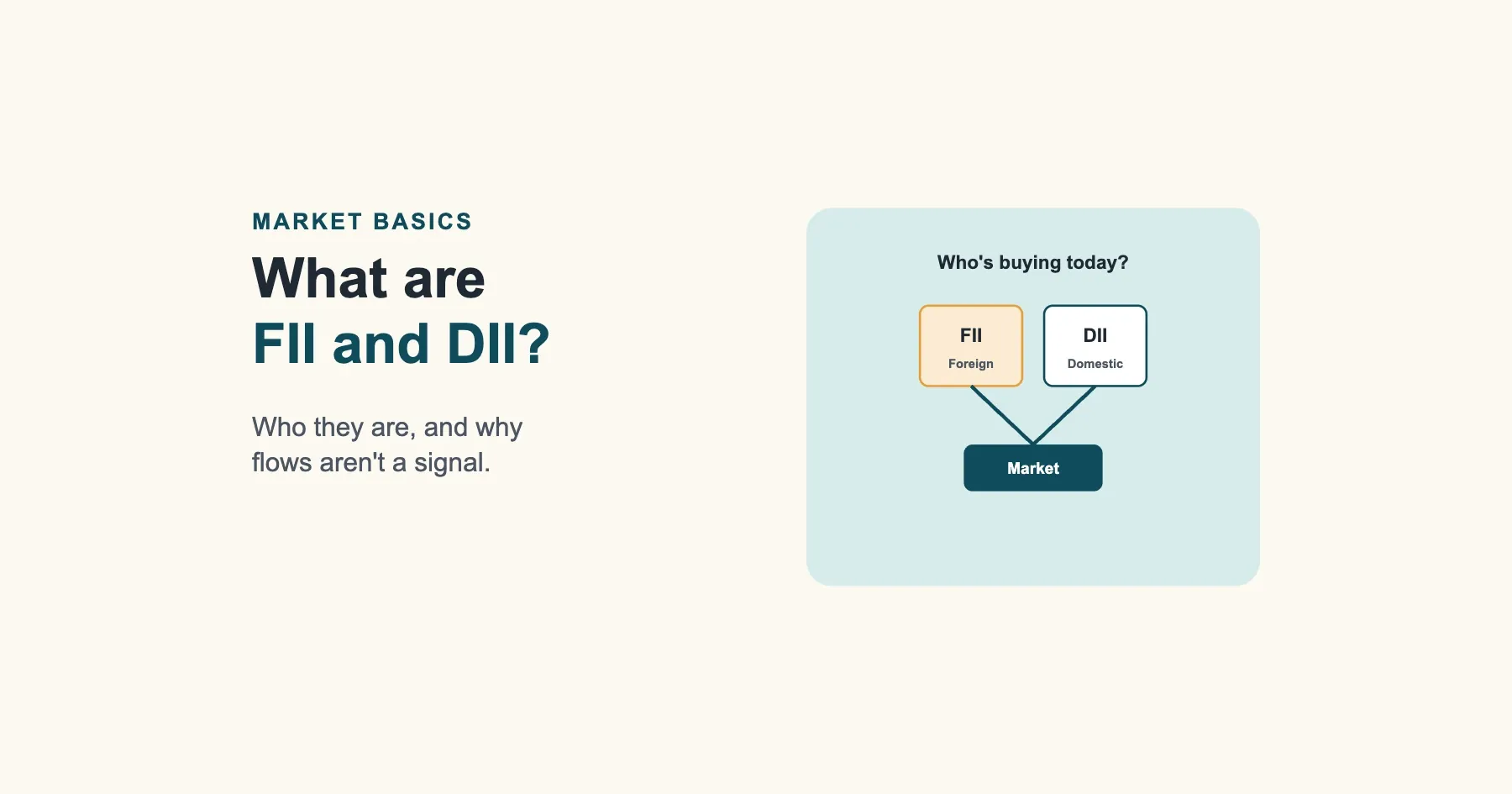
FIIs (now FPIs) are foreign investors; DIIs are Indian institutions, including mutual funds. See where your SIP fits and why flows aren't an SIP signal.
Summarize this article with AI





The short version
- FIIs are foreign portfolio investors; SEBI's current rules are the FPI Regulations, 2019 (last amended 7 July 2026).
- DIIs are Indian institutions, and mutual funds are one of the main groups.
- Your SIP instalment is pooled by the AMC and its share purchases are recorded as DII buying.
- Flows can move prices, and therefore NAVs, in the short term. They are not a signal for when to run your SIP.
- Check figures at the source (NSE, NSDL, AMFI) and always note the date.
FIIs are foreign investors who buy and sell Indian shares and bonds; SEBI's rulebook now calls them foreign portfolio investors (FPIs). DIIs are Indian institutions such as mutual funds, insurance companies, banks and pension funds. Your SIP instalment goes to a mutual fund, so it becomes a small part of DII buying. Daily flows can move prices for a while, but they don't tell you when to invest.
As of 19 November 2026. Rules and data sources can change.
Mutual fund investments are subject to market risks, read all scheme related documents carefully. Equity prices, and the NAVs of funds that hold equities, can fall as well as rise. This page explains terms; it is not a recommendation to buy, sell or hold anything.
Ishita, 26, works in Kanpur and runs a ₹6,100 monthly SIP in an equity fund. One morning her news app says "FIIs sell heavily, DIIs step in". She wonders whether she should do something. This guide explains who these two groups are, where her ₹6,100 sits in that headline, and what the numbers can and can't tell her.
FII vs FPI: why the headlines use an older name
"FII" stands for foreign institutional investor. The current SEBI regulation for these investors is the SEBI (Foreign Portfolio Investors) Regulations, 2019, which SEBI lists as last amended on 7 July 2026. That regulation uses the term foreign portfolio investor, or FPI.
News reports and many data tables still say "FII", so you will see both terms. They point to the same idea: investors based outside India, such as foreign pension funds and asset managers, who hold Indian securities as a portfolio investment and register under SEBI's FPI rules.
"Portfolio" means financial holdings, not running a business. An FPI buying listed shares is different from a foreign company building a factory in India, which is direct investment.
Who counts as a DII
"DII" stands for domestic institutional investor. The term describes Indian institutions that invest on behalf of many people. The groups usually included are:
- Mutual funds, which pool money from investors like Ishita.
- Insurance companies, which invest premiums they collect.
- Banks and other financial institutions.
- Pension and provident fund bodies.
Exactly which entities an exchange counts in its DII figure is set by that exchange's own data notes, so read the notes on the page you are using. What matters for you is simpler: mutual funds are one of the main DII groups.
How your SIP becomes DII buying
When Ishita's SIP date arrives, ₹6,100 leaves her bank account and goes to the fund house (the AMC). The AMC pools it with money from many other investors and the fund manager uses the pool to buy shares in line with the scheme's stated mandate. Those purchases are made by the mutual fund, an Indian institution, so they are recorded on the DII side.
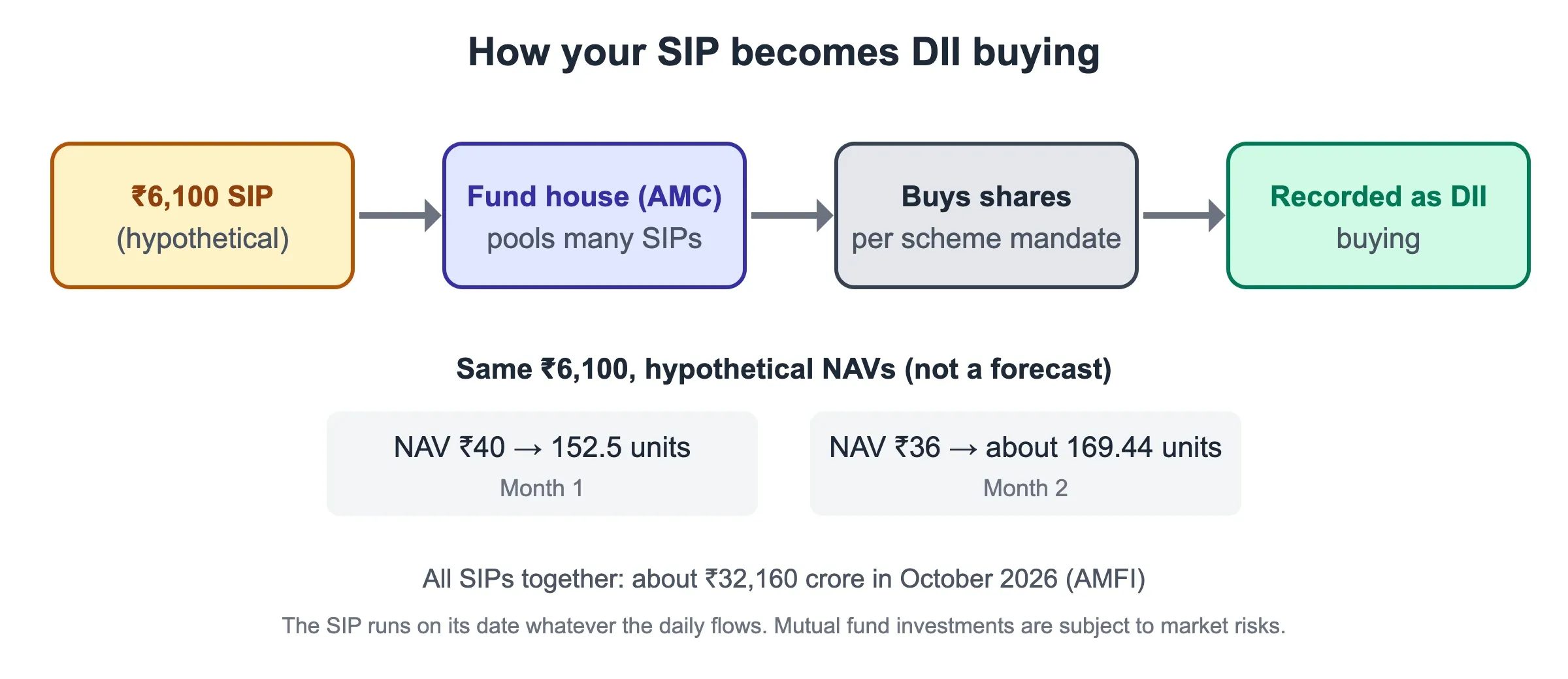
Added up, SIP money is large. According to AMFI's monthly data for October 2026, monthly SIP contributions stood at about ₹32,160 crore, from nearly 10 crore contributing SIP accounts.
As a rough piece of arithmetic (ours, not AMFI's), that works out to around ₹3,200 per account on average. Ishita's ₹6,100 is one of those instalments.
One caution: not all SIP money goes into shares, and a fund's buying on a given day also depends on redemptions and the manager's choices. So "DII buying" is not the same number as "SIP inflows", even though SIP money is part of it.
Does FII selling affect my mutual fund?
It can, in the short term, and only through prices.
Your fund's NAV is the value of everything the scheme holds, divided by the number of units. If heavy selling by FPIs, or by anyone else, pushes down the prices of shares your fund owns, the NAV falls on those days. If prices recover, the NAV rises. FII selling has no separate, direct line into your fund; it matters only through the prices of the scheme's holdings. Why a fund can fall on a day the index rises is covered in why is my mutual fund down when the market is up.
Prices also move for many other reasons: company results, interest rates, global events, the rupee, and the views of domestic investors. Large FII selling on a day when DIIs buy a similar amount may move prices very little. This guide does not predict what flows will do next, and no reliable rule turns today's flow figure into tomorrow's NAV.
A worked example in ₹ (hypothetical)
These figures are hypothetical NAVs, not a forecast. They are chosen only to show the arithmetic.
- Month 1: Ishita's ₹6,100 buys units at a NAV of ₹40. ₹6,100 ÷ ₹40 = 152.5 units.
- Month 2: In a hypothetical month, NAV falls to ₹36 (a 10% fall). Her next ₹6,100 buys ₹6,100 ÷ ₹36 = about 169.44 units.
- At ₹36, the Month 1 units are worth 152.5 × ₹36 = ₹5,490, which is ₹610 below what she paid.
- Across both months she has invested ₹12,200 and holds about 321.94 units, worth about ₹11,590 at ₹36. Her average cost is about ₹37.89 per unit.
The SIP ran on its date both months, whatever the headlines said. The lower NAV meant more units for the same amount; the earlier units were worth less. Neither tells her what the NAV will be next month.
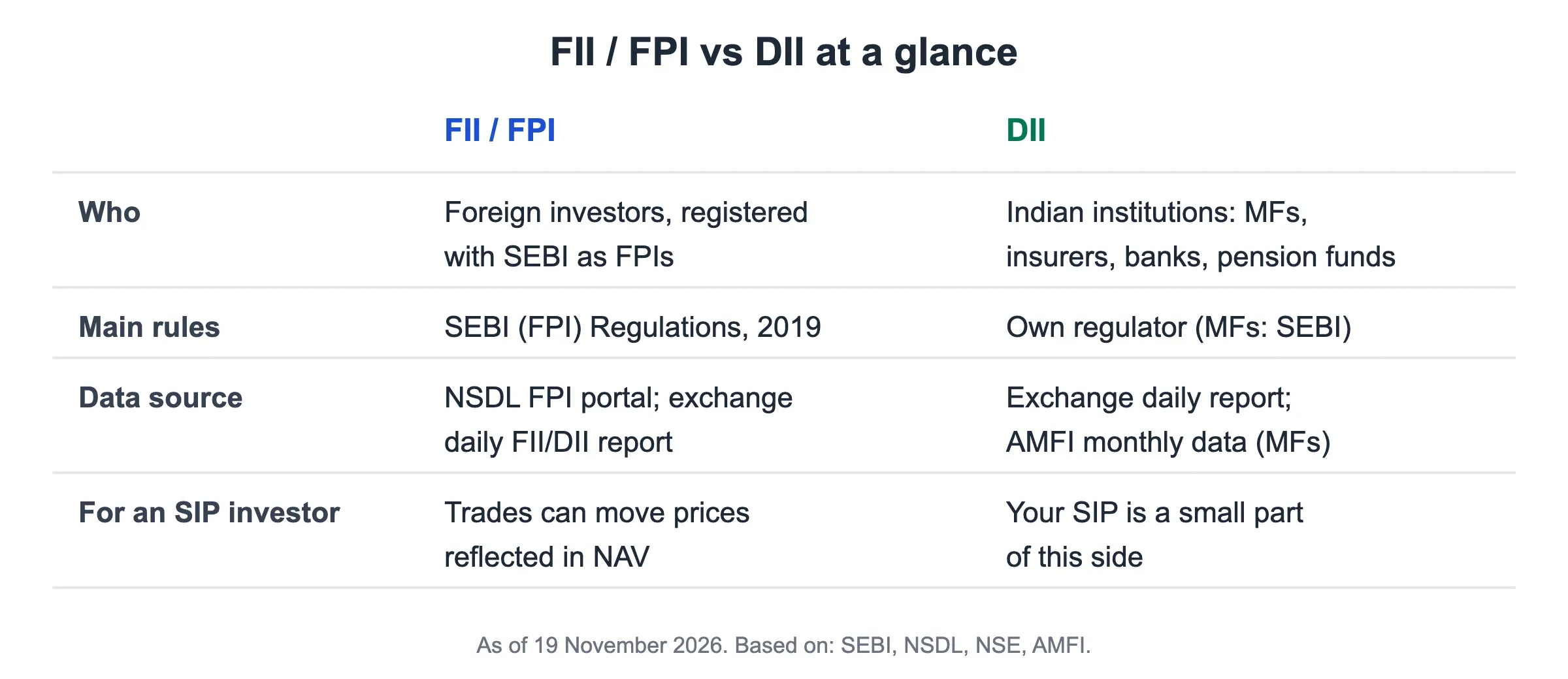
FII/FPI vs DII at a glance
| FII / FPI | DII | |
|---|---|---|
| Who | Investors based outside India, registered with SEBI as FPIs | Indian institutions: mutual funds, insurers, banks, pension funds |
| Main rules | SEBI (Foreign Portfolio Investors) Regulations, 2019 | Each group's own regulator (for mutual funds, SEBI) |
| Where data appears | NSDL FPI portal; exchange daily FII/DII reports | Exchange daily FII/DII reports; AMFI monthly data for mutual funds |
| What it means for an SIP investor | Their trades can move prices you see in NAV | Your SIP is a small part of this side |
Where to see the data yourself
If you want to check the numbers behind a headline, go to the source rather than a screenshot:
- NSE's "FII/DII trading activity" report (nseindia.com, under Reports) shows daily buying, selling and net figures for both groups. Use the official nseindia.com address; type it yourself rather than following a link.
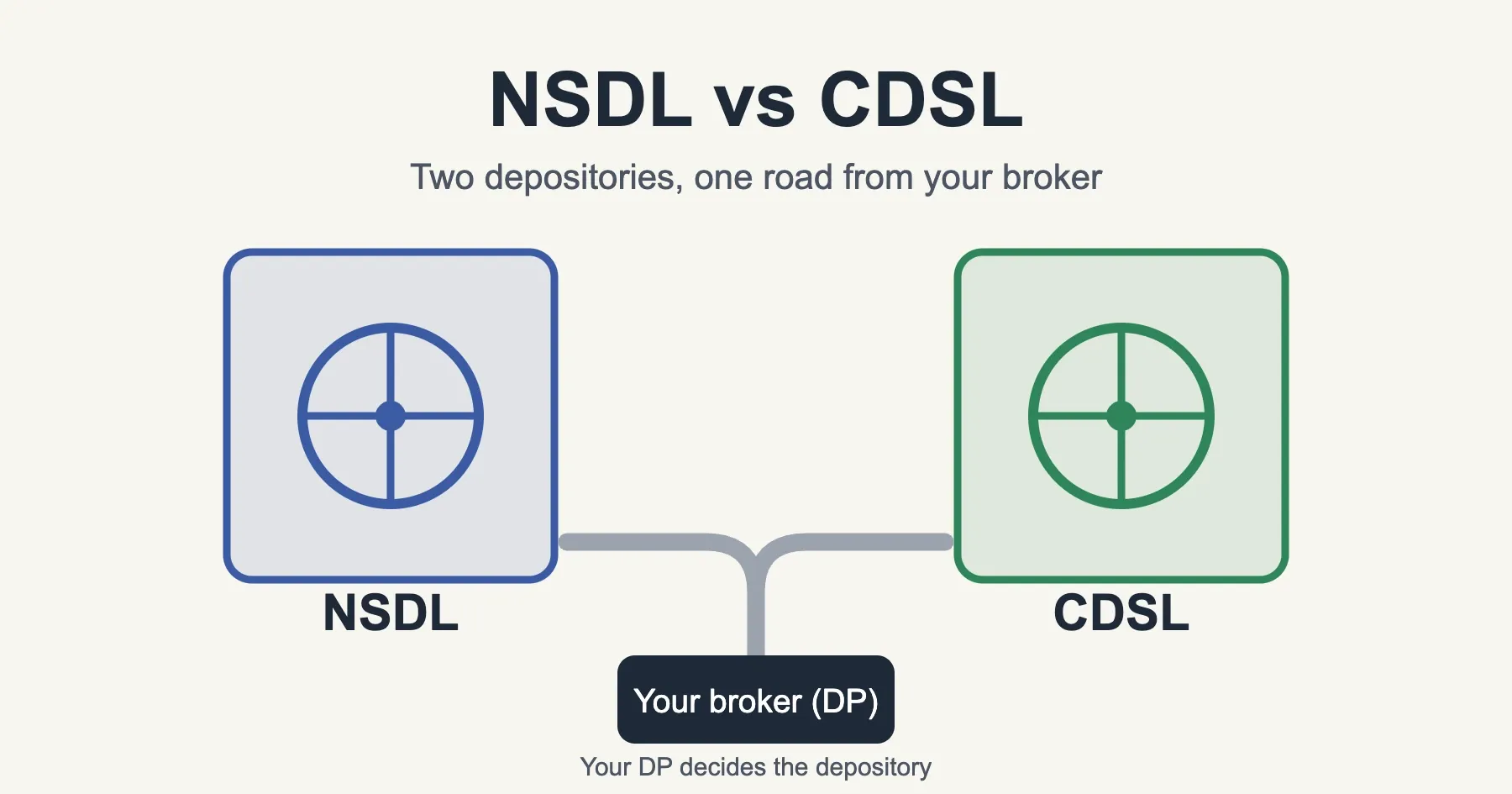
- NSDL's FPI portal (fpi.nsdl.co.in). NSDL, as authorised by SEBI, monitors FPI investment and displays FPI data on its web portal.
- AMFI's monthly data and monthly note (amfiindia.com) for mutual fund inflows, including SIP contributions.
Read each page's notes on dates and method. Daily exchange figures and NSDL's FPI figures may not match for the same period, so quote any figure with its date and source.
Should flows change your SIP?
An SIP is a schedule, not a timing tool. It invests a fixed amount on a fixed date, whatever the headlines say. FII and DII figures describe what large investors did yesterday; they don't tell you what the market will do next, or what your fund's NAV will be on your SIP date.
If a run of selling headlines makes you uneasy, check things that are about you rather than about flows:
- Is the goal for this money still as far away as when you started the SIP?
- Is the fund's category still the one you chose for that goal?
- Has your income or emergency fund changed?
Our guide on what happens to your SIP when the market falls walks through those questions, and NAV cut-off time for an SIP explains which day's NAV your instalment actually gets.
Frequently asked questions
What is FII and DII in simple words?
FIIs, now called FPIs, are foreign investors buying and selling Indian securities. DIIs are Indian institutions such as mutual funds, insurers, banks and pension funds. Headlines track how much each group bought or sold on a day.
FIIs are selling heavily. Will my mutual fund go down?
It can, if the selling pushes down prices of shares your fund holds, because NAV moves with those prices. Other buyers, including DIIs, may absorb the selling, and prices move for many other reasons too. No one can reliably say from a flow figure what your NAV will do.
Are mutual funds counted as DIIs?
Yes. Mutual funds are Indian institutions and are one of the main groups counted as DIIs. Your SIP money, once pooled by the fund house and invested, is part of that buying.
Where can I check daily FII and DII buying and selling data?
NSE's FII/DII trading activity report on nseindia.com shows daily figures, NSDL's FPI portal (fpi.nsdl.co.in) carries FPI data, and AMFI publishes monthly mutual fund flows. Note the date and source of any figure.
Should I change my SIP when FIIs are selling?
Flow data is not a timing signal for an SIP. Review your SIP against your goal, time horizon and finances, not against daily flows. See our guide on what happens to your SIP when the market falls.
Read next
Next, read how a buy order travels from your phone to your demat account in how the stock market works in India. If you are weighing funds against direct shares, see mutual funds vs stocks for beginners.
— Laabh